The transition itself
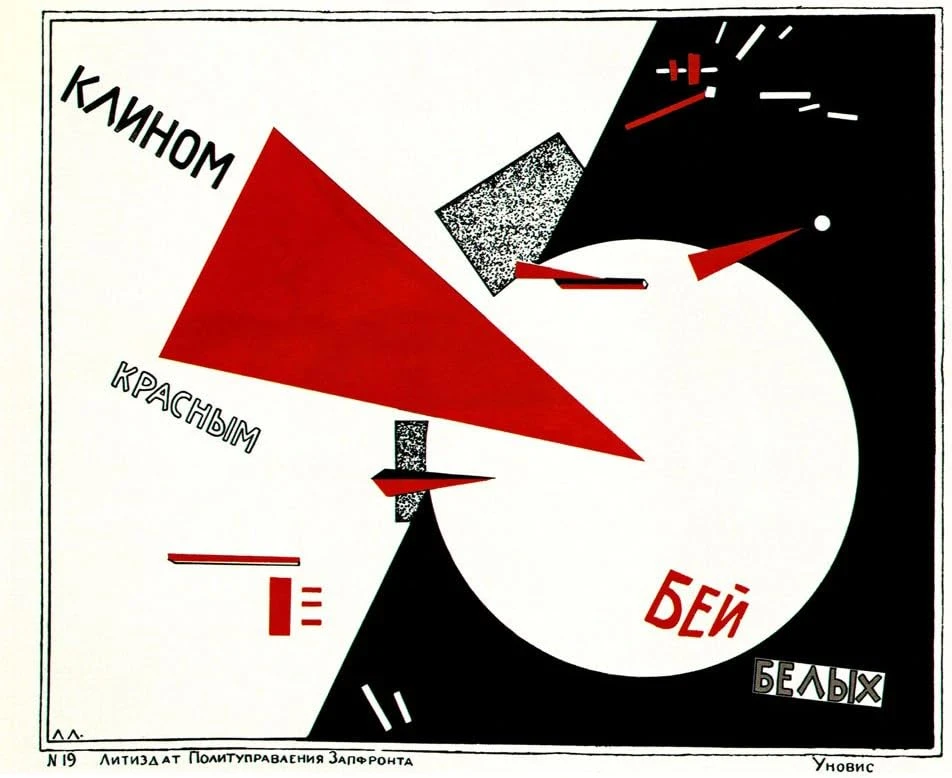
El Lissitzky - Beat the Whites with the Red Wedge, 1919. Lithograph.
Every socialist revolution has faced the same problem at the same moment. The old state is gone. The new state is not yet built. Power must be concentrated to survive - to defend against the imperial counter-attack, to restructure the economy, to build the institutions that do not yet exist. And concentration of power, under RCE, is the activation condition for everything the revolution was fought to prevent.
This is the transition. The period between the seizure of power and the stable operation of the mature socialist state. Every structural mechanism described in the previous chapter - multi-party competition, term limits, political-functional separation, armed populace, glass walls - is the architecture of the mature state: the mature state operating under normal conditions. The transition is the period when some of those mechanisms are not yet operational, when some must be partially suspended, and when the state is most vulnerable to becoming the thing it replaced.
The transition is where Lenin banned factions in 1921 and the ban became permanent. It is where Castro consolidated single-party rule as an emergency measure and the emergency never ended. It is where the Chinese Communist Party centralized economic authority during the Great Leap Forward and the centralization calcified into a permanent command structure that later became the vehicle for capitalist restoration. The pattern is not coincidental. It is structural. Emergency centralization, absent specific architectural countermeasures, becomes permanent centralization. The temporary becomes the normal, and the revolution reproduces the state it overthrew under different colours.
The framework names this as its weakest point. The transition is the period of greatest danger, and the architecture proposed here - sunset clauses, enforcement mechanisms, distributed counter-power - is the best available option, not a solved problem. No socialist project has navigated the transition successfully. The framework proposes mechanisms that would have changed the outcome in every historical case. It does not claim certainty that they will work. It claims that they are structurally superior to every alternative that has been tried, and that the alternative - building no transition architecture at all - has a zero percent success rate.
The claim-strength structure of this chapter is explicit. The diagnosis that emergency centralization becomes permanent centralization under the activation conditions - institutional persistence of the centralizing body, retained expertise in centralized authority, budget inertia around crisis mandates, absence of designed containment - is a near-universal claim.i The prescriptions are strong-tendency claims at best.ii Sunset clauses can be extended. Enforcement mechanisms can be captured. Distributed counter-power can be consolidated. What makes the prescriptions defensible is not certainty that they will hold. It is that each targets one of the activation conditions directly, and that the combination raises the structural cost of capture above the cost of compliance. A reader who finds this hedge uncomfortable has found the right chapter to be uncomfortable in. So have I.
The five origins
The transition has at least five origin conditions, each producing a different threat profile and demanding different architecture. The principle is calibration: a movement calibrated for one origin that arrives in another has built the wrong architecture, and origin assessment is the first prescriptive task of any movement preparing for transition. Most of this chapter develops the insurrectionary case in detail, because the historical failures the framework studies are concentrated there - Russia, China, Cuba, Vietnam - and because the failure mode is most severe under those conditions. The architecture is largely shared across origins; the calibration is what differs.
Origin A: democratic-electoral. Power transferred through existing institutions, legitimacy already demonstrated through the ballot - Allende, hypothetically successful, the hypothetical North American left-coalition. The danger is external and inherited rather than internal and emergent: capital flight begins the morning after the result; foreign-backed sabotage begins within weeks; the inherited judiciary and military are the most dangerous open questions in the country. The transition window is shorter, the armed-populace activation conditions are correspondingly higher, and the architecture front-loads capital controls, judicial reform, currency stabilization, and immediate deterrent capacity acquisition.
Origin B: insurrectionary. The old state broken, the new state not yet built, military emergency acute. The four sections that begin with "What gets centralized" develop this case; it sits at the dangerous end of the calibration scale.
Origin C: negotiated coalition. Power-sharing with class enemies built into the founding compact - South Africa has elements of this even though it was not socialist. The architecture must lock in structural commitments before the coalition cracks, because the coalition will crack: irreversibility of nationalization, identity protections written constitutionally, federated organizing capacity that survives the rupture rather than being built afterward.
Origin D: collapse-and-rebuild. No old regime to overthrow because it has already failed - increasingly the realistic scenario for the next several decades. The risk profile is opposite to the insurrectionary case: the danger is feudalization rather than centralizing emergency state, with regional strongmen filling the vacuum. The federated chapter network is natural here because local capacity is what already exists; the architecture follows from federated coordination from day one rather than centralization first and federation later.
Origin E: sub-national emergence. Kerala, Catalonia, Rojava - socialist construction operating within a containing non-socialist state. Sovereignty is structurally constrained from the start, and the transition is permanent in the specific sense that full transition is not available. A partial transition that holds against the containing pressure for decades is itself a contribution to the international project.
The per-origin operational specification - the architecture each origin requires, the failure modes it is exposed to, the case material - lives in the origin-specific deep-dive at the end of the chapter. The closing section names origin assessment as the first prescriptive task of any movement preparing for transition.
What gets centralized
Not everything. The impulse to centralize everything during a transition is the impulse that killed the Soviet experiment. The framework is specific about what requires temporary centralization and what does not.
Security and defence coordination. The transition happens under hostile conditions. Imperial powers will attempt to destroy the project through military intervention, economic warfare, covert destabilization, or all three simultaneously. Chile is the template. The coordination of defence - military readiness, intelligence, counter-espionage, border security - requires centralized command during the period of acute threat. A federated defence structure is the mature-state goal. During the transition, when the threat is existential and the institutions are new, centralized coordination prevents the gaps that imperial intervention exploits.
Economic restructuring. The nationalization of systemically critical enterprises, the transition from employer-employee to cooperative ownership below the threshold, the establishment of public provision for housing, healthcare, and education - these require coordinated implementation. The nationalization chapter describes the standing commission, the adversarial evidentiary process, the operational continuity principle. During the transition, the volume and pace of these transitions requires a coordinating authority that can sequence nationalizations, manage the transition of ownership structures, and ensure that the supply chain does not collapse during restructuring. This is not permanent central planning. It is transitional coordination of a structural transformation.
Crisis response. The transition will produce crises. Economic disruption from restructuring. Capital flight. Potential sabotage. Supply chain interruption. The state needs crisis response capacity - the ability to redirect resources, mobilize emergency provision, and stabilize essential services during disruption. This capacity requires authority that is broader than normal governance. It is, by its nature, emergency power.
Everything else remains distributed. Local governance continues through democratic processes. The federated chapter network operates independently. Cultural institutions, educational institutions, community organizations, religious bodies - none of these require centralization. The principle is minimum necessary concentration: centralize only what cannot function distributed during the transition period, and distribute everything else from the start.
What is time-bounded
Every centralized authority created during the transition operates under a hard sunset. The principle: emergency centralization that has not been forced to expire becomes permanent centralization, and the only mechanism that has ever forced it to expire is a calendar set before the centralization began. The specific number is calibration; the load-bearing point is that the calendar is fixed before the centralizing body is constituted, and that the body has no authority to amend it.
One workable picture: a five-year maximum on transitional centralization, set by published constitutional rule before the transition begins, with phased transfer through three stages - institutional building, restructuring, sunset preparation - and a sequencing precondition that the technical enforcement layer is sealed before the clock starts. Five years is shorter than most revolutionary transitions have assumed and deliberately so. It is long enough to nationalize critical sectors, establish the cooperative mandate, build the sortition bodies, train the functional civil service, and stand up the monitoring ecosystem. It is short enough that the people who hold centralized authority cannot entrench themselves as a permanent ruling class. Lenin's faction ban was introduced in 1921. By 1926 - five years later - Stalin had used it to eliminate all rivals. The window in which emergency powers either sunset or metastasize is the window the framework closes. The phase-by-phase calendar - what happens in years one to two, two to three, three to four, four to five - is operational specification rather than principle, and lives in the phased-transfer deep-dive at the end of the chapter.
Sequencing precondition. The technical enforcement layer described in the digital sovereignty chapter must be built and sealed before the clock starts. The infrastructure trust is operational, the two-key custodianship has committed the condition specifications, the public code has been audited against the specifications, the formal verification proofs have been published, and the cryptographic key material has been distributed across non-aligned jurisdictions, all before any transitional government is constituted. A transition that begins before the architecture is sealed is a transition whose enforcement layer is still being built by the very government it is supposed to enforce against. The framework prohibits this sequencing directly. The cost - that the technical work happens in public, under adversarial pressure, before the political authority that would benefit from its compromise has been concentrated - is the cost of having the architecture survive the period it is designed to constrain.
Distributed attestation as the certification layer. The condition specifications, the public code repository, the formal verification proofs, and the cryptographic key material's distribution all run under a distributed attestation discipline. Each major artefact carries N-of-M cryptographic signatures from the federated chapters whose composition was committed during the commitment window, against the published condition specifications. The signatures are public, the signing chapters are public, and the attestation requirement is part of the same constitutional package the rest of the precondition rests on. A single-certifier model produces a bottleneck institution whose keys become the inheritance condition for whoever inherits the certifier; the distributed-attestation discipline routes the certification through the federation's standing chapter composition and onto the same cryptographic substrate the two-key custodianship operates on.
Fallback verification body for attestation failure. A temporary sortition body convenes on attestation failure - when a signing chapter is unreachable on the published timeline, when the threshold is missed under conditions a chapter is willing to publicly explain, when an artefact is contested at a level the routine attestation cycle is not equipped to resolve. The body is drawn from the auditing community the digital sovereignty chapter names, with a technical fraction sufficient to read the artefact at the level the verification requires. The mandate is bounded to the contested artefact: verify, refuse, or escalate to the two-key custodianship for re-specification. Convocation is on attestation failure and dissolution is on completion, recorded against the same enforcement layer the rest of the precondition feeds.
Crisis path under hard ceiling. A condition specification that requires attestation under a compressed window - an external emergency that would otherwise force the precondition to wait through its full deliberation cycle - runs through a published crisis path with three bounded properties. The window has a hard ceiling of eighteen months from declaration of crisis to close of the attestation cycle. The ceiling is constitutional: a crisis declaration that runs beyond the ceiling returns the architecture to the standard cycle and the deliberation window restarts from zero. Activation requires an expert-advised assessment by the infrastructure team and the auditing community as a precondition, with the assessment published. Activation also requires a supermajority vote of the federated chapters against a published justification, with the dissenting chapters' positions recorded. The combination is the structural answer to the "permanent emergency" pattern: real compression on a fixed clock, set by a body whose composition was fixed before the crisis, with the path's authority exhausted at the ceiling regardless of whether the underlying emergency has resolved.
How the framework handles capital's attempt to reacquire political power
A transition faces a specific problem the 20th-century tradition never solved: during the period of restructuring, capital will fund political vehicles to reacquire the power it has lost. Every socialist project has encountered this. The orthodox answer - outright prohibition of capitalist parties under the banner of working-class dictatorshipiii - produced the authoritarian drift the framework exists to architect against, because the body that adjudicates which parties are "capitalist" becomes the instrument by which the ruling faction eliminates its rivals. Lenin's faction ban is the defining case.
The framework rejects that answer. The alternative architecture operates at the level of capital controls rather than party prohibition: campaign-finance structures that forbid the aggregation of private wealth into political spending; progressive taxation that limits the private resources available for political capture; transparency obligations that make influence traceable; the monitoring commission that flags accumulation approaching levels at which conversion to political power becomes possible, and responds with taxation and obligation rather than confiscation or prohibition. The programmatic test for electoral participation is adjudicated by the party permission body, a sortition institution structurally independent of the sitting government, with published deliberations and cross-body appeal. A party whose programme would restore private ownership of systemically-critical productive assets fails the programmatic test. The party is excluded from the electoral process on the basis of its programme, not its people - the individuals who supported it retain every civil right and can organize a new party with a programme that does not cross the threshold.
This is a different architecture than outright prohibition, not a lighter one, and it is harder. It requires the political work of actually winning and maintaining legitimacy among the working class whose interests it claims to represent, because it cannot legally silence the parties that will argue the other side at the level of organization - only at the level of programme. The framework accepts this constraint as a feature. A socialism that has to silence its opposition to survive is one whose legitimacy is already failing. A socialism that can engage its opposition openly has preserved the self-correction mechanism every failed project discarded. The self-critique chapter returns to this question honestly: the party permission body is the institution whose capture risk the framework most depends on procedural rather than architectural safeguards to contain.
Sunset triggers
The five-year clock is the outer bound. The transition can end earlier if conditions permit. The framework defines three independent sunset triggers, any one of which initiates the transition to the mature state:
Elapsed time. Five years from the formal declaration of the transition. This trigger is unconditional. It fires regardless of whether the other conditions have been met. If the state has not completed its restructuring in five years, it completes the restructuring under mature-state governance. The alternative - extending the transition because the work is not done - is the mechanism by which every historical transition became permanent.
Achievement of specified conditions. A defined checklist of institutional benchmarks: sortition bodies operational and adjudicating, multi-party elections held, political-functional separation implemented across all nationalized sectors, armed populace programme operational, monitoring ecosystem functional, judicial selection body operating. When all benchmarks are met, the transition ends regardless of elapsed time. If the state achieves this in three years, the transition ends in three years.
Supermajority democratic decision. A two-thirds supermajority of the electorate, in a referendum with mandatory minimum turnout, can end the transition at any time. The people whose revolution this is decide when the emergency is over.
Extension
The five-year limit can be extended. Once. By two years. Under the following conditions:
A three-quarters supermajority of the first operational sortition body - not the transitional government, not the military command, not the coordinating authority - votes to extend. The sortition body is the only institution that can authorize extension because it is the only institution without a structural interest in the continuation of centralized power. The transitional government benefits from extension. The military command benefits from extension. The coordinating authority benefits from extension. The sortition body, composed by random selection from the general population, does not.
The extension is for two years maximum. It cannot be renewed. After seven years total, the transition ends unconditionally. There is no mechanism for further extension. The architecture does not permit it. A state that cannot complete its transition in seven years has failed, and the failure must be addressed through mature-state democratic processes, not through continued emergency centralization.
The extension conditions are published in advance, before the transition begins. They are constitutional. They cannot be amended during the transition. The people who enter the transition know its maximum duration before it starts. This prevents the incremental extension that characterized every historical case - the Soviet "temporary" faction ban that lasted seventy years, the Cuban "temporary" single-party consolidation that lasted six decades.
Who enforces sunset against a government that refuses to leave
This is the critical question. Every mechanism described above is a piece of paper unless someone enforces it. The transitional government that has held centralized power for five years and does not want to relinquish it will not enforce its own sunset. The question is who does.
The framework provides four enforcement mechanisms, layered for redundancy.
The armed populace. This is the primary enforcement mechanism and the reason the armed populace programme must be operational before the transition ends, not after. The previous chapter establishes the constitutional duty to overthrow - not merely the right, but the obligation of the people to dismantle a future socialist state that has degenerated. A government that refuses to honour its sunset has degenerated. The armed populace, organized through federated chapters independent of the state, with their own communication infrastructure and their own chain of legitimacy, is the material capacity to enforce what the constitution requires. The government that extends the transition beyond its constitutional limit faces not a protest movement but a distributed, federated, armed population with a constitutional mandate to remove it.
The sortition bodies. By year three to four, the sortition bodies are operational. They are composed by random selection. They have no loyalty to the transitional government. Their constitutional role includes the adjudication of whether the state has met its transition benchmarks. A sortition body that declares transition benchmarks met - and a government that refuses to transition despite that declaration - has created a constitutional crisis with a clear aggressor. The sortition body's declaration provides the legal and institutional basis for the armed populace's enforcement action.
The federated chapter network. The chapters that organized the revolution do not dissolve during the transition. They remain independent, self-governing, and networked. They provide the organizational infrastructure for coordinated resistance to a government that refuses to transition. The chapters are not state institutions. They cannot be dissolved by the state. They operate on the same kill switch logic described in earlier chapters: if the state crosses the line, the network activates.
International observer mechanisms. Allied states, international solidarity networks, and the knowledge-transfer infrastructure described later in this series provide external verification. A government that claims the transition conditions still require centralization faces external assessment of that claim. This is the weakest enforcement mechanism - no international body can compel a sovereign state to transition - but it provides informational support to the domestic enforcement mechanisms. The armed populace that knows, through independent international assessment, that the government's justification for extension is fraudulent acts with greater legitimacy than one operating on domestic information alone.
The honest acknowledgment: these mechanisms are not guaranteed to work. A sufficiently ruthless government with sufficient military loyalty can suppress an armed populace, ignore sortition bodies, destroy chapter networks, and expel international observers. The framework does not claim to have solved the problem of enforcement against a determined tyrant. It claims to have made enforcement structurally possible in ways that no previous socialist project achieved. The Soviet population had no armed capacity, no independent institutions, no chapter network, and no international verification. The framework provides all four. Whether they are sufficient in every case is an open question, but whether they are superior to having none of them is not.
The four mechanisms above share a structural property: each operates through human action at the moment of a potential violation. Each requires that a human enforcer judge that the conditions have been met, decide to act, and carry the action through political pressure that is at its peak in exactly the moment the action is required. The framework adds a fifth mechanism that does not share this property. It is treated separately below because its character is different from the four above and because the architecture it requires is significant enough to warrant its own chapter.
The fourth modality: technical enforcement
The transition chapter's enforcement architecture has, until this point, been read across three modalities the rest of the book has developed in detail: the ratchet clause, which is a constitutional auto-trigger that imposes immediate institutional cost on attempts to dismantle the sunset-enforcement capacity; the Monitoring Commission, which is the standing oversight body whose findings drive the constitutional consequences; and the armed populace and its associated infrastructure, which is the material capacity to enforce what the constitution requires when the constitution is being broken. The framework adds a fourth modality, parallel to the three above, that operates on a different principle and addresses a different failure mode.
The fourth modality is the technical enforcement layer described in the digital sovereignty chapter. Its distinguishing property is that it does not require a human decision at the moment of a potential violation. The ratchet, the Monitoring Commission, and the armed populace all require human enforcers to act under direct pressure from the people they are enforcing against. The technical enforcement layer triggers automatically on the satisfaction of pre-committed, machine-verifiable conditions, and the consequence - a structural payment freeze on the entities that have violated the conditions - proceeds without anyone having to decide, in the moment, that the conditions have been met. The conditions were committed publicly, before the transition began, by a body that was not the transitional government and that ceased to have authority to amend them once the commitment window closed.
The fourth modality does not replace the other three. It operates in parallel. A government that has captured the Monitoring Commission, pressured the sovereign defence trust, and is in the process of disarming the populace still faces an automated structural consequence if the condition specifications are triggered. A government that has the technical enforcement layer compromised - through infiltration of the building institution, capture of cryptographic key material, or formal-verification failure - still faces an armed populace, a federated chapter network, sortition bodies, and a Monitoring Commission. The four modalities cover each other's failure modes by design. No single capture, defection, or technical fault ends the architecture.
The fourth modality has its own exposure. The institution that builds and operates the technical enforcement layer - the infrastructure trust, named and developed in the digital sovereignty chapter - holds structural leverage that is itself subject to the framework's principle. The dissolution of the trust on satisfaction of the transition completion conditions is the load-bearing containment, and its exposure is treated directly in the self-critique chapter. The fourth modality is not exempt from the framework's analysis. It is included under it.
The relationship to the other three modalities is operational and bidirectional. The Monitoring Commission's investigative function feeds the upward financial-flow monitoring layer that the technical architecture provides; the technical layer in turn provides the Commission with a machine-readable, public, real-time view of the structural indicators the Commission's analysts work from. The ratchet clause and the technical layer are constitutionally co-specified: an attempt to alter the technical layer's scope or operation triggers the ratchet's institutional consequences in the same way an attempt to dismantle the militia does. The armed populace and the technical layer are the two material guarantees the architecture rests on, and either failing without the other is a partial failure rather than a total one. The framework's commitment is that the four modalities together raise the cost of capture above the cost of compliance. None of them alone is sufficient. The combination is the dam, and the dam is partial.
The technical detail - the bilateral separation between the infrastructure trust and the two-key custodianship that specifies the conditions, the security architecture of public code and cryptographic distribution and formal verification, the upward monitoring layer's directionality and its surveillance-transgression boundary, the dissolution protocol - lives in the digital sovereignty chapter. This chapter names the modality, locates it in the transition's enforcement architecture, and specifies the sequencing requirement below.
Insulating the sunset enforcer from the government it must depose
The four enforcement mechanisms above are the necessary architecture. They are not the sufficient architecture. A government that wants to extend the transition will not move first against the constitution. It will move first against the institutions that would enforce the constitution. The militia gets defunded by quiet line item. The federated chapters lose access to communications infrastructure under "security review". International observers are denied visas and replaced with friendlier ones. The constitutional text is honoured, on paper, while the material capacity to enforce it is dismantled, off paper. This is the failure mode every prior transition followed, and it is the gap the architecture below is built to close.
A sovereign defence trust. The militia, the federated communication infrastructure, and the chapter-network operating budget are administered by an entity structurally separate from the executive: a sovereign defence trust. Its trustees are drawn by sortition from the general population. They serve a single non-renewable rotation. The trust holds and disburses the constitutionally fixed share of the national dividend that funds militia training, equipment, communications infrastructure, and the operational base of the federated chapters. The transitional government, the elected mature-state government, the legislature, the security ministries - none of them has standing to alter the trust's assets, redirect its disbursements, or interfere with its operations. A government that wants to defund its own immune system would have to dissolve the trust, and dissolving the trust requires the same super-majority national referendum that any other constitutional reduction requires. Quiet defunding is structurally unavailable. Loud defunding is available, in principle, and the loudness is the point.
The ratchet clause. Any executive or legislative action that attempts to restrict the militia's training rights, communications infrastructure, organizational autonomy, or material readiness self-executes a structural penalty. The transitional or mature-state government's discretionary authority budget is automatically frozen pending review. The Monitoring Commission opens an inquiry on a constitutional emergency timeline. A sortition session on the executive's continued mandate convenes within ninety days. The penalty is a constitutional consequence of the action rather than a vote, applied by the constitutional enforcement body. A government that wants to disarm the population pays an immediate institutional price. The cost of the action is paid up front, before the action's benefits accrue, which inverts the political calculus that disarmament arguments have always relied on.
Constitutional recognition from day one. The militia, the federated chapters, and the trust are constitutional institutions. Their existence does not depend on the goodwill of any sitting government. They have direct standing to petition the sortition bodies, the Monitoring Commission, and the Constitutional Court without going through the executive. They have the same procedural status as any other branch of the constitutional order. A government that ignores the militia's standing is committing a constitutional violation, and the violation is itself the activation condition for further enforcement steps. The status that every prior socialist militia held only by sufferance - tolerated when convenient, dissolved when not - is, here, structural and original.
External guarantor as observer, not arbiter. International observer mechanisms remain in the role the previous section names: verification, reporting, informational support to the domestic enforcement architecture. They are not the enforcer. The enforcer is the population whose constitutional capacity the architecture above protects. International observation is the channel through which the population's assessment is corroborated to the international solidarity network, and through which the international solidarity network's assessment is communicated to the population. Both flows raise the legitimacy cost of an unjustified extension. Neither flow substitutes for the domestic capacity the trust, the ratchet clause, and the constitutional recognition together preserve.
The honest acknowledgment carries forward. The architecture above raises the cost of dismantling the sunset-enforcement capacity above the cost of honouring the sunset itself. It does not eliminate the dismantling option. A government willing to pay the constitutional cost - to break the trust, to ignore the ratchet, to refuse the constitutional standing of the militia - has begun the open phase of the conflict the architecture exists to prevent. The architecture's purpose is to ensure that when that conflict opens, it opens in the open. The covert dismantling that closed every prior socialist transition is what this architecture is built against, specifically.
The professional-managerial transition
The class chapter and the credential reform section diagnose the professional-managerial class as a coherent and persistent class formation. The diagnosis sits on strong-tendency ground. The architecture of credential reform sits in the economic chapter because credentialism is an economic structure first. What sits here, in the transition chapter, is the political architecture of the PMC's transition - the period during which the credential monopolies are dismantled, the scarcity-rent component of professional income compresses, and the specific class capacities that were grown under capitalism either convert into the new architecture's functional roles or do not.
The transition has to handle the PMC carefully. Not because the PMC is owed deference. Because the PMC controls capacities the transition cannot proceed without. Surgeons keep operating. Engineers keep the grid running. Lawyers staff the new tribunals during the period when the new credentials regime is being built. A transition that loses these capacities through resentment or sabotage is a transition that fails on the operational floor, regardless of how clean the political architecture above it looks. A transition that handles them by preserving the class structure they came out of is a transition that has rebuilt the class it was supposed to dismantle. The architecture below is the path between those failures.
A socialist professionals' guild. Pre-transition, federated certification bodies are stood up parallel to the existing credential bodies. The new bodies operate under the political-functional firewall and the credential-reform principles - sortition seats for non-practitioners, transparent standards, externally audited pass rates, no monopoly over training or admission. The professionals who choose to certify under the new bodies join the new guild. The guild is a federated certification network, not a hiring hall. Its function is verification of competence under the new standards, not allocation of work or political representation of the certified.
Post-transition, functional roles in nationalized sectors are reserved for guild-certified professionals. The old credential bodies do not vanish - they are inherited, brought under the political-functional firewall, restructured to meet the new standards, and either continue under the new architecture or are wound up. The transition is gradual at the institutional level: the bar association, the medical college, the engineering body, all become subject to sortition oversight, externally audited pass rates, and transparent standards-setting. Their internal culture changes faster or slower depending on conditions. Their external function - certifying competence under the new architecture - is constrained and accountable from the moment the architecture activates.
The transition bond, optional and constrained. A one-time, optional, transferable instrument is offered to credentialed professionals who choose to participate in the transition rather than emigrate or refuse. The bond is denominated to roughly cushion the income compression - not to preserve the prior income, but to soften the slope of the descent and to fund the period during which the professional rebuilds practice under the new architecture. The bond is inheritable in the same modest sense the inheritance architecture permits any other personal asset to pass: small inheritances pass with minimal taxation, large ones do not. The bond is sized below the threshold at which it could compound across generations into the secondary accumulation the inheritance architecture exists to prevent. A surgeon who takes the bond, retires, and passes it to a child passes a comfortable inheritance, not a foothold for class re-formation. The constraint is structural, not aspirational, and the standing commission on accumulation has the bond explicitly within its monitoring remit.
Temporary de-recognition of credentials used to sabotage the transition. A constitutional provision, time-bounded, sunsetting at the close of the transition window, permits a special tribunal to de-recognize credentials of professionals or groups of professionals demonstrated to be acting in coordinated sabotage of the transition's operational requirements. The tribunal is convened ad-hoc, draws panel members by sortition, publishes its evidence, and is structurally barred from acting against individual practice or individual political dissent. The threshold is collective action: a group of physicians coordinating to deny care for political reasons, a body of engineers coordinating to refuse maintenance on a nationalized utility, a group of lawyers coordinating to stall constitutional adjudication. Individual conscientious refusal does not trigger the tribunal. Individual political disagreement does not trigger the tribunal. Coordinated sabotage of the transition's operational floor does. The provision sunsets when the transition closes. It does not become a permanent tool of the mature state. The sunset is constitutional and cannot be amended during the transition window, by the same logic that governs every other transitional emergency power.
Differential sequencing. The compression is not uniform across professions. Capital-adjacent professions - the legal, financial, and managerial functions whose income depended most directly on the capitalist class structure rather than on technical scarcity - compress rapidly, on the transition's primary calendar. Essential professions whose technical training cannot be replaced quickly - surgeons, certain engineering specialties, research scientists - cushion through a phased compression with hard time limits. The phase-in is not open-ended. It is calendar-defined, with the end-state ratio published at the start. A surgeon entering the transition knows on day one what the ratio will be at the end of the phase-in window and can plan around it. The protection is operational, not class-protective: the phase-in exists because the population needs surgical care during the transition, not because surgeons are owed continuity of capitalist income. When the time limit closes, the ratio closes with it. There is no second phase-in, no extension on grounds of new circumstances, no professional carve-out that becomes permanent.
The honest acknowledgment: the PMC transition is one of the framework's politically hardest moves. The PMC is the class most likely to read this book, and the class whose material position it most directly compresses. The architecture above does not pretend the compression is gentle. It specifies the compression, time-bounds it, and offers structurally bounded transitional support to the professionals who participate in the transition rather than against it. What it does not do is preserve the class. The framework's commitment is that class re-formation is the failure mode the entire architecture is built to prevent, and the PMC is one of the fragments from which class re-forms first if the transition is loose. The architecture above is the structural answer. The political work of carrying the architecture through the transition is the work the bridge chapter and the action chapter describe.
I am inside the class this section compresses. The income I have made under capitalism, the credentials I hold, the autonomy of practice I have accepted as the ordinary condition of my work - these are the things this section names as the targets of structural compression. I am asking the reader holding similar credentials to accept the compression as a condition of the framework's coherence. I do not know how to write this section more honestly than that. The transition either compresses the class I belong to or it produces the class re-formation the framework was written to prevent. There is no third path the architecture admits. At the same time, I have to admit that personally, I think this is better for my own class: namely, material floors for all of us shifts the focus from survival to purpose.
Symmetric self-submission
The framework imposes severe demands on the state apparatuses it analyses as class enemies - that documented instruments of imperial or colonial coercion be dismantled, that individuals with documented (public or state-secret) roles in those instruments be tried under accountability standards scaled to their integration with the apparatus, that the architecture of the receiving state be built with dams against the rot the prior apparatus produced.iv The framework would not be coherent if it asked these of others and not of itself. The state that this framework's transition founds is subject to the same standards, in the same terms, as a structural condition of its founding act. The symmetry is not rhetorical. It is constitutional. The case-studies chapter develops the dismantlement standard at full length against the apparatuses the framework identifies as class enemies; this section names the symmetric commitment that binds the framework's own future state on the same logic.
Constitutional commitment. The same evidentiary standard applied to the dismantlement of class-enemy state apparatuses applies to the framework's own future state if the transition's dam fails. A future Canadian socialist state - or any state founded under the architecture this book describes - that has degenerated into the apparatus the architecture exists to prevent, that is concretely the activation conditions of RCE operating at scale against its own population, is itself subject to dismantlement on the same logic the framework applies to any other coercive apparatus. The duty to overthrow named in the anti-ossification chapter is the form this commitment takes against the framework's own state. The Indigenous-sovereignty axis the sovereignty chapter develops names the most concrete way the same commitment operates against the framework's own state from day one of the transition rather than only at the moment of failure: a settler-colonial apparatus does not get cleansed by changing the colour of the flag.
Architectural specification. The commitment is operational, not aspirational. The Monitoring Commission's investigative scope explicitly extends to the framework's own state, with the same threshold for documented role and the same evidentiary publication standard the framework demands of any other accountability mechanism. The published condition specifications that drive the technical enforcement layer include conditions that fire on the framework's own state's degenerative pattern, not only on its predecessor's. The federated chapter network's proportional-response calibration treats a degenerated framework state by the same logic it treats any other state operating outside its constitutional discipline: the conditions determine the response, regardless of the state's nominal politics. The pre-state authorisations the proportional-response chapter developed for intelligence and sabotage tools expire on the day the movement assumes the apparatus, on the same logic that governs every other transitional emergency power, and the same architectural enforcement - structural separation of personnel, declassification timetable, federated and Monitoring-Commission oversight - applies in full from that day. There is no transition period during which pre-state authorisations persist.
Indigenous-sovereignty axis. The framework is written from a Canadian metropolitan position. The Canadian state is, in the framework's own vocabulary, a settler-colonial apparatus that was rebuilt under social-democratic management without ever being dismantled at the level the structural-distance test would require. A transition that produces a successor Canadian state and does not address this is a transition that has not done the work. The sovereignty chapter develops Land Back as a structural political demand, not a metaphor; this section names the symmetric commitment that goes with it. The post-transition Canadian state is subject to the same dismantlement-and-rebuild logic on the Indigenous-sovereignty axis as the framework applies to any other settler-colonial apparatus, and the framework's authors - being among the metropolitan beneficiaries of the apparatus the rebuild addresses - are subject to the same individual accountability scaling the framework specifies for documented roles. The asymmetry the framework would otherwise have produced - applying the standard outward but not inward - is the asymmetry the self-critique chapter returns to as one of the framework's standing exposures.
Why this commitment must be in the founding act. Every architectural commitment the transition makes is most enforceable at the founding moment and least enforceable later. This is the load-bearing structural argument of the sequencing precondition: the technical layer is built and sealed before the transitional government is constituted, because a layer built later is built by the body it is supposed to constrain. The same logic governs symmetric self-submission. A constitutional commitment to subject the framework's own future state to the same dismantlement standards as the apparatuses it dismantles must be made at the founding act, in the founding document, on the same ground as the militia, the trust, and the ratchet clause. A commitment deferred to "after the transition" is a commitment never made. The political incentives the moment after the transition are exactly the incentives the architecture exists to constrain, and a framework that asks the post-transition state to volunteer self-submission at that moment has not understood its own diagnosis. The dam is built at founding or it is not built at all.
State capacity and the transition problem
the transition requires significant state capacity to execute. By definition - it is the period when centralization is operational, when restructuring is happening at scale, when new institutions are being built while old ones are being transformed. This capacity does not appear from nowhere.
The framework's state-capacity precondition must be named directly. The full transition architecture described here presupposes: a functioning bureaucracy capable of complex policy implementation, a legal system capable of adjudicating constitutional questions, an educated population capable of staffing the new institutions, and physical infrastructure sufficient to coordinate national-scale economic restructuring.
Many states that have attempted socialism did not have this baseline. The Russian Empire in 1917 was a semi-feudal agrarian state with mass illiteracy. Cuba in 1959 was a sugar economy with a narrow professional class. Burkina Faso in 1983 was one of the poorest countries on earth. The framework must address what the transition looks like when state capacity is low.
The answer is: shorter and narrower. In low-capacity contexts, the transition centralizes less because the state cannot competently administer what it centralizes. Nationalizing an energy grid requires the capacity to run an energy grid. Establishing sortition bodies requires a literate population. Building a political-functional firewall requires enough trained professionals to staff both tracks. Where these preconditions are absent, the transition focuses on building the capacity rather than deploying the full architecture.
A low-capacity transition might look like this: centralize security coordination and basic economic stabilization only. Use the transition period to build state capacity - train civil servants, expand education, develop the professional class needed to staff the mature-state institutions. Defer comprehensive nationalization until the functional capacity exists to manage nationalized enterprises. Run a shorter transition - three years instead of five - because less centralization means less risk of entrenchment. Accept that the transition to the mature state will be incomplete and that the completion will happen under mature-state governance, more slowly but with democratic accountability.
This is a departure from orthodox Marxist theory, which treats state capacity as produced by the revolution rather than prior to it. The framework argues the position directly: state capacity cannot be built overnight, and some systems already exist and only need repurposing. Projects that attempt the full architecture without it reproduce the failure modes the framework identifies: the Soviet Union attempted comprehensive central planning with a bureaucracy that was not capable of comprehensive central planning. The result was falsified reports, misallocated resources, and a planning apparatus that produced numbers rather than goods. The framework argues that it is better to acknowledge the limitation and build the capacity before deploying the architecture, than to pretend the limitation does not exist and watch the architecture collapse under its own weight.
The specific failure modes
Every historical transition failure followed identifiable patterns. The framework names them so that the architecture can be evaluated against them.
Lenin's faction ban, 1921. Introduced at the Tenth Party Congress as a temporary measure to preserve party unity during the crisis of War Communism and the Kronstadt rebellion. The ban was never lifted. Within five years, Stalin used it to eliminate the Left Opposition, the Right Opposition, and every faction that might have challenged his consolidation. The "temporary" measure became the structural basis for one-party autocracy. The framework's response: constitutional sunset that cannot be amended during the transition. No "temporary" measure without a hard expiration date set before the measure is introduced.
Emergency powers becoming permanent. Cuba's revolutionary government declared a state of emergency that has never been formally lifted. The emergency justified single-party rule, restricted press, limited assembly, and centralized economic management. Each year, the emergency was renewed because the imperial threat persisted - and the imperial threat did persist, which made each renewal defensible in isolation. The aggregate effect was permanent emergency governance. The framework's response: the sunset is unconditional. The imperial threat does not pause it. The external environment does not extend it. If the state is still under existential threat at the end of the transition, it defends itself under mature-state governance - with multi-party competition, term limits, and the full anti-ossification architecture operational. The claim that security requires autocracy is the claim that every failed transition has made. The framework rejects it.
Crisis coordination calcifying into class formation. The Soviet Union's War Communism period (1918-1921) centralized food distribution, industrial management, and military coordination. The people who administered these functions during the crisis became the people who administered them permanently. By the mid-1920s, the nomenklatura - the list of positions controlled by the party - was a permanent administrative class with privileges, access, and interests distinct from the working population. The centralization that was necessary during the civil war became the class structure of the Soviet state. The framework's response: the people who hold coordinating authority during the transition are constitutionally barred from holding political office in the mature state. The administrator who manages the economic transition cannot run for election in the first mature-state government. This breaks the pipeline from emergency authority to permanent power. The cost is the loss of experienced administrators from political life. The benefit is the prevention of a new ruling class forming from the emergency administration.
Origin assessment as first task
Whichever origin produces the conditions, the first task of any movement preparing for transition is honest origin assessment. A movement calibrated for insurrectionary transition that arrives in democratic-electoral conditions has built the wrong architecture - it will centralize where centralization is unnecessary, alienate the existing democratic legitimacy it could have used, and provoke the imperial response on a faster clock than the architecture can absorb. A movement calibrated for democratic-electoral that arrives in collapse-and-rebuild has built the wrong architecture too - it will look for an electoral apparatus that no longer exists, and miss the moment when federation could have been built before the warlords organized.
Origin assessment is itself the framework's first prescription at the transition stage. The assessment is conducted federatively, contested openly within the chapter network, and revised as conditions change - because the conditions can change. A democratic-electoral path can collapse into insurrection if the imperial response is sharp enough. An insurrectionary path can stabilize into a negotiated coalition if the inherited class can no longer organize the counter-action. The architecture of assessment must be structurally separate from the architecture of execution, for the same reason every other oversight body in the framework is structurally separate from what it oversees: a faction that captures the assessment process can use it to justify whichever calibration serves the faction's strategic preferences. The self-critique chapter takes up this risk directly. For now, the prescription stands at the level of principle: do not assume the origin. Assess it.
The anchor-trigger architecture that the per-origin deep-dive develops at length is named here because it is load-bearing across origins. Anchor triggers operate against the slope rather than the violation: pre-committed, materially disruptive escalation points, published during the organizing stage before the movement is anywhere near power, that fire on absorption signatures rather than on a single discrete breach - the slow, deniable, individually-defensible drift in which each compromise looks reasonable at the moment of compromise, the sunset clause is quietly extended for plausible reasons, the capital controls are loosened in response to coordinated international pressure, and at the end of the process the movement that won the election is the institutional twin of the one it replaced. The chapters that committed to the trigger committed before they had any institutional incentive to soften it, and the trigger fires regardless of whether the movement that has now moved into the inherited state would prefer that it did not. The detailed signature list, the trigger conditions, and the capture-mitigation logic live in the origin-specific deep-dive.
What this does not solve
The transition is the chapter where the framework's architectural confidence is lowest, and the chapter where the cost of failure is highest. The honest accounting belongs here, not buried later where it would be easier to soften.
The transition window cannot be guaranteed safe. Every mechanism in this chapter raises the cost of capture above the cost of compliance. None of them eliminate the option. A transitional government willing to ignore the calendar can still ignore it. A coordinating authority willing to dismantle the sovereign defence trust can attempt the dismantling. The architecture's purpose is to ensure that the dismantling happens in the open, at maximum visible cost, and against the structural standing of the institutions the population depends on - not to make the dismantling impossible, but to make it expensive enough that the population has time to act.
There is no mechanism in this chapter that does not depend, at the end of the chain, on the population's capacity to enforce it. The trust, the ratchet clause, the constitutional standing, the sortition bodies, the international observers - each is a piece of paper unless someone enforces it. The armed populace is the structure that enforces. Whether the armed populace will act, when, and against whom - these are not architecturally specified. They depend on collective judgment under conditions the architecture does not control.
The five-year window is a structural commitment, not a guarantee. The framework has done the closest thing it knows how to do to building the dam. The historical record on this exact dam-building is uniform: every prior attempt failed. The framework's claim is that prior attempts failed because the architectural elements named here were absent, not because they were present and inadequate. The claim is testable only by attempting the architecture and watching what happens. The asymmetry between the claim and its testability is itself an acknowledgment that this chapter sits closer to the analogical end of the claim-strength spectrum than the rest of the book does.
What is not at stake is the diagnostic. Every historical transition that lacked these mechanisms failed. That part is near-universal. What is at stake is whether their presence is sufficient.
Phased transfer of transitional authority
The five-year sunset above is the principle. The phase-by-phase calendar is the operational specification: what each phase looks like under the workable picture, calibrated for the insurrectionary case and adjusted under shorter clocks for the other origins.
Year one to two. Security coordination remains centralized. Economic restructuring begins under coordinating authority. The sortition bodies are established through initial random selection. The political-functional firewall is implemented in all newly nationalized enterprises. Multi-party registration opens for all parties whose programmes meet the socialist threshold test.
Year two to three. First contested elections under the new multi-party system. The elected government begins to assume strategic direction from the transitional coordinating authority. The sortition bodies begin to adjudicate - transgression, nationalization threshold, party permission. The judicial selection body begins operation. Economic coordinating authority begins to transfer sector-by-sector to the elected government and functional managers.
Year three to four. Security coordination transitions from centralized command to the federated model. The armed populace programme is operational - community chapters trained, equipped, and networked. The monitoring ecosystem is functional. Glass-wall transparency requirements apply to all political officeholders. The transitional coordinating authority retains only residual crisis-response capacity.
Year four to five. Full transfer. The transitional coordinating authority dissolves. All governance operates through the mature-state architecture described in the previous chapter. The elected multi-party government holds strategic direction. Functional managers operate nationalized sectors. Sortition bodies adjudicate their domains. The armed populace stands as the structural immune system. The transition is over.
Per-origin architecture
The five-origins overview names the calibration principle. This deep-dive is the operational specification for each non-insurrectionary origin and the anchor-trigger architecture they share.
Origin A: democratic-electoral. The architecture front-loads against the inherited threat profile, because reconstruction is unnecessary and most of the inherited state is functional. Capital controls activated within the first day, before the wealth that will fund the counter-action has left the country. Judicial reform protecting nationalization decisions from inherited courts, with the adversarial evidentiary process operating from day one. Currency stabilization against flight, coordinated through the central bank rather than left to the foreign-exchange market the inherited bourgeoisie still dominates. Immediate deterrent capacity acquisition - the sovereignty lesson from Chile, that the window between the vote and the imperial-backed counter-action is months rather than years. The transition ends when capital flight stabilizes, the inherited courts have been reformed enough to enforce nationalization, and the deterrent capacity raises the cost of imperial intervention above the imperial willingness to pay.
Origin C: negotiated coalition. The architecture must lock in structural commitments before the coalition cracks, because the coalition will crack. Irreversibility of nationalization decisions, identity protections written constitutionally rather than statutorily, federated organizing capacity that survives the inevitable rupture rather than being built afterward. The bounded multi-party model applies most cleanly here: the coalition partners themselves are the parties whose programmatic boundaries the framework constrains, and a partner whose programme is restoration of pre-transition ownership is suppressed on the same structural grounds as any other restoration party. The trap is gradualism - the inherited bourgeoisie uses the coalition period to reorganize and prepare a constitutional basis for reversal. The clock is the question: a negotiated transition that fails to do irreversibility work in its first three years has produced a coalition the inherited class will dismantle.
Origin D: collapse-and-rebuild. The federated chapter network is natural here because local capacity is what already exists. The architecture follows: federated coordination from day one rather than centralization first and federation later, rapid mutual-aid scaling with the safeguard floor decommodified at the local level, and explicit prohibition on regional consolidation by individual figures - the duty to overthrow applied laterally, with chapter-network adjudication of the strongman pattern when it begins to form. There is no centralized authority to dissolve; the whole question of sunset triggers and constitutional bars on transitional administrators applies differently when no one held centralized coordinating authority at all. The framework's prescriptive weight in this origin is lighter and more honest. What can be specified at architectural strength is the prohibition on regional consolidation, the federation requirement, and the safeguard floor. The timeline cannot be specified; it is dictated by the depth of the collapse the rebuild is responding to.
Origin E: sub-national emergence. The architecture must be partial-sovereignty-compatible: a dual-power approach where socialist institutions are built parallel to and within the inherited state rather than replacing it; federation with other sub-national experiments to reduce isolation, because Kerala alone is more vulnerable than Kerala in a network sharing financial infrastructure and political solidarity; parallel monetary and credit systems that the containing state cannot fully suppress, including cooperative finance networks operating below the threshold the containing state would intervene to break. Full transition is not available, because the containing state will not permit it without breaking the constitutional arrangement that allows the experiment to exist at all. The framework treats this as acceptable: a partial transition that holds against containing pressure for decades is itself a contribution. Kerala has demonstrated that a partial transition can be sustained against a containing state for half a century without producing the failure modes the insurrectionary case is built to prevent.
Anchor triggers - operational specification. Anchor triggers operate against the absorption pattern that destroyed every electoral and negotiated transition in the historical record: not the sophisticated capture but the long, deniable, individually-defensible drift the next four chapters of any of those transitions describe. The signatures are specific. Governance reversion under coordinated international pressure - the central bank's functionality quietly restored, the political-functional firewall amended to admit dual roles, the party permission body's findings overridden by executive review. The sunset clause's quiet extension - any extension of any transitional centralisation past its constitutional window, regardless of the procedural justification offered. Capital-control relaxation - any decoupling-reversal that returns the architecture's monetary autonomy to the dollar settlement infrastructure the currency chapter describes. The nationalization threshold's softening - any move to raise the systemic-criticality bar above the level the standing commission's published methodology required at the moment of the electoral mandate. Each signature is observable, machine-checkable where the upward monitoring layer covers it, and judgment-reviewed where it does not.
The triggers themselves are pre-committed and material - actions the federated chapters have already prepared and rehearsed during the organizing stage (the strike, the port refusal, the disruption of specific capital flows the absorption depends on, the public release of the dossier the chapters have been compiling) - and they fire on the signature rather than on a deliberation triggered by the signature. The deliberation happened during the organizing stage, while the signature is the published result. This is uncomfortable on purpose: the movement that wins the election will, by the time the absorption signature appears, contain a large fraction of the people who organized for the election, and those people will have institutional reasons to argue the signature is not what it looks like. The architecture refuses to route the response through the people who now have the reasons. The mechanism is structurally analogous to the sovereign defence trust register - a constitutional commitment whose dismantling requires paying a visible cost - but located in the movement rather than in the constitution, because the absorption failure mode operates faster than the constitutional architecture can be activated against it.
The honest acknowledgment carries forward, sharpened. Anchor triggers are themselves capturable. The mitigations are the ones the proportional-response chapter developed for the rest of the movement architecture: the triggers and their conditions are public from commitment, the chapters that committed are on the public record, the absorption signature definitions are themselves committed during the same window and not amendable later by the same chapters. A trigger that has been quietly retuned in the absorption window is itself an absorption signature, and one of the published triggers fires on it. The cost is real. Anchor triggers fire under conditions that elements of the movement-now-government will sincerely believe do not warrant firing. The framework treats this as the price of having an architecture that survives the period it is designed to constrain. The alternative - a movement that arrives in power and depends on its own future judgment to recognize absorption while it is happening - has, in the historical record, the worst record of any architectural choice the framework considers.
Historical failures of the transition
The Soviet trajectory (1917-1929), the Cuban consolidation (1959-present), and the Chinese trajectory (1949-present) are the three historical cases the framework's transition architecture is built against. They are treated at full length in the case studies chapter. The transition-relevant point is structural rather than narrative: each failure mode the cases produced corresponds to an architectural absence the framework names directly. Soviet faction ban without a hard sunset becomes constitutional sunset that cannot be amended. Cuban permanent emergency under external threat becomes unconditional sunset that the threat does not extend. Chinese centralization that calcified into a new ruling class through the nomenklatura pipeline becomes the constitutional bar on transitional administrators converting their authority into mature-state political office. The architecture is the inverse of the historical record. The case-studies chapter is where the inverse is shown trajectory by trajectory.
The transition in low-capacity contexts
The framework's full transition architecture presupposes significant state capacity. What happens when that capacity does not exist?
Burkina Faso, 1983-1987. Thomas Sankara's revolution is the most instructive compressed case. State capacity was minimal. The government attempted rapid structural transformation: mass vaccination campaigns, literacy programmes, land redistribution, women's rights legislation, reforestation, food self-sufficiency. The results in four years were extraordinary: infant mortality dropped, literacy rose, agricultural output increased, women entered public life in numbers unprecedented in the region. The government refused IMF structural adjustment, rejected foreign debt as illegitimate, and built domestic capacity through domestic mobilization. Sankara did not attempt comprehensive nationalization of industry because there was little industry to nationalize, and did not build elaborate sortition bodies because the institutional infrastructure did not exist. What he did was focus centralization on the areas where the state could act effectively - public health, land reform, infrastructure - while mobilizing the population directly for tasks the state could not administer. The literacy campaigns were taught by literate citizens; the vaccination campaigns used community health workers; the reforestation was community-organized. The transition was interrupted not by internal failure but by assassination - a French-backed coup in 1987 - and the four-year experiment demonstrated more structural progress per unit of state capacity than any comparable case.
Tanzania, 1967-1985. Julius Nyerere's Ujamaa programme attempted socialist transformation in a low-capacity context through villagization - the consolidation of dispersed rural populations into planned villages with collective agricultural production. The programme produced significant achievements in education and healthcare (literacy rose from 31% to over 90%, rural healthcare access expanded dramatically), but the agricultural component largely failed: forced villagization produced resentment, resistance, and decreased agricultural output. The central government did not have the capacity to manage the logistics of relocating millions of people, and the coercion required to implement the programme against popular resistance contradicted its own democratic principles. The framework diagnosis: Nyerere's transition was too broad for the available state capacity. The literacy and healthcare campaigns succeeded because they required mobilization, not comprehensive administration. Villagization failed because it required administrative capacity the state did not possess, and the state resorted to coercion to compensate for the missing capacity - the reciprocal-materialist failure mode, the tool that turns inward.
What low-capacity transition prioritizes. Narrow security coordination focused on sovereignty defence, not a comprehensive security state. Capacity building - education, professional training, civil service development. Community mobilization for public health, literacy, and local governance - programmes that use the population's own capacity rather than requiring state administrative capacity. Targeted nationalization only where the state can demonstrate operational competence; if the state cannot run the copper mine better than the foreign corporation, do not nationalize the copper mine yet. A shorter timeline - three years instead of five - because less centralization means less risk of entrenchment.
The constitutional bar on transitional administrators
This framework leans toward barring individuals who hold coordinating authority during the transition from political office in the first mature-state government. The strongest case for the bar is that the people who manage the transition are the people best positioned to convert transitional authority into permanent power, and the historical record on that conversion is uniform. The constraint is specific and significant, and deserves detailed treatment.
The rationale. The people who manage the transition are the people best positioned to convert transitional authority into permanent power. They know the levers. They have the relationships. They have demonstrated competence (if they were competent) or accumulated loyalty (if they were not). In every historical case, the transitional administrators became the first generation of the new ruling class. The Soviet nomenklatura was composed primarily of people who had held administrative roles during the revolution and the civil war. The Cuban leadership class was composed primarily of the people who had fought in the Sierra Maestra and administered the early revolutionary state.
The constitutional bar breaks this pipeline. You serve the revolution during the transition, or you rule the state afterward. The service and the power are structurally separated.
The scope. The bar applies to individuals who held centralized coordinating authority. Not to every participant in the transition - that would bar an entire generation from political life. The bar applies to the coordinating committee (or equivalent body) that exercised emergency centralized powers. If you held the authority to direct nationalization, command military coordination, or exercise crisis-response powers, you are barred from standing for election in the first mature-state electoral cycle.
The bar lasts one electoral cycle - eight years under the framework's term limit structure. After that, the former administrators can stand for election like any other citizen. The bar is not permanent exclusion from political life. It is a cooling-off period that prevents the direct conversion of emergency authority into electoral power.
The cost. The framework loses experienced administrators from the first mature-state government. People who understand the new institutions, who built them, who know their strengths and weaknesses, are excluded from the political leadership that directs those institutions. This is a real cost. The framework accepts it because the alternative - allowing the builders to become the permanent rulers - has a one hundred percent historical failure rate.
The mitigation. Barred administrators can hold functional roles. The engineer who coordinated the nationalization of the energy grid can continue to manage the nationalized energy grid as a functional implementor. The military commander who coordinated sovereignty defence can continue in a defence role under the political-functional firewall. The bar is on political office - elected positions that set strategic direction. Functional positions that implement direction are not barred. This preserves institutional knowledge while preventing the conversion of that knowledge into political power.
The enforcement. The sortition bodies adjudicate. If a former transitional administrator stands for election in violation of the bar, the party permission body rules the candidacy invalid. The sortition body has no loyalty to the former administrator - its members are randomly selected. The ruling is published and appealable to a separate sortition body. The enforcement mechanism is the same as for any other constitutional violation: an independent, randomly selected body with no structural interest in the outcome.
The transition in the tradition
The theoretical question that the transition engages is as old as Marxist revolutionary theory: what is the relationship between the seizure of power and the withering away of the state?
Marx described the dictatorship of the proletariat as a transitional form - a period in which the working class holds state power and uses it to suppress the bourgeoisie, reorganize the economy, and create the conditions for its own dissolution.1 The state, having served its purpose, eventually withers away as class distinctions disappear and the need for a coercive apparatus vanishes.
Lenin, in State and Revolution (1917),2 developed this into a more specific theory: the bourgeois state must be smashed and replaced with a workers' state, which is itself a transitional form. Lenin quotes Engels's 1875 letter to Bebel for the formulation - the workers' state is "no longer a state in the proper sense of the word"3 - the organized working class exercising power over its former exploiters. As exploiters are eliminated as a class, the state's functions become progressively simpler, eventually becoming unnecessary.
The historical record is unkind to this theory. No workers' state has withered. Every one has expanded. The dictatorship of the proletariat became, in practice, the dictatorship of the party, which became the dictatorship of the party leadership, which became the dictatorship of the general secretary. The theory predicted progressive simplification and dissolution. The reality produced progressive concentration and permanence.
The framework's diagnosis: Marx and Lenin were correct about the need for a transitional period. They were wrong about its dynamics. The transitional state does not tend toward dissolution. It tends toward self-perpetuation. This is not because socialist revolutionaries are uniquely power-hungry, but because every institution, once created, develops institutional interests in its own survival and expansion. This is RCE applied to the revolutionary state itself. The tool turns inward. The state built to liberate the working class develops the material interest of perpetuating itself.
The framework's contribution is to take this dynamic seriously as a design problem. If the transitional state tends toward self-perpetuation, then the transition must be architecturally bounded. Not trusting the people who hold power to voluntarily relinquish it - because they will not, because the structural incentives prevent it - but building the relinquishment into the constitutional structure, with enforcement mechanisms that operate independently of the people being constrained.
This is the secular-materialist expression of the tragic insight that the Burkean-Niebuhrian tradition articulates in different terms: institutions cannot be trusted to correct their own degeneration. The correction must come from outside the institution. For the transitional state, "outside" means the armed populace, the sortition bodies, the chapter network, and the constitutional sunset - structures that are not part of the centralized authority and cannot be dissolved by it.
The framework does not promise that the transition will succeed, it only aims to structure the architecture such that the transition must end. The success of the mature state depends on what was built during the transition. But the ending of the transition does not depend on its success. The architecture requires the transition to end. Whether anyone will let it is the open question.
Karl Marx, The Civil War in France (1871). ↩
Vladimir Lenin, The State and Revolution (1917). ↩
Friedrich Engels, Letter to August Bebel, 18-28 March 1875 (1875). ↩
i. Near-universal claim. Holds across every documented case where emergency centralisation met the four activation conditions. Counter-cases require a centralising body that persisted with retained expertise, continuing budget, and no designed containment, and that nevertheless surrendered its emergency mandate cleanly. The case studies in the case-studies chapter examine the historical record on this directly. ↩
ii. Strong-tendency claim. Sunset clauses, enforcement mechanisms, and distributed counter-power are documented to constrain expansion in specific cases (Ginsburg-style judicial term-limit proposals, the Swiss militia model through 1990, Mondragón's bounded-ratio enforcement) and to be captured in others. The claim is that the combination raises the structural cost of capture above the cost of compliance, not that any single mechanism reliably holds. ↩
iii. Marx's term was dictatorship of the proletariat - class power, not party power. The original-vocabulary lineage is laid out in the Marxist-lineage essay; chapters 001–019 use translated language so the architecture is legible without the inherited terminology. ↩
iv. Near-universal claim on the structural symmetry requirement; strong-tendency on the architectural commitments specified. A framework that imposes dismantlement standards on the apparatuses it identifies as class enemies and exempts itself from the same standards has produced the asymmetry every imperial and colonial apparatus has historically produced, in the inverse direction. The disconfirmer for the structural claim would be a coherent argument that the framework's own future state is categorically distinct from the apparatuses the framework analyses, such that the same standards do not apply. The framework's structural-distance test refuses this move directly: a state apparatus is judged by its function, not its nominal politics. The architectural commitments - Monitoring Commission scope, technical-layer condition specifications, federated-network proportional-response application, intelligence-tool transition rule - are calibrated as strong-tendency because each is an architectural prescription rather than a structural inevitability, and each has the capture exposures the rest of the chapter names directly. ↩