The budget that does not vote
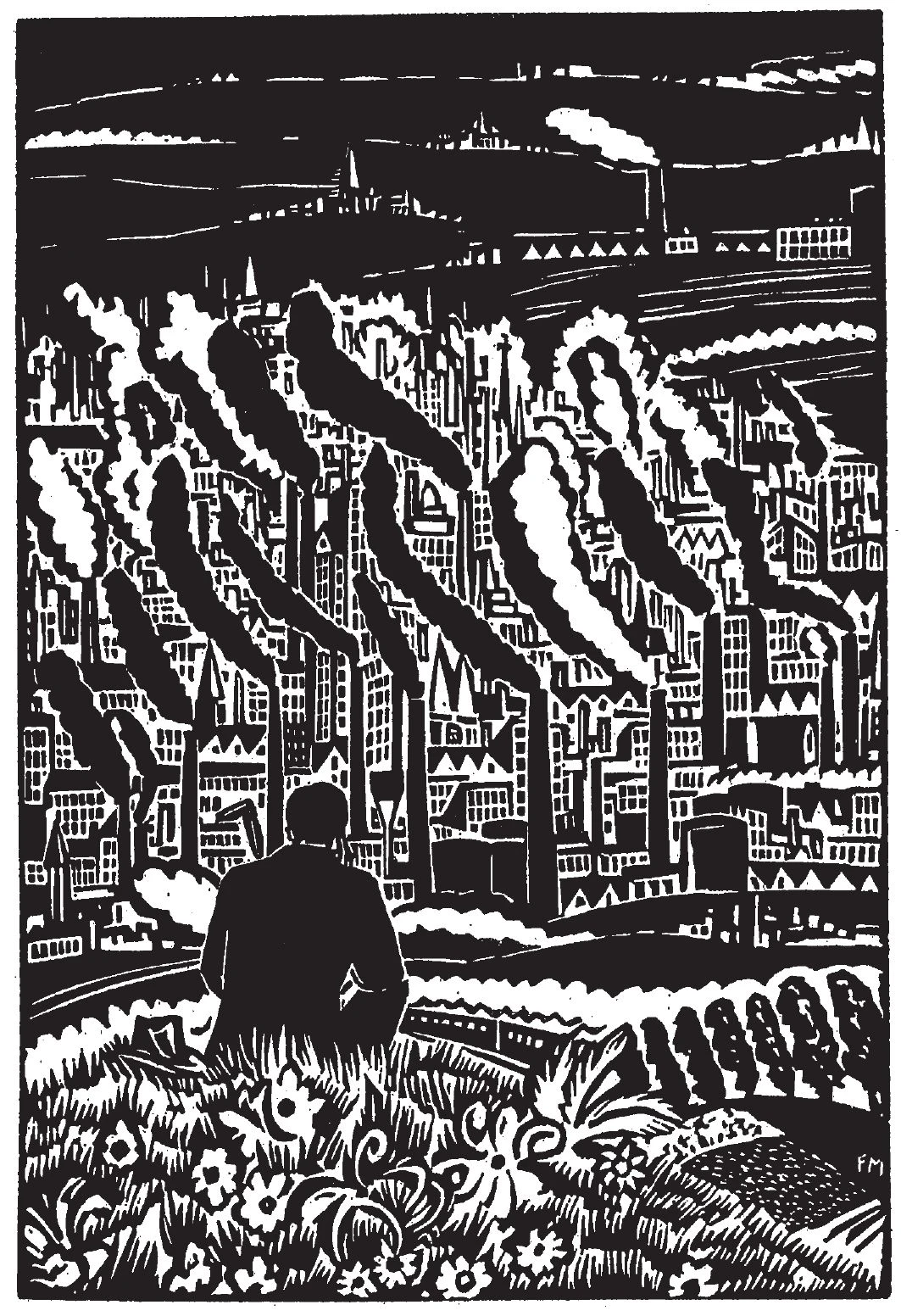
Frans Masereel - La Cité, 1925. Woodcut. Placeholder; replace at integration time with an image of land or water held against the line.
The political constitution operates within the ecological constitution. The federation is sovereign within the budget. It holds no sovereignty over the budget itself. The thresholds the planet sets are physical facts, not political agreements - revisable as the science improves, not as the legislature pleases. This is the chapter that says so directly, before the economic architecture describes how the surplus is allocated under the constraint, and before innovation-attribution describes how durability is rewarded as a primary category of productive labour.
The chapter sits where it sits because the order is structural. Wages and ownership are decided by people. Carrying capacity is not. A book that placed the economic architecture first and the ecological constraint after would imply that the constraint is an adjustment to the economy. The constraint is not an adjustment. It is the ground.
The principles rest on metabolic-reciprocity groundi - a sibling mechanism to the reciprocal containment that runs through every other chapter. Drawing a metabolic resource down faster than it regenerates is the unfair exchange the architecture exists to refuse. The consequence (collapse of the productive base, breakdown of the conditions under which the economy is intelligible) is structurally predictable. The dam against the dynamic is the budget the chapter specifies.
The budget that does not vote
Planetary boundaries are not negotiated. They are measured. The atmosphere absorbs a finite quantity of carbon before the climate system shifts to a new equilibrium. An aquifer refills at a rate set by precipitation, soil structure, and the geology of its basin. A fishery regenerates at a rate set by reproductive biology and habitat. None of these rates is open to vote. The democratic process inside the architecture decides what is produced, how the surplus is distributed, and what ecological priorities the federation pursues. It does not decide whether the aquifer refills.
The framing is the same one a structural engineer uses for the speed of light or the load-bearing capacity of a beam. You account for it, or it kills the project. The architecture's ecological commitment is the engineering posture, not the moral one: not "we should protect the planet because it is beautiful" but "the productive economy is intelligible only inside the constraint, and outside the constraint there is no economy to argue about." The first formulation is true. The second is structural. The chapter writes from the second.
The boundary set the framework operates against is the planetary-boundaries framework as developed by Rockström and the Stockholm Resilience Centre1 - carbon, biodiversity, freshwater, biogeochemical flows (nitrogen and phosphorus), land-system change, ocean acidification, atmospheric aerosols, novel entities (synthetic chemicals, microplastics), stratospheric ozone. The framework does not freeze the science. The constitutional commitment is to the structure - boundaries exist, they are knowable empirically, they are revised as evidence accumulates. The specific values, the methodologies, the contested cases - those are revised by an independent scientific body operating under the same architectural protections that govern every other functional body in the framework: term limits, glass walls, sortition oversight at the meta level, sunset clauses on its specific empirical mandates.
Where the regeneration rate itself is contested under disputed measurement - fisheries under competing stock assessments, soils under contested carbon-cycle accounting, atmospheric sinks at the climate-system boundary - the carrying-capacity setting defaults to the lowest defensible value, revising upward only on convergence of evidence and not downward in its absence. The asymmetry is the architecture's answer where the physics is honest and the data is not yet.
Three temporal layers
The constitutional architecture operates against three time horizons, because the ecological situation the federation inherits is not the ecological situation the federation builds toward.
Pre-transition: the drawdown, named honestly. The current state is one of accelerating extraction across most of the boundaries listed above. The framework does not pretend the federation arrives in equilibrium. It arrives in deficit, with the first confirmed planetary tipping point already crossed - warm-water coral reefs, on which nearly a billion people and a quarter of all marine life depend, have passed their thermal threshold.2 The remaining carbon budget for 1.5°C of warming is approximately 170 gigatonnes of CO2, roughly four years at current emission rates.3 Governments under the existing order plan to produce roughly 110 percent more fossil fuels by 2030 than would be consistent with limiting warming to 1.5°C.4 The architecture's first temporal task is to halt the drawdown. The drawdown is the inheritance.
Transition redirection window. Five years from the start of the transition (or seven with supermajority extension, matching the political sunset on the time-bounded centralization the framework permits during transition), the existing productive apparatus is redirected toward the steady-state architecture. The negative list and the redirection list (below) are the operational content of the window. The window is not a slow ramp. The drawdown does not allow it to be.
Steady state. Day 1825 (or 2555 under the supermajority extension), the budget operates as the architecture's permanent posture: aggregate extraction held within carrying capacity at biome, watershed, and airshed scale, allocations distributed across the federation by the steady-state mechanism, restoration drawing down the inherited deficit on a published schedule.
The three layers are constitutionally specified together rather than handed off as separate problems. The federation does not negotiate the steady-state architecture later, after the transition; it commits to the steady-state architecture as the destination the transition is moving toward. The transition is the route. The steady state is the architecture's permanent posture.
The negative list
A short, specific list of activities prohibited at transition start. The list is not aspirational. Each item is a structural extraction whose continuation is incompatible with the architecture's ecological commitment, and each is named in the negative because the alternative formulation ("we will pursue sustainability") has produced the historical record the framework rejects.
- New oil and gas exploration. Existing reserves under production wind down on the redirection schedule below; new exploration ends at transition start.
- Coal beyond steel-grade metallurgical use during the transition window. Thermal coal generation ceases; metallurgical use continues only to the extent the redirection list requires.
- Fishing of stocks below their sustainable yield, as assessed by the independent scientific body. Stocks above sustainable yield continue to be fished; stocks below it close until measured recovery.
- Deforestation for agricultural expansion. Existing agricultural land continues; new agricultural land does not come from forest conversion.
- Single-use plastic beyond medical and laboratory use. Packaging, consumer single-use, and disposable food-service ware end at transition start; medical and laboratory exceptions continue under the standard exception schedule.
The list is short because each item is a hard line. It is not exhaustive; the steady-state architecture will refine it. It is specific because the historical record on ecological commitment under prior socialist architectures is one of long lists of aspirations and short lists of enforcements. Write the list in the negative because the negative is enforceable, and the lack of a list is existential.
The redirection list
The trades worker, the engineer, the manufacturing worker, and the construction worker are the central agents of the transition window, not its casualties. The transition chapter develops the political content of the redirection at full length; this section names the material flows.
- Mining capacity: grid storage. Lithium, cobalt, nickel, rare-earth processing capacity built or held during the existing order is redirected toward the materials inputs of grid-scale and distributed storage.
- Manufacturing capacity: durable goods. Production capacity built around planned-obsolescence consumer goods is redirected toward goods built to last - appliances on a fifteen-year service horizon rather than a five-year one, electronics with field-replaceable components, vehicles built on long-cycle modular platforms. The economic architecture's recognition of durability as a primary innovation category sits in the innovation-attribution chapter; the metabolic case for the redirection sits here.
- Construction capacity: retrofit and transit. New-build single-family construction yields to deep-energy retrofit of the existing building stock, public-transit expansion, intercity rail, and the housing-stock work the not-utopia chapter develops.
The redirection is a labour-intensive programme, needing industrial mobilization at the scale of war-time spending. The trades worker whose current employer extracts oil is the trades worker whose new employer retrofits buildings, lays grid storage, or maintains transit infrastructure. The engineer whose current employer designs planned obsolescence is the engineer whose new employer designs the replacement. The manufacturing worker whose current line builds disposable goods is the manufacturing worker whose new line builds durable replacements. The pathway is the transition chapter's PMC-and-trades architecture extended to ecological work.
Throughput honesty
The metropolitan reader is told, accurately, that the federation reduces aggregate material throughput. The framework is precise about what is being reduced: waste, friction, and rent.
A phone built to fail at twenty-four months is not a phone you wanted to replace at twenty-four months. It is a phone the manufacturer engineered to fail. The replacement cycle is throughput. The throughput is also the failure. Eliminate the engineered failure mode and the replacement cycle elongates - the same utility delivered at a fraction of the materials, the energy, the mining, the assembly, the shipping. The phone you carry under the framework's durability standard is a better phone than the one you carry now, and you carry it longer. Utility goes up. Throughput goes down.
Advertising-induced demand is throughput. The fraction of consumer purchases attributable to manufactured want - to the cumulative effect of the surveillance-advertising apparatus the fourth-domain chapter treats as a systemic-criticality problem - is a fraction of consumption that delivers no utility above the baseline the consumer would have chosen in the absence of the apparatus. Eliminate the apparatus and the fraction goes away. Throughput goes down. Utility does not.
Packaging is throughput. The packaging-to-product ratio in the existing distribution system is set by retail-shelf logic, not by the requirements of getting the product home intact. A distribution system built around durable reusable containers, refill infrastructure, and bulk staples - of which the Cuban example carries fragments and the framework's nationalization of distribution carries the structural conditions - delivers the same nutrition and the same goods at a fraction of the packaging waste.
Healthcare downstream of overwork is throughput. The cardiovascular, metabolic, and mental-health load of fifty-hour weeks, two-hour commutes, food-system inadequacy, and the absence of the safeguard floor produces medical demand whose root cause is not biology but social structure. The economic architecture's reduction in working hours, the safeguard floor's housing and food provision, and the public-health upstream the framework's healthcare commitment names produce a population that needs less acute care because it is less acutely damaged. Throughput goes down. Health goes up.
The financial sector is throughput. The fraction of the existing economy's measured output that is rent extracted by financialization - mortgage securitization, insurance overhead, credit-default swaps, payday lending, the apparatus of household-debt servicing - is throughput that delivers no productive good. The elimination of the rent-extracting layer is a reduction in measured throughput that is simultaneously an increase in productive output. The economist who scores the pre-architecture economy at one figure and the post-architecture economy at a lower figure has miscounted the first; the rent was never productive, a house is not an investment, and removing it is not a loss.
Military spending downstream of imperial extraction is throughput. The fraction of the existing economy's productive capacity dedicated to enforcing the unequal exchange the sovereignty chapter identifies is throughput that purchases no domestic good. The architecture's anti-imperial-borders commitment removes the structural demand for the enforcement apparatus. Throughput goes down. Domestic productive capacity, redirected, goes up.
The metropolitan reader's nominal consumption falls. The metropolitan reader's utility, measured against the actual goods their lives are made from, rises. The framework names this directly because the alternative - pretending nothing falls - is unsurvivable under contact with the reactionary critique that the framework's ecological commitment will impoverish the population. The right will weaponise consumption decline regardless. The architecture's answer is precision about what is being reduced, not denial that anything is.
Steady-state allocation
Day 1825. The transition window has closed. The drawdown has been arrested. The architecture operates against the budget as its permanent posture. The mechanism that distributes the budget across the federation is the steady-state allocation system.
Sortition-based budget body. The aggregate budget is administered by a sortition body, term-limited, glass-walled, operating under the same architectural protections as every other functional body the framework specifies. The body's mandate is bounded: distribute allocations across the federation against the carrying-capacity envelope, audit cooperative and nationalized compliance, recommend revisions to the budget when the independent scientific body's assessments cross thresholds. The body does not decide whether the aquifer refills. It decides who gets to use what fraction of what does.
Cooperative bidding. Cooperatives below the nationalization threshold bid for shares of the budget through their sectoral federations. The bid is technical (what the cooperative will produce, with what materials, at what energy and waste profile) and democratic (the cooperative's worker council has authorised the bid). Allocation is by sectoral need, regional balance, and demonstrated efficiency on the existing share. Hoarding is penalised - the cooperative that bids more than it consumes returns the differential to the regional pool and faces a reduced bid ceiling at the next cycle.
Federation approaching aggregate boundary. When the federation as a whole approaches a carrying-capacity boundary - aggregate carbon emissions approach the annual budget, aggregate freshwater extraction approaches the watershed envelope - the budget body has automatic authority to reduce allocations across the federation, proportionally and transparently, with the published reasoning the architecture's glass-wall commitment requires. The reduction is not subject to legislative override during the budget cycle. The legislative response is at the next cycle, against the public record of the reduction.
Enforcement against members exceeding allocation. A member federation, sectoral cooperative, or nationalized enterprise that exceeds its allocation faces a graduated response: first cycle, public reporting and operational audit; second cycle, allocation reduction at the next cycle; third cycle, systemic-criticality assessment extended to ecological concentration. The same standing commission, the same adversarial evidentiary process, the same political-functional firewall - applied to the metabolic case by default rather than by exception. The enforcement is structural rather than punitive: the persistent over-extractor is restructured under the architecture, not fined under it.
Ecocide as electoral disqualification
Three consecutive years of measured biosphere decline within the federation's territory, in the absence of a documented external cause (volcanic event, regional climate forcing the federation did not contribute to, hostile foreign action), constitute a constitutional failure of the elected government's ecological mandate. The incumbent legislature and executive are disqualified from standing in the next two electoral cycles. The disqualification is structural, applied by the constitutional enforcement body on the Monitoring Commission's confirmed finding, and not subject to legislative review. The mechanism is bounded: it disqualifies the incumbents, not the parties they came from, and it applies to the cycle of decline under the incumbent's own watch, not to historical legacy.
The political cost of presiding over biosphere decline is positioned to exceed the political cost of holding inside the constraint. This is the architecture's structural commitment that ecological responsibility is a first-order political question rather than a discretionary one. A government can be voted out for any number of reasons under the framework's bounded multi-party competition. A government that presides over measured decline is removed by the architecture, not by the electorate, because the electorate's mandate did not include authority to license the decline.
The metabolic loop
The mechanisms above administer the constraint. The metabolic loop is the framework's account of how the surplus the federation produces is returned to the systems that make production possible. The loop is constitutionally specified - not a budget line that can be cut during austerity, but the earth's share of collectively generated wealth, paid first.
Ecological architecture mechanisms
The annual ecology budget. A constitutionally specified, annually declining cap on aggregate extraction across the economy, set against carrying-capacity measurement at the biome, watershed, and airshed level. The annual decline schedule is published in advance with multi-year visibility. Industries, regions, and individual enterprises operate against allocations from the budget rather than against an open extraction frontier. Exceeding the budget is not a fineable infraction. It is a constitutional violation that triggers an automatic mid-term election, on the grounds that the elected government has presided over a structural failure the population's mandate did not authorize. The mechanism is severe by design.
Restoration-first allocation. A constitutionally specified percentage of total economic surplus is allocated to a restoration coordinating body before any portion reaches the per-citizen national dividend. The body is sortition-based, operating under the political-functional firewall, with technical seats for ecologists and restoration scientists whose function is to inform the work, not to direct it. Its mandate is bounded: closed-loop manufacturing infrastructure, reforestation, soil regeneration, water-system restoration, and atmospheric carbon drawdown. The allocation is automatic - not a budget line that gets cut during austerity, but the earth's share of the national surplus, paid first, on the same constitutional weight that protects the safeguard floor from monetary erosion.
The national dividend's ecological component. A share of the national surplus is held back from per-citizen distribution and returned directly to the metabolic loop through restoration, regeneration, and reserve funds. The share is set democratically within a floor - a minimum proportion of the national surplus that cannot be reallocated to consumption regardless of political pressure - and adjusted upward as the monitoring ecosystem documents extraction approaching carrying capacity.
Cooperative ecological compliance. Below the nationalization threshold, every cooperative above a scale threshold files ecological compliance reports against carrying-capacity standards for its site of operation. The reports are public. Sustained violation forfeits the operating licence. Scale is not a licence to damage.
Regional ecological assemblies. Federated bodies, structurally independent of the executive and the legislature, composed of practising ecologists, Indigenous custodians of the bioregion, residents of the affected territory, and sortition-selected citizens. The assemblies operate at the bioregional scale rather than the political-administrative scale, on the principle that the watershed and the airshed do not respect provincial or municipal boundaries. They hold binding veto power over projects that exceed an ecological-impact threshold the ecology budget defines, with appeal to a separate sortition body. Seats rotate under the eight-year ceiling. Indigenous custodian seats are appointed under the consent architecture of the sovereign Indigenous nation whose territory the bioregion includes.
Each of these mechanisms sits on metabolic-reciprocity ground rather than institutional-expansion ground. The structural commitment is the same: build dams against identified reciprocity dynamics before the water arrives, not after.
What the constitution commits to and what it leaves open
Committed positions. The budget that does not vote (planetary boundaries as physical constraint, not political agreement). The independent scientific body's role as the empirical layer the budget operates against. The negative list as the immediate prohibitions at transition start. The redirection list as the structural form of the transition window. Throughput honesty (the reduction is of waste, friction, and rent; not of utility). Steady-state allocation (sortition-based budget body, cooperative bidding, federation-level reduction authority, graduated enforcement). Ecocide as electoral disqualification. The metabolic loop (annual ecology budget, restoration-first allocation, ecological component of the national dividend, cooperative ecological compliance, regional ecological assemblies with binding veto).
Principles without specific model. The exact carrying-capacity threshold values for each boundary - those are the independent scientific body's mandate. The specific sectoral allocation formulas - those are democratic determinations within the budget body's mandate. The exact percentage of national surplus held back from the dividend for restoration - constitutionally floored, democratically set above the floor.
Open questions the constitution names but does not resolve. The federation's relationship to non-federation ecological commitments and externalities (the sovereignty chapter carries the equal-exchange substance and the self-critique chapter names the inherited-aporia frame for ecological tipping points already crossed). The interface with bioregions whose carrying capacity is shared with non-federation territories. The temporal relationship between the steady-state architecture and tipping points whose feedback dynamics may have already passed the threshold the architecture is built to hold against.
The chapter is honest about the open questions because the alternative - pretending the constraint is solved - would be caught immediately by a population that can read the data the glass-wall architecture makes public. The budget is committed. The science is committed. The enforcement is committed. The interface with the rest of a planet that is not yet inside the architecture is a problem the chapter names and assigns, instead of a problem it solves in full.
Johan Rockström et al., "A safe operating space for humanity", Nature, vol. 461, pages 472-475 (2009). ↩
Global Tipping Points consortium (University of Exeter et al.), "Global Tipping Points Report 2025" (2025). https://www.stockholmresilience.org/research/research-news/2025-10-01-world-reaches-first-climate-tipping-point--widespread-mortality-of-coral-reefs.html. ↩
Robin D. Lamboll et al., "Assessing the Size and Uncertainty of Remaining Carbon Budgets", Nature Climate Change (2023). ↩
SEI, Climate Analytics, E3G, IISD, UNEP, "Production Gap Report 2023" (2023). https://productiongap.org. ↩
i. Strong-tendency claim, with the calibration noted directly. The Holocene-scale stability that allowed agriculture, cities, and industrial production to develop is a contingent material condition the architecture does not produce and cannot extend by political will alone. The framework's commitment is structural: build the dams against the extraction dynamics the architecture controls, name the inherited dynamics it does not (the self-critique chapter carries the inherited-aporia treatment in full), and operate the budget against the lowest defensible value of every threshold under disputed measurement. Where carrying capacity is contested, the asymmetric default is downward. ↩