Consent, coercion, and the tower of babel
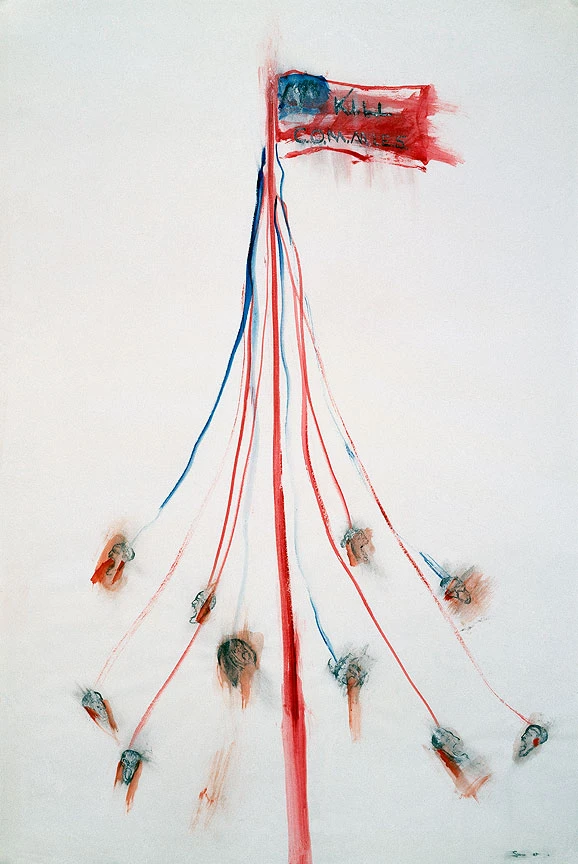
Nancy Spero - Kill Commies / Maypole, 1967. Gouache and ink on paper, 36 x 24 in.
You were not born believing the system is natural. You were taught.
You were taught that hard work leads to success. You were taught that the economy is complicated and best left to experts. You were taught that the police exist to protect you, that the courts are fair, that elections produce representation, that the news is information, that the way things are is more or less the way things have to be. You absorbed this through school curricula written by institutions funded by the people who benefit from the system, through media owned by the people who benefit from the system, through cultural products made within and distributed by the system, and through the daily experience of living in a world where every surface confirms what you have been taught.
This is something more effective than conspiracy: you exist in a system that reproduces itself through the ordinary functioning of its institutions, without anyone needing to sit in a room and plan it.
Antonio Gramsci, introduced earlier in the intellectual tradition that grounds this framework, gave this process a name.1 He called it hegemony - the process by which the ruling class maintains power not exclusively through force, but through the manufacture of consent. The ideas that make the system seem natural, inevitable, and good are embedded so deeply in education, media, culture, religion, and common sense that most people accept the system without ever consciously deciding to. They do not need to be coerced, because they have been convinced. The coercion exists - the police, the prisons, the riot gear - but it is the backup system. The primary system is the ideas in your head.
This is how a society in which a vanishingly small class extracts the surplus of everyone else's labour can persist without constant open warfare. The people being extracted from defend the system that extracts from them. They defend it because they have been taught to see it as the natural order, or as the least bad option, or as the only game in town. The factory worker who votes for the party that cuts his pension. The tenant who blames immigrants for her rent increase instead of her landlord. The gig worker who calls himself an entrepreneur. This is the success of hegemony, and we cannot attribute it to a failure of intelligence if the worker has been told all his life that the system is right, natural, and normal.
The success is total because it encompasses the entire permitted political spectrum. The right-wing party and the liberal-left party appear to disagree. On the surface, they do - on immigration, on social policy, on the tone of governance. Underneath, they agree on the thing that matters: the productive apparatus stays in private hands. The extraction continues. The debate between right and left within liberal democracy is a debate conducted inside hegemony, not against it. It is the system arguing with itself about how best to manage the people it extracts from - through fear or through inclusion, through austerity or through modest redistribution, through the flag or through the university - while the question of who owns the factory is never on the ballot.
Gramsci understood that challenging power requires more than seizing the state, it requires challenging the ideas that make the state's power invisible. You cannot overthrow a system that most people believe is natural, you have to make the machinery visible first. You have to show people the extraction, the surplus, the class relation, the imperial logic - and you have to do it in terms they can connect to their own experience. Then, and only then, does the question of what to do about it become possible to answer.
The tower of babel
The internet should have solved this problem. It did not.2 It made it worse.
For the first time in human history, a technology exists that allows every person on earth to communicate with every other person, instantaneously, without gatekeepers. The potential for mass consciousness - for working people across borders to recognize their shared conditions and organize against the systems that exploit them - has never been greater. The raw material for counter-hegemony is everywhere. The rent is too high. The wages are too low. The planet is on fire. The billionaires are in space. Everyone knows. Everyone is talking about it.
And nothing happens.
The internet is simultaneously the most powerful tool for awareness in human history and the most effective mechanism for preventing that awareness from becoming action. It is the tower of babel - everyone is talking, nobody is organizing, and the system that should be shaking is more stable, even expanding, faster than ever.
The mechanism is not complicated. Social media platforms are businesses. Their product is your attention, sold to advertisers. The metric that matters is engagement - time on screen, clicks, reactions, shares. The algorithms that determine what you see are optimized for engagement, and engagement is optimized by outrage. Content that makes you angry keeps you scrolling longer than content that informs you. Content that makes you argue in the comments generates more data than content that makes you close the app and do something.
The result is a system that converts political awareness into consumable content. You see a post about housing unaffordability. You are angry. You share it. You argue in the comments. You feel like you have done something. The algorithm registers your engagement and serves you more content designed to produce the same response. The cycle continues. Your anger is real. Your awareness is real. But the action you have taken is posting, and the only entity that benefits from your posting is the platform that sold your attention to an advertiser while you were doing it.
This is the consciousness trap. The internet does not suppress class consciousness - the material conditions do that work on their own, and the internet actually accelerates the transmission of awareness. What the internet does is metabolize consciousness. It takes the impulse to resist and converts it into the impulse to post. Posting about exploitation provides a neurochemical reward - social validation, the appearance of participation, the feeling of having contributed - that is similar enough to the reward of actually resisting that it substitutes for it. You feel like you fought back, but you did not: you generated content.
The ruling class does not need to censor the internet. It does not need to suppress your awareness. Your awareness is profitable. Your outrage is engagement. Your political energy is content. The system has found something more effective than censorship: absorption. It lets you scream into the machine, and the machine sells your scream to the highest bidder.
The asymmetry deepens. As of 2025, 65 right-leaning online political shows command audiences of a million or more. On the left, the number is 21.3 The right dominates new media not because its ideas are better but because its content is optimised for the engagement metrics the platforms reward - scapegoating produces engagement more reliably than structural analysis.
The way out
If the trap is that posting substitutes for action, then the way out is action.
Do not turn this into a slogan. It is a diagnostic claim about how movements actually form. Of all the chapters here, this is the one I am writing for myself as much as for anyone reading it. Every successful revolutionary movement in history solved the same problem: how do you convert awareness into organization? The answer, every single time, was action that filters for commitment.
The Bolsheviks had party membership requirements - agreement with the programme and demonstrated organizational work. The Black Panthers ran breakfast programmes for children because the people who showed up to feed children at six in the morning were the people who would show up for everything else. Castro's movement was forged in the Sierra Maestra - the mountain campaign filtered for the people willing to endure physical hardship alongside political commitment. In every case, the mechanism was the same: action separates the committed from the sympathetic. Theory recruits sympathizers. Action produces revolutions.
The Palestine solidarity movement tested the mechanism at scale. Nearly 12,400 protests were recorded in the United States within eight months of October 20234 - the largest sustained mobilisation triggered by a foreign event since the Iraq War. Millions posted. The filter operated: the spring 2024 university encampments across over 130 American universities and 34 British universities separated those willing to pitch a tent and face arrest from those who shared a graphic. Over 3,100 students were arrested. ICE detained a Columbia University encampment negotiator under a 1952 immigration act designed to deport political dissidents.5 The state does not arrest people who are performing resistance: it arrests people it considers a threat.
The internet age has not changed this. Instead it has made it more urgent, because the internet produces an unprecedented number of sympathizers and an unprecedented capacity to mistake sympathy for commitment.
The framework proposes an engagement boycott of performative consciousness. The logic is simple. If someone posts about the need for revolution but does nothing, the revolutionary does not engage. No arguments, no corrections, no recruitment attempts in the comments. The revolutionary performs action - organizing a tenants' union, running a mutual aid network, blockading a supply chain, striking - and other revolutionaries amplify that action. The action is the signal, the posting is noise.
This creates a social gravity well. If you want to be part of the community that is visibly doing things, you have to do things. If you post about revolution, revolutionaries will not respond. If you show up at the picket line, the mutual aid kitchen, the blockade, the strike - you get solidarity. You get community. You get the thing the posting was trying to simulate.
The objection that this is elitism, or gatekeeping, is the wrong objection: revolutionaries must operate with recognition that consciousness without organisation is just anger, and the internet has perfected the production of anger without organisation. The test the framework imposes is not ideological - no one is being asked to pass a theory exam. It asks you to show up and do something. That is the test, and it is the only test that matters.
While the boycott targets performative posting - it does not target strategic communication. The distinction is between communication as the action (rejected) and communication about the action (essential). A chapter that runs a successful tenant action and documents it for recruitment is doing strategic communication. A person arguing about tenant rights in a comment thread is performing. The signal is the action. Communication amplifies the signal.
The boundary is real but not always obvious, so test it with cases: a post that documents last week's blockade and includes a date and location for the next one is strategic communication - it serves a specific organizational function and its effectiveness is measurable (did people show up?). A post that livestreams a confrontation with police in real time is strategic communication if it is coordinated with a legal support team and produces a documentation record, and it is performance if it exists to generate engagement for the person holding the phone. A post that shares an analysis of how to organize a rent strike in your building, written by someone who has done it and including the steps they took, is strategic communication. A post that reshares someone else's analysis with a comment about how everyone should do this is performance - it produces the feeling of contributing without the friction of organizing. The test is always the same: does this communication serve an action that exists independently of the communication itself?
What this argument is not saying, before enthusiastic readers collapse the distinction: it is not saying do not share information. Nor saying abandon online work entirely, or that communication is morally suspect: posting is not wrong. What it is saying is that posting is not organizing, and that the substitution of the first for the second is the mechanism by which the system absorbs most of the political energy produced in the current media environment. Share documentation. Publish analysis. Coordinate action. Keep the public record that lets the next chapter do the work better. The prohibition is narrower than it reads: the prohibition is on treating the post as the action, not on posting.
Every effective revolutionary movement in history understood this: The Black Panthers published a newspaper and ran breakfast programmes.6 The Bolsheviks had Pravda and organized strikes.7 The Zapatistas used the internet for international solidarity and maintained armed territorial control. The IRA published An Phoblacht and maintained an army.8 None of these movements chose between action and communication, they just made communication serve action. The framework adopts the same position: communicate what you are doing, not what you think about what others should do.
Capital eats everything
There is a second trap, and it is older than the internet.
Capital suppresses resistance and absorbs it. Every counterculture, every radical aesthetic, every revolutionary symbol in the last century has been commodified.
Che Guevara's face is on t-shirts sold by corporations that would have funded his assassination. Black Power is a Nike campaign. Punk was sold back to the suburbs by the same music industry it claimed to reject. Occupy Wall Street's language - "the 99 percent" - was used in political campaigns by millionaires soliciting donations from billionaires. The raised fist is clip art. "Resist" is a bumper sticker. The system is extraordinarily good at taking the language, the symbols, and the aesthetic of resistance and selling them back to the people it exploits.
This is not only ironic but also structural: capital commodifies everything. That is what it does. It sees a market, it fills it. If people want to feel like rebels, capital will sell them rebellion. The product is not the t-shirt, but instead the feeling of resistance without the cost of resisting.
The question is: what can capital not commodify?
Its own disruption.
Capital can commodify the aesthetic of a general strike, but it cannot commodify a general strike. It can sell a documentary about a port blockade, but it cannot sell a port blockade. It can absorb the language of revolution, but it cannot absorb the material disruption of its own operation. A supply chain that stops moving costs money in a way that no amount of radical branding can recover.
The framework's anti-commodification mandate follows from this: revolutionary action must directly disrupt capital, or it is not revolutionary action. Actions that do not disrupt capital - regardless of their symbolic value, their media impact, or their emotional resonance - burn energy that could be directed at something the system cannot absorb.
The mandate should be a practical filter over an abstract standard: Does this action impose a material cost on the system? Does it interrupt the flow of extraction, the movement of goods, the operation of the platform, the function of the institution? If yes, it is resistance. If no, it is content.
State-permitted protest is the clearest example of the difference. If the police facilitate your march, the march is not disrupting anything. It is a pressure valve - the appearance of dissent that allows the system to present itself as tolerant of opposition. The permit is the tell. A march that requires permission from the entity it claims to challenge is not a challenge. It provides a performance, and a brand for capital to commodify. And the system needs the performance, because the performance channels energy that might otherwise go somewhere less... comfortable.
This does not mean every permitted march is worthless. It means that permitted protest, by itself, is system maintenance. It becomes resistance only when it escalates - when the march becomes a blockade, when the strike becomes a general strike, when the demonstration becomes a sit-in, when the people who showed up for the performance decide to stay for the disruption.
A rally is an event in the production of consciousness. Hundreds of thousands of people in the street, looking at each other, seeing that they are not alone, reading the same signs and hearing the same speeches - that is the raw material of a movement. The moment matters. The moment is not the movement. A crowd that assembles, vents, and disperses has generated consciousness and wasted it, because consciousness that does not attach to organization decays within a week. What converts the rally into something the system cannot absorb is the infrastructure that catches the people leaving. A chapter at the edge of the crowd with a clipboard and a meeting time next Tuesday is doing more revolutionary work than the speaker at the microphone. The march is the recruitment pool. The building across the street where ten people from the march sit down and plan a rent strike is the work. Treat mobilisation as the first day, not the whole campaign. Without the infrastructure waiting to receive them, a million people in the street produce one good afternoon and a slightly stabilised regime. With it, the same million produce an organization that can impose costs the system cannot pay.
Demanding, not requesting
There is a posture that runs through every absorbed movement, and it is the posture of the request. Please consider our grievances. Please hear our voices. Please reform the system that is destroying us.
The system hears the request. The system considers. The system adjusts a dial, passes a regulation, launches a commission, publishes a report, and continues exactly as before. The requesting posture is built into the logic of permitted protest: you ask, they decide, and the decision is always calibrated to absorb just enough pressure to prevent the thing they actually fear, which is disruption. Half a century of theory on this question and the prescription has not improved on "ask nicely or wait for consciousness to ripen." Neither one is a strategy.
The framework rejects the requesting posture entirely. The posture is demand. Not because demand is more emotionally satisfying (though it is), but because the requesting posture is structurally designed to fail. When you request, you accept the authority of the entity you are requesting from. You accept that they have the right to say no, and you accept the terms under which the conversation is conducted. And those terms are set by the people who benefit from the outcome.
This is not a dismissal of every non-confrontational approach. The requesting posture has tactical utility - it generates documentation of refusal, it builds a public record that demonstrates good faith exhausted, and in some conditions it shifts the burden of escalation onto the institution that says no. What it cannot do is produce structural change, because the institution retains the authority to refuse, and the refusal carries no cost. The tactical value of requesting is that it sets the stage for demanding: we asked, they refused, here is what we do now. Requesting as a step is not by itself an error, treating it as the destination is.
Demanding is structurally different, a demand does not accept the authority of the entity it addresses. A general strike does not request better wages, it imposes a cost that makes refusing better wages more expensive than granting them. A port blockade does not ask for the cessation of arms shipments, it stops the ship. The action is the demand, and the demand is enforced by the material cost of ignoring it.
Remember, you operate within a system which demands work from you - whether forced through slavery or coerced by fear of homelessness, a system which demands work from you requires you therefore demand in reciprocation.
The shift from requesting to demanding is both postural and organizational. This requires the capacity to impose costs - which means organization, discipline, solidarity, and the willingness to absorb the consequences of confrontation. It requires what the previous pieces in this series have described: an understanding of where the surplus goes, an understanding of how tools turn, and the willingness to act on that understanding in ways the system cannot absorb.
This is what counter-hegemony looks like in practice. Not better arguments. Not more compelling content. Not more sophisticated analysis of the system's contradictions. Action. Material, costly, disruptive action that the system cannot commodify, cannot permit, and cannot absorb. The rest is noise.
The recuperation machine
The capacity of capital to absorb resistance is one of the system's most reliable features, and it operates with a consistency that should be studied rather than lamented.
Occupy Wall Street is the instructive case, because the recuperation happened in real time and on camera. The movement's language - "the 1 percent," "the 99 percent" - entered mainstream political discourse within weeks; politicians adopted it; commentators used it. The encampments were cleared, the organizers arrested or dispersed. The language survived because the language is free; the material disruption was eliminated because material disruption is the only part the system cannot tolerate. Earlier cycles run the same: punk absorbed by the music industry that punk defined itself against, hip-hop absorbed by the entertainment corporations whose customers were the children of the people the form had been built to indict.910 Capital absorbs the symbolic dimension of resistance and eliminates the material dimension. Symbols, language, aesthetics, cultural products commodify. Physical occupation, supply chain disruption, labour withdrawal do not.
Permitted protest is the institutionalized form of the absorption. A demonstration negotiated with the police, following a pre-approved route, operating within designated time limits, dispersing when instructed, is a managed expression of dissent that serves a systemic function: it lets the discontented feel they have acted and channels energy away from actions the system cannot control. The "no kings" demonstrations of 202511 put millions of people in the streets and imposed zero material cost. The targets continued exactly as before, because the format was designed to be absorbable. The critique here is structural, not personal: the people inside the format are not the problem; the format is.
The machine operates at every scale. A radical academic publishes a book critiquing capitalism through a capitalist publisher, distributed through a capitalist supply chain, purchased by readers who absorb the critique and continue participating in the system the book describes. A social media influencer posts about wealth inequality; the post goes viral; the platform sells the engagement to advertisers; the advertiser sells products to the followers; the inequality continues. The only reliable counter is material disruption. You cannot put a blockade on a t-shirt, franchise a supply chain stoppage, or brand a general strike. Capital can absorb everything except the interruption of its own operation.
The anti-commodification aesthetic
If capital absorbs every symbol, the revolutionary movement operates without symbols that can be sold. Every movement that developed a distinctive visual identity saw that identity commodified - punk's safety pins, the Panthers' berets, Occupy's Guy Fawkes masks - and the commodification replaces resistance with consumption. The principle is simple: if it can be sold, it has already been absorbed.
The practical form is austere. All black, no logos, no merchandise. Black clothing carries no brand and cannot be commodified because there is nothing to commodify; the absence of a uniform is the uniform. A logo is a commodity in waiting - the moment a movement produces one, someone prints it on a shirt and the shirt replaces the action the logo was supposed to represent. Movement identity is communicated through what it does, not what it looks like; fundraising flows directly to legal defence, mutual aid, and material support, not to branded apparel.
Discipline does the aesthetic work. A hundred people in black standing in organized formation at a blockade communicates more than a thousand people in branded t-shirts within a police cordon. Identity is built on action, not appearance: you know who your allies are because they showed up at the picket line, the mutual aid kitchen, the blockade. The branded movement attracts people who want to belong to the brand; the unbranded movement attracts people who want to do the work. The filter is automatic.
This is a practical constraint, not a permanent one. The Panthers' berets communicated discipline and solidarity effectively before commodification swallowed them. Under current media conditions, where a logo deployed on Monday is on a t-shirt by Friday, the only defence is having no logo to commodify. If the capacity for commodification is disrupted, the constraint relaxes.
Risk distribution as solidarity
Not everyone pays the same price for resistance.
An Indigenous land defender in Canada who blockades a pipeline faces state violence - militarized police, detention, criminal charges, and the documented history of how the Canadian state treats Indigenous resistance. A white professional in Toronto who organizes a tenant union faces social friction and career risk. An undocumented worker in the United States who joins a labour action faces deportation. A Palestinian in the occupied territories who participates in any form of resistance faces imprisonment without charge, home demolition, or death.
The cost of action is distributed unevenly because the system distributes violence unevenly. The system knows this, the uneven distribution is itself a tool of control. Analysis can be done to determine whether this is intentional, or a product of the expansion of structural mechanisms into spaces optimized to prevent equal distribution of violence and risk - the underlying mechanism however ensures that the people with the most to gain from resistance are the people for whom resistance carries the highest cost, and the people with the least to gain - the comfortable, the privileged, the insulated - are the people for whom resistance is optional.
The framework's position is that different levels of solidarity based on different levels of risk is unacceptable. The distribution of risk within the movement must be the inverse of the distribution of privilege in the system. The people who face the least state violence must absorb the most risk. The people who face the most state violence must receive the most protection.
This is not charity, nor allyship in the liberal sense - standing beside in sympathy, expressing concern, donating to the cause while remaining personally untouched. It is a structural obligation: if you are privileged, your privilege is the product of the same system that produces the violence your comrade faces. You are not helping them, you are paying a debt the system created. The price of solidarity is not optional, but the condition of membership.
The mechanism is practical, avoiding sentimental politics. When a privileged body absorbs state violence, the political cost to the state increases. The system is designed to brutalize the marginalized invisibly - violence against Indigenous people, undocumented workers, and racialized communities is normalized, expected, and unremarked. Violence against a white professional generates media attention, and violence against a crowd that includes identifiable middle-class faces generates outrage that the state cannot easily contain. True, this is not fair: but it must be instrumentalized.
The privileged revolutionary's role is not to lead. It is not to speak for. It is to stand in front of the truncheon so that the person behind them does not have to. It is to get arrested so that the person whose arrest would mean deportation does not have to. It is to absorb the cost that the system is designed to fall on someone else.
The framework connects this directly to organizational structure: the federated model described in later pieces builds risk distribution into its architecture. An attack on one localized group activates all federated groups in solidarity - including groups whose members face less state violence. The state cannot surgically target the most vulnerable while the privileged observe safely. Solidarity is never a moral choice, and must be an organizational mechanism that distributes the cost of resistance across the entire movement, weighted by the capacity to absorb it.
The kill switch - the distributed activation protocol detailed in the next piece - encodes this principle structurally. When the state attacks one group, every group responds. The privileged professional's chapter activates alongside the targeted Indigenous chapter. The state cannot isolate itself, because solidarity is pre-built into the architecture.
There is a hard truth here. Solidarity that costs nothing is performance - if your solidarity with the brutalized costs you nothing - if you post about it, donate to it, vote about it, but never put your body or your livelihood at risk for it - you are performing solidarity within the system. The system has a name for this. It is called being a liberal. Liberalism is, structurally, the performance of solidarity without the absorption of risk. The framework rejects it. Not out of contempt for individuals, but because the structure does not produce change. Change requires the redistribution of risk from those who have been absorbing it alone.
This is uncomfortable. It should be. If you are comfortable, your solidarity is not costing you enough.
Strategic communication in practice
The engagement boycott distinguishes performance from communication that serves action. The useful side has five practical forms.
Documentation of material actions - photos, video, written accounts of every tenant victory, workplace win, mutual aid delivery, blockade - produced not for engagement metrics but for recruitment and legitimacy. When someone wants to join, the documentation is how they find you; when another chapter needs to know what worked, the documentation is how they learn. Counter-narrative work responds to hegemonic frames with the framework's analysis grounded in specific local conditions: the rent is too high, here is who owns the building, here is what happened when the tenants organized - concrete, local, tied to experience, not a thread about capitalism in the abstract. Recruitment communication directs people from awareness to action: the post that ends with "come to the meeting Tuesday at 7" is strategic, the post that ends with "share if you agree" is performance. Amplification of other chapters focuses on the action itself, not commentary on the action - inter-chapter visibility and solidarity, demonstrating to sympathizers that real things are happening in real places.
The measurement is operational: a chapter's communication output is measured by whether it produces new members, new actions, or new material support, not by engagement metrics or virality. If communications reach thousands and produce zero new participants at the next meeting, the communications are performance.
Finally, energy protection between comrades. The impulse to type an argument at a fellow organizer online - about theory, strategy, the correct analysis of conditions - feeds the engagement machine the framework is built to refuse. Default to voice or in-person for internal disagreement. Every hour two organizers spend arguing in a comment thread is an hour neither spent organizing.
Gramsci, Althusser, Debord, and the mass strike
Gramsci's theory of hegemony, developed in the Prison Notebooks (1929-1935),12 provides the analytical foundation for this piece. His distinction between coercive power (dominio) and consensual power (direzione) - the state's two faces, force and hegemony - remains the most precise account of how class power is maintained without continuous open warfare. The ruling class rules not primarily through the repressive state apparatus (police, military, prisons) but through civil society (education, media, religion, cultural institutions) which produces the "common sense" that makes the existing order appear natural.
Gramsci's concept of the "organic intellectual" - the intellectual produced by and serving a particular class - is directly relevant to the framework's analysis of the professional-managerial class (PMC) as a buffer stratum. The PMC functions as the organic intellectual of capital: it produces and reproduces the ideas that make extraction invisible, and it does so not through conspiracy but through the ordinary operation of the professions, the universities, the media, and the cultural industries. The PMC does not know it is performing this function, which is precisely what makes it effective. Hegemony operates through agents who believe they are exercising independent judgment while reproducing the conditions of their own subordination.
Louis Althusser's theory of Ideological State Apparatuses (ISAs), developed in Ideology and Ideological State Apparatuses (1970),13 formalizes Gramsci's distinction into a structural model. The Repressive State Apparatus (RSA) - police, military, courts - functions primarily through violence. ISAs - the educational system, the media, the family, the legal system, the political system, the cultural apparatus - function primarily through ideology. Althusser's contribution is the insistence that ideology is not false consciousness in the vulgar sense (people believing wrong things) but a material practice embedded in institutions. You do not "believe" in capitalism the way you believe in a proposition. You live it - through the daily practices of going to work, paying rent, consuming media, obeying traffic laws - and the living is the ideology.
This has direct consequences for counter-hegemonic strategy. If ideology is a material practice, it cannot be defeated by better arguments alone. You cannot argue someone out of a practice. You can only replace the practice with a different one. This is why the framework insists on action over discourse. The counter-hegemonic moment is not the moment you convince someone that the system is unjust - most people already know this. The counter-hegemonic moment is the moment they participate in an action that disrupts the system. The action replaces the practice of submission with the practice of resistance. The consciousness follows the action, not the other way around.
Guy Debord's The Society of the Spectacle (1967)14 anticipates the internet's recuperative function with uncomfortable precision. Debord argues that in advanced capitalist societies, social life has been replaced by its representation. The spectacle is not a collection of images - it is a social relation between people mediated by images. What Debord describes is the process by which lived experience is replaced by its consumption, and resistance is replaced by the consumption of resistance. The internet has perfected this process. The social media feed is the spectacle in its purest form: every experience, every political conviction, every act of resistance is flattened into content, consumed, and metabolized without remainder. Posting about revolution is the quintessential spectacular act - it is the representation of resistance replacing resistance itself.
Debord's analysis connects to the anti-commodification mandate. The spectacle commodifies everything it touches, including opposition to itself. The only escape from the spectacle is the act that refuses to be represented - the act whose material impact is its own justification, independent of its media image. A general strike does not need media coverage to impose a cost. A port blockade does not need to be filmed to stop the ship. In Debord's terms, these are acts that refuse the logic of the spectacle by operating on the material plane rather than the representational one.
Rosa Luxemburg's mass strike thesis, articulated in The Mass Strike, the Political Party and the Trade Unions (1906),15 provides the organizational precedent for the action-as-filter principle. Luxemburg argued, against both the reformist trade union leadership and the ultraleft voluntarists, that the mass strike is not an action that can be called or prevented by organizational decision. It arises from the material conditions - but it arises through action, not through theory. Workers who participate in a strike develop class consciousness through the experience of striking, not as a prerequisite for it. The strike produces the solidarity, the organizational capacity, and the political awareness that the next strike will require. Consciousness and action develop dialectically, each producing the other.
The framework's engagement boycott updates Luxemburg for an age in which the substitution of posting for striking has become the primary obstacle to the dialectical process she described. In Luxemburg's time, the obstacle was organizational - the trade union bureaucracy that prevented spontaneous action. In the internet age, the obstacle is neurochemical - the platform that provides a simulated experience of resistance sufficient to prevent the real one. The boycott removes the substitute by refusing to validate it with engagement. When posting receives silence from revolutionaries and action receives solidarity, the incentive structure shifts. The person who was posting may begin to act, because acting is now the only way to access the community that matters.
The framework's position within the tradition is: Gramsci provides the diagnosis (hegemony is maintained through consent manufactured by civil society institutions). Althusser provides the structural formalization (ideology is material practice, not false belief). Debord provides the media-specific extension (the spectacle replaces lived experience with consumed representation, including consumed images of resistance). Luxemburg provides the prescription (consciousness develops through action, not as a prerequisite for it, and the organizational task is to create the conditions under which action can occur).
What none of these thinkers could have addressed is the internet's specific contribution: a system that simultaneously accelerates awareness and prevents it from crystallizing into action, that metabolizes revolutionary energy into content, and that monetizes the metabolization. The framework's counter-hegemonic strategy - the engagement boycott, the anti-commodification mandate, the action-as-filter mechanism - is the attempt to apply their analytical tools to a media environment none of them anticipated, while remaining faithful to the materialist commitment they share. The answer is the same answer it has always been: act. But the obstacles to action have changed, and the strategy must change with them.
Antonio Gramsci, Prison Notebooks (1929-35). ↩
Evgeny Morozov, To Save Everything, Click Here (2013). ↩
Media Matters for America, "Right-Leaning Online Shows Disproportionately Reach Variety Audiences and Shape Political Discourse" (2025). https://www.mediamatters.org/fox-news/right-leaning-online-shows-disproportionately-reach-variety-audiences-and-shape [accessed 2026-04-16]. ↩
Jewish Voice for Peace, "Deadly Exchange: The Dangerous Consequences of American Law Enforcement Trainings in Israel" (2018). https://deadlyexchange.org. ↩
NPR, "Mahmoud Khalil Immigration Case" (2025). https://www.npr.org/2025/04/11/nx-s1-5357994/mahmoud-khalil-immigration-judge-deported [accessed 2026-04-16]. ↩
Joshua Bloom; Waldo E. Martin Jr., Black Against Empire: The History and Politics of the Black Panther Party (2013). ↩
Vladimir Lenin, What Is to Be Done? (1902). ↩
Richard English, Armed Struggle: The History of the IRA (2003). ↩
Jon Savage, England's Dreaming: Anarchy, Sex Pistols, Punk Rock, and Beyond (1991). ↩
Greil Marcus, Lipstick Traces: A Secret History of the Twentieth Century (1989). ↩
Wikipedia contributors, "No Kings Protests" (2025). https://en.wikipedia.org/wiki/No_Kings_protests [accessed 2026-04-16]. ↩
Antonio Gramsci, Prison Notebooks (1929-35). ↩
Louis Althusser, Ideology and Ideological State Apparatuses (1970). ↩
Guy Debord, The Society of the Spectacle (1967). ↩
Rosa Luxemburg, The Mass Strike, the Political Party and the Trade Unions (1906). ↩