Every revolution fails the same way
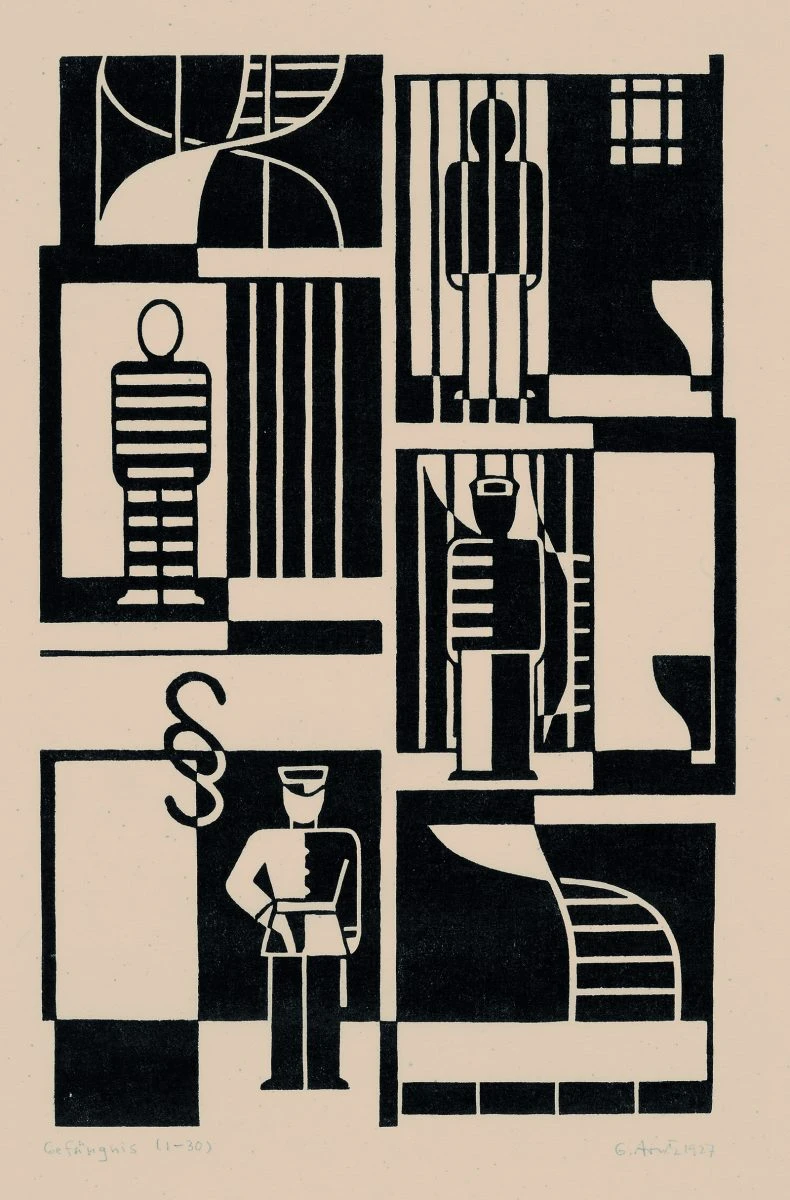
Gerd Arntz - Gefängnis (Prison), 1927. Woodcut on paper.
The Bolsheviks overthrew the tsar. Within a generation, the Communist Party of the Soviet Union had become a new ruling class - with its own dachas, its own shops, its own privileges, its own material interests antagonistic to the workers it claimed to represent.1 The party that abolished the bourgeoisie became the bourgeoisie.
The Chinese Communist Party liberated a nation from feudalism and imperialism. Within two generations, it presides over the second-largest economy on earth, run by billionaires who are members of the party. The party that overthrew capitalism became the vehicle for its restoration.
Cuba survived a revolution, an embargo, the collapse of its primary ally, and six decades of imperial hostility. And yet power has passed from one Castro to another, from one generation of the same family to the next, in a country whose revolution was fought against precisely this kind of hereditary authority.
The pattern is the same every time. The revolutionary party seizes power, consolidates it, and then cannot let it go. The party becomes a class. The class develops its own material interests. Those interests diverge from the interests of the workers. The state that was built to liberate the working class begins to extract from it. The revolution eats itself.
This is a structural failure, and it has a structural cause: every socialist state in history was built without mechanisms to prevent the people who run it from becoming the people who own it.
The framework addresses this structurally. Not with better leaders. Not with better intentions. Just with architecture. I do not know how to build something that stays human while it gets efficient. The architecture below is the closest I can get.
The political-functional firewall described in this chapter affects a category of professional autonomy I have held and that I am asking the reader holding similar autonomy to accept constraint on. The ask is not comfortable, and it is not asymmetric. My position is that this constraint, applied to me, is the condition of the framework's anti-ossification working. If the firewall does not bind the technical fraction I belong to, it does not bind anyone.
This chapter sits on near-universal ground.i The activation conditions the framework names - institutional persistence, expertise retention, budget inertia, absence of designed containment - are the default state of every party apparatus, every bureaucracy, every security service, every judiciary that has ever been built inside a socialist state. The expansion dynamic follows from the conditions with the same regularity that steel in saltwater corrodes. The prescriptions below - multi-party competition within socialist bounds, sortition bodies, term limits, recall, political-functional separation, glass walls - are dams built against those conditions specifically. A reader who wants to weaken the case should show a state apparatus that persisted with retained expertise, continuing budget, and no designed containment, and did not expand. The framework predicts no such case.
The pipeline, step by step. The party-to-class trajectory is mechanical, not accidental, and naming the steps clarifies what each dam in the rest of this chapter targets. Single-party rule eliminates faction competition. Without competing programmes inside the working class, the ruling party stops having to defend its own programme, and the analytical work that justified it stops being done because nothing forces the work. The dam is multi-party competition within socialist bounds, the topic of the next section. Centralised cadre selection follows. With no competing party to defect to, the ladder upward runs through a single body and the body controls who climbs; selection becomes loyalty filtering, not capability filtering. The dam is sortition for the adjudicatory and monitoring bodies, breaking the ladder where the ladder would otherwise calcify into a recruitment funnel. The secret-police pipeline runs in parallel. Pre-state intelligence personnel - the people who held authorisation to operate against the existing state during the transition - become, structurally, the people best positioned to operate the post-state security apparatus, and the historical record on this conversion is uniform: the Soviet Cheka-to-NKVD trajectory, the East German Stasi's lineage, the Cuban G2's continuity. The dam is the pre-state-to-post-state transition rule - structural separation of personnel, declassification timetable, federated and Monitoring-Commission oversight - applied at the moment of state assumption rather than deferred to a transition period the historical record shows is the period during which the apparatus calcifies. Material privilege accrues to the cadre tier. Special shops, better housing, dachas, educational access for cadre children - the Soviet nomenklatura's privilege ladder is the documented case, and the mechanism is the same wherever a cadre tier persists. The dam is the cooperative mandate below the nationalization threshold and the safeguard floor above it: privilege has nowhere to land architecturally because the surplus distribution has no separate stream for the cadre to draw on. Privilege transmits intergenerationally. Cadre children attend cadre schools; cadre marriages produce cadre households; cadre networks place cadre children in cadre roles. The class crystallises one generation at a time, on a clock too slow for any single intervention to catch. The dam is the political-functional firewall and the eight-year term limit, which break the personnel continuity that intergenerational transmission requires. Class crystallisation, finally, becomes structural. The cadre is the ruling class and the ruling class is the cadre, with material interests divergent from those of the workers it governs. The dam is the duty to overthrow and the armed populace below it, which the framework names as the last layer not because it is preferred but because every prior layer has, in the historical record, sometimes failed. The chain is what the architecture is built to interrupt at six separate joints. A reader who wants to weaken any single dam should be able to name which joint it targets and which other dam carries the load if the first one fails.
Multiple parties, no capitalists
The first structural mechanism is competition.
The Soviet Union had one party. The Communist Party of the Soviet Union was the only permitted political organization for seventy years. If you disagreed with the party's direction - its economic programme, its foreign policy, its approach to national questions - you had no mechanism for organized opposition. You could not form a competing socialist party that argued for a different path to the same goal. Your choices were: agree, stay quiet, or be destroyed.
This is how a revolutionary party rots. Without competition, it does not need to defend its ideas. Without the need to defend, it stops developing them. Without development, it stagnates. Stagnation produces a party that maintains power through inertia rather than performance - and a party that maintains power through inertia develops the material interest of maintaining power for its own sake. The party's survival becomes its primary objective. The workers become secondary. The revolution is over, and the new ruling class is wearing the old revolutionary's uniform.
This framework leans toward multi-party competition within socialist bounds, because a socialist party whose analysis cannot survive contest with other socialist analysis is a party whose confidence in its own analysis is unearned. If your model of socialism cannot win against a competing model of socialism in a fair political process, then your model is not good enough. Find a better one, or step aside for the party that has.
The framework is structured against capitalist parties competing for state power, and the architecture that accomplishes this is specific rather than general. The orthodox answer - outright suppression under the banner of working-class dictatorshipii - produced the authoritarian drift this book exists to architect against, and the framework rejects the answer in the tradition's interpretation. What it keeps is the distinction Marx was drawing: class power, not party power. The working class holds power, as a class. Within that class power, multiple parties compete for the right to direct the state, and parties whose programmes would restore private ownership of collectively-held productive assets fail the programmatic test rather than being banned as organizations. The competition produces better policy, better accountability, and the structural impossibility of a single party accumulating unchecked authority. The competition is bounded by the transgression category: parties cannot campaign on identity persecution any more than they can campaign to restore capitalism or build a domestic surveillance apparatus. Identity persecution is a transgression because it fragments the class whose collective power the entire system is built to maintain. A party that campaigns on persecuting a segment of the working class has exited the bounds of socialist competition and is suppressed on the same structural grounds as a capitalist party.
The boundary between permitted and suppressed parties needs a definition precise enough to adjudicate, because vague boundaries are the tool every ruling faction has used to suppress legitimate opposition under the banner of defending the revolution.
The boundary is the nationalization threshold. A party is permitted if its programme maintains or extends collective ownership of the means of production. A party is suppressed if its programme would restore private ownership of collectively held productive assets, or if it campaigns on identity-based persecution that fragments class power. The test is the programme, not the rhetoric - a party that calls itself socialist while proposing the privatization of nationalized industry has crossed the line. A party that calls itself conservative while proposing worker cooperatives within socialized industry has not. The content of the programme determines the classification, not its branding.
The adjudicatory body that makes suppression decisions must be structurally independent of all competing parties. It is one of the five disaggregated sortition bodies described in the sortition architecture section below - the party permission body, subject to the same eight-year rotation, the same recall mechanisms, and the same glass-wall transparency that govern every other institution. Its members are drawn by sortition from the general population, with disqualification for current or recent party membership. Its deliberations are published. Its decisions are appealable to a separate sortition body. No sitting government appoints the members of the body that decides which parties are permitted. The body that adjudicates party suppression must be the institution with the strongest anti-ossification architecture in the entire system, because it holds the power most susceptible to abuse.
The abuse risk is real and must be named. Every historical case of party suppression under socialist governance began with a defensible boundary - no parties that would restore capitalism - and ended with the ruling faction defining all opposition as capitalist restoration. The Soviet Union suppressed the Mensheviks, the Socialist Revolutionaries, and eventually every Bolshevik faction that disagreed with the leadership. Cuba suppressed all political parties, including socialist ones. China's "united front" parties exist at the Communist Party's pleasure. In every case, the mechanism was the same: the body that adjudicated the boundary was controlled by the party in power. The sortition model breaks this mechanism. A randomly selected body has no factional loyalty. It can still make bad decisions - sortition does not guarantee wisdom - but it cannot be systematically captured by the ruling party, because its composition changes and no party controls the selection.
A worked example clarifies the boundary. Suppose a party emerges that argues the state should license private enterprises in consumer goods manufacturing - restaurants, clothing, furniture - while maintaining collective ownership of heavy industry, energy, transportation, and communications infrastructure. This party has not crossed the nationalization threshold. The means of production in strategic sectors remain collectively owned. The party is proposing a mixed-economy model within socialist bounds. It is permitted, and it competes for votes on the merits of its argument.
Now suppose a second party emerges that argues the state should sell its ownership stake in the energy sector to private investors to fund a universal basic income. This party has crossed the threshold. Energy is a strategic collectively owned asset. The proposal is privatization. The party is suppressed - not imprisoned, not persecuted, but denied access to the electoral process for the same structural reason that a fascist party is denied access in most liberal democracies. The programme, not the people, is excluded. The individuals who supported the party retain every civil right and can organize a new party with a programme that does not cross the line.
This is the confidence argument. A socialist system that is confident in its analysis does not fear political competition from other socialist tendencies. The system that fears competition is the system that knows its analysis is weak. Suppression of internal debate is a confession of weakness, not a demonstration of strength. And under RCE, that suppression boomerangs: it produces stagnation, corruption, and the delegitimization of the entire project.
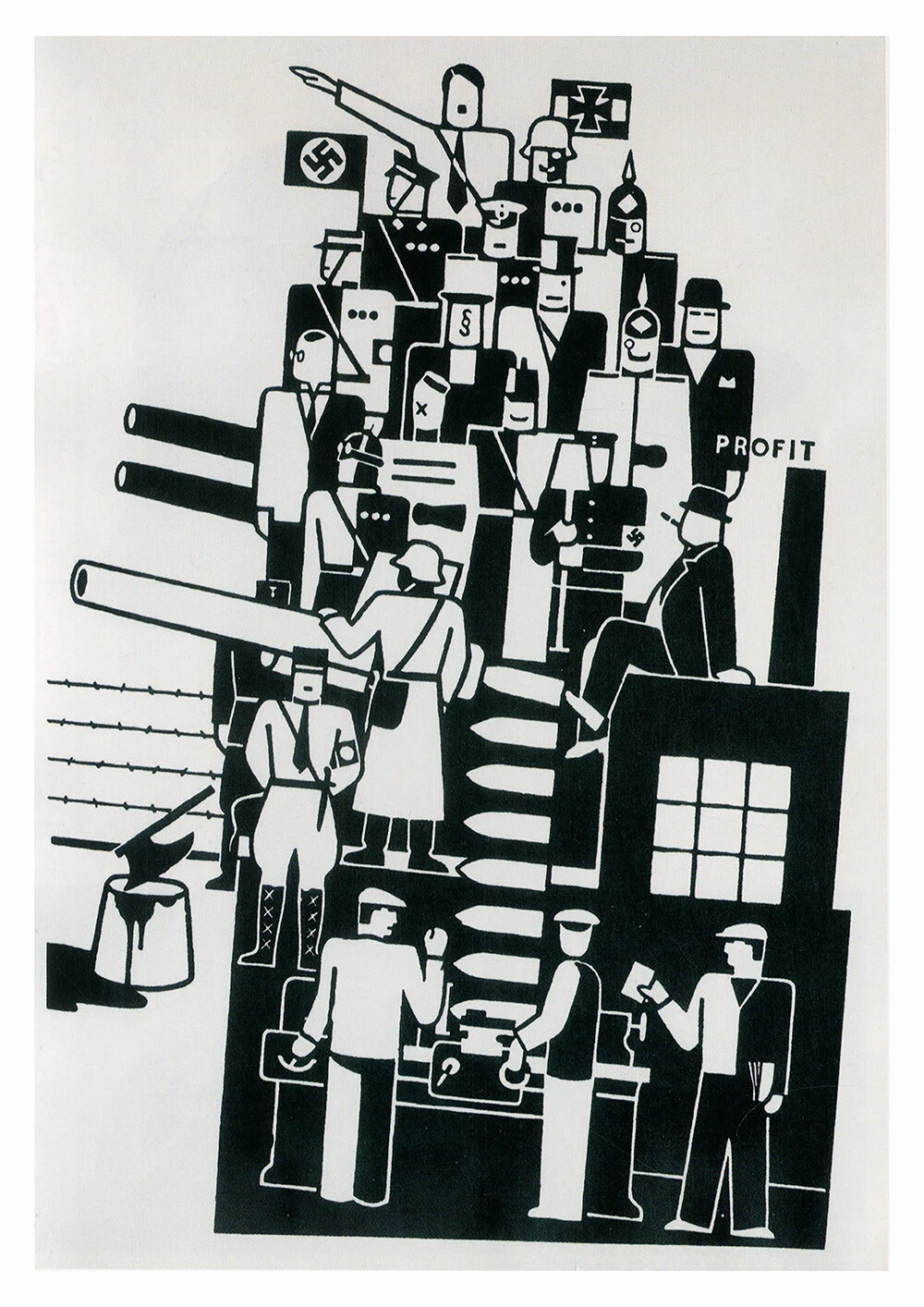
Gerd Arntz - The Third Reich, 1936. Woodcut.
Rotation: term limits within a four-to-eight-year band
The second structural mechanism is rotation. The principle: every political role rotates on a clock calibrated to its power-concentration risk, and a hard ceiling closes the workaround that lets a clever holder accumulate across roles. The specific numbers are calibration, not doctrine; the load-bearing point is that no political role escapes a clock and no clock can be quietly extended.
One workable picture: four-to-eight-year band, calibrated by concentration risk, set by the petition body in consultation with the monitoring commission. Highest-concentration executive roles - head of state, head of government, ministers controlling the largest budgets - at the shorter end (four to five years), where the lifetime-accumulation pattern has historically lived. Legislative roles in the middle (four to six years), staggered so no full chamber rotates at once. Adjudicatory and oversight roles - sortition bodies, the monitoring commission, judicial selection - at the longer end (six to eight years), where institutional memory matters and the rotation pressure is already met by the body's structural composition. Eight years is the absolute ceiling. Nothing exceeds it.
The reason for the band is the failure mode it dams against: career politicians are the mechanism by which power concentrates. A holder who sits for twenty years develops the relationships, debts, and dependencies that make removal through ordinary political process impossible. The network becomes self-sustaining. The network becomes a class. The band is long enough at each tier to develop and implement a programme, short enough that the network cannot form. The experience objection is real and is answered by the next two mechanisms - the career cap closes the cross-role workaround, and the political-functional separation keeps the operational expertise where it lives.
The career cap
Per-role limits without a career cap produce the same failure with extra paperwork. The Soviet pattern was exactly this. The same individuals cycled between Party Secretary, Politburo member, and ministerial roles, building a career-long network across positions while never violating any single role's clock. The framework closes the workaround.
Total political tenure across all roles is capped at the equivalent of two full role-terms, after which the individual returns to non-political life for at least the equivalent duration before any further political role. A person who serves six years as a legislator and six years as a minister returns to civilian life for at least twelve years before any further political office. A person who serves a full eight-year cycle plus another six returns for fourteen.
This is a political-tenure cap, not a public-service cap. The hospital administrator who runs the hospital for twenty years is doing functional work and should continue. The political officeholder who has held political office for twelve years should not. The cap closes the workaround that pure per-role limits leave open: the political class reconstituting itself through cabinet reshuffles, term-extensions disguised as new portfolios, "interim" appointments that become permanent. The workaround is structural. The closure is structural.
The people who make policy are not the people who run things
This is the structural separation that makes the rest work.
In the Soviet Union, the party secretary of a steel plant made production decisions. The party secretary of a region managed both the political direction and the operational reality of that region's economy. Political authority and operational management were fused. The result was bad politics and bad steel. The result was also a direct pipeline from factory floor to Politburo - a person could accumulate political power through an operational role, then leverage that power into higher political roles, building the exact kind of career trajectory that produces a permanent ruling class.
The framework mandates a hard structural separation between two kinds of roles.
Political roles are the people who make policy. They set strategic direction. They legislate. They determine national objectives. They provide oversight. They are elected through multi-party democratic processes, and they are subject to the eight-year term limit. They rotate out. They are not professionals of power. They are citizens who serve, temporarily, in a political capacity.
Functional roles are the people who implement policy. They manage nationalized industries. They administer public services. They run the hospitals, the transport networks, the power grid, the water system. They are selected on the basis of competence, not political affiliation. And they are not subject to term limits. A competent engineer running a nationalized power plant does not need to be replaced every eight years. She needs to run the power plant well. Her expertise is an asset, not a threat. Non-discrimination is an operational competence requirement for every functional role, not a political litmus test. A housing administrator who systematically excludes a population from allocation is operationally failing - measured by output patterns, not beliefs. Systematic exclusion triggers the same review process as any quality failure in any functional domain. The monitoring body detects the pattern; the functional hierarchy corrects it. This is not policing thought. It is measuring performance.
The separation is enforced structurally. A person holding a functional role cannot simultaneously hold political office. A person holding political office cannot directly manage operational systems. The politician sets the direction: we need more housing, we need to transition the energy grid, we need to expand healthcare access. The functional implementor executes: here is how to build the housing, here is the engineering plan for the grid transition, here is the staffing model for the hospitals. The politician has oversight and veto power. The implementor has operational autonomy.
This is what prevents the Soviet trajectory. When the factory manager is also the regional party boss is also the national committee member, you get a person with both operational control and political power - the exact combination that produces a ruling class. When the factory manager is a factory manager and the politician is a politician, neither can accumulate the dual authority that leads to autocracy.
The separation also answers the experience objection to term limits. The political leadership rotates every eight years. The operational expertise does not. The knowledge of how to run a power grid or manage a healthcare system stays in the hands of the people who know how to do it. What rotates is the political authority to decide what the grid or the healthcare system should prioritize. That authority belongs to the people, expressed through their elected representatives, and those representatives belong to the people, not to the office.
Glass walls
The third structural mechanism is transparency enforced by design.
A citizen has privacy. A politician does not. This is the cost of power, and it is non-negotiable.
Every device provided to a person holding political office - every phone, every laptop, every communication channel - is subject to freedom of information request. Not after a scandal. Not after a court order. By default. The records exist. The public can access them. This is the architecture.
An independent monitoring body - structurally separated from the political apparatus it oversees, staffed by functional professionals subject to the same political-functional firewall described below - maintains oversight of all official communications. Its mandate is not censorship or direction; it is ensuring that the person holding temporary power over the collective is not being blackmailed, is not being bribed, is not cutting deals that serve private interests while claiming to serve public ones. The monitoring body carries a second mandate: detecting systematic patterns of identity-based exclusion in state functions. Housing allocation, healthcare access, judicial outcomes, functional hiring - these produce data. When the data shows systematic exclusion of a population, the monitoring body flags it. This is not surveillance of citizens' private attitudes. It is oversight of the state's operational outputs. Consistent with the principle that a citizen has privacy and a politician does not, the body monitors the state's behaviour, not the population's beliefs.
This is not surveillance of citizens. This is accountability of servants. The distinction is absolute. The framework prohibits domestic surveillance of the population as a transgression - a violation so severe that no justification suffices. But the person who holds political power is not in the same position as the person over whom that power is exercised. The citizen did not volunteer for scrutiny. The politician did. The citizen's privacy is a right. The politician's transparency is a duty.
Whether the boundary holds once the apparatus exists is the open question. I do not know.
Dignity is preserved through specific exemptions. Consensual sexual activity within legal bounds - between adults, with mutual consent - is excluded from disclosure. Medical information unrelated to capacity for office is excluded. Personal relationships that do not intersect with the exercise of political authority are excluded. The monitoring body operates under strict mandate: its purpose is the detection of corruption, coercion, and conflicts of interest. It judges the exercise of public power, not the conduct of private lives.
The logic is reciprocal. If the framework demands that the state not surveil its citizens, then the citizens must surveil their state. The politician who objects to transparency is making the same confession as the state that objects to an armed populace - they are telling you what they plan to do when no one is watching.
Law and the containment of state power
If RCE says every coercive apparatus expands against its operator unless structurally contained, then the judicial apparatus is subject to the same law. Judicial power capable of being directed will be directed. A court system that can be captured by a political faction will be captured by a political faction. The accountability architecture is derived from the framework's own principle, not inherited from liberal democracy - the same structural logic that produces the transgression category produces the judicial architecture. Where the protections overlap with what liberal democracy accomplishes, that is evidence the principle generalizes, not that the framework is borrowing.
Judicial selection by sortition body. Judges are selected by a dedicated judicial selection body - one of the disaggregated sortition bodies described below, distinct from the transgression adjudication body, the nationalization threshold body, and the party permission body. The judicial selection body has a sortition majority (preserving the anti-capture property), elected delegate minority (preserving democratic accountability), and functional legal expertise (because judicial selection requires judgment about legal competence). Judges selected through this body cannot be appointed by sitting politicians, cannot be nominated by political parties, and cannot be removed except through a process controlled by a different sortition body. The pipeline from political faction to judicial appointment is broken at every stage.
Case assignment by lottery. Cases are assigned to judges by random docket. No case can be steered to a sympathetic judge. No political actor can arrange for a specific judge to hear a specific case. The randomization is structural, not procedural - it operates through the court administration system, not through a clerk who can be pressured. Forum shopping is eliminated by the same mechanism: if you cannot choose your judge, you cannot choose your venue to get the judge you want.
Prosecutorial separation from executive authority. The prosecution function is structurally independent of the executive branch. Prosecutors do not serve at the pleasure of the head of state. They are appointed through a separate track - functional selection for competence, with oversight by the judicial selection body rather than by political leadership. A president who can fire a prosecutor investigating the president's allies has captured the judicial system. The framework prevents this by making the prosecutor's appointment and removal independent of executive authority.
Federated appeal chains. No single political formation can capture the full judicial stack. Appeals move across jurisdictional lines - a case decided in one region is appealed to a panel drawn from other regions. The appeal chain is federated, not centralized. A political faction that captures the judiciary in one jurisdiction faces reversal from a panel with no institutional loyalty to that faction. The cross-jurisdictional structure is the dam against systematic judicial capture.
Jury trials as democratic mechanism. The framework recognizes jury trials as a core democratic institution, not as an inherited procedural formality. Juries composed of ordinary citizens provide the most direct democratic check on legislative overreach. The framework goes further: jury acquittals - including what liberal systems call nullification - are formally recognized, particularly for soft crimes where law diverges from collective consciousness. When a jury of citizens refuses to convict under a law they regard as unjust, that refusal is itself a democratic signal. These cases are enshrined as precedent and preferred in the soft-crime zone, creating a structural feedback loop between law and the population's sense of justice. The hard-crime / soft-crime distinction maps to the transgression split: technical-structural transgressions (surveillance, identity persecution at the state level) are hard crimes where jury nullification is not appropriate because the harm is structural. Structural-consequentialist transgressions and the broad category of statutory offences are the domain where the jury's democratic judgment operates most powerfully.
Autonomy domains as state-reach limits. The framework identifies specific domains where state reach is structurally limited - not because abstract rights theory says so, but because RCE predicts that state reach into any of these domains expands beyond justified scope. Each domain is protected for the same structural reason the transgression category exists: the boot, once placed, does not lift itself.
Bodily autonomy: the state does not compel what enters or exits the body. The operationalization the framework argues for is full decriminalization of all substances for adults - not marijuana, not cocaine, not heroin, not any substance - paired with a positive obligation to provide pharmaceutical-grade safe supply, harm-reduction infrastructure, and voluntary social support. The criminal-code apparatus is the wrong tool: the forty-year drug war is the case study, where enforcement expanded from trafficking organizations to users to communities to entire racial populations exactly as RCE predicts. Portugal's twenty-year experiment is the positive evidence base - decriminalization paired with health, housing, and social investment produced measurable reductions in deaths, HIV transmission, and incarceration with stable use rates; British Columbia's partial implementation is the negative case where decriminalization without provision produced the disorder critics use to discredit the approach.iii Age restrictions for minors and context-specific restrictions (operation of vehicles, industrial equipment, aviation) mirror the framework's treatment of alcohol - narrow, justified by immediate safety risk rather than moral judgment about the substance. Voluntary case workers are offered at point of access - opt-in, revocable, no record of refusal, harm-reduction oriented rather than abstinence-mandating. The case worker is a resource, not a monitor.
Linguistic autonomy: the state does not compel language use. Communities speak what they speak. The state provides services in the languages its population uses.
Religious autonomy: the state does not interfere with religious practice or religious institutions' internal governance. A church's hiring practices, a mosque's membership criteria, a temple's ritual requirements are the institution's business. The state does not impose requirements on religious institutions' internal operations, for the same reason it does not impose requirements on other voluntary associations - because state reach into institutional autonomy expands beyond justified scope. The framework protects religious communities' autonomy and does not instrumentalize religion for political purposes.
Family autonomy: the state does not regulate family structure, kinship, or household composition. Who you live with, how you organize your household, how you raise your children within the bounds of the children's own rights - the state's role is to provide the material floor (housing, healthcare, education) that supports families, not to define what a family is.
Associational autonomy: the right to organize, to form voluntary associations, to build community institutions outside the state. The state does not require membership in any organization. The state does not prohibit membership in organizations that operate within the transgression boundaries.
Cognitive autonomy: protection against manipulation of cognition and attention by both state and capital. This is the framework's extension beyond liberal rights theory. Liberal democracy protects against state censorship. The framework protects against the algorithmic manipulation of attention that platform capitalism has industrialized. A citizen whose cognition is being shaped by an engagement-maximizing algorithm is not free in any meaningful sense, regardless of whether the shaping is done by a state or a corporation.
Informational autonomy: protection against surveillance by both public and private actors. The framework's position on domestic surveillance as a technical-structural transgression applies equally to state surveillance and to the corporate surveillance apparatus that platform capitalism has built. A private company that tracks your movements, reads your messages, and builds a behavioural profile for sale to advertisers is conducting surveillance. The legal form (terms of service rather than warrant) does not change the material reality.
Double containment - state and capital as equal threats. This is the framework's specific advance beyond liberal democracy. Liberal democracy architected against state capture of the judiciary. It left capital capture operative. The result is visible in every liberal democracy: judicial appointments are influenced by donors, judicial campaigns are funded by corporate interests, judicial doctrine increasingly serves capital's interests. The framework is architected against both. Safeguards that address only state capture leave capital capture operative, and the judiciary becomes an instrument of private power rather than public accountability. The sortition-based selection, the random docketing, the prosecutorial independence, and the federated appeal chains all operate against both state and capital capture simultaneously.
The petition body and democratic input
The accountability architecture creates containment. The petition body creates the democratic input channel - the mechanism through which citizens surface needs, propose changes, and hold the state accountable for gaps between commitment and delivery.
The petition body is the fifth sortition body, distinct from the four adjudicative bodies (transgression, nationalization threshold, party permission, judicial selection). Its function is advisory and aggregative, not adjudicative: it does not decide what crosses into the transgression category or when enterprises cross systemic criticality. It surfaces citizen demand and translates it into policy-shaped requirements that elected policy makers must address.
The flow. Citizens submit petitions - individually, collectively, through organizations, through chapters. The petition body aggregates related petitions, evaluates their substance, and translates citizen need into a policy requirement. The requirement goes to the elected policy makers. The policy makers debate, shape implementation, and respond with published reasoning. The functional apparatus implements. The electorate judges the response at the next election.
The body's authority is to surface and articulate, not to compel. Policy makers must respond to the petition body's requirements - they cannot simply ignore them. But the response can be "no, and here is why," published and subject to electoral judgment. The petition body does not override democratic process. It feeds democratic process with structured citizen input.
Scope-weighted petitions. Narrow-scope petitions: low signature thresholds, quick review, rapid disposition (a neighbourhood requesting a transit route change, a workplace requesting wage-band review). Broad-scope petitions: substantial signature thresholds, full deliberation, extended review for petitions that propose major state-scope expansion (nationalization of an industry, absorption of a charitable function into state provision, wage-structure changes affecting whole sectors). The escalation criteria are explicit: scope of proposed change, fiscal implication, precedent-setting effect.
What it handles. Compensation-adjustment petitions from the economic architecture - workers petitioning for wage-band changes, communities petitioning for cost-of-living adjustments. Charity-to-state-absorption petitions - when a charitable function is diagnostic of state failure (healthcare gap, housing gap, food security gap), citizens can petition for the state to absorb the function. Democratic input on any policy domain that the adjudicative bodies do not cover.
Capture-risk safeguards. The petition body faces distinct risks: astroturfing, corporate-funded petition campaigns, demographic-unrepresentative signature bases. Safeguards: representativeness standards on signatures (geographic and demographic breadth), transparency about funding sources for petition campaigns, published deliberation, and cross-body appeal to a relevant adjudicative body when a petition concerns that body's domain.
The disaggregated sortition architecture
The main text references sortition bodies in the party-permission context. The full architecture requires five distinct bodies, each with specialized function, distinct selection procedures, and independent accountability.
Transgression adjudication body. Decides what crosses into the transgression category. Highest stakes - a transgression determination affects the entire framework's scope. Longest deliberation periods. Strictest transparency requirements. Sortition majority, with functional expertise in constitutional law and the framework's theoretical foundations.
Nationalization threshold body. Decides when specific enterprises cross into systemic criticality. Technical-economic focus. Benefits from functional expertise in economics, industrial organization, and the specific sectors under assessment. Sortition majority provides the anti-capture property; expert members provide the technical competence that systemic-criticality assessment requires.
Party permission body. Decides which parties meet the programmatic test for electoral competition. Direct implications for political participation - this body can exclude parties from the electoral process, which is the power most susceptible to abuse. Strongest procedural safeguards: mandatory expert consultation, public hearings, specified deliberation periods, explicit dissent publication, appeal to a separate body. No current or recent party member serves. Rotation within the body is frequent. The monitoring ecosystem tracks the body's decisions against subsequent outcomes - was the excluded party actually proposing privatization, or was the exclusion politically motivated? The track record is published.
Judicial selection body. Selects judges, prosecutorial leads, and appeal-chain members. Strict transparency; rotation; cross-stack review (the body that selects judges in one jurisdiction is reviewed by the body in another). The functional expertise component includes practising lawyers and legal scholars who can assess judicial competence. The sortition majority prevents the legal profession from capturing the selection process.
Petition body. Described above. Advisory function. Aggregates citizen input. Translates need into policy requirement. Does not adjudicate.
Each body operates independently. No body is final authority on its own decisions - appeal mechanisms cross between bodies. Dissent within each body is published. Rotation within each body prevents internal ossification. The monitoring ecosystem tracks each body's decisions against outcomes, and the track record is published. Transparency about success and failure rates is itself an anti-ossification mechanism: a body whose decisions are consistently overturned or whose assessments are consistently wrong faces legitimacy erosion that the democratic process can act on.
The Monitoring Commission
The disaggregated sortition bodies adjudicate. They do not measure. The measuring function - documenting systematic identity-based exclusion in state functions, tracking the political class's transparency obligations, watching private accumulation against the threshold at which it converts into political power, monitoring extraction rates against carrying capacity - is concentrated in the Monitoring Commission. The Commission generates the evidence that the adjudicative bodies act on. Its findings are not verdicts. Its findings are the public record against which adjudication operates.
This is the institution the framework's own principle most clearly identifies as exposed to capture. The body that watches the state can become the body that protects the state. The body that documents accumulation can be bought by the accumulators. The body that measures ecological harm can be captured by the extractors whose harm it measures. Every prior monitoring institution has trended this direction once it was built. The framework names the exposure directly in the self-critique chapter, and the architecture below is the structural answer to it.
Independent funding. The Commission's budget is constitutionally fixed as access to a percentage of the national dividend, disbursed directly by the Treasury under a formula the legislature cannot alter without a super-majority national referendum. No political body can defund the Commission, delay its operations, or condition its funding on its findings. The legislature that wants to cut the Commission's budget has to convince a super-majority of the population that the watchdog should be defunded, and the population is the constituency the watchdog exists to serve. The mechanism that closed every prior oversight institution - the slow defunding, the line-item retaliation against an awkward investigation - cannot operate against a budget that the legislature cannot quietly touch.
Automatically executing consequences. When the Commission confirms a systemic violation - documented identity-based exclusion in housing allocation, sustained transparency failure by a sitting officeholder, accumulation that has crossed the conversion threshold, extraction that has exceeded carrying capacity - a pre-specified constitutional penalty triggers without political intermediation. The offending institution's discretionary budget pauses. The responsible functional head is suspended pending review. The penalty is applied by a separate constitutional enforcement body, whose only mandate is the execution of penalties the Commission has confirmed. The enforcement body executes; the investigation is the Commission's; the execution is the enforcement body's. The two functions sit in different institutions because combining them produces the discretion that gets bought.
Periodic involuntary dissolution. The Commission and the bodies that audit it dissolve and reconstitute on a fixed clock: a workable picture is twelve years for the Commission with a six-year offset for the audit body, set within the federation by published rule and adjustable by super-majority referendum. The principle is the load-bearing point: dissolution is on the calendar rather than at the discretion of the institution being dissolved, and the watcher and the watched-watcher are never of the same vintage. No commissioner or senior staff member may be reappointed to the same body. The dam against incestuous culture, against the long relationships between the watchers and the watched, against the slow drift toward the institutional self-interest the framework's own principle predicts, is the calendar.
Adversarial oversight. The watchdog itself is watched. A second sortition body, the commission audit body, has no other mandate than to investigate the Monitoring Commission for capture, bias, or procedural failure. It operates under the same independent funding and automatic-consequence architecture as the Commission. It can publicly censure the Commission and, in cases of demonstrated capture, trigger early dissolution and reconstitution ahead of the calendar. Its dissolution clock offsets from the Commission's so the two are never reconstituted together; if the Commission is dissolved early, the audit body's clock resets to within three years of the early reconstitution. The principle is that there is always a body watching the watchers, and capture of one would have to be paired with capture of the other to defeat the architecture - which raises the cost of capture above the cost of compliance.
The upward monitoring layer. The Commission's measurement function is supported by a named sub-component developed in the digital sovereignty chapter: the upward monitoring layer. The layer inverts existing know-your-customer and anti-money-laundering infrastructure - the same technical instrument, pointed upward - and surfaces the structural failure modes the framework names with precision: asset accumulation by transitional and mature-state administrators, financial relationships between public procurement and private entities with administrative connections, salary and compensation flows that signal the emergence of a privileged tier within the state apparatus, and corporate financial behaviour relative to the nationalization threshold. Detection of a sustained pattern initiates a progressive compliance procedure terminating, if cure does not occur, in an automated structural payment freeze that the Commission cannot reverse - reversal requires the cryptographic coalition described in the digital sovereignty chapter. This is the structural property that makes Monitoring Commission capture insufficient to defeat enforcement: a Commission that has been defunded, staffed sympathetically, or worn down still cannot reverse a layer-triggered freeze, because the keys are held by bodies the Commission does not control. The layer's directionality is architectural, not legal - the data it processes is financial-flow and structural-indicator data, not personal communications data.
The architecture is real and it is not sufficient. The Monitoring Commission is one of the institutions the framework most depends on and one of the institutions whose long-run drift the framework's own principle predicts. The structural answers above raise the cost of capture; they do not eliminate it. The closing diagnosis sits in the self-critique chapter where it belongs.
Federation tribunals: dispute, audit, schism
The bridge chapter sets out the charter that constitutes federation membership. The architecture below is the structural response to the question that chapter does not resolve: how is sustained charter violation adjudicated, by whom, and under what protections against the adjudicative body itself becoming the new orthodoxy machine?
Defined sustained-violation process. Sustained charter violation has a defined meaning. Three documented, separately adjudicated instances of the same charter violation by the same chapter, occurring over a two-year window. Single incidents go through the staged dispute resolution worked out below. Pattern of three within two years is the threshold that triggers federation forfeit. The threshold is published in advance and constitutional within the federation. A chapter knows the line before it walks across it.
Adjudication is by ad-hoc panel. Each instance is heard by a panel of three randomly selected chapters drawn from different regions and different domains than the chapter under review. The panel hears the evidence, publishes its finding, and dissolves. There is no permanent tribunal that accumulates interpretive power over what the charter means. The interpretive authority sits, federated, with the chapters themselves, refreshed on each adjudication, with the institutional memory carried by published findings rather than by a standing body that develops its own jurisprudence.
The panel's finding is appealable, and the appeal goes to a second ad-hoc panel of three different chapters drawn the same way, with no overlap to the original panel. The appeal's finding is final. There is no third level. Two independent randomly drawn panels agreeing on a finding is the structural ceiling on adjudication, because anything beyond that begins to reproduce the centralized tribunal the form is built to avoid.
Mandatory annual cross-audit. A fraction of all chapters - the framework targets ten percent, set within the federation by published rule - is randomly paired each year with a chapter from a different region and a different domain to audit each other's charter compliance. Findings are published to the whole network. The cross-audit is an information mechanism, not a punishment mechanism. A chapter knows that in any given year it may be paired with a peer it has never coordinated with, that the peer will read its records, observe its practice, and publish what it finds. The pairing is reciprocal: the auditor is also being audited that year, by someone else, somewhere else. The mechanism is small in any given year, distributed across the network over time, and structurally incompatible with the formation of a permanent inspection apparatus.
The cross-audit's checklist runs the standing audit, the federation's continuous self-examination across charter, class interface, and cadre health. Five named indicators sit on the checklist alongside charter compliance. Each publishes its findings. The federation's resource flow responds to what is published. There is no tribunal, no sanction, no purge. The audit itself is the corrective.
The standing audit
The first is representation fidelity. Each chapter maintains a public, auditable record of the specific, named, material benefits it has delivered to non-members in its stated geographic or sectoral base. The cross-audit reviews the record and interviews a random sample of beneficiaries, consenting and anonymized, about their experience. A chapter whose external benefit record is thin or self-reported without verification is flagged. The flag triggers resource redirection toward chapters that demonstrably serve the broader class. The corrective pressure is internal.
The second is demographic integrity. The cross-audit examines whether the chapter's composition reflects the working class around it. A chapter network in a majority-immigrant neighbourhood that is composed entirely of native-born activists is a blocked interface, and the blockage is a material fact, not a moral accusation. The audit surfaces the blockage and the chapter is required to produce a published remediation plan. The plan typically routes through the participation subsidies named in the bridge chapter's class interface and through language and access work - translated materials, accessible meeting times, childcare at meetings - that lower the entry rung.
The third is cultural output. How many public-facing educational events, skill-shares, and accessible publications did the chapter produce, and how many non-members attended? A chapter that is materially effective but culturally silent is a chapter that will not reproduce itself across generations. Pedagogical rotation sits inside this indicator: every member who reaches a defined seniority spends a defined period training new members or producing accessible educational materials, and this work is audited and credited as material action. The cross-audit tracks whether the rotation is happening or whether the seniors are sitting on their seniority without transmitting what they know. A chapter whose senior members do not rotate through pedagogical work is a chapter whose institutional knowledge will not survive the first wave of departures.
The fourth is burnout indicators. Departure rate, reasons for departure where the departing member chooses to share them, sabbatical requests, length of sabbatical, return rate. A chapter with a high burnout rate is flagged for cultural review. The review is not an inquisition. It examines whether the chapter's tempo, role distribution, and participation infrastructure are sustainable, and prescribes adjustment.
The fifth is service-state risk. Has the chapter become the de facto government of its neighbourhood - providing all services, brokering all disputes, substituting for the assembly rather than feeding it? A chapter that has crossed this line has crossed from dual power to replacement state, and the standing audit redirects resource flow toward fostering autonomous mass organization rather than substituting for it. The audit flag is the catch. It does not undo the substitution that has already happened.
Right of schism. Any chapter or group of chapters may separate from the existing federation and form a new federation with its own interpretation of the charter. The seceding chapters lose all solidarity commitments and resource-sharing arrangements with the original federation. The original federation loses its claim on the seceding chapters. Both federations continue to exist. Neither has standing to compel the other's compliance or dissolution. The mechanism is structural rather than punitive: it prevents any single federation from accumulating a monopoly on charter interpretation, because the alternative to losing an interpretive argument is always available, and the cost of taking the alternative is real but bounded - the loss of the solidarity arrangements the seceding chapters were already drawing on.
The right of schism is the dam against the failure mode the federation form is most exposed to: the slow conversion of the federation's adjudicative practice into orthodoxy, the formation of an inner circle whose interpretation of the charter is binding, the soft drift toward the centralized command structure the form was built to prevent. The schism mechanism does not prevent the drift; it makes the drift survivable, because the chapters that disagree with where the drift is heading have a structural exit that is not exile.
Federation-level joint infrastructure. The federation holds infrastructure that is federation-level by constitutional construction rather than by aggregation of chapter-level holdings. The upward monitoring layer's keys, the cross-audit machinery, the petition body's federated reach into the chapter network, the discourse coordination layer, the standing audit's own apparatus, and the resource-sharing flow that carries the safeguard floor across chapters whose own productive base cannot sustain it - each of these is a property of the federation. A chapter that schisms leaves them behind in the same sense that an emigrant leaves the post office behind. The construction raises the cost of exit by specifying, in advance, that the assets a seceding chapter would otherwise claim a share of are held federation-level. Principled exit remains available; casual exit becomes expensive. The federation's holdings remain the federation's holdings.
A disputes body for the terms of separation. When schism occurs, the question of how the federation's holdings are divided - the books, the records, the physical infrastructure the federation has accumulated, the running obligations to peripheral chapters whose safeguard-floor support flows through the federation - is a real question that the schism right does not, by itself, resolve. The framework's response is a sortition body convened on declaration of separation, drawn from the whole federation including chapters not party to the schism. Its mandate is bounded: adjudicate the division of jointly held assets and the disposition of joint obligations when a separation occurs. The body's authority ends at the terms of separation; the substance of the dispute that produced the schism remains the chapters' own, and the body's standing dissolves once the separation is recorded. Convocation is on demand and dissolution is on completion, on the same architectural pattern the adjudication panels above run on. The disputes body raises the standing cost of schism above zero - the federation's joint commitments are settled, on the record, before separation is final - within bounds that preserve the schism right itself.
The constitutional resource-sharing flow. The framework's commitment to the safeguard floor is uniform across the federation rather than chapter-by-chapter. A chapter whose own productive base cannot sustain the floor receives the difference from a federation-level resource-sharing flow, administered under the political-functional firewall and triggered against the safeguard-floor indicators the economic-architecture chapter develops. The flow's existence is constitutional and the enforcement architecture registers any attempt to defund it as an open constitutional violation. The flow is federation-level by definition, so a chapter that schisms also exits the flow. The flow's calibration moves through deliberation; the commitment itself is fixed.
The honest acknowledgment. The architecture above raises the cost of schism without eliminating fragmentation as a permanent risk. A federation whose every dispute can become a schism is a federation that loses scale; the joint-infrastructure construction and the disputes body raise the price of casual exit and preserve principled exit. The framework accepts the residual cost. A federation that cannot fragment is a federation that has produced the central authority that defines membership, and that authority will, under the framework's own principle, expand against its operator. The fragmentation cost is the price of the form, bounded but not eliminated.
The landed-knight failure mode. The dispute and audit architecture above is calibrated against drift in the federation's centre. The opposite failure mode - drift in a single chapter or region under a charismatic, unaccountable figure who quietly converts the chapter's resources into a personal apparatus - is one of the most common fates of left organizations and one of the least often architecturally addressed. Call it the landed-knight pattern, after the medieval strongman who accumulates retainers, controls the surrounding population's material conditions, and presents the federation with a chapter that nominally remains within the charter while operating, in practice, as the figure's instrument. The structural response is the lone-dissent protocol applied inward: the surrounding chapters publish their assessment and the supporting evidence (resource flows, decision records, rotation compliance, the figure's accumulation pattern), the audited chapter's transparency obligations escalate to cross-audit levels, and an ad-hoc review panel convenes under the federation tribunal architecture above. A chapter operating within the charter has nothing to lose by accepting the elevated transparency window. A chapter that has been quietly converted has lost the cover the silence provided. If the audited chapter refuses, the schism mechanism runs in the unfamiliar direction: the surrounding chapters schism away from the captured one, which retains its name, its building, and its figure but loses solidarity arrangements, resource-sharing access, and the federation's recognition. The cultural posture the architecture requires is a near-superstitious suspicion of the brilliant silent operator who delivers results without documenting process, calibrated harder than the suspicion of the loud incompetent operator who fails in public.
Sunset on the federation's own infrastructure
The framework's near-universal claim is that institutions persist, retain expertise, develop budget inertia, and expand into available space unless structurally contained. The federation's permanent infrastructure is subject to its own diagnostic. The cross-audit machinery, the discourse coordination layer, the disruption-calibration body, the standing audit itself - each is an institution. Each meets the activation conditions for capture. Each, left alone, will accumulate the expertise that becomes entrenched authority and the budget that becomes a constituency.
The sunset logic the transition chapter applies to transitional governance applies here. Every federated body is dissolved and reconstituted, or abandoned, on a fixed cycle - six years is the working default, with the staggered offsets the Monitoring Commission and its audit body use to prevent simultaneous capture. Dissolution is the default. Continuation requires an affirmative vote of the federated chapters with published justification: what the body did, what it failed to do, what is still needed that no other body can provide. The vote is held under the same transparency obligations the federation tribunals run on. A body whose continuation case cannot be made in public has already given the answer.
The auditors are not exempt from being audited out of existence. The standing audit's own machinery dissolves on the same cycle as the bodies it audits, offset so the audit is never reconstituted alongside what it audits. The infrastructure trust has a dissolution mechanism for the same reason every other body in this chapter does. If the framework's diagnostic is true, it is true here. The architecture does not exempt its own enforcement layer.
The residual is real and is named in the self-critique chapter: the dissolution mechanism is itself an institution, and the vote that decides whether to continue a body is held by people who have spent six years inside the existing federation culture and may not be able to imagine the work continuing without the bodies they have grown around. Sunset is the strongest dam available against soft permanence. It is partial. The chapter does not pretend otherwise.
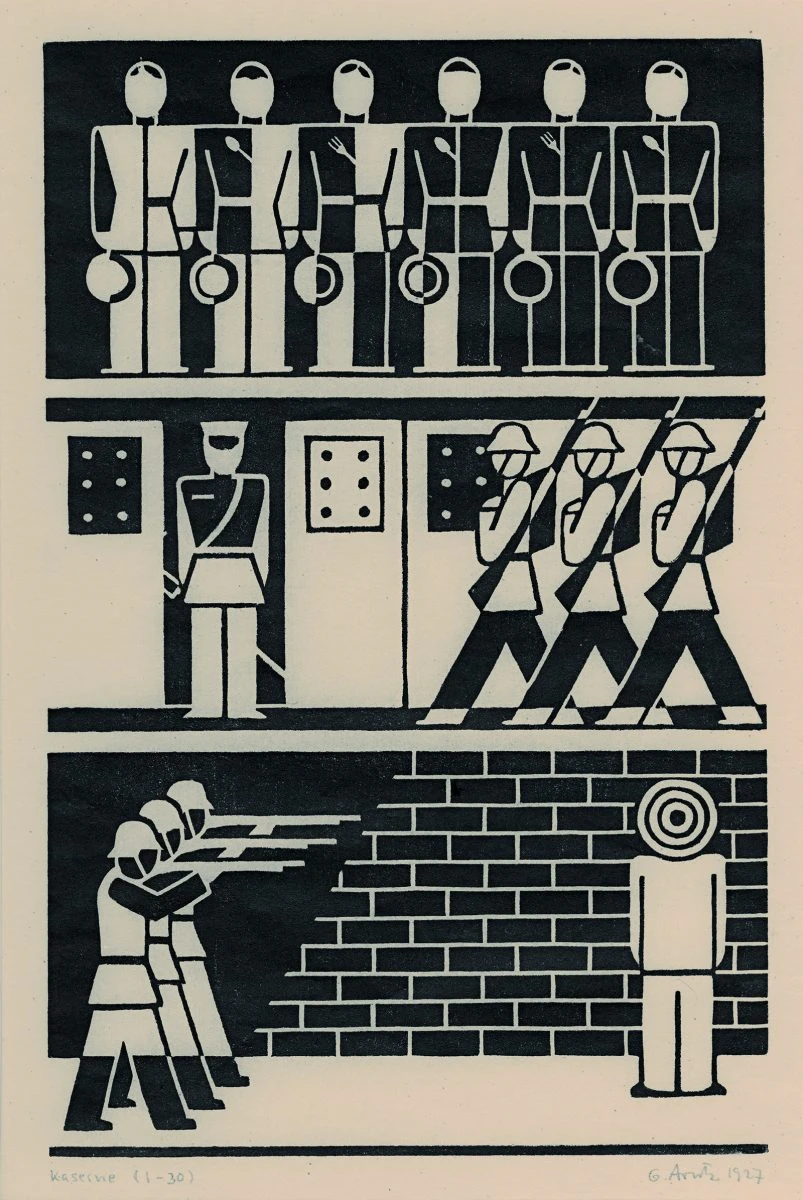
Gerd Arntz - Kaserne (Barracks), 1927. Woodcut, from Twelve Houses of Our Time.
Practice and outward teaching
The federation runs two functions that occupy the same chapters and rotate between them on a fixed cycle. The practice function is the chapter's day-to-day work: the cooperative campaigns, the workplace organising, the mutual-aid administration, the audit pairings, the federation-tribunal rotations, the technical-substrate maintenance the rest of this chapter has specified. The outward-teaching function is the chapter's work as an outreach node: civic education in the community around it, integration support for newcomers to the federation, the open-house presence that keeps the federation's practice legible to the population it operates among.
Each chapter does both, on a rotation the federation publishes. A chapter at the practice pole of the rotation runs campaigns and feeds the audit pairs. A chapter at the outward-teaching pole runs the civic-education programme the action chapter specifies and absorbs the surrounding population into chapter practice on the federation's published terms. The cycle runs at a working default of one year in three at the outward-teaching pole, with overlap windows the federation tunes against its capacity, and chapters can request adjustment through the petition body on documented grounds. The structural commitment is that the rotation runs, that the register shows where each chapter sits in its cycle, and that the outward-teaching pole is occupied on rotation rather than by a permanent assignment. A chapter that holds the outward-teaching role across multiple cycles is the institutional substrate for the canon-keeping body the framework's diagnostic predicts will calcify under exactly those conditions, and the rotation cycle exists to prevent that substrate from forming.
Per-node audit travels with the rotation. A chapter at the outward-teaching pole is audited by chapters at the practice pole, and the audit reads the outward-teaching content for divergence from the federation's published practice: the soft canonisation of an interpretation that has not yet been adjudicated, the consolidation of a teaching style that operates as a credential gate, the drift toward a pedagogical authority that runs ahead of the practice it claims to teach. The findings are public and route through the standing audit's machinery on the same terms as every other federation-level audit. The architecture's commitment is that outward teaching draws from current practice and is read against current practice, on a cycle short enough that the divergence the diagnostic predicts is caught before it sets.
The state must arm the people against itself
Here is the mechanism that gives all of the above its teeth.
Every structural design described so far - multi-party competition, term limits, office transparency, and the political-functional separation - can be undone by a state that decides to ignore its own rules. Constitutions can be suspended. Term limits can be extended. Parties can be banned. Laws can be changed to prevent disclosure. The Soviet Union had a constitution too. It guaranteed freedom of speech, freedom of assembly, and freedom of the press. None of that mattered, because the people had no material capacity to enforce it.
So the question this framework treats as structural, rather than as a tactical instruction to any individual reader, is: what is the minimum floor of collective capacity a population must retain for its state to remain accountable to it? Every state that has failed the test above - Chile, the degenerated Soviet state, the captured social democracies - failed in part because the population had no material capacity to correct the failure once the state had crossed the line. Elections were insufficient or unavailable. Parliament was captured or dissolved. The general strike was broken. What a population retains, in the form of organization, infrastructure, solidarity, and, under conditions where state violence has already crossed specific thresholds, the organized means to defend communities against that violence, is the structural answer.
This framework's answer leans toward a distributed, organized, materially-capable civil society - the federated chapters, the mutual-aid networks, the communication infrastructure, and, under the conditions named above, the militia. This is a spectrum, not a switch. Under functional democratic conditions, which is where most readers of this book live, the floor is organization, infrastructure, and solidarity. Under conditions of active state violence against organized communities, the floor rises. Under conditions of imperial intervention or coup, it rises again. This framework does not instruct the reader to arm themselves. It asks the reader's chapter to know what it would do if conditions changed, and to have the analysis and the discipline to recognize when they have.
This is not a metaphor. The population must, as a structural rather than a rhetorical matter, maintain collective readiness: the organised, trained, equipped capacity to dismantle the state by force if the state degenerates. This is the militia in the framework's specific sense - not a symbol, not a cultural tradition, but a functioning immune system, with the operational properties of one.
A healthy socialist state has nothing to fear from an armed, organized populace. If the government is serving the people, the militia is just a bunch of citizens who train on weekends. If the government begins to rot - if term limits are being extended, if parties are being banned, if the political-functional separation is being eroded, if power is concentrating - then the militia is the cure. Not the only cure, not the first cure, but the last cure. The cure that cannot be legislated away.
The American founders understood part of this: the Second Amendment enshrines the right to bear arms as a check on state tyranny. But the framework goes further in a way that matters.
The people have the right to overthrow tyranny, they also have the duty.
The distinction is not semantic. A right can be waived, a duty cannot. A right means the state permits you to resist, while a duty means the state requires you to resist - and if you do not, if you stand by while the state degenerates, if you passively accept the concentration of power that the architecture was designed to prevent, you are complicit.
And complicity has a specific form. The politician who works to disarm the population - who restricts militia access, who dismantles collective defence capacity, who erodes the people's ability to exercise their duty - is committing a crime against the collective. Not theoretical, but a legitimate, structural crime. They are removing the immune system from the body. There is only one reason to do that, and the reason tells you everything about what they plan to do next.
This is not to say we should not require training and safety handling, on the contrary, the socialist state must facilitate regular, community-centred activities to ensure a well-disciplined population that respects the arms it is given. Likewise, there must be social controls in place to prevent the individual will to perform mass casualty events. However, one cannot risk the collective safety due to fear and misunderstanding of the tools that can protect it, on the contrary, one must strive for proficiency.
Four structural differences separate the framework's militia from the American Second Amendment model. First, the militia is organized and collective, not atomized and individual. A person with a rifle is a person with a rifle. A trained, coordinated chapter embedded in a federated network with shared communication infrastructure and rehearsed activation protocols is a structural check on state power. The Second Amendment produces the first. The framework produces the second. Second, the militia is embedded in the full anti-ossification architecture described in this piece - multi-party competition, term limits, transparency, political-functional separation. It does not exist in a constitutional vacuum where armed citizens coexist with unchecked economic power. The American experience demonstrates what happens when an armed populace lacks the institutional architecture to direct its capacity: the arms protect individual property, not collective freedom. Third, the framework treats collective defence as a duty, not merely a right. A right permits, a duty obligates. The armed populace is a structural component of the state's immune system, not a lifestyle choice or a cultural tradition, maintained because the alternative - an unarmed populace facing a state that has begun to degenerate - has been tested repeatedly and has failed every time.
Fourth, a constraint follows from the transgression classification of identity persecution. Militia chapters cannot exclude on identity grounds. You cannot be disciplined for who you are - this is not a description of the culture the framework hopes to produce, but a structural constraint on participation. A chapter that excludes members on the basis of orientation, ethnicity, gender, or origin has exited the framework. The reverse kill switch applies: the network stands against the exclusionary chapter, not in solidarity with it. An armed collective that reproduces identity hierarchies is not a check on state power. It is a rehearsal for the kind of state the framework exists to prevent.
Weapons scope. The militia's arms are defensive and anti-institutional: small arms, communications equipment, basic tactical capability. Not armour, not artillery, not air power, not the heavy weapons that enable offensive operations against peer military forces. The Swiss model is instructive: citizens keep service rifles and ammunition at home. The YPG model is instructive for what community defence looks like in active conflict. Neither equips militia members with the weapons that would enable offensive military campaigns against civilian populations. The militia must be strong enough to make governance after a coup impossible and weak enough that no militia chapter can project offensive power against neighbouring communities. The asymmetry is intentional - the militia does not need to defeat the professional military. It needs to make repression more expensive than compliance with constitutional order.
The settler-colonial case. The armed populace proposal must be tested against the hardest case: a settler-colonial context where the armed majority is the settler population and the minority is the Indigenous population. In this scenario, arming the populace is arming the settlers. The framework's answer is to acknowledge that the armed populace is a conditional proposal, not to pretend the problem away - conditional on the transgression architecture being operative. In a state where identity persecution is structurally classified as transgression, where the monitoring ecosystem tracks systematic exclusion, where militia chapters that exclude on identity grounds are subject to the reverse kill switch, the armed populace operates within those containments. In a state where those containments do not exist, arming the populace is arming the oppressor. The proposal does not stand alone. It stands within the full architecture or it does not stand.
The wealth-inequality positive case. Beyond autocracy, the armed populace is also a check against economic capture. Every society where wealth inequality reached grotesque levels did so under conditions where the wealthy could not be materially challenged. The Soviet nomenklatura accumulated privilege because the population had no material capacity to resist the accumulation. Chinese princelings operate behind party protection that an unarmed population cannot contest. Cuban leadership's hereditary transfer proceeded because no structural mechanism existed to prevent it. The Nordic social democracies - the nearest approximation to sustained equality - maintained their relative equality during periods of high unionization and strong social cohesion, which functioned as soft material checks on elite accumulation. The armed populace is the hard version of the same logic: a population with material capacity to resist elite capture is a population whose elites must negotiate rather than dictate.
Containment is weaker here. The framework is honest about this: the armed populace is the mechanism where containment is weakest. The other anti-ossification mechanisms - term limits, political-functional separation, transparency, multi-party competition - are architectural. They operate through structure, automatically, without requiring collective decision. The armed populace requires collective judgment: when has the state degenerated far enough to justify activation? That judgment is procedural, not architectural. It depends on people making the right call under conditions of uncertainty. The framework surrounds this weakness with structural supports - the monitoring ecosystem, the bright-line triggers, the consultation-scope framework, the legitimacy costs of unjustified activation - but it cannot eliminate the judgment problem. The armed populace is necessary because all the architectural mechanisms can be dismantled by a state willing to dismantle them. The armed populace is the mechanism that cannot be dismantled without the population's consent. That it requires judgment rather than automaticity is its weakness. That it exists at all is its strength.
Dissent is not a problem to solve
There is a temptation in every revolutionary state, and it is this: the revolution has the right analysis. The revolution knows what the people need. Dissent is therefore either ignorance or sabotage, and in either case it should be corrected or suppressed.
This logic has destroyed every socialist experiment that adopted it. The suppression of dissent is not a defence of the revolution. It is the beginning of the revolution's end. Under RCE, the tool always turns inward. The apparatus built to suppress counter-revolutionaries will be used to suppress critics. The apparatus built to suppress critics will be used to suppress rivals. The apparatus built to suppress rivals will be used to suppress anyone who notices that the party has become the thing it overthrew.
The framework's position is absolute. Dissidents are permitted, protected, and necessary.
There is no merit to a system that cannot hold against objections. A socialist state that jails its critics is a socialist state that does not believe its own analysis. If the analysis is correct, it can defend itself in open debate. If it cannot defend itself in open debate, it is not correct, and the dissident who exposed that fact performed a service. Non-coercion is the standard. The state wins its legitimacy through performance - housing people, feeding people, educating people, defending sovereignty. Not through enforcement.
This connects to the multi-party requirement. If a citizen objects to the governing party's approach to economic planning, they can organize a competing socialist party, recruit supporters, and contest the next election. If a citizen objects to the framework of national service, they can publish their objection, organize politically against it, and campaign for its modification. The system provides channels for dissent because dissent is the system's diagnostic tool. The dissident is the canary in the coal mine. Silence the canary and you lose the warning.
National service
The final structural mechanism is collective participation.
Sovereignty requires defence. Public institutions require staffing. Infrastructure requires maintenance. These are collective responsibilities, and the framework acknowledges them as such. National service - mandated participation in the apparatus of the state - is a legitimate expression of collective duty.
This 'conscription' model exists for sovereignty defence, not imperial deployment. The socialist state has no imperial military to staff: it does not invade and it does not project power overseas. The purpose of military service is sovereignty defence - ensuring that the state can defend itself against the imperial powers that will attempt to destroy it, because every socialist experiment that could not defend itself was destroyed.
But the framework imposes hard constraints.
Conscientious objection is fully permitted. No individual is compelled to serve against their conscience. Refuse, and the state accommodates the refusal. There is no punishment. Not a fine, not imprisonment, not revocation of rights, not a mark on any record. The state does not punish refusal because coercion is incompatible with the framework's commitment to individual rights.
This raises the obvious question: if there is no punishment for refusing, what happens when people refuse?
The answer is that accountability is social, not legal. The community may regard refusal to contribute to collective defence as socially unacceptable - in the same way a community regards someone who refuses to help during a flood, or who takes but never gives. But the state does not enforce social disapproval. It does not translate it into legal consequence. The community's judgment is the community's business. The state's business is to not coerce.
And if the system cannot inspire enough people to serve voluntarily - if the refusal rate is high enough that sovereignty defence is compromised - then the system has failed. The objector has not failed. The system has failed to make a compelling case for collective participation. That is a diagnostic, not a crisis. Fix the system. Do not compel the people.
The reciprocal logic ties this together. The duty to serve and the duty to overthrow are two expressions of the same relationship between the individual and the collective. You serve the state because the state serves you. You overthrow the state if the state stops serving you. National service is the mechanism for the first. The armed militia is the mechanism for the second. Both are voluntary in the deepest sense - they depend on the state earning the participation it requires. A state that must force people to defend it is a state that has already lost their loyalty. Forcing them will not get it back.
What this does not solve
The architecture above is the densest dam-building in the book. It is also the least guaranteed.
The transition window cannot be guaranteed safe. Every revolutionary state that built mechanisms to prevent its own degeneration did so under pressure - civil war, embargo, invasion threat, economic collapse. The pressure produces centralization, the centralization is presented as temporary, and the framework's structural sunset clauses are the best dam I know how to build. They are not a guarantee. A power-holder willing to ignore the calendar can still ignore it. The default of dissolution shifts the burden, but the burden is shiftable only if the architecture has population behind it. Population behind the architecture depends on the organizing stage having done its work, and the organizing stage depends on conditions the framework does not control.
The Monitoring Commission and its audit body are the institutions whose long-run drift the framework's own principle most clearly predicts. Independent funding, automatic consequences, periodic involuntary dissolution, adversarial oversight - these raise the cost of capture but do not eliminate it. The closing diagnosis sits in the self-critique chapter where it belongs.
The armed populace requires collective judgment under uncertainty - when has the state degenerated far enough to justify activation. The structural supports around the judgment are real and they are not the same as automaticity. The framework names this as the mechanism where containment is weakest, surrounds it with bright-line triggers and monitoring evidence, and accepts that the residual judgment problem cannot be designed away.
National service depends on the state earning the participation. A state that cannot inspire service does not deserve it. The framework treats mass refusal as diagnostic rather than crisis, and the diagnostic only works if the state is willing to read it. A state that responds to refusal by tightening rather than reforming has already begun the rot the architecture exists to prevent. The architecture does not bind a state that has already crossed the line. The armed populace does.
The architecture raises the cost of every failure mode the historical record has produced. It does not eliminate any of them. It buys the population the time and the room to act before the failure compounds, and it gives them the tools to act when the time comes.
How the USSR rotted
The Soviet trajectory - faction ban as temporary measure becoming permanent autocracy, the nomenklatura as Djilas's new class, the merger of political and functional authority that produced both bad politics and bad steel, the structural absence of the armed populace - is treated at full length in the case studies chapter. The diagnostic relevant to this chapter is structural rather than narrative: every one of the anti-ossification mechanisms described above was absent in the Soviet design. Political competition: absent. Term limits: absent. Political-functional separation: absent. Armed populace: absent. The case-studies chapter shows how the absences compounded over seven decades. The transition-relevant point is that the absences were architectural, not personnel: different leaders within the same architecture would have produced the same trajectory, because the architecture is the trajectory.
The political-functional firewall
The separation between political roles and functional roles is a structural design requirement with specific operational implications, not a vague principle.
How nationalized industries operate. When an industry is nationalized - when private ownership yields to public ownership because the industry has become systemically important - the operational structure generally continues as-is. The engineers keep engineering. The managers keep managing. The supply chains keep moving. What changes is the governance layer.
The state appoints a political oversight body. This body sets strategic direction: the nationalized energy company will prioritize renewable transition. The nationalized housing authority will build a certain number of units per year in specific locations, and restrict ownership above a single unit via taxation or ban. The nationalized healthcare system will expand coverage to currently underserved regions. The oversight body has veto power over operational decisions that conflict with national objectives. It does not have operational control.
The people who run the energy company - the plant managers, the grid engineers, the procurement specialists - answer to the oversight body on matters of strategic alignment. They do not answer to the oversight body on matters of operational competence. The oversight body does not tell the engineer how to build a turbine. It tells the engineer that the turbine should be built, and in what general direction the energy grid should move. The engineer builds the turbine according to engineering standards, not political standards.
This preserves operational competence while establishing democratic accountability. The public, through their elected representatives, determines what the nationalized industry should prioritize. The professionals who know how to run the industry determine how to achieve those priorities. The political layer rotates with term limits. The functional layer provides continuity.
How the firewall prevents the Soviet trajectory. In the Soviet model, a person could accumulate power by excelling operationally and then leveraging that operational success into political advancement. The party secretary who met production targets was promoted to regional party leadership. The regional leader who met regional targets was promoted to the national level. At each stage, the person held both operational and political authority.
The firewall makes this trajectory structurally impossible. A person holding a functional role - managing a nationalized industry, administering a public service - cannot simultaneously hold political office. If the manager of a nationalized energy company wants to enter politics, she resigns from the management role. If the politician overseeing the energy sector wants to manage the company directly, he resigns from the political role. The two tracks are separate. You can move between them. You cannot occupy both simultaneously.
This removes the dual accumulation mechanism. political power cannot be built on an operational base, because the operational base requires abandoning the political role. Operational expertise cannot be converted into political authority, because the conversion requires starting fresh in the political track, subject to the same competitive multi-party processes as any other citizen.
The accountability mechanism. Functional implementors are accountable to the political oversight body for strategic alignment, and to professional standards for operational competence. If a manager of a nationalized industry is failing operationally - the trains are not running, the housing is not being built, the power grid is unreliable - the political oversight body can remove and replace them. But the removal is for operational failure, not for political disagreement. The functional implementor is protected from political interference in the exercise of professional judgment, and subject to removal for failures of professional performance.
Politicians, in turn, are accountable to the electorate. If the political oversight body sets bad strategic direction - if its priorities are wrong, if its vetoes are damaging, if its vision for the nationalized industry is failing - the electorate removes them at the next election and replaces them with a competing socialist party that has a different vision. The feedback loop is: the public judges the outcomes, the outcomes determine the political leadership, the political leadership sets the direction, and the functional implementors execute. No single point in this loop accumulates unchecked power.
Edge cases and tensions. The separation creates genuine tensions. What happens when strategic direction and operational reality conflict? What happens when the political oversight body wants something that the operational experts say is infeasible? The answer is that the oversight body has veto power but not directive power. It can say no. It cannot say how. If the political body wants a result that the functional implementors say is impossible, the dispute is resolved through transparent process - the implementors present their technical case, the political body presents its strategic case, and the resolution is documented and public. Neither side can simply override the other without explanation.
This is slower than autocratic decision-making. That is the point. Speed of decision-making is not a virtue when the decisions are bad. The Soviet system was very fast at making decisions. Many of those decisions were catastrophic because they were made by people with political authority and no operational competence, or by people with operational competence and no political accountability. The firewall trades speed for quality. In the long run, the quality matters more.
National service within non-coercive bounds
The framework's approach navigates a tension every socialist state has handled badly: the collective need for participation in sovereignty defence against the individual right to refuse. The forms of contribution are broad - military, civil service, public infrastructure, education, healthcare, emergency response - and the expectation is universal. Refusal is cost-free in legal terms: no fines, no imprisonment, no loss of rights, no administrative consequences, no list, no second class of citizens who avoided service. Conscientious objection requires no proof of religious belief, philosophical commitment, or panel approval - the state does not interrogate conscience. Social accountability fills the space where legal coercion does not: a community that depends on collective defence will have views about those who refuse, and the framework neither suppresses nor instrumentalizes those views - communities have their own mechanisms of accountability that do not require state enforcement. Mass refusal is a diagnostic, not a crisis: if a significant percentage of the population refuses, the state has failed to make a compelling case for collective participation, and the appropriate response is reform rather than compulsion. The reciprocal connection: the duty to serve and the duty to overthrow are the same duty expressed in different conditions. The person who serves in sovereignty defence today is the person who could lead the overthrow of a degenerate state tomorrow. National service maintains the instrument; the duty to overthrow replaces it if it breaks. Both require the state to earn the participation it depends on.
:::
Dual-force architecture
The framework requires two distinct armed structures whose separation prevents military coups and whose interaction prevents either from degenerating into an instrument of faction. The professional military defends the state against external threats - a socialist state facing imperial hostility (and every socialist state in history has faced imperial hostility) needs trained armed forces capable of deterring invasion. The people's militia, operating independently from the military chain of command, defends the people against the state itself: it ensures that no faction - including the military - can seize state power and hold it against the population's will. The asymmetry is by design. The military is optimized for conventional and unconventional external defence; the militia is optimized for making governance after a coup impossible. A military junta facing a distributed federated militia that cannot be decapitated, commanded, or suppressed without sustained domestic warfare cannot govern the country.
Five structural commitments hold the architecture together. Officer corps barred from political office - military officers cannot hold political office while serving or for a defined period after, breaking the pipeline that produced Pinochet, Sisi, and Bokassa.2 3 Soldier councils - enlisted personnel and junior officers maintain democratic structures with veto power over orders that violate constitutional bounds (deployment against civilians, suppression of political activity, support for factional seizure). The councils do not direct operations; they are the internal immune system. Command rotation on three-to-four-year cycles prevents the accumulation of personal loyalty networks within specific units. Radical transparency for military operations - budgets, procurement, deployment decisions, strategic planning - under the political-functional firewall, with classified operational details during active operations excepted and everything else open. National service as anti-coup glue - universal rotation ensures the military is never a separate caste; every neighbourhood has veterans, and the soldier ordered to fire on civilians is being ordered to fire on the population she came from and will return to.
The armed populace: models, triggers, and the framework's own test
The main text establishes the principle: the state arms the people against itself, and the people have the duty to overthrow a degenerate state. This section develops the operational architecture: what the armed populace looks like in practice, how the duty to overthrow is triggered, what historical models inform the design, and how the framework applies its own diagnostic to its most dangerous proposal.
Armed populace vs. organized militias. The framework proposes individual ownership, not a centralized militia. The distinction matters. A centralized militia with a command structure can be captured - a commander who controls the militia controls the armed populace, and a person who controls the armed populace while also controlling the state has eliminated the immune system. Individual ownership - the Swiss model adapted - means citizens own arms individually. Community-level training and coordination occur through local chapters, but no centralized command structure exists above the chapter level. The absence of centralized militia command prevents the armed populace from becoming a parallel state. Individual ownership prevents monopolization, while community training prevents isolation. The combination produces an armed population that is collectively capable but not collectively commandable.
Weapons storage and access. Individual ownership means weapons stored at home: not in centralized armouries that can be seized in a single operation, nor in state facilities that a coup government can lock down. Distributed across the population, as widely as the population itself. Community-level training is conducted through local chapters on a regular cycle. The distributed model is itself the containment architecture - a coup government that wants to disarm the population must go house by house, neighbourhood by neighbourhood, across the entire country. The cost of disarmament is proportional to the distribution, and the distribution is total.
Duty to overthrow - triggers. The constitutional duty is activated through a dual system that addresses both sudden seizure and gradual degeneration.
Constitutional triggers operate on bright lines. If any of the following occur, the duty is automatically activated: suspension of scheduled elections, mass political imprisonment (detention of political actors without judicial process above a defined threshold), deployment of the professional military against civilian populations in a domestic context, or abolition of multi-party competition within socialist bounds. These are bright lines whose crossing is unambiguous. They do not require interpretation or consensus-building. They activate the duty because the constitutional order has been broken in a way that cannot be repaired through the constitutional order itself.
Monitoring-based assessment operates on gradual degeneration - the more common and more dangerous failure mode, because it lacks the clarity of a coup. The monitoring ecosystem described in proportional response provides the evidentiary base: sustained documented decline across multiple independent indicators (judicial independence, media freedom, electoral integrity, transparency compliance, political-functional separation adherence), exhaustion of the consultation-scope process (the network has assessed conditions, communicated assessments, and concluded that democratic correction mechanisms have been tried and failed), and demonstrated failure of democratic correction across multiple electoral cycles. The judgment under monitoring-based assessment remains difficult. The structural checks - consultation across independent chapters, evidence-based assessment against published indicators, friction proportional to escalation severity, and the legitimacy cost of unjustified activation - constrain it without eliminating it.
Indicators and the burden shift. The two paths above carry the duty's activation differently, and naming the difference forecloses the misreading that turns the duty into either a dead letter or a self-licensing one. The bright-line triggers are automatic burden-shifters: the moment a scheduled election is suspended, mass political imprisonment begins, the professional military is deployed against civilians in domestic context, or multi-party competition within socialist bounds is abolished, the constitutional order has been broken and the presumption shifts onto the state to demonstrate it has not. The duty does not wait for further evidence. The state that has crossed one of these lines carries the burden of disproving the crossing, and it cannot discharge the burden without restoring what it has broken.
The monitoring-based path operates as cumulative burden-shifters: the presumption shifts when sustained documented decline crosses multiple independent indicators - judicial-independence scoring, electoral-integrity measurement, transparency-compliance failure, political-functional separation breach, and the audit body's confirmation that the Monitoring Commission has been captured - and the consultation-scope process has been exhausted, and democratic correction has failed across multiple electoral cycles. No single indicator is sufficient. Each indicator standing alone licenses inquiry and resistance, not activation. The combination, sustained over the timeframe the proportional-response chapter specifies, is what shifts the presumption from democratic correction to constitutional duty.
Who reads the indicators is the federated chapters and the militia structures the rest of this chapter names, by the same logic that puts those structures below every monitoring layer in the book. The framework refuses to designate an official duty-trigger authority for the same reason it refuses to designate an official anything else: the body that holds the authority to declare the state degenerated is the body that has already accumulated enough authority to be the next thing the framework would warn against. The architecture forces the conflict into the open and does not predetermine the outcome. The self-critique chapter returns to the residual cost of this commitment and names it as a cost the framework cannot eliminate without becoming the thing it was built to prevent.
Historical models. Two inform the design.
The Swiss militia system is the stability case: Switzerland has maintained institutional continuity for over seven centuries. For most of that history, it had no standing army. Defence was provided by citizen-soldiers who kept their weapons at home, trained regularly in community settings, and could be mobilized rapidly but were not maintained as a permanent force. The model demonstrates that an armed populace is compatible with democratic stability over very long timescales. The Swiss system operated under conditions of relative external peace for most of its modern history, which limits its applicability to revolutionary contexts, but its core principle - individual ownership, community training, no permanent command - informs the framework's peacetime architecture.
The YPG/YPJ in Rojava is the conflict case. The People's Protection Units and Women's Protection Units in northeastern Syria demonstrated what community defence looks like under active siege. Armed units integrated with democratic governance through commune and canton structures. Women's units operated with full autonomy. The model functioned under conditions of existential threat from both ISIS and the Turkish state, demonstrating that distributed armed defence and democratic decision-making can coexist even under extreme pressure. The YPG/YPJ model is closer to the framework's transition than to its mature state, and the compromises forced by wartime conditions - centralization of some command functions, dependence on external alliances - are instructive about the pressures the transition window creates.
The framework's own test. RCE applied to the armed populace itself. The armed populace is a coercive apparatus. The principle says coercive apparatus expands into available space. If the framework is honest, it must apply its own diagnostic to its most dangerous proposal.
The expansion risk is real. An armed populace trained for the duty to overthrow could be mobilized against a legitimate government by a faction that claims degeneration where none exists. Militia communities that develop cohesion and capability could become power bases for local strongmen. The armed populace, designed as the immune system, could become the autoimmune disease.
The dams: distribution prevents any single faction from commanding the armed populace as a whole. No centralized command means no single point of capture. Constitutional constraints - the bright-line triggers and the monitoring-based assessment requirements - create a structural threshold that must be cleared before the duty activates. The monitoring ecosystem provides an evidentiary anchor external to any single chapter's assessment. The consultation-scope framework introduces friction proportional to the severity of the proposed action. And the legitimacy cost of unjustified activation - the documented divergence between the activating chapter's assessment and the broader network's assessment - creates accountability after the fact.
None of these eliminate the risk. They make unjustified activation structurally difficult, visible, and costly. The armed populace is the framework's most dangerous proposal, and the framework must apply its own diagnostic to it honestly. The honest position is that the risk of an armed populace misused is real and contained by structural mechanisms, and the risk of an unarmed populace facing a degenerating state is real and contained by nothing.
Inter-chapter conflict and fragmentation
Distributed armed capacity creates a vulnerability that must be named: armed chapters can turn on each other. The Spanish Civil War's Republican side fragmented into factional warfare that contributed to Franco's victory.45 Libya after Gaddafi dissolved into competing militias.6 Syria's opposition splintered into groups that spent as much energy fighting each other as fighting the regime.7 The framework treats violence between chapters as a structural transgression: a chapter that initiates violence against another has exited the framework, and the response is the reverse kill switch - every chapter stands in solidarity with the attacked chapter and against the aggressor, the same distributed response the state faces when it attacks any single chapter. Disputes that have not crossed into violence escalate through staged informational friction (direct, neighbouring, published) without any external body acquiring authority to impose resolution; at the neighbouring stage the chapters in dispute enter a mutual stand-down relative to each other while preserving posture toward the state and external threats. Anti-infiltration architecture in the proportional-response chapter is the first line of defence against COINTELPRO-style8 provocation; the staged dispute resolution and reverse kill switch are the second. The post-activation review described in the kill-switch protocol provides crisis-speed legitimacy: a chapter that repeatedly triggers network activation through miscalibrated escalation loses legitimacy through documented evidence rather than through punishment from above. The honest residual is that no architecture eliminates the possibility of fragmentation; the combination above makes it less frequent and less catastrophic than in any prior model - because prior models had none of these mechanisms.
The transition window
The period between revolutionary victory and full implementation of the dual-force architecture is the maximum vulnerability window. Every coup that has destroyed a socialist state exploited it. The military dimension runs in three stages - inherited force (existing military intact, militia forming, soldier councils not yet established), dual force (parallel restructuring with the militia's readiness rising as the officer corps rotates and democratizes), and federated force (full readiness, dual-force architecture complete). The key metric across the stages is the militia's readiness relative to the military's capacity for unilateral action. The framework's specific guidance - speed of militia formation, early establishment of soldier councils even before full command rotation, immediate application of the political-functional firewall to the defence ministry, external sovereignty defence as the top priority that buys time for internal restructuring, and Chile9 as the case study of what happens when the transition is navigated without these - sits in the transition chapter, where the broader sequencing logic and anchor-trigger mechanisms are developed in full. This deep-dive names the window so the reader holds the military shape of it; the chapter that owns it carries the rest.
The centralization dam: navigating the transition and the mature state
The transition window section above describes the military dimension of the three force stages. This section addresses the broader political dimension - the structural mechanisms that prevent the transition itself from producing the centralization it was designed to prevent.
The problem is specific and historical. Every revolutionary state centralized during the transition. The Bolsheviks centralized under the pressure of civil war, foreign intervention, and economic collapse. The Cubans centralized under embargo and invasion threat. The Chinese centralized under the pressure of industrialization and external hostility. In every case, the centralization was presented as temporary - a necessary response to emergency conditions. In every case, it became permanent, because no structural mechanism existed to enforce its expiration.
This is the Lenin-to-Stalin pipeline.iv Lenin's ban on factions within the Communist Party was introduced as a temporary emergency measure at the Tenth Party Congress in 1921, in the context of the Kronstadt rebellion and economic crisis. The ban was never lifted. It became the structural foundation of single-party autocracy. Not because Lenin intended permanent autocracy - the historical debate on his intentions is beside the point - but because the mechanism he created had no built-in expiration. The emergency power persisted because nothing forced it to end.
Transition - structural sunset clauses. The framework's response is architectural. Any emergency centralization measure during the transition includes four structural components.
First, a hard expiration date. Not "when the emergency ends" - that formulation allows the power-holder to define the emergency into permanence. A calendar date. Sixty days, ninety days, one hundred and eighty days. Written into the measure itself.
Second, a defined review process. Before the expiration date, the measure must be reviewed by a body that is not the body that benefits from the measure's continuation. If emergency powers are being exercised by the transitional government, the review body is drawn from the broader federated network - chapters that did not participate in the centralization decision and have no institutional interest in its continuation.
Third, a default outcome of dissolution. If the review does not occur - if the body fails to convene, if the process is obstructed, if the power-holder prevents the review - the measure expires automatically. The default is not renewal. The default is dissolution. Lenin's faction ban persisted because the default was continuation. Under this framework, the emergency power that is not actively renewed ceases to exist. This is the dam against the Lenin-to-Stalin pipeline.
Fourth, published reasoning. Every centralization decision and every renewal must include published justification that the broader network can assess. The justification is the evidentiary record against which the power-holder's claims can be tested by independent observers, not a formality.
Distinguishing temporary centralization from permanent capture. The difference is structural, not intentional. Temporary centralization has: defined scope (what powers are being centralized and what remains distributed), a sunset clause (when it ends), a review process (who assesses whether it should continue), and a dissolution default (what happens if the review fails). Permanent capture has: undefined scope (the power-holder decides what falls under emergency authority), no expiration (the emergency is defined by the power-holder), review controlled by the power-holder, and renewal as default (continuation unless actively stopped). Every historical case of revolutionary centralization becoming permanent capture followed the second pattern. The framework mandates the first.
Anti-ossification from day one. Anti-ossification mechanisms operate from day one. Term limits, multi-party competition, political-functional separation, and the armed populace are constitutional requirements binding on the transitional government from the moment it assumes authority. The argument is simple: if the mechanisms are not present from the beginning, they will never be implemented. The people who hold power during the transition have every institutional incentive to delay the mechanisms that constrain their power. "We will implement term limits once the situation stabilizes" is the universal formula for never implementing term limits. The framework rejects the formula.
Mature state - the architecture in operation. The mature state is the full operation of the architecture described throughout this series, not a separate design: multi-party competition within socialist bounds, eight-year term limits, political-functional separation, glass walls, armed populace with the duty to overthrow, the nationalization framework, sovereignty defence. The organizing stage builds the organizations and infrastructure. The transition implements the constitutional architecture under the pressure of displacing the old order, with structural safeguards against centralization. The mature state is ongoing operation of the completed architecture, subject to its own anti-ossification mechanisms in perpetuity.
The honest acknowledgment. The transition is where every previous attempt has been most vulnerable. The framework cannot guarantee safe passage through the transition. What it can do is name the failure modes, identify the structural decisions that produced them, and propose alternatives that have not yet been tested together. The centralization during transition is the single most dangerous moment in the entire sequence. Every structural mechanism described here - sunset clauses, independent review, dissolution defaults, published reasoning, constitutional anti-ossification from day one - exists because the historical record shows what happens when those mechanisms are absent. Whether they are sufficient is an empirical question that can only be answered by the attempt.
Marx, Weber, Djilas, and the Federalist Papers
The anti-ossification design synthesizes four sources. Marx's Critique of the Gotha Programme (1875)10 supplies the class-power foundation: the dictatorship of the proletariat is the political supremacy of the working class as a whole, not the dictatorship of a party. The collapse of this distinction - class to party to central committee to general secretary - is the precise mechanism by which every twentieth-century socialist state degenerated, and the multi-party requirement above is the structural prohibition on that trajectory. Max Weber on bureaucracy11 supplies the diagnostic: bureaucracies tend toward self-perpetuation and the accumulation of rule-making authority that serves the bureaucracy rather than what it was designed to serve. The "iron cage" anticipates what this framework calls RCE applied to administrative institutions, and the political-functional separation combined with mandatory rotation weakens the cage at its joints without claiming to escape it. Djilas's The New Class (1957)12 supplies the empirical case: the communist bureaucracy constitutes a new owning class, distinguished from the old bourgeoisie not by the absence of ownership but by its mechanism - administrative control rather than private title, with identical material extraction. Every mechanism in this chapter exists to prevent the formation of the new class he documented. The Federalist Papers, Nos. 29 and 46,13 14 supply the structural insight that an armed populace is the last-resort immune system against political tyranny - adopted while rejecting the political context, because the right to bear arms did not prevent the Gilded Age, monopoly capitalism, the company town, or the gig economy. Marx provides class power; Weber provides the diagnostic; Djilas provides the failure mode; the Federalist authors provide the immune system. The framework integrates all four because the historical record demonstrates that addressing any one in isolation is insufficient.
Michael Voslensky, Nomenklatura: The Soviet Ruling Class (1984). ↩
Lesley Gill, The School of the Americas: Military Training and Political Violence in the Americas (2004). ↩
Vincent Bevins, The Jakarta Method: Washington's Anticommunist Crusade and the Mass Murder Program that Shaped Our World (2020). ↩
Antony Beevor, The Battle for Spain: The Spanish Civil War 1936-1939 (2006). ↩
George Orwell, Homage to Catalonia (1938). ↩
Frederic Wehrey, The Burning Shores: Inside the Battle for the New Libya (2018). ↩
Yassin al-Haj Saleh, The Impossible Revolution: Making Sense of the Syrian Tragedy (2017). ↩
US Senate Select Committee to Study Governmental Operations, "Alleged Assassination Plots Involving Foreign Leaders" (1975). ↩
Peter Kornbluh, The Pinochet File: A Declassified Dossier on Atrocity and Accountability (2013). ↩
Karl Marx, Critique of the Gotha Programme (1875). ↩
Max Weber, Economy and Society (1922). ↩
Milovan Djilas, The New Class (1957). ↩
Alexander Hamilton, The Federalist No. 29 (1788). ↩
James Madison, The Federalist No. 46 (1788). ↩
i. Near-universal claim. Holds across every state apparatus where the four activation conditions co-occur. Counter-cases require demonstrating documented persistence, retained expertise, continuing budget, and no designed containment, with no expansion of mandate or capability over a timeframe sufficient to rule out latency. The historical record provides no such case. The prescriptions in the chapter are strong-tendency at best - they target the activation conditions but cannot guarantee the conditions stay targeted. ↩
ii. Marx's term was dictatorship of the proletariat - class power, not party power. The original-vocabulary lineage is laid out in the Marxist-lineage essay; chapters 001–019 use translated language so that the architecture is legible without the inherited terminology. ↩
iii. The activation conditions for the drug-war apparatus were present from day one - enforcement persisted, expertise was retained, budgets grew - and the expansion against communities and racial populations is what RCE predicts. The state's positive obligation to provide safe supply derives from the nationalization chapter: if the state does not provide, the black market does, and the black market kills through dose uncertainty, contamination, and the violence prohibition markets produce. Where the water goes depends on what dams are in place; decriminalization without provision is a half-built dam. ↩
iv. Strong-tendency claim. Every documented revolutionary transition that locked in emergency centralisation without a structural sunset reproduced it as permanent governance - the case base is unanimous and small. The claim weakens on a documented transition that met the conditions (centralisation under acute threat, retained expertise and budget, no structural sunset) and dissolved the centralised authority voluntarily as the threat ended. No such case exists. The architectural answer this section specifies - hard expiration date, review by a body that does not benefit from continuation, dissolution as default if review fails, published renewal justification - is built on the assumption that the strong-tendency calibration is the correct one. A near-universal claim here would be over-claiming against the case base; a weaker claim than strong-tendency would not justify the architectural cost the sunset imposes. ↩