Start where you are
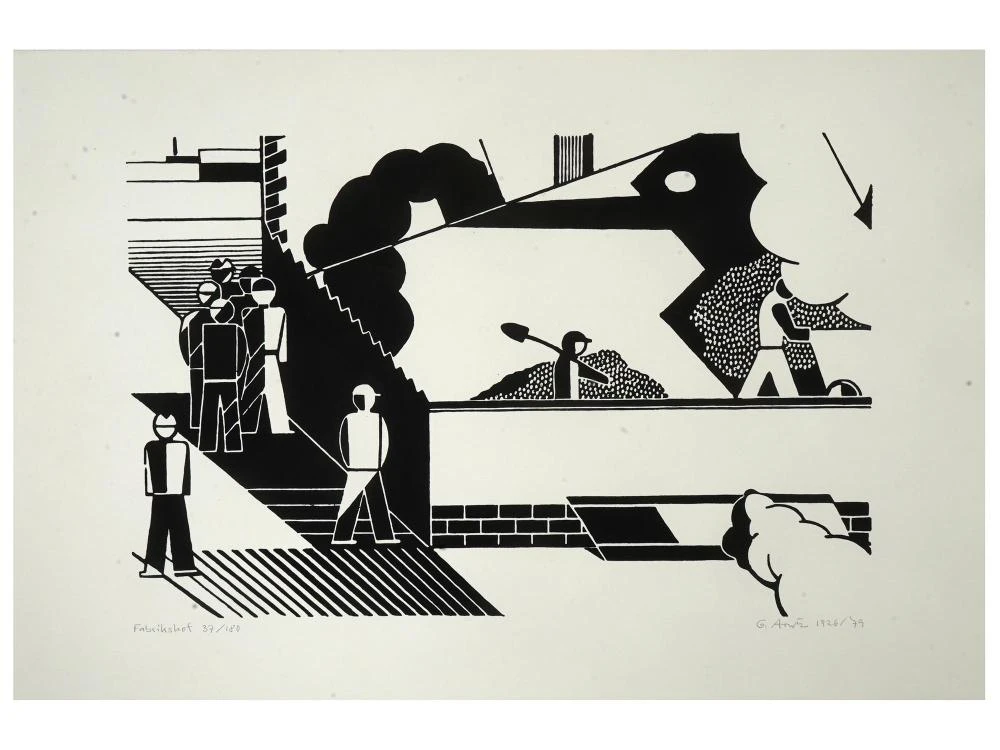
Gerd Arntz - Isotype pictogram, c. 1928-65. Woodcut print.
Four chapters of theory so far. Several more to come. Some of those chapters will be argued with hard, and they should be. None of that argument has to happen before you start.
The organizing work is the same regardless of which architectural positions you end up holding. It starts tomorrow. It starts small. It starts in person.
A fuller treatment waits in the action chapter at the end of the book. This one is a bridge: if you bounce off the next few chapters, you still have what follows. You can skip ahead at any point, or you can read the core of it here.
A note on how I arrived here. My own materialist ethics did not come through theory. It came through professional work in conditions where the gap between what the system claimed to be doing and what it was actually doing was visible at the level of code and data flows. There was no concrete moment. There was a compounding - the discovery, over years, that what distinguished the right call from the wrong call was almost never moral and almost always conditional. The conditions determined the outcome. The framework's grounding of its prohibitions in material consequence rather than moral abstraction is not a theoretical preference. It is the only honest way to describe what working inside the apparatus actually teaches.
Organize in person
Not online. In person. With people you know, people you trust, people you can look in the eye.
Start with whatever fits your conditions. A reading group. A tenants' union. A workplace committee. A mutual-aid network. A community-defence training programme. Whatever the material conditions around you demand and whatever your capacities allow.
The counter-hegemony chapter diagnosed the problem: the internet converts the impulse to resist into the impulse to post. Consciousness without organization is anger that goes nowhere. The solution is not better posting. The solution is an organization that exists in physical space, with people who show up, who have names, who take on roles and carry them out.
I am not going to soften this. The post is not the work. The thread is not the work. The video is not the work. The work is action.
The internet is not useless. It is a tool for amplifying action, not a substitute for it. Use it to coordinate. Use it to broadcast. Do not use it to perform.
Begin with one concrete problem
The unit of organization is the chapter. A chapter is a small, purpose-specific group with internal discipline, shared analysis, and operational autonomy. Start with a few people, maybe five. Fifteen at most. Enough to do something real, small enough to trust each other. You can grow later. Right now you need a room, a purpose, and people who will show up next week.
Pick one concrete problem. A bad landlord in a specific building. A wage theft pattern at a specific employer. A gap in services that your neighbours are feeling and the state is not filling. Something narrow enough that the chapter can act on it in weeks, not years. The point of starting with one concrete problem is that the chapter learns how to act by acting. Abstract commitment without a first win produces burnout. A first win produces a second attempt.
The chapter is single-purpose. The bakery campaign is the bakery campaign. The tenant union is the tenant union. The community defence training programme is the community defence training programme. A chapter that works in one domain does that work well; a chapter that takes on a second domain because it has the energy is a chapter that has stopped doing the first one well and is on its way to doing neither. Cross-domain work happens through coordination between chapters, not through consolidation inside a chapter. The federated form is what makes cross-domain coordination possible without forcing single-purpose chapters to become multi-purpose ones.
Membership is bounded. Fifteen people is the working ceiling - the number I landed on after going back and forth, and I am not certain it is right. Something has to be the number; a chapter without a ceiling becomes a chapter without accountability. Thirty is the absolute ceiling, written into the federation charter and not movable by chapter vote. Above fifteen, the face-to-face accountability that keeps a chapter honest begins to thin. Above thirty, it has thinned past the point where any informal practice will recover. A chapter that grows past the ceiling does not stay a chapter. It splits. Splitting is the design, not the failure mode. Two chapters of fifteen are stronger than one chapter of thirty, because the second chapter retains the small-group accountability the first one was about to lose. If you find a different ceiling that holds, hold it.
The first win does not need to be big, it needs to be real. A tenant who was going to be evicted is not evicted. A worker who gets back wages that were stolen. A family that gets fed when a benefit lapsed. These are the units the work is measured in.
That is the whole chapter, in case you want to put the book down here and go. The rest is written for the people who stay - who want to know how to build the infrastructure that makes the wins reproducible, and who are willing to read another few hundred pages to find out.
The dual-use problem
The federated chapter form is not unique to the left. It is the organizational shape any movement adopts when it expects to be infiltrated, decapitated, or legally pursued. Leaderless cells, operational autonomy, resistance to top-down capture - these are structural features, not political ones. The form is dual-use. An honest framework says so before building on it.
Naming the right-wing version of the form alongside our own is not pleasant work. I would rather not have to. The book proceeds anyway, because the form is dual-use the way a hammer is dual-use, and refusing to discuss hammers does not get the house built.
Historical cases of the federated form
Right-side cases. Louis Beam's 1983 essay "Leaderless Resistance" is the originating document for modern decentralized extremist cell structure, adopted by The Base, Atomwaffen Division, and their successor formations: small cells, no centralized command, operational autonomy, communication through shared principle rather than mappable hierarchy. The shape is the same as what this book proposes. What differs is the charter. Those cells organize around identity hierarchy as their constituting premise and select members through adversarial internal dynamics that reward brutality. The framework rejects identity hierarchy at the transgression level worked out in the foundations chapter, and the anti-ossification architecture is built specifically to prevent the adversarial internal-selection dynamic. The form is the same; the constituting conditions are foreclosed.
Left-side cases. The Black Panther Party was decentralized in practice and was still infiltrated and decapitated by COINTELPRO.1 What the framework adds is charter-level commitments that make infiltration more expensive: a chapter captured to identity persecution or state-aligned violence forfeits federation standing on self-execution, removing one of the vectors COINTELPRO exploited when it turned chapters against each other. The Zapatistas - the longest-surviving decentralized left formation in recent history2 - resolve the relationship between the political and the functional through practice rather than doctrine, and ground the dignity of the organizing unit in something other than scale. Rojava and the YPG provide a current large-scale democratic-confederalist example under wartime pressure;3 a federation that works at the scale of a thousand is not automatically the federation that works at a million, and the book does not claim to have solved the scale problem - it claims to have identified it. Weather Underground is the case that matters for internal degradation: decentralized, charismatically captured, and imploded through the romanticization of violence and through sexual politics weaponized as discipline. The lesson feeds the internal-rot section below.
The charter
A federated model is a shape and a set of commitments. The commitments are what prevent the shape from being assimilated to the dual-use cases above. The proposal is that the commitments are enforceable at the federation level, not aspirational.
The charter commitments that constitute federation membership:
- Anti-identity-persecution as transgression, per the foundations chapter. A chapter that organizes around ethnic, religious, sexual, or national persecution is not inside the federation.
- Land Back non-negotiability in settler-state context. A chapter operating on Indigenous territory without consent from the sovereign Indigenous nation whose territory is affected is not inside the federation.
- Ecological-constraint adherence, per the economic architecture. A chapter whose work systematically breaches carrying-capacity or metabolic-reciprocity commitments is outside.
- The transgression-category commitments from the foundations chapter - no domestic surveillance infrastructure, no identity-persecution apparatus, no uncontained deployment of the technologies the book names as transgressions.
- The safeguard-floor commitments from the economic architecture. A chapter that actively works against decommodified essentials or against the material floor is outside.
- The single-purpose mandate and the size caps. A chapter operates in one domain. Membership is bounded at fifteen for active work and thirty as the absolute ceiling. A chapter that consolidates multiple domains under one roof, or that grows past the size ceiling without splitting, has exited the form the federation is built to coordinate.
The enforcement mechanism is specific. A chapter found in sustained violation of any of the above forfeits federation standing. Sustained violation has a defined meaning, set out in the anti-ossification chapter: three documented, separately adjudicated instances over a two-year window. Single incidents are addressed through the staged dispute resolution worked out there; sustained pattern is what triggers the forfeit. The federation does not vote on whether the chapter gets to stay. The chapter has self-excluded through the entry conditions, and the architecture notices.
The boundary matters. Disagreement over tactics, local adaptation, regional variation - expected, protected, necessary. A chapter in a settler city and a chapter in a northern community will not do the same work and should not. A chapter running a tenants' union and a chapter running a community-defence programme will not use the same calendar and should not. None of that is charter violation. Charter violation is the specific act of organizing around a constituting principle the transgression categories foreclose.
The difference from centralized expulsion is that the federation does not destroy the chapter. The chapter remains free to organize as it pleases. It simply does so outside the federation. Solidarity obligations - resource sharing, mutual defence, infrastructural support - end at the charter boundary. There is no quarrel to settle. There is a line the chapter has walked across, and the federation has stopped walking with it.
The charter is what turns the federated model from form to movement. Without it, the form is just leaderlessness. With it, the form is the specific thing this book is arguing for.
The class interface
The charter binds the chapter to the class it organizes alongside, not only to the class it claims to represent. The federated vanguard chapter distinguishes active from passive membership. The charter has to make the distinction architectural, because a chapter that selects only for people who can sustain a high tempo will, over a decade, be composed of people who can sustain a high tempo - disproportionately young, able-bodied, educated, and childless - and will become alien to the working class around it. Four commitments make the binding structural rather than rhetorical. Together they are the chapter's class interface, the working connection between organized cadre and unorganized mass, audited as a permanent function of the chapter's operation.
The gradient and the peripheral register. The chapter maintains a public, low-barrier entry point - a mutual-aid shift, a know-your-rights training, a clinic. The entry rung is materially valuable to the participant before it is instrumental to the chapter. From there, the gradient increases: attend, take on a role, train for a readiness mode, become an organizer of organizers. Capacity varies with life conditions. No one is shamed for sitting at a lower rung. Nobody at a higher rung holds their position because they sit there. The chapter maintains a peripheral membership register: people who have made a public solidarity pledge to be available for specific actions - votes, boycotts, mass turnout - without taking on chapter operational duties. The register is a channel, not a test. It tells the chapter how much capacity it has when it calls.
The chapter's petition channel. The chapter operates a regular, public, facilitated forum where non-members can surface needs, grievances, and proposals, and where the chapter presents its ongoing work. The forum is deliberately slower and more accessible than chapter meetings. Its outputs are documented and published. The chapter is not bound to act on every demand, but it is bound to respond, in writing, with reasoning - can do, cannot do alone, can do under these conditions. This is the chapter-level prototype of the mature petition body. The same logic. A different scale.
The all-hands protocol. A pre-committed, publicly rehearsed set of assembly points and signals, distributed among solidarity-pledge holders and the broader population. When a crisis threshold is met - a general strike call, a state assault on a community - the chapter activates the protocol. Members deploy to pre-designated public locations, visibly competent and calm, providing water, medical support, legal hotlines, and tactical information. The protocol is rehearsed not in secret but as community resilience drills that double as mass-mobilization training. The skeleton is visible before the crisis. The unorganized person who arrives angry and afraid sees a structure they can join. The openness of the protocol is itself calibrated; under repressive conditions it retracts into vetted channels along the proportional praxis ladder, and the retraction is itself a signal of where on the ladder the chapter sits.
Participation subsidies as operational expenses, not charity. Childcare at meetings. Stipends for lost wages. Transportation support. The chapter budgets for them as the cost of remaining of the class. A chapter that cannot afford participation subsidies has not yet built the material base to be a legitimate representative of its own neighbourhood, and the federation's resource flow prioritizes helping it build that base.
The interface obligations are charter-level, not aspirational. A chapter that fails them across a sustained audit window is in charter violation, and the structural response below applies. One residual the obligations cannot close: the chapter that becomes the de facto government of its neighbourhood, providing all services and brokering all disputes, has crossed from dual power to replacement state. The interface specifies that the chapter's work feeds the assembly rather than chairs it, and the standing audit flags chapters that have become service organizations so that resource flow can shift toward fostering autonomous mass organization rather than substituting for it. The flag does not prevent the failure mode. It catches it earlier than the failure would otherwise be caught.
Against internal rot
Decentralized structures fail to internal degradation as often as to external attack. The federation has to be built against both. Nine architectural elements target the failure modes named in the Weather Underground case and across the broader left record.
Chapter size caps. The earlier reference to a team of fifteen is not decoration. Chapters exceeding roughly the range should split. Above that size, personality-driven capture and factional dynamics outpace the face-to-face accountability mechanisms that kept them bounded. Splitting is the point at which a chapter becomes two chapters, each of which can do the work the original no longer can.
Rotation within chapters. Internal roles - external representation, resource management, meeting facilitation, communications - rotate on fixed schedules. Personalized authority within a chapter is a local version of the ossification dynamic the anti-ossification architecture prevents at state level. The logic is the same: the rotation is cheap, the consolidation is not.
Against charismatic capture. A chapter that forms around a single individual's vision is structurally different from a chapter that forms around a problem the members collectively chose to work on. The federation distinguishes. This is not a prohibition on leadership. Leaders exist, organizers exist, people who train the next cohort exist. It is a structural distinction between chapters whose organizing principle is a person and chapters whose organizing principle is a problem. The second is what the federation is for. The first is what it has to guard against.
Internal practices are not private from the federation. The action chapter lays out the consultation-scope framework. Transparency of internal deliberation, recorded consultations, published assessments - these apply to internal practice as much as to external action. A chapter whose internal practice is opaque to the federation is a chapter whose failure will be discovered only after the failure has compounded.
Healthy dissolution. Chapters end. Purposes get completed, conditions shift, internal coherence erodes, members move. The federation treats dissolution as ordinary rather than as failure. The provisions: resources hand off to neighbouring chapters; solidarity commitments transfer to named successor chapters; members rotate into other chapters that fit their current work. A chapter that has run its course and dissolves cleanly leaves the federation stronger. A chapter that has run its course and refuses to dissolve is the failure mode the anti-ossification architecture exists to prevent, reproduced at chapter scale.
Charter quarantine, not purge. A chapter found in sustained charter violation does not have its members expelled. It loses standing. The federation withdraws access to the shared legal defence funds, the communications infrastructure, the inter-chapter coordination, and the solidarity commitments of the broader network. The chapter's members are free to join other chapters and are welcomed if they accept the charter. The chapter itself continues to exist or does not, on its own resources and its own legitimacy. No public show trial. No internal security apparatus. The quarantine is declared by the federation tribunal mechanism, the published finding is the publicity, and the resource withdrawal is the enforcement.
This is the structural alternative to the purge. Purges destroy trust, produce martyrs, and consume the energy the network needs for the work it exists to do. The state's counter-insurgency doctrine is built around provoking the purge. The quarantine refuses the provocation. It imposes continuous, low-level pressure against drift without building the enforcement body that would itself become a site of capture. The right of schism is preserved alongside the quarantine: a chapter that believes the finding is wrong can federate independently, and the two federations are then in the legitimacy contest the framework names elsewhere.
The sabbatical right. A member in good standing can step away from operational duties for up to twelve months, retain chapter membership and access to mutual-aid resources, and return to active status without inquiry into the reasons for leaving or returning. This is charter-level. It is not a reward, and it is not a sanction. It is a structural recognition that the movement's resource is human capacity, and that capacity requires replenishment. The organizer who has been arrested, fired, evicted, or simply ground down by the work returns to the chapter that held a place for her. She does not have to prove she was loyal during the year she was gone.
Trust archaeology as diagnostic. A chapter cannot select members on a single conversation and cannot resolve trust by vouching alone. The diagnostic the federation commits to is trust archaeology: a published cycle of documented prior work, named relationships within the chapter and the broader movement, and a deliberate slow-cohort entry pathway in which the new member's first six months are visible operational work at the public-facing entry rung before any access to the chapter's higher-rung infrastructure. The diagnostic is bounded against the failure mode it addresses (the COINTELPRO infiltration pattern, the agent-provocateur pattern) and bounded against its own expansion logic (trust archaeology is not a loyalty test, the published cycle does not collect information beyond what the operational work itself surfaces, and the chapter's posture toward newcomers is welcoming rather than adversarial). The diagnostic is the dam against the silent-trust-decision failure mode in which the chapter admits a member because no one objected and discovers, six months later, that no one had grounds to object because no one had asked. The diagnostic is also the dam against the inverse failure mode - the chapter that refuses to admit anyone outside its existing relationships and ossifies into the kitchen-room scale forever. Trust archaeology produces the documented basis on which the chapter scales. The standing audit tracks the diagnostic's operation as a chapter-health indicator.
Operational security discipline at the chapter scale. The chapter operates under operational security discipline calibrated to the discipline gradient the action chapter specifies. At kitchen-room scale: in-person meetings, no chapter business in unencrypted channels, no chapter membership lists in cloud services the chapter does not control, and the basic operational hygiene the counter-hegemony chapter names as the standard infiltration pathway. At network scale: secure communication committees, the political-functional separation in miniature, the chapter's communication infrastructure built and audited against the same architectural pattern the digital sovereignty chapter specifies in miniature, and the operational pattern the federation's secure-communications protocol commits to. At pre-federation scale: the architecture the transition chapter specifies for cross-chapter coordination. The discipline is not paranoia. The discipline is the recognition that the imperial state's counter-intelligence apparatus has demonstrated the capacity to disassemble organisations that did not run the discipline, and the chapter that pretends the demonstration does not apply to it is the chapter that supplies the next case. The OpSec discipline is also bounded against its own expansion logic: it does not produce the security-culture-as-status-game failure mode that prior left organisations have produced, and the standing audit flags chapters whose security culture has crossed from operational into performative.
The federation that consumes its own people will eventually have no people left to consume, and the ethic of taking care of each other has to be more than a closing line in a book to mean anything. The standing audit tracks departure rates, sabbatical requests, and return rates as cadre-health indicators; a chapter with a high burnout rate is flagged for cultural review, not as inquisition but as diagnosis.
None of the nine is a guarantee. The framework's own principle says no architectural element is a guarantee. What the nine do is raise the cost of the specific internal failure modes the historical record identifies, and specify the site at which the failure can be addressed before it metastasizes.
The rest of the book works out the architecture an organized population can build toward. The action chapter works out the practice in detail - readiness modes, communications infrastructure, the logic of disruption, the discipline of filtering performance from action, the obligation the privileged owe the vulnerable. You do not need any of that to begin. You need a room, a purpose, a few people, and a concrete problem - and the conviction to match your response to the conditions you actually face.
Starting where you are is also the right answer to the international question. The chapter you build does not wait for foreign solidarity to arrive before it does the work; the foreign solidarity arrives, when it arrives, in support of work that is already operational. The sovereignty chapter's international approach develops the on-your-own posture as the structural default at the level of the state; the same posture applies at the level of the chapter. International coordination is a force-multiplier on what is already there. It is not a substitute for what is not, and it is not a reason to defer the work the chapter can do today against the conditions the chapter actually faces.
What this does not solve
The organizing stage runs into limits the framework does not pretend to fix. Naming them is the cost of being honest about what starting where you are can and cannot do.
The first chapter does not transform the conditions around it. It works inside them. A tenants' union does not eliminate landlord power, it makes one building harder to extract from. A workplace committee does not abolish the wage relation, it shifts the local terms of negotiation. Structural transformation depends on coordination across thousands of chapters - and on conditions the local chapter does not control.
The size caps are working ceilings, not verified ones. Some chapters will function above fifteen, some will degrade well below thirty. The architecture treats split-rather-than-grow as the design, but no chapter-internal practice will catch every charismatic-capture or factional-implosion failure mode in time.
The charter is enforceable at the federation level only when the federation exists. In conditions where the federation is two chapters in two cities, the charter is aspirational. The enforcement weight grows with the federation's size; until then chapters hold the commitments themselves and accept that the architectural defences against internal degradation are weaker than they will be later.
The dual-use problem does not go away because we named it. The form is the form. Constituting commitments can fail under pressure, and no specification eliminates the possibility that a chapter walks the line and the federation has to notice.
The class interface and the sabbatical right are partial mitigations. A chapter can be perfectly charter-compliant and still drift away from the working class around it; the standing audit catches drift earlier than it would otherwise be caught, and does not undo a decade of drift already happened. The honest position, taken up in the self-critique chapter, is that continuous pressure is metabolically expensive in a way no architecture fully closes.
The boot does not lift itself.
Start where you are.
Joshua Bloom; Waldo E. Martin Jr., Black Against Empire: The History and Politics of the Black Panther Party (2013). ↩
Ejercito Zapatista de Liberacion Nacional, "First Declaration of the Lacandon Jungle" (1994). https://schoolsforchiapas.org/wp-content/uploads/2014/03/1st-Declaration-of-the-Lacandona-Jungle.pdf. ↩
Michael Knapp, Anja Flach, and Ercan Ayboga, Revolution in Rojava: Democratic Autonomy and Women's Liberation in Syrian Kurdistan (2016). ↩