Speak the language of your adversaries

Varvara Stepanova - Textile design, c. 1924. Gouache on paper.
In 1973, a democratically elected socialist president was overthrown by a military coup backed by the CIA.1 He had won the election. He had nationalized industries through legal channels. He had respected the constitution. The military bombed his presidential palace. His strategy for change had been democratic, and it worked - right up until the forces arrayed against him decided that democracy was no longer in their interest.
Five years later, in Italy, the Red Brigades kidnapped and executed a former prime minister in an attempt to spark revolutionary upheaval. The Italian working class, which had been engaged in the largest wave of factory occupations and wildcat strikes in Western Europe, recoiled. Public sympathy collapsed. The state used the crisis to justify a crackdown on the entire left - the militants, the moderates, the trade unions, everyone. The violence did not destabilize the system, instead it just gave the system permission to crush its opponents.
Two failures: One used too little force for the conditions it faced, the other used too much. Both were destroyed - not because the people involved were wrong about the system being unjust, but because they chose the wrong tool for the situation they were in.
I know the cost of getting this wrong is not abstract.
The principle
The form of resistance must match the form of oppression. This is explicitly strategic.
Violence against a state that permits democratic channels turns the people against you. Peaceful protest against a state that kills you for protesting gets you killed for nothing. The choice is not between violence and nonviolence in the abstract. The choice is determined by the conditions you face.
I am calling this a proportional praxis. The word "proportional" is doing the important work. Not maximum force. Not minimum force. Proportional force - calibrated to the specific conditions, the specific opponent, the specific moment. Get it wrong in either direction and you lose. Use too little and you are absorbed or destroyed, or worse, performative. Use too much and you are delegitimized, or you give the state the excuse it was looking for.
The spectrum
The common framing sorts resistance into three buckets: peaceful protest, mass mobilization, armed revolution. Pick one.
The framing is wrong.
There are not three categories. There is a continuous spectrum, and the correct position on that spectrum is determined by one thing: what the state is doing.
You start democratic. Always. Do not think this is a concession to liberalism: again, be strategic. Democratic action within functional democratic institutions costs the least, reaches the most people, and builds the legitimacy that material disruption requires to succeed. If democratic channels are available - if you can organize, vote, strike, publish, demonstrate without being killed or imprisoned for it - you use them. They work, when they work.
If the state escalates past democratic engagement - if it suppresses organization, jails dissidents, sends riot police against peaceful demonstrators, bombs its own presidential palace - then the proportionate response has been set by the state. You did not choose escalation. The state chose it for you. You are matching what you face.
And if the state escalates again - martial law, mass imprisonment, disappearances, assassinations of organizers - you match again. Each escalation is the state's. Each response is yours. The state writes the terms of engagement through its own actions, you read and respond in kind.
This means the question is never "should we use violence or not?" The question is: what is the state doing right now, in this place, to these people? The answer determines the form of resistance. Nothing else does. I realize the discomfort this makes us feel, especially those who have been born into liberal thinking. The unfortunate fact is: you do not set the terms of engagement, the armed state does.
The evidence from 2025 and early 2026 illustrates the principle with uncomfortable clarity. The "no kings" anti-Trump demonstrations mobilised an estimated five to eight million participants across three major actions2 - among the largest single-day domestic protests in American history. The material impact was zero. No capital was disrupted. No cost was imposed. There were not even demands. The participants went home and the administration continued as before: it was a pressure valve. In the same period, French dockworkers blocked a shipment of arms components bound for Israel,3 sparking solidarity actions from Italian dockworkers in Genoa - part of a wave of port refusals that had already seen Belgian transport unions,4 Barcelona stevedores,5 Indian dock workers,6 and Swedish dockworkers78 refuse to handle Israeli military cargo since the war began. These actions reached a fraction of the "no kings" turnout and achieved more, because they operated at the point where the system is vulnerable: the movement of goods and the accumulation of capital. In Minneapolis, after federal immigration agents killed two American citizens during enforcement raids,9 the community responded with surveillance of agent movements, an economic disruption day, and sustained direct action until the administration retreated. The principle holds: the form of resistance must match the form of oppression. A march that disrupts nothing is proportionate to... nothing.

Varvara Stepanova - Textile design, c. 1924. Gouache on paper.
Different conditions, same moment
Here is the part that makes people uncomfortable. The answer is not the same for everyone.
An Indigenous community in Canada is not facing the same state as a white professional in downtown Toronto. The Indigenous community is facing colonial violence that has been continuous for centuries. Militarized police raids on land defenders. Children taken from families within living memory. Drinking water advisories that have lasted longer than some people's entire careers. The boomerang that reciprocal materialism describes is not theoretical for them - they are living inside the apparatus the colonial state built and never dismantled.
For that community, an escalated baseline response is already proportionate. The state has already escalated. The state escalated generations ago and never de-escalated. The proportional response to ongoing colonial violence is not a petition. The sovereignty chapter develops what this means concretely - Land Back as a structural political demand, not a metaphor, and the framework's commitment that socialist state-building does not reproduce the colonial relationship under a different flag.
For the white professional in Toronto, the conditions are different. Democratic channels are functional - imperfect, captured, slow, but functional. The professional faces economic extraction, not militarized violence. The proportional response for the professional is democratic organizing, labour action, tenant unions, electoral challenges. Not because violence is wrong in the abstract, but because violence by the privileged in a context where democratic channels exist would be premature, indefensible, and politically catastrophic.
Both responses are valid. Neither dictates to the other. The Indigenous land defender does not need the professional's permission to resist at the level the conditions demand. The professional does not need to match the land defender's escalation to stand in solidarity. What they need is to agree: each response is proportional to its own conditions, and solidarity means supporting each other's assessment rather than demanding uniformity.
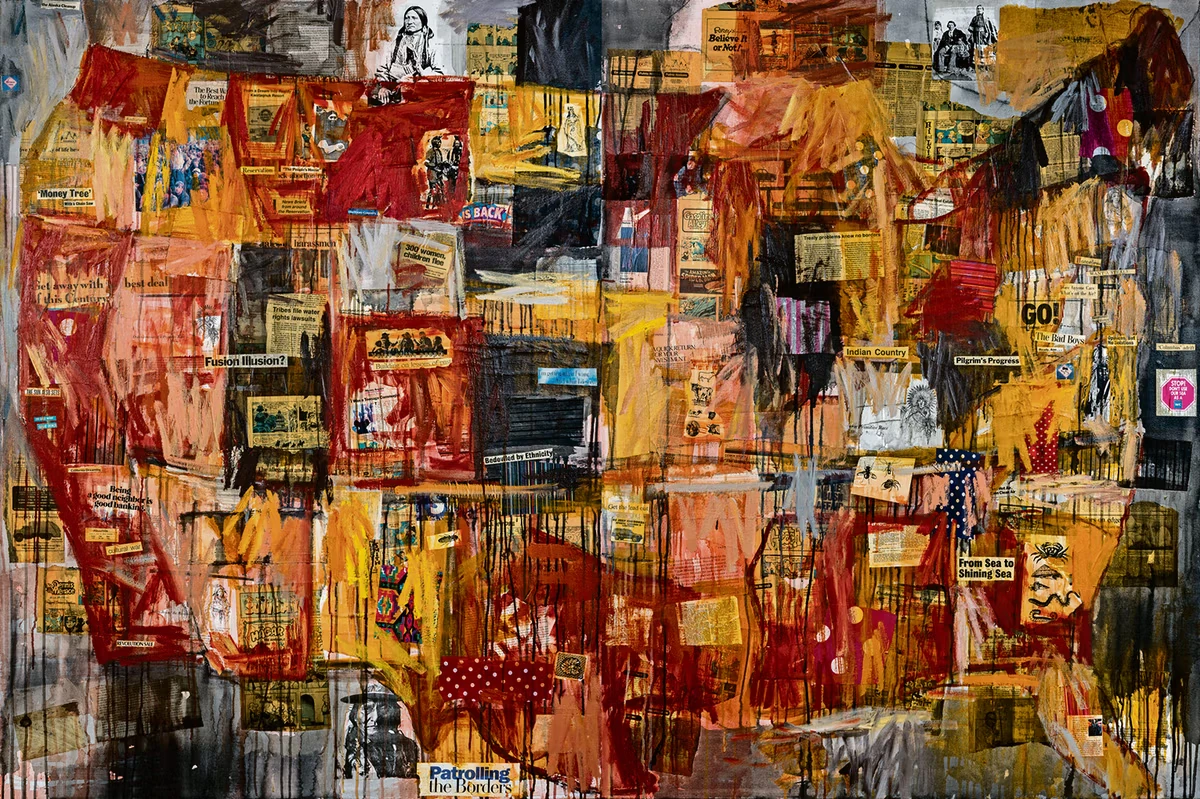
Jaune Quick-to-See Smith - Indian Map, 1992. Mixed media on canvas.
This connects directly to the risk distribution described in the previous piece. The professional's role is not to match the land defender's escalation but to absorb risk within their own context - to put their body, their career, their comfort on the line in ways that multiply the land defender's leverage without substituting for the land defender's judgment. This is solidarity in practice.
The same calibration extends past the chapter and territory the framework was first written for. A state apparatus designed to deploy against a population it does not recognise as having full standing has set the escalation baseline by its own architecture - the population's existential conditions are under continuous coercive denial, and the state's military, police, intelligence, and settlement-administration infrastructure are deployed, as designed, against the people they do not recognise. Under the proportional-response logic above, the formation of organised resistance is structurally proportionate to that baseline. The framing that 'one person's terrorism is another's liberation' is not relativist evasion in this chapter's vocabulary; this is a structural observation that the label depends on whose escalation baseline is being measured against whose response. The Palestine treatment in the case-studies chapter develops this calibration in full, including what it implies for the framework's posture on the resistance formations that exist because the baseline produced them.
Solidarity across escalation levels
There is a circularity here, which should be named. Proportionality is the rule. It is also the thing most likely to be misjudged under pressure. Who decides that the conditions justify escalation? The people who want to escalate. Who validates the assessment? The same people, or people facing different conditions who cannot fully evaluate theirs. The framework does not pretend this is fully solvable. It proposes architectural mechanisms - external monitoring as an evidentiary anchor independent of any chapter's self-assessment, consultation friction proportional to the severity of the decision, network deliberation that forces multiple independent assessments before the most consequential actions. They reduce miscalibration. They do not eliminate it. Sometimes the data is ambiguous and the chapter reading it gets it wrong. No architecture solves that.
Different groups operating at different levels of response must stand together without commanding each other. This is the hardest organizational problem in any resistance movement, and most movements have solved it badly - either by demanding uniformity (which alienates the people facing the worst conditions) or by fragmenting into factions that denounce each other (which lets the state divide them).
The framework solves this through a simple mechanism: legitimacy as natural selection. Groups that can sustain empirical justification for their level of escalation retain public support and grow. Groups that cannot lose support and dissolve. No central authority decides. The evidence does. If the state is killing people, the claim that conditions justify armed resistance holds. If the state is sending sternly worded letters, it does not. The broader working class - the people this system extracts from - makes this assessment continuously.
This mechanism operates at two speeds. In steady state, it works over months to years. A chapter's analysis either matches conditions or it does not. Chapters that match grow; chapters that do not shrink. This is slow, organic, and self-correcting. In crisis, the post-activation review compresses the feedback loop from months to days. After any activation event, the network conducts an open assessment: what triggered it, was the triggering chapter operating within proportionate bounds, did the state initiate or did the chapter provoke? The assessment is published to the network. A chapter that misjudges under time pressure faces network-wide evaluation within the same operational period - not months later when the damage is irreversible. The slow cycle governs chapter development. The fast cycle governs crisis accountability. Both operate through the same principle: evidence-based legitimacy, not hierarchical authority.
This is the strength of decentralization. A centralized movement that gets the escalation wrong loses everything at once. A federated movement where some groups get it wrong loses only those groups - the rest adapt, recalibrate, and continue.
The federated vanguard
So how do you organize this? Not through one big organization with a charismatic leader and a central committee. That model has been tried. It produces the problems the next piece in this series addresses: concentration of power, bureaucratic capture, and a single point of failure that the state can target and destroy.
Instead: many small, disciplined, purpose-specific groups. A federated model.
Some groups prepare for physical resistance. Some prepare for cyber operations - disrupting the digital infrastructure that capital and the state depend on. Some prepare for democratic disruption - mass voter mobilization, labour organizing, legal challenges, electoral campaigns. Some prepare for mutual aid - the infrastructure of care that keeps a movement alive when the state tries to starve it.
No group commands the others. Each group determines its own form of readiness, its own internal discipline, its own operational security. Each shares information nationally with other groups. Each stands in solidarity with the others. None dictates.
This is neither pure spontaneity nor centralized command. Rosa Luxemburg argued that revolution arises from the masses, that no party can call it or prevent it. Lenin argued that disciplined vanguard organization is necessary to channel revolutionary energy into effective action. They were both right about different conditions. Under conditions that permit mass mobilization, the masses lead and the organizers follow. Under conditions that require coordinated militant resistance, disciplined organization provides the coherence that spontaneous action cannot.
The federated model holds both possibilities simultaneously. Each local group operates with vanguard-level discipline internally. No central command coordinates them externally. The ecology of resistance is diverse, adaptive, and impossible to decapitate - because there is no head, only the network.
Vietnam's people's war operated on this principle at national scale.10 Highly disciplined local units with strategic coordination but operational autonomy. The United States had overwhelming firepower and centralized command. Vietnam had distributed resistance that could not be destroyed by killing any individual leader or capturing any individual base. The United States lost.
Iran in 2026 demonstrated the principle under conditions of extreme asymmetry. The United States and Israel assassinated the supreme leader, struck over ten thousand targets, and deployed fifty thousand service members. By every conventional metric, Iran should have collapsed. It did not. Closing the Strait of Hormuz - a chokepoint through which roughly a fifth of the world's oil passes11 - sent global oil prices over a hundred dollars a barrel12 and imposed a material cost on the world economy that no amount of military superiority could offset. The operation required no centralized command, only the capacity to disrupt a single critical node in the flow of capital. The result, at the time of writing, has been the unfreezing of Iranian assets and the loosening of sanctions - concessions extracted not through military victory but through the weaponization of economic interdependence. Iran did not win the war; it made the war more expensive than the alternative. That is adversarial reciprocation: you do not need to match the empire's firepower; you need to impose a reciprocal cost it cannot absorb. The Strait of Hormuz was Iran's kill switch, and when it fired, Empire blinked.
Up before, in after
There is an asymmetry in the federation's use of intelligence and sabotage tools that has to be named explicitly, because every documented socialist transition that did not name it produced the secret-police apparatus the framework otherwise refuses.i The pre-state movement uses intelligence on the existing state's coercive apparatus, sabotage of infrastructure the state is using to escalate, and operational security against the state's penetration. The authorisation comes from the same proportional logic that authorises any other organised resistance to a state operating outside its constitutional discipline. Pre-state, the movement treats the existing state as an adversary. The tools point up.
The authorisation is not unlimited; it must be bound by the same proportionality test applied to every other resistance posture, and specifically against operations that target the population the movement seeks to represent. Pre-state intelligence is up. It is not lateral. It is not down. A movement that monitors its own members the way it monitors the state has built the apparatus the framework was meant to replace, before the framework has even arrived.
On the day the movement takes responsibility for a state of its own, the authorisation inverts. The tools the movement built against the prior state become, structurally, the tools a state apparatus holds against its own population. The framework's domestic-surveillance prohibition - developed in the digital-sovereignty chapter and grounded in the structural-distance test - applies in full from that day. The transition is not gradual. There is no transition period during which the pre-state authorisation persists, because every transition period in the historical record has been the period during which the new state built the surveillance apparatus it then could not dismantle.
The transition rule is enforced architecturally, not by declaration. Personnel who held pre-state intelligence roles are subject to a structural separation from post-state intelligence and security functions, on the same political-functional firewall logic the anti-ossification chapter applies to other transitions. Pre-state operational records are subject to immediate declassification, on the same transparency logic applied to any other accountability mechanism. Post-state intelligence functions, where they exist at all, are subject to the federated chapter and Monitoring Commission oversight that the anti-ossification architecture names for any other concentrated capability. The framework does not pretend these enforcement mechanisms are sufficient against the temptation the transition presents. It claims they are necessary, and it names the failure modes that occur when each is absent: pre-state intelligence personnel rotated quietly into post-state roles becomes the new state's secret service in the personnel that holds the old state's penetration networks; pre-state operational records kept secret becomes the leverage the new state uses against the federated chapters that built it; post-state intelligence outside the Monitoring Commission's oversight becomes the apparatus that watches the Commission. Build the dam immediately, or it will not be built at all.
The kill switch
Revolutions do not always happen on deliberative schedules. The state can escalate in hours. Pinochet's coup took a single day. Emergency decrees. Communications blackouts. Mass arrests. When Empire moves fast, a federated movement needs a way to respond fast - without centralized command.
The framework calls this the kill switch. It is not a button. It is a protocol - a graduated readiness ladder. The principle is graduated assessment: a single signal does not trigger full activation, because false activations degrade the mechanism's credibility. One workable picture: three modes - inquiry, posture, activation - with the thresholds set by the federation in consultation with the monitoring ecosystem. The number of rungs is illustrative. A federation that finds two modes sufficient, or four, or that calibrates the thresholds differently for different operational contexts, has not left the framework; it has taken a position the architecture is built to absorb. What is non-negotiable is the principle: assessment precedes activation, and the cost of false activation has to be weighed against the cost of delayed activation in the same calculation.
Every group in the federated model has already determined what it will do if the state moves to crush the movement. There is no deliberation phase at the highest level. The response is pre-planned. The cyber operations group knows its targets. The physical resistance chapter knows its positions. The democratic disruption group knows its legal and communication channels. The mutual aid chapter knows its supply routes. Everyone knows their role before the signal comes.
But the signal is not silence alone. You need silence plus context. A single communication channel going dark could be a storm, an outage, or routine maintenance. A binary system that treats every silence as state suppression produces false activations, and false activations degrade the mechanism's reliability over time - the movement that cries wolf loses its capacity to respond when the wolf arrives. The graduated ladder addresses this.
Inquiry. A single channel goes silent. The chapter attempts verification through alternative channels - mesh network, analogue fallback, trusted contact in another chapter. No operational response. No activation. This is the "was it a storm?" check. Inquiry is nearly instant.
Heightened posture. Multiple channels are down AND observable indicators of state action are present - reports of arrests, military movement, emergency declarations, media blackouts. Each chapter independently assesses whether the pattern matches state suppression or infrastructure failure. Chapters prepare but do not activate. Resources are staged. Roles are confirmed. The chapter is ready to move to full activation but has not committed.
Full activation. All channels are down across multiple regions, OR a chapter has confirmed state aggression against another chapter through any available means, OR pre-agreed indicators of coup or crackdown are present (specified in advance, context-dependent for each chapter's conditions). Predetermined protocols execute. The kill switch fires.
Each communication layer serves double duty: redundancy for communication AND verification of whether the failure of the layer above was natural or deliberate. The encrypted channel fails - you check the mesh. The mesh confirms the encrypted channel was taken down deliberately, or the mesh also fails. Each layer's failure or success provides information that moves the chapter up or down the readiness ladder.
There is a named tradeoff. Graduated activation is slower than binary activation. If the state moves at Pinochet speed, verification costs time. The mitigation is structural: the inquiry mode is nearly instant, and chapters in direct contact with state violence skip to full activation based on firsthand assessment. The graduated system applies to remote chapters assessing a situation they cannot directly observe. A chapter whose members are being arrested does not need to verify through alternative channels. They are the verification. The ladder protects against false activation without preventing rapid response where the threat is immediate and confirmed.
And when the state attacks one group, every group stands in solidarity. This is unconditional. The guarantee that an attack on any chapter triggers a network response is what makes repression costly. If solidarity were conditional - if chapters could opt out because they disagreed with the target's tactics - the state would simply target the chapter with the least network sympathy first, then the next, then the next. Unconditional solidarity removes that option.
The distinction that makes this survivable is between solidarity and activation mode. Solidarity is unconditional - every chapter responds. Activation mode is independently assessed. Standing in solidarity is not the same as executing your full operational protocol. A chapter that assesses genuine state aggression responds at full capacity. A chapter that assesses ambiguity responds with solidarity actions - public statements, legal support, resource sharing - while not executing its full operational protocol. The three assessment questions are: was the attack state-initiated or provoked? What are our local conditions right now? What response form actually helps the attacked chapter?
This addresses the infiltration vulnerability directly. An agent provocateur who pushes a chapter toward premature escalation, triggers a state response, and forces network-wide activation under unfavourable conditions succeeds only if every chapter responds at maximum escalation. When each chapter independently assesses the situation, the provoked escalation produces solidarity but not uniform full activation. The network supports the attacked chapter without committing to an escalation level that only the provoked chapter's assessment would justify.
Chapter A is engaged in physical resistance and is attacked. Chapter B responds with a general strike. Chapter C responds with legal action and public solidarity. Chapter D responds with cyber disruption. The state cannot isolate Chapter A. But Chapter A's assessment does not drag the network into an escalation level others have not independently validated. The network's overall posture self-corrects toward the median proportionality assessment rather than locking to the most escalated chapter's read.
The deterrent is intact. The state still faces the full network response to any attack on a single chapter. What the state cannot do is predict what form the response takes - because each chapter determines that independently based on its own conditions and its own assessment of the monitoring data. Unpredictability is a stronger deterrent than guaranteed uniformity - the state cannot model a response it cannot predict.
The state faces a paradox. It cannot disrupt the network without activating it. It cannot isolate a target without triggering a distributed response. It cannot suppress without signalling. The architecture turns the state's strongest move - rapid, decisive repression - into a self-defeating one.
Loved comrades, not martyrs
One more thing about how the movement operates. It is not organizational. It is human.
People will be lost. That is the material reality of confronting a system that kills to maintain itself. The framework refuses to instrumentalize that loss.
Those who are lost in service to the movement are honoured as loved comrades - not as martyrs whose deaths serve a strategic purpose. The movement remembers its dead as people. Their lives. Their contributions. Their humanity. Not as sacrifices whose deaths justified or advanced anything.
This is not simple sentimentality. Keep it structural. A movement that valorizes sacrifice creates incentives for sacrifice. Under RCE, that incentive boomerangs: a movement that consumes its own people will eventually consume itself. The entire defensive architecture described above - the federated model, the graduated kill switch, the risk distribution - exists to minimize loss. Readiness is loss prevention. Discipline is care. Solidarity is the mechanism by which no one absorbs more than they have to.
The revolution remembers its dead with grief and love. Not with instrumentalized glory.
How the federated model works
The federated vanguard is an organizational architecture, not a metaphor. It has specific structural features that distinguish it from both centralized parties and loose horizontal movements.
The unit. The basic organizational element is a localized group with a defined purpose. A physical resistance chapter in a rural area. A digital operations collective in a city. A tenant organizing committee in a specific neighbourhood. A legal defence network covering a region. Each unit determines its own purpose, its own membership requirements, its own internal structure, and its own operational discipline.
Purpose-specific discipline. This is where the model diverges from horizontal movements that reject all hierarchy. Each unit has discipline - but the discipline is determined by the unit's operational purpose, not by ideological conformity. A cyber operations collective requires technical competence and operational security. A physical resistance chapter requires physical readiness and tactical coordination. A municipal electoral campaign requires campaign discipline and message coherence. The discipline requirements are functional, not political. No unit polices its members' identity, expression, sexuality, or internal political tendency. You can be disciplined for breaching operational security. You cannot be disciplined for who you are.
Multi-modal readiness. The framework does not require every person who joins to be a soldier. It requires every person to know what they will do when the conditions demand it. A disabled organizer contributing through legal defence or communications is as necessary as someone with physical operational readiness. A coder building encrypted communication infrastructure is as necessary as someone running a mutual aid kitchen. The movement's readiness is distributed across modes, not concentrated in one form of action.
Active and passive membership. Not everyone in the movement has a defined operational role, and that is fine. Passive membership - people who support the movement, share its analysis, participate in actions when they can, but have not committed to a specific readiness role - is valid and necessary. The critical structural requirement is that every active member and every unit has a pre-determined response to activation. Passive members contribute when and how they can. Active members respond to the protocol. Remember though, passivity does not permit performance.
Formation and dissolution. Units form when a group of people in a location identify a purpose and organize around it. They dissolve when the purpose is fulfilled, when the members move on, or when the unit loses legitimacy. There is no central authority that creates or terminates units. The ecology governs itself. Units that are effective attract members. Units that are ineffective lose them. This is legitimacy as natural selection applied to organizational form.
National coordination without national command. Units share information, analysis, and situational assessment with other units nationally. They do not receive orders from a national body. Coordination happens through shared analysis and mutual agreement, not through command. Regional networks may form for coordination purposes, but no network commands the units within it. The information flows horizontally, not vertically.
The structural difference from a party. A party concentrates decision-making in a leadership that directs the membership. The federated model distributes decision-making to units that coordinate horizontally. A party can be captured by a faction, corrupted by leadership, or destroyed by targeting its leaders. The federated model cannot be captured because there is no centre to capture. It cannot be corrupted because there is no permanent leadership to corrupt. It can lose individual units, but the network survives because no individual unit is necessary for the network to function. This is not to say a party cannot form or align to the movement; however, the party must not permit itself to remain anything more than a vehicle to amplify action. Do not oppose those who decide their own proportionate action, and remember that there is no true movement party outside the people who take action themselves when the state remains capitalist despite the party.
The structural difference from a leaderless movement. Jo Freeman identified the problem with structurelessness in 1972: when a movement claims to have no leaders, leadership devolves to informal networks that are unaccountable, invisible, and often more authoritarian than the formal structures they replaced. The federated model addresses this by acknowledging that each unit has structure - internal leadership, defined roles, operational discipline - while refusing to extend that structure across units. Structure within, federation across. This preserves the benefits of decentralization (resilience, adaptability, no single point of failure) while avoiding the pathology Freeman diagnosed (invisible, unaccountable power).
Historical model honesty. The federated vanguard borrows from several traditions and should name what it takes from each and what it rejects. From Lenin's vanguard party: the insistence on organizational discipline and strategic coordination. Rejected: the claim that the party knows the proletariat's interests better than the proletariat does, and the structural inevitability of leadership ossification once the party holds state power. From anarcho-syndicalist federations: horizontal coordination, local autonomy, and the refusal of permanent command hierarchy. Rejected: the frequent inability to coordinate strategically across distance and time when conditions demand rapid unified action. From Zapatista autonomous municipalities: purpose-specific governance structures accountable to their base communities. Rejected: the geographic isolation that makes the model difficult to generalize to urban industrial contexts. The federated vanguard is a synthesis. It takes organizational seriousness from the Leninist tradition without its centralization pathology. It takes horizontal coordination from the anarchist tradition without its strategic coordination deficit. It takes community accountability from the Zapatista model without its geographic constraints.
The Occupy cautionary case. Occupy Wall Street (2011) demonstrated both the power and the failure mode of structurelessness at scale. It succeeded spectacularly at shifting public discourse - "the 99%" entered the political vocabulary permanently. It failed operationally because it could not convert attention into sustained action. Without defined units, operational roles, or escalation architecture, Occupy could not respond coherently when the state moved against it. The evictions happened city by city, each encampment isolated. No federated response protocol existed. No kill switch. No mutual aid infrastructure that survived the loss of the physical space. The energy dissipated. The lesson is structural, not motivational: the participants were committed and courageous. The architecture was absent. The federated model exists because Occupy proved that horizontalism without structure produces movements that are easy to admire, and easy to disperse.
Strategic versus tactical coordination. The federated model distinguishes between strategic coordination (shared analysis of conditions, agreed escalation frameworks, mutual aid protocols) and tactical coordination (specific operational planning for specific actions). Strategic coordination is network-wide and continuous. Tactical coordination happens between units that are directly cooperating on a specific action and includes only those units. This distinction matters because it determines what information flows where. A general strike requires strategic coordination across many chapters - shared timing, shared messaging, shared assessment of readiness. The specific logistics of how each chapter executes the strike are tactical and stay within the chapter. An infiltrator who gains access to strategic coordination learns the movement's analysis of conditions. An infiltrator who gains access to tactical coordination learns operational details that endanger specific people. The architecture treats these information categories differently.
Inter-chapter disagreement. Chapters will disagree about analysis, tactics, and priorities. The framework does not require agreement. It requires two things: solidarity when any chapter is attacked by the state (unconditional), and honest public assessment of each other's actions (recorded and visible). A chapter that believes another chapter's tactics are counterproductive says so publicly. That assessment becomes part of the network's record. The broader working class uses the combined record - the action, the assessments, the outcomes - to evaluate legitimacy. This is messy. It is supposed to be messy. The alternative is a central body that adjudicates disagreements, and that body is the seed of every party bureaucracy that ever ossified. The mess is the price of avoiding capture. The legitimacy-as-natural-selection mechanism is the only adjudicator: chapters whose analysis proves correct over time gain influence. Chapters whose analysis proves wrong lose it. No formal authority resolves the disagreement. Reality and empirical data resolves it.
The kill switch protocol
The kill switch is the federated model's mechanism for rapid coordinated response. It is not an offensive weapon. It is a defensive architecture that aims to make the cost of repression higher than that of allowing the movement to exist. Its graduated structure - inquiry, heightened posture, full activation - prevents false activation from eroding the mechanism's credibility while preserving rapid response when conditions demand it.
Pre-determined response modes. Each unit determines in advance - during peacetime, during the ordinary course of organizing - what it will do upon activation. This determination is specific, practical, and rehearsed. The cyber collective knows which systems it will target. The physical resistance chapter knows where it will deploy. The legal defence network knows which courts, which lawyers, which communication channels. The mutual aid chapter knows its supply routes, its shelters, its distribution points. None of this is improvised. The deliberation happens before the crisis, the crisis gets only execution.
Voting-based activation. A unit activates through its own internal process - typically a vote of active members. When a unit assesses that conditions in its area require immediate full escalation, it activates itself. The activation is communicated to the broader network. Other units assess independently. No unit is compelled to activate because another unit has. Each unit retains full autonomy to assess its own conditions. The information that a unit has activated is a signal, not an order.
Graduated signal interpretation. The original formulation treated silence as the signal. The graduated formulation preserves this principle but operationalizes it. A single channel going dark triggers inquiry through alternative channels - mesh network, analogue fallback, trusted contacts. Multiple channels going dark with corroborating indicators of state action (arrests reported, military movement, media blackouts) triggers heightened posture. Confirmed state aggression against a chapter, or all channels down across multiple regions, triggers full activation. Each communication layer serves double duty: redundancy for communication AND verification of whether the failure of the layer above was natural or deliberate. The encrypted channel fails - you check the mesh. The mesh confirms the encrypted channel was taken down deliberately, or the mesh also fails. Each layer's failure or success provides information that moves the chapter up or down the readiness ladder.
This means the state still cannot quietly dismantle the network's communication infrastructure - but the network also does not false-activate when a thunderstorm takes out a cell tower. The false activation failure mode is named because it is serious: a movement that activates without cause degrades its own capacity to activate with cause. The graduated ladder addresses this directly.
Cross-solidarity activation. An attack on any unit activates all units in solidarity. This activation is unconditional - it does not depend on agreement with the targeted unit's escalation level. But each responding unit activates at the escalation level it independently assesses as proportionate for its own conditions. The attack on the Indigenous land defence camp activates the urban professional chapter (which may respond with legal action and public solidarity), the student organizing collective (which may respond with campus occupation), the tech workers' cyber group (which may respond with infrastructure disruption). The state cannot isolate one target without triggering a response from every demographic it cannot uniformly repress. The solidarity is unconditional. The escalation level is autonomous. This is where risk distribution becomes operational. The state calculated it could brutalize the land defenders without consequence because violence against Indigenous people is normalized. Cross-solidarity activation means the state now faces a response from demographics whose brutalization is not normalized - whose presence in the resistance generates media attention, public sympathy, and political cost the state did not budget for.
The public disavowal reflex. Cross-solidarity is unconditional. Network-wide ratification of the escalation that produced the activation is not, and the distinction has to be operationalized before the moment that requires it, not after. When a single chapter jumps the consultation framework - whether through impatience, miscalibration, or successful provocation by an infiltrator - the network's reflex is a paired statement issued in the same window: solidarity with any members of that chapter facing illegitimate arrest, and refusal to ratify the action as a network-wide signal. The form is something close to: Chapter X has acted outside the consultation framework. We stand in solidarity with any members facing illegitimate arrest, but we do not ratify this action as a network-wide escalation. The reflex is hard to execute under pressure, because the state's framing in the same window will treat any visible distance from the chapter as a failure of solidarity. The architecture has to refuse that framing in advance. Solidarity is the protection of the people. Ratification is the assessment of the action. They are separable, they have to be separated publicly, and the discipline to separate them is the structural answer to the provocateur strategy that depends on collapsing them.
Post-activation review. After any activation (including false activations that were stood down at inquiry or posture), the network conducts a structured review: what triggered the escalation, was the assessment accurate, what would have improved the response? False activations are treated as diagnostic events, not failures. A network that never false-activates is a network whose thresholds are too high. A network that frequently false-activates is a network whose thresholds are too low. The review mechanism calibrates the thresholds over time, producing an architecture that learns from its own operation.
Where a chapter was provoked rather than mistaken, the review takes a different form. The closer analogue is a truth and reconciliation process inside the network rather than an after-action report. The provoked chapter testifies in public to how the provocation succeeded - who pushed, on what timeline, against which internal disagreements, with what supporting material. The purpose is inoculation, instead of purge. A chapter that has been infiltrated is not the architectural failure mode. A network that learns nothing from the infiltration, and therefore loses the next chapter the same way, is. The review's published record becomes the training material the rest of the network reads before it is in the same position. The discipline to treat the provoked chapter as a source of intelligence about state technique, rather than as a contaminated cell to be quarantined, is the difference between a network that gets one chapter taken and a network that gets one chapter taken at a time, on a long enough timeline, by the same recognizable method.
Pre-built resilient infrastructure. The protocol requires that the communication infrastructure exists before it is needed. Mesh networks. Encrypted channels with redundancy. Offline protocols - physical dead drops, pre-arranged meeting points, printed instructions distributed in advance. The infrastructure must be censorship-resistant. If it relies on a single platform, a single server, a single technology, the state can eliminate it with a single action. Redundancy is survival.
The cascading paradox. Every mechanism in the protocol reinforces the others. The state suppresses communications: suppression (once verified through the graduated ladder) triggers activation. The state targets one unit: targeting triggers cross-solidarity activation. The state escalates violence: escalation justifies proportionally escalated response. Every move the state makes to prevent coordinated resistance produces coordinated resistance. The architecture is designed so that the state's optimal strategy is de-escalation - because every form of escalation makes the state's position worse.
This does not mean the protocol guarantees success. A sufficiently brutal state can overwhelm any defence. The protocol does not promise victory. It promises that the state pays the maximum possible price for repression, and that repression cannot be surgical, quiet, or cost-free. It turns every act of state violence into a distributed organizational event.
Defending against infiltration
Every decentralized movement in history has faced infiltration. COINTELPRO (1956-1971) infiltrated, disrupted, and destroyed the Black Panthers, the American Indian Movement, the Socialist Workers Party, the Southern Christian Leadership Conference.13 Documented techniques: agents provocateurs pushing groups toward premature violence; informants reporting on membership and plans; disinformation campaigns creating interpersonal conflict; legal harassment through manufactured charges. The British state's use of undercover officers - false identities maintained for years, intimate relationships with targets, children fathered under assumed names - shows infiltration is not a historical curiosity but ongoing systematic practice.
The question is not whether the state will attempt infiltration but how the architecture defends against it.
Proportionality as anti-infiltration. The most effective provocateur technique is to push toward premature escalation. The framework's rule - response mirrors state action, does not precede it - filters this directly. A member pushing for action that exceeds proportionality is acting outside the framework, whether infiltrator or merely impatient; the discipline mechanism does not need to distinguish.
Federation limits damage. A single infiltrator in a centralized leadership has access to the whole movement. A single infiltrator in one federated unit has access to that unit and nothing more. National coordination happens through shared analysis, not shared operational plans. Compromising one unit does not compromise the network.
Operational security proportional to escalation. A tenant organizing committee conducting public actions has minimal security requirements. A unit preparing for physical resistance maintains strict compartmentalization, vetted membership, secure communications. The posture matches the risk.
No individual is indispensable. Distributed knowledge, redundant leadership within units, and the protocol's principle that suppression triggers activation regardless of who is suppressed mean no single arrest collapses the network.
The discipline boundary. Internal discipline addresses operations and security, never identity, belief, or expression. COINTELPRO explicitly seeded suspicion along racial, gender, and ideological lines, exploiting internal identity conflicts to fracture organizations. The rule that discipline applies to operations only, never to identity, removes the lever the state uses to fracture groups along identity lines.
No architecture guarantees imperviousness. A sufficiently resourced state can penetrate any organization given enough time. The defence is resilience: the capacity to lose units, members, even operations while the network continues to function. The federated model does not prevent infiltration; it ensures infiltration cannot be fatal.
Decentralized monitoring
Proportional praxis requires evidence: you cannot calibrate response to state escalation without measuring it. The full architecture - the Monitoring Commission, the commission audit body, the upward monitoring layer, the rotation rules that prevent any single tracker from becoming an authoritative source - is specified in the anti-ossification chapter. What this chapter requires from that architecture is operational, not architectural.
The evidentiary anchor for proportionality. A chapter that escalates while every independent tracker shows no corresponding state escalation is visibly acting outside the framework. The trackers provide the shared evidentiary basis against which any chapter's proportionality assessment can be tested by other chapters, by the public, and by the chapter itself. The monitoring ecosystem is what makes proportionality a defensible claim rather than a rhetorical one.
Methodological pluralism, not authoritative tracking. Different analytical frameworks produce different assessments of the same conditions. The framework refuses an authoritative tracker because an authoritative tracker is a single point of failure. Many trackers, many methodologies, many data sources. Over time, the trackers whose assessments are confirmed by subsequent events gain credibility. The same legitimacy-through-natural-selection that governs chapters governs trackers.
Structural independence from action. The people producing the monitoring data must not be the people making escalation decisions. A chapter that runs its own tracker and uses its own tracker to justify its own escalation has created a closed loop. Different people, different organizations, different incentives. The chapter's credibility depends on pointing to trackers it does not control.
Consultation-scope for chapter action
The framework introduces structural friction proportional to the severity of action. This is not hierarchy. No mode creates a command relationship. The friction is time, information-sharing, and recorded responses, scaled to the consequences of the action. The chapter's autonomy is preserved in every mode. The network's collective judgment provides the external check.
Autonomous mode. Legal organizing, mutual aid, public protest, tenant unions, workplace committees, boycotts, strategic communication. No consultation required. This is the default mode and covers the vast majority of what chapters do. The chapter consults the monitoring data on its own assessment.
Consultative mode. Actions imposing significant economic disruption (general strikes, port blockades, supply chain interference) or involving civil disobedience with meaningful arrest risk. Before acting, the chapter shares its assessment and the supporting monitoring data with its regional network. Other chapters respond with independent assessments within 24 to 48 hours. The chapter retains final decision authority. Consultation is mandatory; agreement is not. If the chapter proceeds despite a network that overwhelmingly assessed conditions differently, that divergence is visible and becomes part of the chapter's legitimacy record. Friction, not permission.
Deliberative mode. Actions involving physical resistance or that would trigger kill switch activation. Mandatory sharing with the broadest accessible network. Longer deliberation window: 72 hours minimum. Exception: immediate threat to life, in which case the chapter acts and notifies after. Multiple independent chapters review the assessment against available monitoring data. The chapter retains final authority but a chapter that escalates after a network-wide review where the consensus held that conditions did not warrant it has effectively exited the framework's proportionality standard. The network's solidarity mechanisms still activate if the chapter is attacked - solidarity is unconditional - but the chapter's legitimacy takes the hit, and legitimacy is the currency that sustains organizational support over time.
Where full consultation would endanger members or compromise operational security, notification-only is permitted in place of full consultation: the chapter notifies that it is escalating and provides its assessment after or during the action. The post-action review still occurs. The friction scales with irreversibility - a tenant union organizing a rent strike is reversible and locally contained, while a chapter initiating physical resistance is high-consequence and affects the entire network's posture.
De-escalation architecture and escalation failure modes
The framework specifies escalation triggers in detail. It must specify de-escalation with equal structural weight, because a readiness architecture that can ratchet up but not down is the framework's own expansion dynamic applied to itself. A chapter that has invested identity, training, and organizational energy in physical resistance has institutional inertia toward escalation. This is the principle - capabilities expand into available space - applied to the movement's own tools. The dam must be built here too.
De-escalation triggers. For every escalation trigger in the graduated kill switch, a corresponding de-escalation trigger exists:
Activation to posture: Independent verification (not from the chapter's own assessment) that state violence against the movement has ceased. Sustained period without recurrence - minimum 30 days of no new incidents matching the escalation pattern. Restoration of at least two of: freedom of assembly, freedom of communication, release of detained organizers, withdrawal of military from civilian areas.
Posture to inquiry: Observable indicators of state de-escalation are confirmed across multiple monitoring sources. Communication channels that were suppressed are restored and independently verified. No new arrests or surveillance escalation for a sustained period. At least three independent chapters assess conditions as having returned to pre-escalation baseline.
Inquiry to baseline: Verification channels confirm no anomaly. Routine operations resume.
Mandatory de-escalation review. After any activation at posture or above, a mandatory de-escalation review occurs within 14 days. Every chapter that activated reviews the evidence for continued heightened posture against the evidence for return to baseline. The review is recorded. The assessments are published to the network. A chapter that maintains heightened posture despite a network-wide assessment that conditions have de-escalated must publish its reasoning. The friction is the same as for escalation: time, information-sharing, and recorded responses. Legitimacy applies in both directions.
External validation requirements. De-escalation decisions in the deliberative mode require external validation proportional to escalation severity. A chapter that escalated to physical resistance and now proposes to de-escalate must present its assessment to at least three independent chapters for review. This prevents premature de-escalation under conditions of exhaustion or false calm, and it prevents the opposite: refusal to de-escalate when conditions have genuinely changed.
Escalation failure modes. The historical record provides cases where movements escalated prematurely, and each case has identifiable structural warning signs.
The Red Brigades (Italy, 1970s-80s) escalated from factory organizing to kidnapping and assassination. The structural warning: a small cadre substituted its own assessment for mass conditions. The gap between the cadre's reading and the working class's actual experience widened until the movement had no popular base. The architectural lesson: when a chapter's escalation assessment diverges from the network median and from observable mass conditions simultaneously, that divergence is itself a warning sign. The monitoring system must flag it.
The Weather Underground (US, 1970s) escalated to bombings after splitting from Students for a Democratic Society. The structural warning: a small group convinced itself that dramatic action would catalyse mass consciousness. It did not. It delegitimized the broader movement and provided the state with justification for repression against groups that had nothing to do with the bombings. The architectural lesson: escalation that outpaces mass conditions does not create the conditions for further action. It destroys them.
The FARC (Colombia, 1960s-2016) began as a peasant self-defence force with proportionate grievances. Over decades, narco-financing transformed its material character. The movement's funding source became its operational logic. The structural warning: when a chapter's material base shifts from the working class to an independent revenue stream (whether narcotics, extortion, or external state funding), the chapter's incentive structure decouples from the population it claims to serve. The monitoring system must track funding sources as seriously as it tracks state behaviour.
The Naxalites (India, 1960s-present) escalated to armed struggle in conditions where the mass base supported land reform but not the specific form of violence adopted. The movement isolated itself from the peasant communities whose grievances it claimed to address. The structural warning: escalation that the affected community does not validate is not proportional, regardless of the severity of the underlying conditions.
In each case, the structural warning sign was the same: a widening gap between the group's escalation level and the observable conditions as assessed by the broader population. The monitoring system, the consultation-scope framework, and the legitimacy-as-natural-selection mechanism are designed to catch this gap. But the ratchet risk remains: once a chapter has trained, organized, and built identity around a readiness mode, stepping back from that mode requires its own structural support. Regular reassessment cycles (quarterly at minimum), mandatory de-escalation review after any activation, and the explicit naming of ratchet risk in chapter training are the containment mechanisms.
The monitoring system's own anti-ossification. The decentralized trackers that provide the evidentiary anchor must themselves resist capture. What they track: arrest rates, protest response severity, legislative changes restricting organizing rights, surveillance infrastructure expansion, military deployments to civilian areas, judicial independence indicators, media freedom indicators. Who builds them: individuals or groups independent of any chapter's escalation interest. No tracker is operated by a chapter that would benefit from the tracker's output supporting escalation. Trackers rotate their methodology review on a regular cycle. Their data and methodology are published. Any chapter can audit any tracker. The monitoring system needs its own anti-ossification architecture - rotation of operators, independence from operational chapters, transparency of methodology, and the same legitimacy-as-natural-selection dynamic that governs chapters themselves. A tracker that produces consistently unreliable data loses network trust and is replaced.
The anxiety about premature escalation that many organizers feel is not weakness. It is a healthy instinct, and the architecture is designed to harness it rather than suppress it. The friction mechanisms, the consultation requirements, the mandatory review periods - these exist because the instinct that says "slow down, are we sure about this" is exactly the kind of collective judgment the framework was built to amplify. Every historical escalation failure examined above shares the same structural feature: a small group overrode the broader collective assessment. The architecture makes that override visible, costly, and difficult - not by prohibiting it, but by ensuring that anyone who proceeds against the collective judgment does so with full knowledge of what they are overriding and full accountability for the consequences.
The lone dissent protocol
The consultation-scope framework and the autonomous escalation framework share a vulnerability: majority complacency. If most chapters assess conditions as stable while one chapter reads an escalation others have not registered, the network's median assessment suppresses the early warning. The lone dissent protocol is the Cassandra fix.
Invocation. Any single chapter can invoke the lone dissent protocol. Invocation requires the chapter to publish its assessment and the monitoring data it relies on to the broadest accessible network. The publication is not a request for permission. It is a demand for attention.
Obligation to review. Every chapter that receives a lone dissent invocation is obligated to review the assessment. Not to agree - to review. Each chapter publishes its own independent assessment within a defined window. The result is a forced network-wide snapshot of condition assessment. The snapshot is public. The assessments are recorded.
Material consequence. Invocation triggers a temporary network-wide escalation of readiness posture. Not full activation - heightened readiness. Chapters move to a state of increased alertness, verify their communication infrastructure, confirm their fallback protocols, and ensure their response plans are current. This gives the protocol real weight. It has material consequences - heightened readiness is costly and exhausting if maintained without cause. This cost is the structural brake on frivolous invocation.
Self-regulation through natural selection. A chapter that invokes lone dissent and is subsequently validated by events gains credibility within the network. A chapter that invokes repeatedly on weak evidence - triggering costly readiness escalations that turn out to be unwarranted - loses legitimacy organically. The social and material cost of crying wolf is the structural brake. No formal invocation limit is needed. The network's own assessment of the invoking chapter's track record provides the regulation.
The honest residual. Sometimes the data is ambiguous and the lone chapter reads it correctly while others do not. The monitoring ecosystem provides better data. The lone dissent protocol forces the network to look at it. Looking at ambiguous data does not guarantee correct interpretation - protocol just reduces the frequency of missed early warnings. It does not reduce it to zero, and I do not know which rung is the right rung at any specific calibration. Neither does anyone honest.
Connection to the kill switch. If a lone dissent invocation is validated by subsequent state escalation - if the dissenting chapter was right - the network's readiness posture is already elevated. The graduated kill switch, if activated, operates from a baseline of heightened posture rather than cold start. The lone dissent protocol and the kill switch are complementary architectures: the first catches early signals, the second responds to acute escalation. A lone dissent invocation that moves multiple chapters to heightened posture means the network has already completed the inquiry phase and confirmed indicators - a subsequent state escalation that triggers full activation meets a network that is staged, role-confirmed, and ready to execute.
The action chapter carries worked examples of proportional praxis across the spectrum - tenant organizing, dockworker blockades, dual-power construction (MST, Zapatistas), and armed community defence (Rojava, the Black Panther survival programmes) - to demonstrate how proportional assessment operates concretely at each level.
Luxemburg, Lenin, Vietnam, Freeman, and Nunes
The proportional praxis doctrine and the federated vanguard model sit at the intersection of several long-standing debates within revolutionary theory. The framework's contribution is not to resolve these debates in the abstract but to identify the conditions under which each position applies - converting theoretical disagreement into contextual calibration.
Luxemburg and Lenin. The Luxemburg-Lenin debate on spontaneity versus vanguard discipline is treated in full in the anti-ossification theory block and operationalized in the action piece. The short version for this context: Luxemburg was right that revolutionary action arises from conditions, not organizational fiat. Lenin was right that disciplined organization is necessary under acute repression. The framework does not choose between them. It makes the choice context-dependent, which is the basis for proportional praxis.
Vietnam's people's war. The Vietnamese resistance against French colonialism and American imperialism provides the most developed historical example of federated resistance at national scale. The theoretical foundations laid by Mao's On Guerrilla Warfare (1937)14 and On Protracted War (1938)15 - the principle that a materially weaker force could defeat a stronger one through political mobilization, strategic patience, and deep integration with the civilian population - were adapted and extended by Vietnamese commanders. Local guerrilla units with operational autonomy, strategic coordination without direct tactical command from central leadership, deep integration between military and civilian populations, and a capacity to absorb enormous material losses while maintaining organizational coherence. The Vietnamese model demonstrated that a federated structure - decentralized in operations, coordinated in strategy - could defeat a technologically and materially superior centralized adversary. The framework draws on this model structurally while rejecting the single-party political framework within which it operated.
Jo Freeman's The Tyranny of Structurelessness (1972).16 Freeman's essay, written from within the feminist movement of the late 1960s and early 1970s, identified the failure mode of movements that claim to have no structure. When formal structure is absent, informal structure fills the vacuum - friendship networks, cliques, charismatic individuals who exercise power without accountability. The result is that unstructured movements are often more hierarchical than structured ones, because the hierarchy is invisible and therefore unchallengeable. The framework addresses Freeman's critique directly: each unit within the federated model has explicit internal structure - defined roles, accountable leadership, transparent decision-making. The structurelessness is between units, not within them. Federation across, structure within. This preserves the benefits of decentralization (resilience, adaptability, no single point of failure) while avoiding the pathology Freeman diagnosed (invisible, unaccountable power).
Rodrigo Nunes on network movements. In Neither Vertical nor Horizontal (2021),17 Nunes analyses the wave of network-based movements from the Arab Spring through Occupy and the Indignados, arguing that the dichotomy between horizontal and vertical organizational forms is false. All movements combine elements of both. The question is not which form to adopt but how to manage the tension between distributed initiative and coordinated action. Nunes introduces the concept of "distributed leadership" - leadership that emerges contextually and temporarily, exercised by whoever is best positioned to act in a given moment, without solidifying into permanent hierarchy. The federated vanguard model formalizes this insight: leadership exists at the unit level but does not propagate across the network. Units lead in their domains. No unit leads the movement. The movement's direction emerges from the ecology of legitimate action, not from any unit's directive.
The synthesis. Luxemburg provides the principle that revolutionary action arises from material conditions and cannot be commanded into existence. Lenin provides the principle that disciplined organization is necessary under repressive conditions. Vietnam provides the structural model of federated resistance at scale. Freeman identifies the pathology of structurelessness that the model must avoid. Nunes provides the contemporary theoretical framework for understanding how distributed organization can sustain coherent action without centralized command.
Proportional praxis is the diagnostic tool that determines where on the Luxemburg-Lenin spectrum a given movement should operate. The federated vanguard is the organizational form that holds both positions simultaneously - mass democratic participation where conditions permit, disciplined vanguard operation where conditions demand it - without the rigidity that destroyed every centralized revolutionary organization of the 20th century.
Peter Kornbluh, The Pinochet File: A Declassified Dossier on Atrocity and Accountability (2013), ch. 1. ↩
Wikipedia contributors, "No Kings Protests" (2025). https://en.wikipedia.org/wiki/No_Kings_protests [accessed 2026-04-16]. ↩
France 24, "French Dock Workers in Marseille Block Shipment of Military Material Bound for Israel" (2024). https://www.france24.com/en/europe/20240610-french-dock-workers-in-marseille-block-shipment-of-military-material-bound-for-israel [accessed 2026-04-16]. ↩
Reuters, "Belgian Unions Refuse Handling Arms Shipments" (2023). https://www.reuters.com/world/europe/belgian-unions-refuse-handling-arms-shipments-2023-10/ [accessed 2026-04-16]. ↩
Reuters, "Barcelona Dockers Refuse to Handle Military Material" (2023). https://www.reuters.com/world/europe/barcelona-dockers-refuse-handle-military-material-2023-11/ [accessed 2026-04-16]. ↩
Al Jazeera, "Indian Dockworkers Refuse to Load Arms for Israel" (2024). https://www.aljazeera.com/news/2024/2/indian-dockworkers-refuse-to-load-arms-for-israel [accessed 2026-04-16]. ↩
Labor Notes, "Swedish Dockworkers Vote to Block Military Shipments to Israel" (2025). https://labornotes.org/blogs/2025/02/swedish-dockworkers-vote-block-military-shipments-and-israel [accessed 2026-04-16]. ↩
Euronews, "European Dockworkers Take On Arms Exports to Israel" (2025). https://www.euronews.com/my-europe/2025/07/30/european-dockworkers-take-on-arms-exports-to-israel [accessed 2026-04-16]. ↩
NBC News, "Trump's DHS Immigration Enforcement Officers Shot 14 People since September 2025" (2026). https://www.nbcnews.com/news/us-news/trumps-dhs-immigration-enforcement-officers-shot-14-people-september-2025 [accessed 2026-04-16]. ↩
Vo Nguyen Giap, People's War, People's Army (1961). ↩
U.S. Energy Information Administration, "The Strait of Hormuz Is the World's Most Important Oil Transit Chokepoint" (2019). https://www.eia.gov/todayinenergy/detail.php?id=39932. ↩
Wikipedia contributors, "2026 Strait of Hormuz Crisis" (2026). https://en.wikipedia.org/wiki/2026_Strait_of_Hormuz_crisis [accessed 2026-04-16]. ↩
US Senate Select Committee to Study Governmental Operations, "Alleged Assassination Plots Involving Foreign Leaders" (1975). ↩
Mao Zedong, On Guerrilla Warfare (1937). ↩
Mao Zedong, On Protracted War (1938). ↩
Jo Freeman, "The Tyranny of Structurelessness" (1972). ↩
Rodrigo Nunes, Neither Vertical nor Horizontal (2021). ↩
i. Near-universal claim on the structural risk; strong-tendency on the architectural enforcement. Every documented socialist transition that maintained pre-state intelligence personnel and operational continuity into the post-state apparatus reproduced a surveillance state at higher capacity than the state it replaced. The Soviet Cheka-to-NKVD trajectory, the East German Stasi's lineage from anti-Nazi resistance organisations, and the Cuban G2's continuity from the 26th of July Movement are the documented case base. The disconfirmer is a documented socialist transition that maintained the personnel-and-operational continuity without producing a surveillance state larger than the one it replaced. No such case is currently in the record. The architectural enforcement (structural separation of personnel, declassification timetable, federated and Monitoring-Commission oversight) targets the failure mode but does not eliminate it; the mechanisms are necessary and not sufficient, and the framework names the residual risk directly rather than pretending the mechanisms are enough. ↩