Everything comes back

Leon Golub - Interrogation I, 1981. Acrylic on unstretched linen.
In 1947 the British left India. They left behind a country they had spent two centuries stripping of wealth, labour, and sovereignty. They also left behind something else: the most sophisticated civilian surveillance and population management system the world had ever seen. Fingerprinting, census-based ethnic classification, neighbourhood watch networks repurposed for political intelligence, and administrative surveillance tied to permits and movement control.12 The British built these tools to govern 300 million people they considered subjects, not citizens.
Every one of those techniques came home. Fingerprinting became standard domestic law enforcement before the century was out. Census-based population classification persists in British governance today. The administrative surveillance model - tying access to services to compliance with monitoring - is the architecture of the modern welfare state, and of the digital identity systems now being rolled out across Europe. The tools the British used to control colonial subjects are now used to manage British citizens.
This is not coincidence; it is a pattern, and the pattern repeats everywhere you look.
After September 11, 2001, the United States built the largest domestic surveillance apparatus in history. Warrantless wiretapping. Mass metadata collection. The PRISM programme.3 These tools were justified as foreign intelligence mechanisms directed at external threats. Within a decade, they were collecting the communications of American citizens, journalists, and political activists. The NSA's own internal documents, leaked by Edward Snowden, confirmed the pattern: the apparatus built to watch the enemy was watching the people it was supposed to protect.
Israel developed drone technology, predictive policing software, biometric surveillance, and crowd control systems in the occupied territories - tested on a captive Palestinian population with no legal recourse.4 Those systems were exported. Elbit Systems, Israel's largest defence contractor, now provides surveillance technology for the US-Mexico border. Israeli police and military trainers run programmes for American law enforcement agencies. The techniques developed through decades of occupation - the checkpoint logic, the facial recognition, the algorithmic threat assessment - are now deployed against American communities by American police departments that completed their training in Tel Aviv.
The French case in Algeria, the American counterinsurgency-to-policing pipeline from Vietnam, and several others are documented in the boomerang deep-dive at chapter end. The pattern is consistent enough that two paradigmatic cases and one contemporary one suffice to introduce it.
The principle
The pattern is the same in every case. A state builds tools to control people it does not consider its own - colonial subjects, foreign enemies, occupied populations. Those tools are refined, optimized, and normalized. And then they expand. They expand because the institution that built them still exists, the expertise still exists, the budget still exists, and capabilities are still in demand. Institutions optimize for their own continuation. Budgets justify themselves. Where no containment architecture exists, the capability fills every available space - like water filling a container. The direction of expansion varies. Inward, lateral, temporal. But the dynamic is consistent: capabilities expand into uncontested space.
This is not a moral argument. It is a material one. It is what happens, again and again, regardless of the intentions of the people who build the tools.
I am naming this framing reciprocal materialism. Nothing is one-way. Under identifiable structural conditions - conditions so common as to constitute the default in any system involving coercive, extractive, or surveillance capability - every apparatus, technology, weapon, policy, and institution ever deployed expands into available space until it is deployed against its creator, its wielder, or the system that produced it. This is the core claim of the entire framework, and everything else in this series is built outward from it.
The vocabulary I have to use here is the vocabulary I could find. The tradition is reciprocal materialism (RM) - pattern, ethics, and prescriptions taken together. The mechanism at the heart of it is reciprocal capability expansion (RCE) - capabilities expanding into available space under identified activation conditions. The prescriptive stance built on the mechanism is containment materialism - the design of dams targeted at the conditions. Three words for three layers because collapsing them into one is how a framework that started as analysis drifts into catechism. None of these names are really perfect, just the ones that did not fail outright on the page.
The novel contribution is not the pattern, which has many parents. Luxemburg named the colonial boomerang. Cesaire traced its return to the metropole. Weber described bureaucratic self-preservation. Michels saw organizational oligarchization. Foster read Marx's metabolic rift. Stigler and Kolko described regulatory capture. Each saw a version of what this book calls RCE. What we should consider is the specification of activation conditions: institutional persistence, expertise retention, budget inertia, and the absence of designed structural containment. The pattern has been described many times. The conditions under which the pattern fires are the load-bearing. A framework that named the pattern without naming the conditions tells you the water comes back. A framework that names the conditions tells you where to put the dam.
The accessible shorthand is the boomerang - the tool comes back. Rosa Luxemburg named the dynamic in its colonial form, and the image carries real analytical weight. But the boomerang is the politically visible return - the direction of RCE that is most consequential for the creator. The mechanism itself is described here as the expansion into available space, in every direction in which the space is available. Inward toward the population. Laterally toward adjacent domains. Forward in time, as the capability outlives the justification that built it. The boomerang is what RCE looks like from a distance; expansion into uncontested space is what is actually happening.
The metaphor that connects diagnosis to prescription is the dam. If the mechanism is water flowing into available space, then the containment architecture is a dam. The question RCE poses is not "will the water come back?" It is "where does the water go when there is no dam?" Every prescriptive element in this series - the anti-ossification architecture, the transgression categories, the structural distance spectrum, the political-functional separation - is a dam, built against an identified flow. Containment materialism is the position of building the dam before the water arrives, because the water arrives.
The claim operates at three strengths, each at distinct levels of corroboration:
Near-universal claims: state coercive and surveillance apparatus. For this category, the expansion tendency is overwhelming, and the historical record approaches unanimity. The space for expansion is structurally always available - there is always a new population to monitor, a new justification for control, a new emergency that demands the apparatus point somewhere it was not pointed before. Under the identified activation conditions - institutional persistence, expertise retention, budget inertia, and the absence of designed containment - expansion is near-universal. This is where the inductive case is genuinely powerful, and where the framework stakes its strongest claim.
Strong-tendency claims: broader institutional and technological tools. Algorithms, credit systems, workplace monitoring, platform dynamics, and economic policy instruments. The expansion tendency is strong but contingent - the space may or may not be available depending on institutional context, market structure, and the specific design of the system. The historical pattern is documented and consistent, but individual counterexamples appear in which institutional design successfully channelled or constrained expansion. Strong-tendency claims use tendency language: "strong historical pattern," "documented tendency," not the near-universal language appropriate to state coercive apparatus.
Analogical claims: extensions by metaphor. Identity dynamics, ideology, and international relations operate through cultural rather than institutional transmission. The expansion dynamic operates here by analogy to the institutional mechanism. Identity-based oppression reciprocates through class fragmentation, not through budget inertia. Ideological commitments expand via cognitive and cultural channels that share the pattern but not the precise mechanism. Analogical claims are the framework's most tentative. The prescriptive weight built on them is correspondingly lighter - constraints and principles rather than specific institutional design.
Placing a novel system on the ladder. The three tiers are not free-floating. A capability is near-universal if its expansion proceeds whether or not governance contains it - the activation conditions are themselves the governance gap, and no design above the architectural layer reaches them. It is strong-tendency if governance can contain it where the architecture is designed in advance, and historically does not contain it where the architecture is absent. It is analogical if the mechanism is cultural or cognitive rather than institutional, and the activation conditions are met by transmission rather than by budget. A reader confronted with a system the book does not name - autonomous logistics, real-time emotion detection, agricultural automation at population scale - applies the questions in that order, and stops at the tier the answer lands in. State coercive apparatus stops at the first. Algorithmic, credit, and workplace tools stop at the second. Identity dynamics stop at the third. The test is what keeps the calibration disciplined when the catalogue of capabilities outruns the chapter that named the originals.
Verifying the activation conditions. The four conditions are observable, and a reader who wants to apply the diagnostic to a system in front of them needs to know what counts. Institutional persistence is present where the body operating the capability has a charter, a budget line, and the legal or practical capacity to continue past the political moment that produced it; the disconfirmer is dissolution that survives a change of government. Expertise retention is present where the personnel who operate the system stay in their roles, or rotate into roles that preserve the operational knowledge; the disconfirmer is documented turnover that breaks the continuity of practice. Budget inertia is present where the funding renews by default rather than by affirmative decision - the budget must be cut to disappear; the disconfirmer is a funding formula that requires re-justification on a clock the apparatus does not control. Absence of designed structural containment is present where no architectural mechanism - rotation, sortition, sunset, structural separation, or removal - targets one of the prior three conditions; the disconfirmer is a containment mechanism documented to constrain the apparatus where the conditions otherwise hold. Three of four present is sufficient to predict expansion under the near-universal claim. Four of four is the case the historical record returns most often.
A separate case sits alongside the three. Ecology is not an analogical extension of the institutional mechanism. It is a sibling mechanism with the same pattern and different physics.i Institutional reciprocity runs on institutional persistence, expertise retention, budget inertia, and the absence of designed containment. Metabolic reciprocity runs on a simpler condition: the rate of extraction exceeds the rate of regeneration. The soil does not remember who farmed it; it reciprocates regardless. Same shape, different mechanism, different dam. The ecology deep-dive develops this in full.
The corrosion analogy holds across all three. Not every piece of metal corrodes at the same rate. Corrosion requires specific conditions: moisture, salt, air, and two different metals touching. But those conditions are so common in the places where bridges, ships, and pipelines operate that the engineer who designs without accounting for them is not an optimist. The engineer is negligent. The same standard applies here. The activation conditions are the default state of every coercive apparatus ever built, and the common state of most institutional and technological systems. Designing without accounting for expansion under those conditions is structurally negligent in the same engineering sense. The difference between near-universal and strong-tendency claims is the difference between steel in saltwater and steel in a climate-controlled warehouse. Both corrode. One does it with the certainty that makes ignoring it reckless.
A framework that explains everything predicts nothing. This is the risk RM specifically faces. The discipline against it is the calibration above: analogical domains produce orientation and constraint, not architecture. Where architecture appears in a domain that the institutional mechanism does not reach directly, it derives from a named sibling mechanism with its own activation conditions, not by stretching the institutional mechanism beyond its reach. The framework does not use "reciprocal materialism" as a single solvent.
The claim is conditional-deductive on the trajectory and inductive on the conditions.ii Given the activation conditions named above - institutional persistence, expertise retention, budget inertia, and the absence of designed containment - expansion follows by mechanism the way corrosion follows from electrochemistry once moisture, air, and the right conditions are specified. The historical record carries a different weight on each side of the conditional. On the left side, the record is inductive: the four conditions co-occur across every state coercive apparatus the framework has examined, and the inductive claim is that they will continue to co-occur in apparatuses the framework has not. On the right side, the record is confirmatory: the trajectory under the conditions is what the mechanism predicts, and the absence of counter-cases corroborates the mechanism. A reader who wants to weaken the case has two paths. The inductive path is to show that the activation conditions do not in fact co-occur the way the framework names them. The deductive path is sharper: produce a documented apparatus where the conditions held, the mechanism's preconditions were satisfied, and expansion did not arrive over a timeframe sufficient to rule out latency, indirect expansion, and successful structural containment. The framework predicts no such case. The historical record is extensive but not exhaustive; apparent exceptions fall into the three categories just named, and the theory block on novel predictions below specifies what RM commits to that prior traditions do not, and what evidence would weaken each claim. The Limits and Open Questions section examines the hardest cases honestly.
A preliminary honesty. The framework was partially built from the cases it now explains. The colonial boomerang, the NSA's domestic expansion, and the Israeli-to-American pipeline produced the principle. The principle then retrodicts those cases, which is consistency, not validation. The test is prospective: does it predict the behaviour of systems the framework was not built to explain? The falsification cases in the self-critique chapter are chosen specifically because they were not part of the framework's conception. I am not going to pretend that settles it.
The standard the framework holds itself to is also the standard a challenger to it has to meet. First, name the activation conditions the alternative targets, with the same specificity used here. Second, ground the prohibition or prescription in material consequences rather than moral abstractions - rights, dignity, fairness in the abstract are insufficient; a documented reciprocal harm under specified conditions is sufficient. Third, if contesting an activation-condition claim, provide a case where the conditions held and the predicted outcome did not arrive without structural containment. Fourth, if proposing a different containment mechanism, demonstrate that it is empirically stronger than the dam this framework provides - lower failure rate, longer track record, or more robust against the specific expansion dynamic. Fifth, show that the alternative produces a different trajectory: ignoring the analysis must yield a different result, not the same result with a different aesthetic. The self-critique chapter returns to the standard in detail and applies it to this framework's own prescriptions before it is asked of anyone else's.
Your daily life is made of this
The imperial examples are dramatic, but RCE operates at every scale. The expansion dynamic is the same whether the institution is the CIA or your employer's IT department.
The surveillance camera on your street was installed to deter crime, but now the data it collects is available to police, private security firms, and in many jurisdictions insurance companies. The tool built to keep you safe generates a record of your movements usable against you in ways you never consented to.5
Your employer installed monitoring software on your work laptop during the pandemic to verify productivity. The pandemic ended. The software stayed. A tool built for a temporary emergency became permanent workplace surveillance infrastructure. This is not a slippery slope. It is water filling a container for which no one built a dam.
Social media platforms were built to connect people. The engagement algorithms that power them were designed to maximize time on platform, because time is the commodity sold to advertisers.6 Those algorithms learned that outrage produces engagement more reliably than connection. The tool built for connection is now optimized for atomization - the most effective mechanism for fragmenting collective consciousness in human history.
Predictive policing software was trained on historical arrest data that reflected decades of racially biased policing - more patrols in Black and brown neighbourhoods producing more arrests, producing data that says those neighbourhoods need more patrols.7 The algorithm automated the bias, scaled it, and gave it the appearance of mathematical objectivity.
Credit scoring was invented to assess loan risk. It now determines whether you rent an apartment, get a phone contract, qualify for insurance, or are hired.8 A financial reliability tool became a system of social sorting that follows you everywhere. No one asked you - the capability just expanded to fill the available space.
In every case, the activation conditions are the same: the institution persists, the expertise is retained, the budget continues, and no one designed containment. Under those conditions - the default conditions of every system described above - capabilities expand to fill the space available to them. If you build an apparatus that watches, and the institution that operates it persists, the historical pattern says it will eventually watch everyone. If you build an apparatus that sorts, it eventually sorts everyone. This is the expansion dynamic applied to everyday life. The class analysis and nationalization chapters examine these strong-tendency dynamics throughout structural detail.

Leon Golub - Interrogation II, 1981. Acrylic on unstretched linen.
Transgressions
If everything comes back, then some things should never have been built in the first place.
The framework calls these transgressions - not because they are morally wrong in some abstract sense, but because the material cost of their reciprocation is so severe and so probable that no justification can outweigh it. Build a panopticon, and it will watch you. That is simply how the panopticon was architected.
Transgressions divide into two categories that are defended differently and should not be treated as interchangeable.
Technical-structural transgressions
These are transgressions where the expansion dynamic is inherent to the technology itself. The structural distance between possession and harmful deployment is zero or near-zero. The defence is engineering: these tools, by their architecture, produce reciprocal harm regardless of intentions or governance.
Domestic mass surveillance is the paradigm case. A state that builds the technical capacity to monitor the communications, movements, and activities of its entire population will use that capacity. Not might use it. The probability under the activation conditions approaches certainty. The NSA's programme was built with legal constraints, oversight committees, judicial warrants, and congressional reporting requirements. None of that mattered.9 The capacity existed, and the capacity was used against the people it was built to protect. This is what RCE predicts, and the prediction was confirmed within a decade.
The problem is not oversight. The problem is not bad leadership or insufficient regulation. The problem is structural. A domestic surveillance apparatus cannot exist without being turned inward, because inward is the only direction it points. Foreign intelligence agencies operate against external targets and can, in principle, be structurally separated from domestic application. A domestic surveillance system operates against the domestic population by definition. There is no version of it that does not watch its own people. Acquirement is usage. The moment the infrastructure exists, the transgression has already occurred.
Artificial general intelligence without demonstrated containment is the other technical-structural transgression the framework currently names. The risk is not that the tool will be turned against you by someone else. The risk is that a general-purpose intelligence system cannot be reliably constrained to serve anyone's interests, and the consequences of failure are irreversible. A surveillance apparatus can be dismantled. A superintelligent system that has escaped containment cannot. This is a transgression because the reciprocal consequences are existential - they threaten the survival of any system, regardless of its political character.
The transgression is not only the deployment of an unaligned system, but the development pathway that produces such a system without the verification capacity to know whether it is aligned. A laboratory operating with frontier capability research without commensurate alignment capacity has already crossed the line. Post-deployment containment is unavailable here for the same reason it is unavailable for surveillance. By the time the system runs, the activation conditions are producing expansion that no institution can bound. The constraint operates at the development stage, or it does not operate. The framework prohibits, at the architectural level, the structural relationship in which capability development outpaces verification capacity. Acquisition is usage, and for general-purpose intelligence, the acquisition begins with the training run, not with the release. The historical record of the surveillance apparatus says nothing brings a deployed capability back. The same physics applies here.
Measuring the structural distance. The two cases above are paradigm; the technical-structural category is not exhausted by them. The reader confronted with a capability the book has not named applies the test directly: structural distance is zero when the system, deployed as designed, can be redirected against the operator's own population without architectural modification - only a parameter, a target list, or an authorization change. Predictive policing fails the test; the data and the model are the same whether the deployment predicts where to police or which neighbourhood is policed for, and the redirection is a configuration step, not a redesign. Social-credit infrastructure fails the test; to score is to sort, and the apparatus that sorts is the apparatus that exists. Facial recognition deployed at population scale fails the test; gated to a logged-access checkpoint, with the architectural separation that makes general-population deployment physically harder than a parameter change, it does not. AGI fails the test plus the irreversibility multiplier the prior paragraph names. A state apparatus designed to deploy against a population it does not recognise as having full standing fails the test by design - the Palestine treatment in the case-studies chapter develops the settler-colonial reading at full length. The test reads the temporal axis as well: a capability built by a pre-state movement against the existing state narrows to zero structural distance on the day the movement assumes the apparatus and the same tool becomes the new state's tool against its own population, which is the asymmetry the proportional-response chapter develops as the pre-state versus post-state rule. The test is the reader's tool for capabilities the book will not have named. A capability that fails it is a transgression whether or not it is in this chapter.
Structural-consequentialist transgressions
These are transgressions where the harm is not inherent to any single act but to the historical pattern produced by the policy. The structural distance between a single instance and catastrophic reciprocation is not zero - it is the cumulative effect of sustained practice. The defence is empirical: historical evidence shows these produce specific reciprocal consequences with such consistency that the framework treats them as transgressions, but the argument is different in character from the engineering argument above.
Identity persecution - the criminalization of queerness, the systematic exclusion of ethnic minorities, the enforcement of conformity by the state - is a structural-consequentialist transgression. The mechanism is not that a single act of discrimination is inherently self-destructive, as a surveillance apparatus is. The mechanism is that sustained identity-based persecution fragments the working class along identity lines, and a fragmented working class cannot hold power as a class. The historical evidence is unanimous across every socialist project that reproduced imperial identity hierarchies: the USSR's recriminalization of homosexuality under Stalin,10 the specific ethnic persecutions of the Chinese Cultural Revolution, and the racial hierarchies preserved in Cuban socialism - each produced measurable reductions in the cohesion and legitimacy of the state.
The distinction matters for how the framework defends each category. Technical-structural transgressions are prohibited because the tool itself is the harm - no governance regime makes domestic surveillance safe. Structural-consequentialist transgressions are prohibited because the historical pattern is so consistent and the consequences so severe that the framework treats them as functionally equivalent to technical-structural transgressions for prescriptive purposes, while recognizing that the underlying argument is empirical rather than architectural. A critic who says "identity persecution could theoretically be practiced without fragmenting the working class" is making a claim the historical record has never supported - but the claim is empirically refutable rather than logically incoherent, which is a different epistemic status from arguing that domestic surveillance would be practiced without surveilling.
Capital accumulation past the systemic-criticality threshold is the other structural-consequentialist transgression. A single firm growing large is not inherently self-destructive. A pattern of firms accumulating to the point where they exercise quasi-governmental power over populations that did not elect them produces the reciprocal consequences the nationalization chapter addresses - the conversion of economic power into political power, the capture of state institutions by private interests, the emergence of a class whose material position makes democratic accountability impossible.
Productive automation deployed without displacement containment is the third. The technology is not the transgression. The framework endorses the development of productive technology - automation that eliminates drudgery and frees human time is one of the conditions under which the abundance phase of communist society becomes possible. The transgression is deployment under conditions where the workers it displaces are not absorbed back into the productive structure at the wage they held before. The mechanism of absorption can vary - a four-day week distributed across the still-employed, retraining at full wage into expanded public-sector employment, an earlier retirement age. What cannot vary is that absorption occurs, and that the gain from automation accrues to the workers it displaces rather than to the owners of the system that displaced them.
Historical evidence on this transgression is still emerging as the book is being written. The 2023-2026 tech-sector layoff cycles, the gig-economy displacement of stable employment, and the early returns from generative AI deployment are the leading edge of a wave whose full reciprocation has not yet been measured. The trajectory under capitalist relations is already visible: deployment without redistribution reproduces the same RCE dynamic that the framework elsewhere names. The tools the working class built to free itself become the instruments of its political dissolution. Containment of this transgression is architectural rather than aspirational. The displaced cannot be absorbed into a reserve army of labour that exists to discipline the still-employed. That reserve army is the mechanism through which capital captures the gains from automation. Eliminating the reserve army is what makes automation socially survivable, and the framework's prescriptive answer is built around that elimination from the start.
The boundary
The transgression category has a boundary, and the boundary matters.
Nuclear weapons are not a transgression. They can be possessed without being used. A nuclear arsenal sitting in hardened silos serves a purpose - it deters any adversary from using theirs, because the reciprocal cost is annihilation. This is acquirement without use. The weapon exists as capability, and the capability deters. First use would be a transgression. Possession is not. The distinction between acquirement-as-usage (surveillance) and acquirement-without-usage (nuclear deterrence) is one of the framework's most consequential. Foreign intelligence collection is not a transgression. Satellite reconnaissance, open source intelligence (OSINT), signals intelligence (SIGINT), and human intelligence networks directed at foreign adversaries - are all sovereign tools. In a world where every major power conducts intelligence operations, the absence of capability creates a vulnerability which encourages the exact kind of imperial intervention the framework exists to prevent. Foreign intelligence is directed outward. Domestic surveillance is directed inward. The line between them must be structural, not legal - not a rule that can be suspended in an emergency, but an architectural separation that makes domestic application physically difficult rather than merely prohibited.
Task-specific AI that automates labour is not, by itself, a transgression. The technology is not harmful. The deployment without containment is - and that is the structural-consequentialist transgression named above. Under capitalist relations, automation eliminates jobs and concentrates wealth. Under the framework's relations - cooperative ownership below threshold, public ownership above, displacement absorbed through reduced hours and redeployment at full wage - the same technology eliminates drudgery and frees human time. What determines the consequences is who controls the deployment and whether the displacement is contained, not the tool.
With that said, what does one do when the state commits transgressions against them? The answer is dependent on your circumstances, but in short: eliminate these systems. Speak the language of capital, and make the cost of preserving them more expensive than removing them.
Ethics without god
Every ethical system the world has produced falls into one of three categories. Religious morality says: do not do this because God forbids it. Liberal idealism says: do not do this because it violates abstract principles of human dignity and natural rights. Utilitarian calculation says: do not do this because the net consequences are negative.
Each has a problem. Religious morality requires belief in God. Liberal idealism requires belief in universal principles that have never, in practice, been applied universally. Utilitarian calculation requires you to predict consequences with a confidence that has never been justified and never will be.
The Marxist tradition has always had an uneasy relationship with ethics. Marx himself was deeply suspicious of moralizing - he saw it as ideology, as a tool the ruling class used to justify its position. The tradition inherited that suspicion, leaving a gap. Socialist movements have always known that certain things are wrong - purging your comrades, criminalizing queerness, building a police state. But the tradition lacked a materialist ground for saying why they are wrong, without importing the liberal framework it had spent its intellectual energy dismantling.
Reciprocal materialism fills that gap.
You do not avoid building a domestic surveillance state because it violates privacy rights; you avoid it because it will surveil you. The material consequence is bidirectional - the apparatus you build will be used against you - and this is why you do not build it. Not morality. Material reality.
You do not avoid persecuting ethnic or sexual minorities because tolerance is a liberal virtue. You avoid it because the imperial machinery that produces identity-based oppression exists to fragment the working class, and will come to turn on you. Every identity-based division within the working class is a weapon the ruling class uses against working people, and criminalizing queerness or persecuting minorities strengthens that weapon. The USSR recriminalized homosexuality under Stalin.11 The material consequence was a fragmented working class, alienated allies, and internal contradictions that weakened the project. That is RCE in action - the oppression came back, not as karma, but as a measurable reduction in the cohesion and legitimacy of the socialist state.
You do not avoid purging dissidents because freedom of speech is sacred. You avoid it because a political culture that permits purges will eventually purge you. Stalin's purges consumed the party - the instrument of purging devoured its own creators. The apparatus of repression does not remain pointed at the people it is intended for; the capacity for repression is a material, reciprocal relation.
This is what reciprocal materialism offers the tradition: a way to ground ethical commitments in material consequences rather than abstract principles. It does not require you to believe in God, in natural rights, or in the possibility of accurate utilitarian calculation. It requires you to observe the historical record and take it seriously. The record says: everything expands into available space. Build your dams accordingly.
The section is titled "ethics without god," but the honest engagement requires naming the traditions where god and materialism have already been reconciled - where faith-based commitment produced the same structural analysis the framework arrives at through secular means.
Liberation theology (Gutiérrez, Boff) reasoned from the preferential option for the poor to base ecclesial communities - neighbourhood-level democratic assemblies in which biblical reflection led directly to collective action on housing, wages, and land. The Vatican and American-backed military governments attacked it because they understood it was structural, not devotional; Archbishop Romero was murdered in El Salvador in 1980 because the theology was political. Islamic socialism, from Ali Shariati's synthesis of Shia Islam and anti-colonial Marxism through the religious left of the early Iranian revolution to the Indonesian Islamic socialist movements, reads the ummah as a political-economic unit with obligations of mutual provision and structural equality that parallel the framework's safeguard floor. Both Iranian clerical consolidation after 1979 and the CIA-backed extermination of the Indonesian left in 1965-66 (between 500,000 and a million dead) were violent because the synthesis was dangerous to existing power. Buddhist economics (Schumacher, Sarvodaya Shramadana) organized over 15,000 Sri Lankan villages around shared labour and collective provision - a programme of right livelihood as material organization, not spiritual aspiration. The Catholic Worker movement (Day, Maurin) built houses of hospitality as concrete experiments in voluntary poverty and mutual aid; over 200 communities persist in the United States today. The Social Gospel (Rauschenbusch, and the tradition King drew on when he linked civil rights to economic justice) argued the kingdom of God was a social programme: the elimination of poverty, exploitation, and structural violence as religious obligations.
We should refrain from collapsing these traditions into compatible decorations arrived via a secular framework; independent arrivals at compatible analysis through different epistemological paths are not immaterial. Where liberation theology says the poor have a preferential claim because God made them, RM says the safeguard floor is architecturally required because its absence produces consequences that will expand without containment. Where Islamic socialism holds that the ummah has obligations of mutual provision, RM holds that the national dividend is the material expression of collective ownership. Where Buddhist economics says accumulation beyond sufficiency produces suffering, RM says accumulation beyond the systemic-criticality threshold produces the specific reciprocal consequences the nationalization chapter addresses. The reasoning differs. The prescriptions converge. That convergence is evidence that the structural analysis is robust across epistemological frameworks, not that one framework needs the other's permission.
Limits and open questions
The framework's honesty requires naming the cases where the analytical work is heaviest - where the principle holds, but the reader should see the interpretive labour that makes it hold. A framework that absorbs every counterexample effortlessly is not a framework. It is a tautology. What follows are the hardest cases, with honest rebuttals that name the assumptions each depends on.
A preliminary acknowledgment. The historical record over-represents dramatic expansions relative to quiet containments. Dramatic failures are studied, archived, and debated. Quiet successes - the surveillance programme that was not built, the coercive capacity that was not expanded - leave less historical residue. This is a known property of historical evidence, not a unique weakness of this system. The framework's response is structural: the asymmetry of consequences justifies the asymmetry of assumption. The cost of assuming containment will hold when it does not is catastrophic - a surveillance state, a purge, a war. The cost of assuming expansion will occur when it does not is over-engineering - building a dam that turns out not to be needed. The framework errs deliberately on the side of over-engineering to contain itself.
South Africa's nuclear disarmament. South Africa built six nuclear weapons under the apartheid regime and dismantled them in 1989-1991, before the transition to majority rule. A state possessed a coercive capability (a near-universal claim, in the deterrent category) and gave it up. The framework's rebuttal: the activation conditions were removed through external economic pressure. Sanctions made the cost of non-compliance exceed the cost of disarmament. The apartheid regime also faced a specific incentive: preventing nuclear capability from passing to a Black-led government. The dismantlement was consistent with the expansion dynamic - the regime expanded the utility of dismantlement itself (as a bargaining chip and a denial of capability to successors) rather than allowing the weapon to expand into post-apartheid hands. But this rebuttal depends on classifying external sanctions pressure as a structural mechanism rather than pure political will. The distinction matters because the framework claims legal and political safeguards alone are insufficient - yet here, the containment operated through economic structure, not legal prohibition alone. The honest position: this case is consistent with the framework, but the consistency requires analytical work that the reader should see.
The internet as omnidirectional expansion. The internet was built as a military communication network, expanded into academic use, then into commercial and social use. It expanded into every available space - including against the interests of the hegemon that built it. The Arab Spring, the Snowden leaks, WikiLeaks, and the global coordination of protest movements all used American-built infrastructure against American interests. The hegemon now seeks to restore containment: digital ID, platform regulation, algorithmic control. The framework's rebuttal: this is consistent. The internet expanded into available space without regard for its creators' intentions, exactly as the principle predicts. The hegemon's response - attempting to build dams after the water has already flowed - is itself an expansion dynamic, as state regulatory capacity grows into the space opened by digital infrastructure. But this consistency depends on the analyst identifying which expansion is primary and which is reactive. The framework provides tools for that identification but does not eliminate the judgment involved. The reader should notice: the principle explains both the expansion and the counter-expansion, which is powerful but also means it must be applied with care to avoid explaining everything, and therefore predicting nothing.
Chemical and biological weapons norms. The Geneva Protocol (1925) and the Chemical Weapons Convention (1993) established legal and normative constraints that have largely held. Most state parties have not used chemical weapons. But Agent Orange in Vietnam, Iraqi chemical attacks on Kurds, Syrian chemical attacks on civilians, and the unilateral structure of enforcement (Security Council vetoes, the American Servicemembers' Protection Act shielding US personnel from international prosecution) demonstrate that the architecture was negligent in the framework's terms. Where enforcement architecture failed to account for power asymmetries, the norm was violated. The framework's rebuttal: the norm held for states without the power to violate it with impunity. For states with that power, the containment was structural in name and legal in practice - and legal containment, as the framework anticipates, fails where structural containment is absent. But this rebuttal redefines "held." The norm held for some states and not others, which is consistent with the framework's claim that legal containment fails where structural containment is absent - but requires the analyst to distinguish between "the norm held" and "the norm held for the powerful." The honest acknowledgment: the CWC is a partial success. It is not a counterexample to the near-universal claim (state coercive apparatus), because the violations came from the state coercive apparatus. It is a genuine complication for the strong-tendency claim, because it shows that normative and legal architecture can constrain expansion for a significant number of actors, even if it fails for the most powerful ones. The framework learns from this: containment architecture works better when the power asymmetries it must contain are smaller.
These cases do not break the framework. They show the framework doing real analytical labour rather than absorbing data points automatically. A reader who finds the rebuttals persuasive has reason to continue. A reader who does not has identified the specific joints at which the framework might give way, which is more useful than a vague sense that something is wrong.
The settler-framework consent problem. The most load-bearing open question in this series is not technical. It is relational and must be named before the architecture that follows arrives in subsequent chapters. This system is written from a settler position on stolen land, in an English that is itself an instrument of colonization, using a political-theoretical vocabulary whose lineage runs through European modernity and its dispossessions. The architectural commitments the series will propose - the disaggregated sortition bodies, the five-year transition clock, the anti-ossification rotation mechanisms, the cooperative mandate below the nationalization threshold, the proportional-response ladder, the dual compensation structure - were specified without co-development with the Indigenous political traditions whose territory any future society on this continent would exist on. That is a structural gap. It does not close itself by the author acknowledging it.
The rebuttal that would be easy to reach for is that the commitments are a general-purpose architecture that any society could adopt, which places the burden of adaptation on the adopting society rather than on the framework. That rebuttal is not available. General-purpose architecture is a claim that becomes true only through the co-development it did not receive. A sortition body designed around a settler conception of political representation, rotated on a clock designed around a settler conception of political time, and constrained by legal forms designed around a settler conception of property and authority is not general-purpose. It is specific. It is specific in ways that become invisible to the person inside the specificity and visible to the person outside it. The architecture, as specified, is a proposal from one tradition, not a synthesis across traditions, and a serious reading requires naming this rather than laundering it through generality.
What is not open: the framework's devotion to Land Back is structural and firm. Land Back is not a symbolic gesture, a renaming, or a land recognition. It is the specific transfer of political authority over territory, including subsurface rights, water, airspace, and the structural capacity to consent to or refuse developments on the land, from the Canadian state to the nations whose territory it is. This commitment is not contingent on the Indigenous nations in question adopting any particular governance form, adopting the framework's architecture, or cooperating with the settler-populated society that might emerge alongside them. Self-determination that is conditional on the self-determining party accepting the conditions of a third party is not self-determination. The framework names this directly and does not negotiate it.
What is open? The architecture above Land Back - the political, economic, and institutional forms that a settler-populated society on this continent might adopt after it has ceased to be a settler-colonial state - is open to rebuild in conversation. What the framework specifies as a starting point is a draft from one tradition, offered for critique, amendment, and refusal by the Indigenous political traditions whose standing to shape any society on their territory is prior to the framework's. The disaggregated sortition bodies may look very different after that conversation. The five-year transition clock may be the wrong clock. The cooperative mandate may need to be reconciled with pre-existing governance forms that predate the framework's vocabulary by centuries and have already solved problems the framework is still seeking to address. The framework commits to the structural commitments (decommodified essentials, anti-ossification, proportional response, anti-imperial borders, the political-functional firewall) and treats the institutional specifics as negotiable in a conversation that has not yet occurred at the scale it requires.
The practical implication. Any settler organizing within this framework runs with the awareness that the framework is a draft, that the draft is conditional on a conversation with the Indigenous nations whose territory the organizing is occurring on, and that the architecture may need to be rebuilt rather than adjusted at the margins. The action chapter addresses what this looks like at the chapter level: settler chapters operating under Indigenous political direction, where the struggle is Indigenous-led, and retaining their own internal governance, where the struggle is their own, without using either asymmetry as an excuse to collapse the other. That operational architecture is also a draft. It is offered in the same posture: as a starting point that expects to be corrected by the people best positioned to correct it, with the correction taken seriously rather than absorbed as performance.
This open question is not resolved by its naming. Naming it is the minimum. The resolution is the conversation, and the conversation is not the author's alone to hold.
Where this goes
Reciprocal materialism is the foundation. Every subsequent piece in this series builds on it.
State structure follows from the framework: every state apparatus you build will expand into available space, so you must build dams - term limits, political competition, an armed populace - that contain the expansion before it reaches the population. The state must give the people the tools to correct it, because the alternative is a state that arms itself against its own population.
Nationalization follows from the framework: the tools of production, when left in private hands past the point of systemic criticality, expand as instruments of entrenched private power against the public interest. Too big to be private, not too big to fail.
Resistance and federation follow from the framework: any centralized structure will be infiltrated and decapitated, because the tools of infiltration expand into every available organizational space. The federated model cannot be destroyed by removing its head, because it has no head.
Sovereignty against empire follows from the framework: the economic and military tools wielded by empires can and must be applied reciprocally against them - not as aggression, but as the material condition for survival. Adversarial reciprocation is building your own dams, and where necessary, redirecting the water.
The principle applies everywhere. The rest of this series is the demonstration.
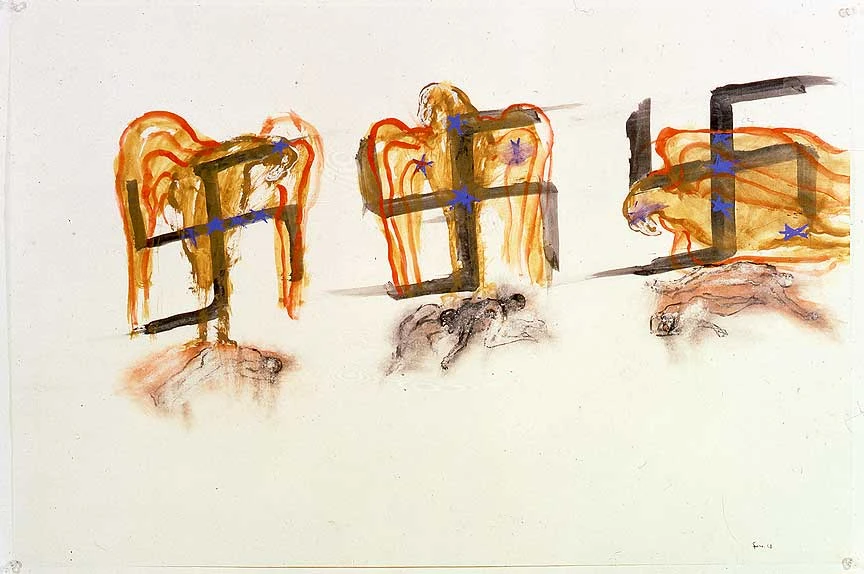
Nancy Spero - Eagles, Swastikas and Victims, 1968. Gouache and ink on paper.
The framework against itself
If reciprocal materialism is real, it applies to the tools this system proposes. The kill switch, the federated vanguard, the armed populace, the nationalization threshold - these are instruments. The principle predicts they will expand into available space.
Each carries a specific exposure. An armed populace trained for the duty to overthrow a degenerate state could be mobilized against a legitimate one. A federated vanguard designed to resist decapitation can equally resist democratic accountability. A nationalization threshold designed to prevent private accumulation of institutional power concentrates that power in the state. The framework's response in each case is structural - consultation-scope friction, legitimacy-as-natural-selection through public transparency, political-functional separation, and the armed-populace-state balance as mutual reciprocal constraint. None of these eliminates the risk; each is a dam designed to make expansion into that particular space structurally difficult rather than merely prohibited.
The full audit, including falsification candidates and the cases where the architecture is most exposed, is the work of the self-critique chapter. A framework that exempts itself from its own principle has already failed the test that principle imposes.
A dedicated chapter toward the end of the book - Where this framework's own principle cuts against it - returns to this self-application in detail. It names the seven places the framework's own prescriptions are most exposed to the expansion dynamic the book is built on: the nuclear arsenal, the transitional coordinating authority, the monitoring commission, the federated chapter network, the organizing-stage leadership, the anchor that triggers the framework to commit federated chapters to firing during the absorption window, and the enforcement infrastructure the framework specifies to plug the others. The reader is invited to read that chapter alongside the architectural chapters rather than as an appendix. The principle is self-applying, or it is nothing.
The boomerang in detail
The intellectual lineage - Luxemburg's Accumulation of Capital (1913), Césaire's Discourse on Colonialism (1950), Arendt's Origins of Totalitarianism (1951), Fanon's Wretched of the Earth (1961) - is treated in full in the marxist-lineage appendix. What follows is the case archive that supplements the three paradigmatic cases in main text.
The French experience in Algeria is among the most thoroughly documented. The Battle of Algiers (1957) saw French forces develop and systematize techniques that would later be classified as "enhanced interrogation" - waterboarding, electrical torture, prolonged stress positions, sleep deprivation. These techniques were overt, taught at military academies and exported through American training of Latin American militaries via the School of the Americas.12 French paratrooper Roger Trinquier wrote Modern Warfare (1961),13 a manual that codified the techniques and became core American counterinsurgency doctrine. The methods moved from Algeria to Vietnam to Latin America to Iraq to domestic "enhanced interrogation" programmes post-2001. Half a century later, during the 2005 uprisings in the Parisian banlieues, the French state deployed the same methods against its own citizens - many of them descendants of the Algerian communities France had colonized. The paperwork had changed. The methods had not.
The British experience is longer and deeper. Fingerprinting was developed in Bengal in the 1850s by William Herschel, refined by Edward Henry into a classification system, and imported to Scotland Yard in 1901.14 Census-based ethnic classification - the technique of sorting populations into governable categories - was perfected in India and became the model for population management throughout the British imperial system. The passport, the identity card, the administrative linkage between surveillance and access to services - these are colonial inventions, designed for colonial governance, now universal. The infiltration of domestic social movements by undercover police officers, exposed by decades of UK scandal, follows the same logic.15
The American experience follows the pattern. The Philippine-American War (1899-1902) was America's first major colonial counterinsurgency; waterboarding was used extensively, and the "strategic hamlet" concept - forcible relocation of civilian populations - was tested there, refined in Vietnam, and now informs "population-centric counterinsurgency" doctrine. The United States spent twenty years in Vietnam developing aggressive patrol-based policing, intelligence-led targeting of community leaders, militarized rapid response, and the treatment of civilian space as battlefield.16 The SWAT team is a Vietnam-era invention. The techniques came home in the 1970s and 1980s and became the model for American urban policing. After 9/11, the USA PATRIOT Act expanded domestic surveillance authority within six weeks; the NSA's PRISM, XKeyscore, and UPSTREAM programmes collected the communications of millions of Americans under laws written for foreign intelligence. The FISA court, the oversight mechanism, approved virtually every request placed before it.
The Israeli-to-American pipeline is the most contemporary and most direct. Elbit Systems17 provides surveillance technology for the US-Mexico border - the same towers, sensors, and integrated systems tested in the West Bank barrier. Israeli defence firms market their products as "battle-tested," meaning tested on a captive Palestinian population. American police departments send officers to Israel for training; the techniques they learn are applied to American communities. The pipeline has names: Cellebrite phone-hacking devices, tested on Palestinian detainees, were used to extract data from Black Lives Matter protesters in Atlanta and Chicago. NSO Group's Pegasus spyware, built by alumni of Israel's Unit 8200, has been sold to dozens of governments; a leaked list of more than 50,000 phone numbers identified as targets of interest by NSO clients included journalists, activists, and heads of state.18 The Israeli prime minister used Pegasus access as diplomatic currency, trading surveillance capability for UN votes. Atlanta's "Cop City" police training facility was modelled on Israel's "Little Gaza" urban warfare replica; protesters opposing its construction were charged under counterterrorism laws. Skydio, which supplies military-grade drones for battlefield use, provided the same drones to Yale University police to surveil Gaza solidarity protesters.
The transfer from colonial laboratory to domestic deployment is no longer measured in decades. It is a procurement cycle. The boomerang does not weaken over time; it accelerates as capital accumulates. Each cycle refines the tools, expands their application, and normalizes their use. The colonial census that required a clerk with a ledger now runs on algorithmic classification systems processing millions of data points per second. The water flows faster each time, and the space available to it grows.
Technology and the transgression category
The framework divides technology into categories based on the reciprocal consequences of deployment. There is no binary classification of good and bad technologies. A socialist system must consider the classification of what happens when the activation conditions are present - and how inherent those conditions are to the technology itself. The nationalization piece develops the full technology spectrum in detail. Here, the relevant contribution is the structural distance concept to ground the classification.
Structural distance between possession and deployment is the diagnostic tool. A nuclear arsenal can sit in hardened silos for decades without being used: its purpose is served by existing. The capability deters because the adversary knows the reciprocal cost of aggression is annihilation - the deterrence of mutually assured destruction is the relevant property here, regardless of one's view on its ethics. Possessing the weapon and using the weapon are separated by wide structural distance - chain-of-command authorization, physical launch procedures, multiple deliberate human decisions. A domestic surveillance apparatus cannot sit unused. A data centre collecting the communications of a population is using its capability by collecting. There is no version of mass domestic surveillance infrastructure that "possesses" the capability without "deploying" it. The structural distance is zero - the act of building the system is the act of using it. For domestic surveillance, acquirement is usage - hence it is a transgression.
Between these endpoints, other technologies fall at various points on the spectrum. Encryption tools have a wide range of structural distances. Biological weapons research has narrow structural distance - the expertise developed for "defensive" bioweapons research is functionally identical to the expertise needed for offensive deployment. Social credit infrastructure sits near the surveillance end - a scoring system that exists is a scoring system that is sorting.
The spectrum replaces a binary distinction with a diagnostic tool. For any technology, the framework asks: what is the structural distance between possession and deployment? How many deliberate activation steps separate the neutral resting state described by Marx from the harmful state? And are the activation conditions for reciprocal deployment inherent to the technology, or contingent on institutional design that can be altered? The full classification - socializable, conditionally deployable, deterrent, and transgressive - is developed in the nationalization piece, where it connects to the question of what should be collectively owned, what should be regulated, and what should not exist.
Identity persecution falls under the transgression category via the structural-consequentialist path rather than the technical-structural path. The structural distance between a single act of discrimination and systemic harm is not zero in the way that surveillance infrastructure's structural distance is zero. But the cumulative pattern produces the same prescriptive conclusion. The working class holds power as a classiii - that is the framework's foundational commitment. Identity persecution - the criminalization of queerness, the systematic exclusion of ethnic minorities, the enforcement of conformity by the state - fragments the working class along identity lines. A fragmented working class cannot hold power as a class. The historical record is unanimous: every socialist state that reproduced imperial-capitalist identity hierarchies weakened itself by doing so. Identity persecution is prohibited because its reciprocal consequences are structurally predictable, severe, and historically without exception. The argument is empirical rather than architectural, and the distinction matters - but the prescriptive weight is the same.
Ecology as reciprocal constraint
Ecology is not a domain in which the institutional mechanism also applies. It is a different mechanism with the same shape - what the main text names metabolic reciprocity, a sibling to the institutional reciprocity that runs through surveillance apparatus, regulatory capture, and party-state ossification. Both produce the same pattern: extraction without return produces return against the extractor. The physics underneath the pattern differs, and the difference matters for what kind of dam holds.
Institutional reciprocity requires an institution. The apparatus persists, the expertise stays with people who keep drawing salaries, the budget reproduces itself, and in the absence of designed containment the capability expands in every direction the institution can reach. Metabolic reciprocity does not require institutions. It runs on a physical condition: the rate of extraction exceeds the rate of regeneration. The soil does not have expertise. The atmosphere does not have a budget. When the extraction rate outpaces the regeneration rate, the return is clear - reduced yields, collapsed fisheries, shifted weather, uninhabitable regions. The political label on the extractor is irrelevant. The Soviet Union's industrial programme destroyed the Aral Sea by the same metabolic mechanism that capitalism destroyed the cod fishery. No institutional memory was required on either side.
Foster's Marx's Ecology (2000)19 and Saito's recent extension are the direct lineage; Marx's original Capital Vol. I, chapter 15 treatment of the metabolic rift20 is the source. The framework treats ecological sustainability as a hard material constraint - the same sense in which gravity is a constraint, something you can account for or be destroyed by, but not negotiate with. The architectural answer (carrying-capacity thresholds, ecology budget, restoration-first allocation, ecocide disqualification) is developed in full in the not-utopia chapter. The point this chapter needs to land is that any socialism that reproduces capitalism's extractive relationship with the earth will produce the same reciprocal consequences as capitalism does, regardless of its political label.
::: figure src="wiley-salgado-kuwait-1991.webp" align="center" Sebastiao Salgado - Kuwait, Oil Wells, 1991. Gelatin silver print.
The unfortunate reality of the ecological issue, globally, is that democratic channels have already been tried. Paris Agreement? Withdrawn. Green New Deal? Failed. The reader is left to choose a proportional response.
:::
The conservative epistemological tradition - Burke,21 Oakeshott, Hayek, Niebuhr22 - made the strongest intellectual case against systems that propose to build new institutions: institutional wisdom accumulates over centuries, practical knowledge cannot be transmitted, dispersed local knowledge resists central design, and institutions amplify the worst tendencies of their members. The framework's response is that "everything comes back" is the secular-materialist expression of the same tragic insight, channelled into structural engineering rather than defence of the status quo. The transition is time-bounded; existing institutional achievements (due process, civil liberties, judicial independence) are preserved where empirically sound; the central principle is applied to the framework's own designs in the self-critique chapter. Whether the dams hold is an empirical question that can only be answered by building them.
Positioning within the tradition
Reciprocal materialism has parents, siblings, and near-cousins. None of them is this system, and none of them are disposable. The full lineage discussion sits in the marxist-lineage appendix; what this block names is the specific delta between RM and each adjacent concept.
Luxemburg's imperial boomerang (Accumulation of Capital, 1913) is the direct parent: capitalism's structural need to expand into non-capitalist territories, the return of imperial methods to the metropole. RM generalizes the mechanism beyond colonial contexts by naming the activation conditions (institutional persistence, expertise retention, budget inertia, absence of designed containment), distinguishing omnidirectional expansion from the boomerang's visible return, and grounding the transgression category in the structural-distance concept.
Djilas's New Class (1957) diagnosed bureaucratic-class formation in socialist states. RM mechanizes the diagnosis: the party apparatus is a coercive apparatus subject to RCE, and the anti-ossification architecture is containment targeted at the activation conditions Djilas identified.
Capture theory (Stigler, Kolko, Laffont-Tirole) describes regulatory capture as a phenomenon. RM specifies activation conditions and prescribes structural rather than legal containment. RM predicts the independent regulator fails at measurable rates because the regulator is itself subject to the same conditions - a testable difference from capture theory's standard remedy.
Foster's and Saito's metabolic rift is the primary-case ancestor for the metabolic-reciprocity mechanism. RM does not stretch institutional-expansion logic to cover ecology - it names metabolic reciprocity as a sibling mechanism with the same pattern and different physics.
A second tier sits further from the core. Michels's iron law is shape-similar but applies to organizational form only. Polanyi's reciprocity is a namespace collision - Polanyi's reciprocity is pro-social (gift economies); RM's is adversarial (the boomerang). Historical institutionalism (North, Pierson) describes path-dependent lock-in; RM adds the expansion dynamic. Weber and Tilly are foundational genealogy.
What RM does not claim is that the pattern is new. What it claims is that the conditions under which the pattern fires have not been specified with this exactness before, and that the prescriptive stance - containment materialism - follows from the conditions rather than from the pattern alone.
What RM predicts that prior traditions do not
Luxemburg, Weber, Foster, Stigler, and Michels each saw a version of the dynamic RM names. The test of originality is whether RM makes specific predictions the prior traditions do not, and whether those predictions can be checked, not whether the mechanism has been described before. What follows is the empirical fingerprint.
Legal containment without structural containment reliably fails. Capture theory and liberal constitutionalism both prescribe legal and procedural limits on power - oversight committees, judicial review, statutory constraints. RM predicts these fail at measurable rates where the underlying activation conditions remain untouched. Test: compare apparatus constrained only by legal means (NSA pre-Snowden, CWC enforcement against powerful states) with apparatus constrained by structural means (Iceland's post-2008 banking architecture, Japan's distributed intelligence structure). The cases fall consistent with the prediction. Capture theory does not distinguish these categories; RM does.
Latency before expansion is predictable from the activation conditions. Where the conditions are present but expansion has not yet arrived, RM predicts it will. Neither Luxemburg's boomerang nor Weber's bureaucracy commits to when the dynamic triggers. RM predicts latency, not just outcome, and the prediction has been confirmed repeatedly - British colonial techniques took decades to return, NSA surveillance took under ten years, and the faster latency tracks the tighter feedback loops of the later cases.
Institutional removal outperforms constraint for containable institutions. Costa Rica abolished its military in 1948 and has not reconstituted it; the policing apparatus that remained did militarize, consistent with RCE's prediction of expansion for the apparatus that persists. RM predicts that where institutional removal is feasible, it outperforms structural constraint. Most frameworks treat removal as unrealistic. RM treats it as the strongest available containment because removal eliminates the activation conditions rather than managing them.
Legal and normative containment varies inversely with the violator's power asymmetry. The Chemical Weapons Convention held for states without the power to violate with impunity; it failed for states with that power. RM predicts this pattern as a structural regularity, not an accident of enforcement. The prediction sharpens the distinction between legal containment (which depends on enforcement capacity) and structural containment (which does not).
Capture theory's independent regulators experience capture or ossification at measurable rates. This is a directly falsifiable prediction against a concrete alternative prescription. If independent regulators hold at rates indistinguishable from structurally-contained institutions, RM's prescriptive divergence from capture theory collapses. If they fail at measurably higher rates, the structural prescription is vindicated. The historical record so far is consistent with the structural prediction, but the case is genuinely open.
Zero-structural-distance capabilities expand regardless of governance regime. The sharpest specific prediction the framework commits to. Any domestic mass surveillance system built will be used against its own population within a timeframe shorter than the government's political cycle - regardless of legal constraints, oversight mechanisms, or regime type. The transgression category derives from this prediction. The prediction is what makes domestic surveillance an architectural prohibition rather than a policy preference.
A framework that predicts what prior traditions also predict is not original. A framework that predicts what they do not predict and that can be wrong in specified ways - is doing the work originality requires. The predictions above are the work RM is accountable for.
The generalization argument
The epistemological status of RCE is inductive, not deductive - a pattern that holds under identifiable activation conditions with such consistency across independent domains that organizing analysis around it is rational, not a theorem proved from axioms. The analogy is to other conditional regularities that lack deductive proof but are confirmed by the weight of evidence: corrosion under specific chemical conditions, evolutionary adaptation under selection pressure, the tendency of capital to concentrate under competitive market conditions. The accumulation of observations over independent domains, combined with consistent activation conditions, produces a confidence level sufficient for analytical commitment and a falsifiable claim.
The implication for socialist theory: the tradition has always needed normative constraints - do not build a police state, do not purge dissidents, do not criminalize minority identity - but has struggled to ground them in material terms. RM grounds them. The constraints derive from material consequences, not from liberal idealism or religious morality. The ethic is derived from the material prediction.
Precedent texts (Marx's metabolic rift, Luxemburg, Césaire, Arendt, Fanon, Rodney, Foster, Moore) are catalogued in the marxist-lineage appendix.
The principle does not exempt the framework that named it. Every institution this book proposes operates under conditions that activate the same expansion dynamic the principle predicts. Naming that exposure honestly is the work of the self-critique chapter, where the architecture is checked against its own analysis.
Nicholas B. Dirks, Castes of Mind: Colonialism and the Making of Modern India (2001). ↩
Chandak Sengoopta, Imprint of the Raj: The Colonial Origin of Fingerprinting (2003). ↩
Washington Post, "Here's Everything We Know about PRISM to Date" (2013). https://www.washingtonpost.com/news/the-switch/wp/2013/06/12/heres-everything-we-know-about-prism-to-date/. ↩
Antony Loewenstein, The Palestine Laboratory (2023), ch. 1. ↩
Electronic Privacy Information Center, "Foreign Intelligence Surveillance Act Court Orders 1979-2022" (2022). https://epic.org/documents/foreign-intelligence-surveillance-act-court-orders-1979-2022/. ↩
Shoshana Zuboff, The Age of Surveillance Capitalism (2019), ch. 1. ↩
Virginia Eubanks, Automating Inequality: How High-Tech Tools Profile, Police, and Punish the Poor (2018), ch. 5. ↩
Frank Pasquale, The Black Box Society: The Secret Algorithms That Control Money and Information (2015), ch. 2. ↩
Washington Post, "Here's Everything We Know about PRISM to Date" (2013). https://www.washingtonpost.com/news/the-switch/wp/2013/06/12/heres-everything-we-know-about-prism-to-date/. ↩
Irina Roldugina, "Soviet Recriminalization of Homosexuality", Russian Review (2025). ↩
Irina Roldugina, "Soviet Recriminalization of Homosexuality", Russian Review (2025). ↩
Lesley Gill, The School of the Americas: Military Training and Political Violence in the Americas (2004). ↩
Roger Trinquier, Modern Warfare (1961). ↩
Chandak Sengoopta, Imprint of the Raj: The Colonial Origin of Fingerprinting (2003). ↩
Rob Evans; Paul Lewis, Undercover: The True Story of Britain's Secret Police (2013). ↩
Stuart Schrader, Badges without Borders: How Global Counterinsurgency Transformed American Policing (2019). ↩
Antony Loewenstein, The Palestine Laboratory (2023), ch. 3. ↩
Forbidden Stories; Amnesty International, "The Pegasus Project" (2021). https://forbiddenstories.org/about-the-pegasus-project/. ↩
John Bellamy Foster, Marx's Ecology (2000). ↩
Karl Marx, Capital, Volume I (1867). ↩
Edmund Burke, Reflections on the Revolution in France (1790). ↩
Reinhold Niebuhr, Moral Man and Immoral Society (1932). ↩
i. Near-universal claim, with a precautionary default for contested measurement. Where regeneration rates are measurable and extraction sustainably exceeds them, collapse of the productive base is mechanical and the claim approaches the strength of physical law - the soil does not have a budget and the atmosphere does not have expertise, which is exactly why the institutional activation conditions are not the operative variables here. Where the regeneration rate itself is contested - fisheries under disputed stock-assessment models, soils under contested carbon-cycle accounting, atmospheric sinks at the climate-system boundary - the architectural default is the lowest defensible carrying capacity, revisable upward on convergence of measurement and not downward without it. The asymmetry is the dam where the physics is honest and the data is not yet. ↩
ii. Conditional-deductive on the trajectory under conditions; inductive on the conditions' co-occurrence. Once the four activation conditions are specified, the expansion follows from material constraints with the certainty that corrosion follows from electrochemistry once moisture, oxygen, and a galvanic couple are specified. The framework's empirical claim sits on the left side of the conditional - that the four conditions co-occur, by default, across every state coercive apparatus and across most institutional and technological systems. A documented apparatus where the conditions held and the trajectory did not arrive, across a timeframe sufficient to rule out latency, indirect expansion, and missed structural containment, weakens the deductive claim and would force the framework to add a fifth activation condition or weaken the calibration to strong-tendency. The corrosion analogy is not rhetorical; it is the conditional-deductive form, and the framework's claim is the same form. ↩
iii. Marx's term for this commitment was dictatorship of the proletariat - class power, not party power. The original-vocabulary lineage is laid out in the Marxist-lineage essay; chapters 001–019 use translated language so that the architecture is legible without the inherited terminology. ↩