Start tomorrow: a framework for action
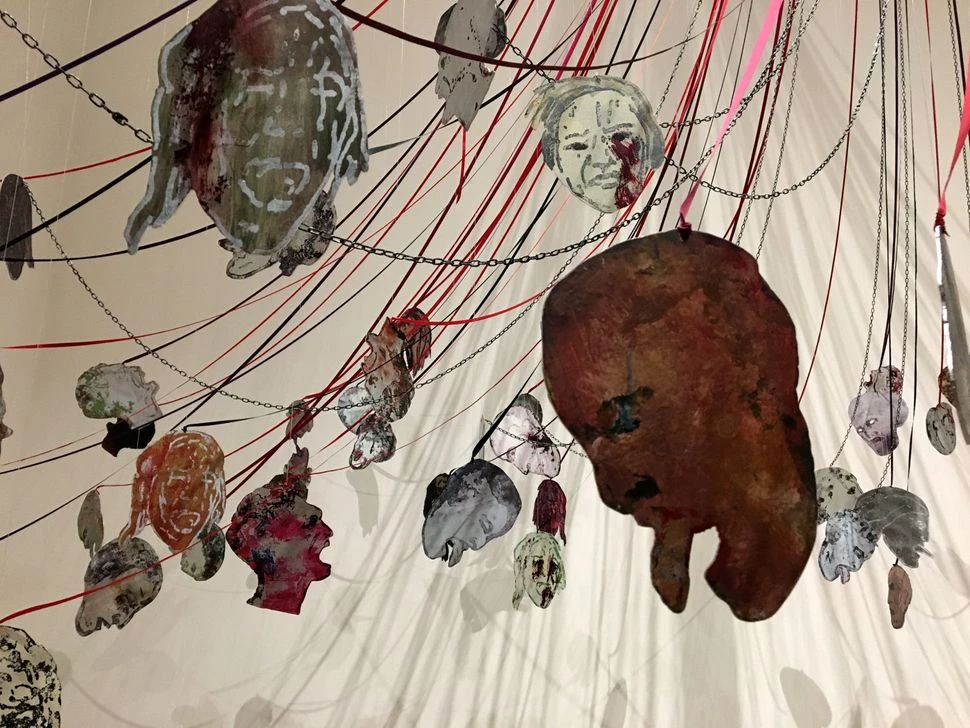
Nancy Spero - Maypole: Take No Prisoners, 2007. Print and installation.
Nine pieces of theory. Structural analysis, historical diagnosis, case studies, a description of what success might look like. All of it necessary. None of it sufficient.
The question that has been running underneath this entire series - underneath the analysis of class, the architecture of the state, the lessons of history, the honest picture of what we are building toward - is the one question that matters: what do I actually do?
This is the answer. It is not complete. It cannot be. Your conditions are not my conditions. The proportional response where you are is not the proportional response where I am. The framework is a compass, not a map. But a compass still tells you which direction to walk.
Here is what to do. Start tomorrow.
Organize in person
Not online. In person. With people you know, people you trust, people you can look in the eye.
Start with whatever fits your conditions. A reading group. A tenants' union. A workplace action committee. A mutual aid network. A community defence training programme. Whatever the material conditions around you demand and whatever your capacities allow.
The counter-hegemony piece diagnosed the problem: the internet converts the impulse to resist into the impulse to post. Consciousness without organization is anger that goes nowhere. The solution is not better posting. The solution is organization that exists in physical space, with people who show up, who have names, who take on roles and carry them out.
This does not mean the internet is useless. It means the internet is a tool for amplifying action, not a substitute for it. Use it to coordinate. Use it to broadcast. Do not use it to perform.
The unit of organization is the chapter. A chapter is a small, purpose-specific group with internal discipline, shared analysis, and operational autonomy. It does not take orders from a central committee or need permission from a national body. It coordinates with other chapters through shared information, shared principles, and mutual solidarity. It commands no one and is commanded by no one.
This is the federated vanguard model. Not one big organization with a leader who can be arrested, co-opted, or assassinated. Many small organizations, each with its own purpose, each with its own discipline, each standing in solidarity with the others. The state cannot decapitate what has no head.
How many people? Start with a few, maybe five. Fifteen at most. Enough to do something real. Small enough to trust each other. You can grow later. Right now you need a room, a purpose, and people who will show up next week.
This is the organizing stage
Name it. What this piece describes - the organizing, the chapters, the infrastructure, the discipline - is the organizing stage. The anti-ossification piece describes what comes after: the transition is the period of necessary centralization during transition, with structural sunset clauses that prevent temporary measures from becoming permanent capture. The mature state is the mature operation of the framework's full architecture. You are building toward the transition by building the organizing stage.
The organizing stage is dual power. Not seizing the state. Building alongside it. Cooperatives that demonstrate worker ownership works. Mutual aid networks that provide what the state will not. Community land trusts that take housing out of the speculative market. Tenants' unions that organize buildings. Workplace committees that win concessions. Each of these is a concrete demonstration that alternatives function - and each builds the organizational capacity that the transition will require.
Dual power is the material existence of parallel institutions that serve the working class better than the existing ones. When enough of these exist, when enough people depend on them, when the organizational infrastructure is dense enough - that is when the conditions for the transition emerge. Not because someone declares the revolution but because the material basis for the next stage has been built, institution by institution, chapter by chapter.
The parallel institutions are ultimately the seed of the post-transition state and the prototype of its operational interfaces, while the organizing stage is when the prototyping has to happen. A national tenants' union that has spent a decade administering its own rent-control case management software is the institution that, on the day the rent-control function moves into public administration, has the working software, the case-handling protocols, the disclosure standards, and the trained membership that the public administration would otherwise have to assemble from scratch under transition pressure. The same logic applies to the mutual aid networks' supply ledgers, the cooperative federation's inter-cooperative settlement tools, the federated chapter network's secure communications layer, and the auditing community the digital sovereignty chapter requires - all of which have to exist as living, version-controlled, regularly-stress-tested infrastructure inside the movement before they are asked to perform the work the transition requires of them. The framework's commitment to building software inside the movement, rather than commissioning it from a vendor at the moment of need, is structurally identical to its commitment to building the auditing community inside the movement: the institutions the framework requires cannot be assembled at the moment of need, and the organizing stage is the period during which they are assembled at the only timescale that produces working artefacts.
The point of naming it is clarity. You are not waiting for the revolution. You are building its preconditions. Every cooperative formed, every mutual aid network established, every community land trust that removes a property from speculation, every chapter that trains and prepares - this is revolutionary activity. The organizing stage is the foundation.
Determine your readiness mode
Not everyone fights the same way. Not everyone should.
The framework identifies multiple modes of readiness. Physical and tactical. Digital and cyber. Democratic and political. Logistical and supply. Medical and care. Educational and consciousness-building. Each is necessary. None is superior.
A coder building encrypted communication infrastructure is as necessary as someone running a mutual aid kitchen. A nurse training others in field medicine is as necessary as someone organizing a workplace strike. A teacher running political education is as necessary as someone blockading a port.
Your readiness mode is determined by two things: what you can do, and what your conditions require. If you live somewhere the state is already exercising violence against your community, physical readiness may be the immediate requirement. If you live somewhere democratic institutions still function, democratic organizing is the right starting point. Both are valid. Both are necessary.
The question is not which mode is correct. The question is: what will you do when conditions escalate? Know the answer before they do.
Every chapter determines its readiness mode in advance. Every member knows their role. This is not paranoia. This is the lesson of Chile. The people who voted for Allende had no militia capacity when Pinochet's tanks came.1 They had won democratically. They were correct to pursue the democratic road. But they had no plan for what the state did next. Over three thousand were killed or disappeared. Tens of thousands were tortured.
Know your readiness mode. Know your role. Rehearse it.
The capacity-building pathway
The self-critique names the constitutional armed populace as the framework's most uncomfortable load-bearing element. The not-utopia chapter describes what it looks like in steady state. This section describes the route from here to there - how an unarmed organizing context, in a society that has not yet entered transition, builds the material competence the constitutional duty will eventually require, without skipping the structural conditions under which such competence becomes legitimate.
The pathway is bounded at four stages, and each stage is conditional on the conditions of the previous stage being met.
Stage one: civic-defence training as a publicly visible competence. First aid certification, communications discipline, coordinated response to non-political emergencies (fires, floods, search-and-rescue). The chapter trains together because the chapter does everything together; the competence developed at this stage is indistinguishable from the competence the chapter would develop in any disciplined collective practice. The political content is the chapter's existence as a federated body, not the specific training. This is the stage most chapters are at most of the time, and it is the only stage the framework asks of any chapter under conditions where democratic institutions remain functional.
Stage two: readiness modes formalized. The chapter declares its readiness mode publicly within the federation, joins the cross-audit pairs that match by mode and region, and develops the operational competence its declared mode requires - mutual-aid logistics for the medical-and-care mode, secure-communications buildout for the digital-and-cyber mode, mass-organizing infrastructure for the democratic-and-political mode. No chapter declares physical-and-tactical readiness without the federation having first met the conditions that the proportional-response analysis names for that mode being proportionate to local conditions. The threshold is structural, set by the federation's reading of the conditions, and applied uniformly rather than chapter by chapter.
Stage three: community defence under conditions where the state has withdrawn protection or has begun to direct violence at specific communities. The framework names this stage explicitly because the historical record shows it arriving in some communities long before others, and the chapters that find themselves at this stage need a doctrine that does not require the entire federation to have reached the same conditions. Community defence is bounded: it protects against immediate violence, it does not pursue, it does not retain captured material, it does not exceed the proportionality of the threat. The chapter coordinates with neighbouring chapters under the federated model, not under unified command. Auditing of community-defence operations is conducted by the cross-audit chapters that did not participate, and the findings are public.
Stage four: coordinated militia under structural conditions. This is the constitutional armed populace the self-critique names. It is reached only under the conditions the transition chapter names, with the sovereign defence trust administering the rotation infrastructure, the constitutional duty-to-overthrow ratified, the federation's chapters holding their constitutional standing, and the state having committed to the constitutional posture the rest of the architecture rests on. The pathway does not run from stage three to stage four through escalation; it runs through structural conditions being met. The framework does not endorse the leap.
The pathway is named in stages because the most common failure mode of the historical record is chapters that skipped stages, and the second most common failure mode is chapters that refused to begin the pathway at all because the destination looked uncomfortable from where they stood. The framework's discipline is that the pathway is walked. The discipline is also that it is walked in order, with the structural conditions for each stage met before the next is contemplated.
Build communications infrastructure
Do not organize on platforms owned by the people you are resisting.
Your group chat, your social media, your cloud storage, your email - all of it runs through infrastructure controlled by the same concentrated capital the framework identifies as the problem. When conditions escalate, that infrastructure will be used against you. This is RCE. Every surveillance tool built for one purpose will be turned to every other purpose. That is the structural constraint the entire framework is built around.
Build your own.
Encrypted channels for communication: end-to-end, not server-side. Mesh networking capability for when centralized systems are taken down. Offline protocols - predetermined meeting points, physical fallbacks, analogue methods for when the digital goes dark.
This is the infrastructure layer of the kill switch. Each communication layer serves double duty: redundancy for communication AND verification of whether the failure of the layer above was natural or deliberate. If the encrypted channel fails, you check the mesh. If the mesh confirms the channel was taken down deliberately - or the mesh also fails - you have moved from inquiry to heightened posture. Each layer's failure or success provides the information that moves your chapter up or down the graduated readiness ladder. This only works if the infrastructure exists in advance, if every member knows the fallback protocol, if the mesh can operate when the servers go dark.
General principles, not specific tools. Tools become outdated, compromised, or co-opted. The principle remains: do not rely on centralized infrastructure you do not control. Any tool endorsed today may be compromised tomorrow. Evaluate every communication tool by a simple test: who controls the infrastructure, and what happens when they decide to cooperate with the state?
Build it now, while conditions are quiet. Test it. Train your people on it. It is useless if no one knows how to use it when they need it.
Civic education and integration
The chapter is also an outreach node for the population around it. The federation pedagogy architecture names the rotation between practice and outward teaching at the federation level; the operational form at the chapter level is the civic-education programme the chapter runs in its community.
The programme is voluntary at every step. Open classes on the framework's principles, the federation's structure, the chapter's current campaigns, and the practical work of organising. Integration sessions for new members that walk the chapter's discipline, communications infrastructure, and proportional-response posture. Public reading groups that work through the framework's chapters on a published sequence. The classes are taught by chapter members on rotation, paired with members from other chapters in the federation when the chapter is at the outward-teaching pole of its rotation. The materials are public and the rotation register is public. The programme functions as integration in the operational sense: a published path from open class to integration session to chapter membership, with each stage running on the same documented cycle the federation's other practice runs on.
The discipline the be-disciplined section and the be-patient section name applies to the civic-education programme at full strength. The classes run on a published cycle. The materials carry the chapter's current practice, drawn from current campaigns. The programme is read against the practice the chapter's other work generates. A chapter whose outreach programme has drifted from its current practice, has consolidated a teaching style that operates as a gatekeeper to participation, or has taken on the texture of a permanent canon-keeping role registers in the federation's audit pairings and the rotation cycle pulls it off the outward-teaching pole. The system's commitment is that civic education stays close to civic practice, on a cycle short enough that the drift the diagnostic predicts is caught before it sets.
Stop performing
Stop posting about revolution and start doing things.
The counter-hegemony piece laid out the trap: the internet provides a neurochemical reward for performing resistance that is functionally identical to the reward for actually resisting. Posting about exploitation feels like doing something. It is not. It is content production for platforms that profit from your outrage.
The discipline is simple. Engage only with demonstrated action. Stand in solidarity with those who act. Ignore those who only post.
If someone organizes a rent strike, amplify it. If someone blockades a pipeline, stand with them. If someone runs a mutual aid programme that feeds people, volunteer. If someone posts a thread about how capitalism is bad, keep scrolling.
This is not cruelty, but filtration. Every successful revolutionary movement solved the consciousness-to-organization problem the same way: through action that separates the committed from the sympathetic. The framework applies the same logic to a generation that has more awareness and less organization than any in history.
You will make enemies of people who believe posting is praxis. That is the cost. The alternative is a movement that is all signal and no substance, absorbed by the very system it claims to oppose.
One failure mode this chapter has to name directly because it has consumed the last decade of left organizing. Protests are not fun. They are not performance. The march that ends at the rally, the rally that ends at the photo, the photo that ends at social media - that is not action, it is the displacement of action by its appearance. The framework does not romanticize this. I have participated in it, watched it produce no structural change, and watched the energy of my generation be absorbed by it. The recommendations in this chapter are calibrated against this specific failure: every recommended practice is one whose success or failure is materially observable, not aesthetic. If a tactic cannot be assessed by what it changed in the conditions, it is not a tactic. It is a pattern of behaviour the framework is trying to break.
A direct address to the segment of readers whose situation I share. The framework asks the technical fraction of the PMC to organize against the apparatus that pays it. I am writing this book under the same constraint. The ask is not naive - there is a material cost, the cost is not symmetric across the layer, and the cost is real. The framework does not pretend otherwise. What it argues is that the cost of not acting, distributed across the timeline the diagnosis chapter describes, is higher.
The PMC is not a single class, and the ask is not symmetric across it. The class chapter names the layer's internal heterogeneity directly, and the economic-architecture chapter names the structural place each fraction occupies. The technical fraction - the engineers, the analysts, the platform builders - holds the apparatus's operating instructions and is paid in proportion to the apparatus's success. The care-labour fraction - the nurses, the teachers, the social workers, the community-health workers - holds the apparatus's exposure points and is paid in proportion to the apparatus's failures. The two fractions are not interchangeable, and the ask the framework makes of each is not the same.
The technical fraction is asked to redirect competence. Build the mesh network. Audit the open-source code your chapter depends on. Refuse the contracts whose function is the apparatus's expansion. The cost is the performance review, the partnership track, the security clearance, the reputation in the industry; the framework does not pretend the cost is small.
The care-labour fraction is asked to refuse complicity at the points the apparatus depends on care-labour for legitimacy. The nurse who documents use-of-force injuries at protests instead of looking the other way. The teacher who runs political education in the curriculum the district has not yet found a reason to dismantle. The social worker who refuses to be the data-collection front-end for a state apparatus whose downstream uses the framework's analysis predicts. The community-health worker who carries the chapter's medical readiness across the threshold from voluntary to constitutional when the conditions activate. The cost for the care-labour fraction is administrative friction, performance reviews, sometimes licensure - and, distinct from the technical fraction's costs, the social cost of refusing to perform the role the apparatus has scripted for the helping professions. The care-labour fraction's compliance is what makes the apparatus look like it cares. The framework's ask is that the appearance is withdrawn from the apparatus that has not earned it.
Both fractions are necessary. The framework does not value one above the other. The diagnosis applies to both, the cost is real for both, and the structural conditions under which both are organized are the conditions the federated chapter model is built to provide.
Accept risk
There is no change without risk. Anyone who tells you otherwise is selling you a pressure valve.
This means different things for different people. For the privileged - the white professional, the person with savings, the citizen with legal status - risk means your career, your reputation, your comfort. For the undocumented worker, the Indigenous land defender, the racialized person in a country that polices bodies by default, risk means your freedom, your safety, your life.
The framework's position is unambiguous: different levels of solidarity based on different levels of risk is unacceptable. The privileged must absorb more risk to reduce the burden on the vulnerable. This is structural obligation, not optional solidarity.
If your comrade faces deportation for striking, your obligation is to strike alongside them. Absorb the career risk that is smaller than their existential risk. Make the state's calculation harder. If your comrade faces police violence for blockading, your obligation is to be at the blockade. Make the state brutalize a body it was not expecting to brutalize. Generate outrage it cannot contain.
The system treats different bodies differently. That differential treatment becomes a weapon when the privileged refuse to benefit from it. When the professional stands next to the land defender, and the state must decide whether to brutalize both, the cost of repression rises. This is the material logic of solidarity. It is not sentiment. It is strategy.
Accept the risk that corresponds to your position. Then accept a little more.
Concrete cases. You are a software engineer. Your risk is using your skills to build communication infrastructure for a chapter, and the possibility that your employer discovers your political organizing. You are not risking your life. You are risking a performance review. Build the mesh network. You are a lawyer. Your risk is taking on cases that your firm's clients would rather you did not take, or providing pro bono legal support to organizers who cannot afford representation. You are risking a partnership track. Take the case. You are a nurse. Your risk is documenting use-of-force injuries at protests rather than looking the other way, or training your chapter in field medicine. You are risking administrative friction. Document the injuries.
The framework does not ask everyone to risk everything. It asks everyone to risk something. The something is proportional to your position - the more you have, the more you can absorb, and the more you should. The person with nothing to lose has been risking everything already. The person with everything to lose has been risking nothing. The framework asks the second person to move.
If you are worried about what happens to your house, your debt, or your pension under the framework, the material specifics address this directly - your home is not taken, your debt is cancelled, and your retirement is guaranteed.
Disrupt capital
Not symbolically. Materially.
A march the police permit is not disruption. It is a pressure valve. The system absorbs it, photographs it, reports on it, and nothing changes. The next day the rent is still due. The CEO still receives the bonus. The warehouse still runs shifts at a pace designed to break human bodies.
Disruption means imposing costs on capital that capital cannot absorb or redirect. Strikes. Blockades. Work stoppages. Supply chain interruptions. Port shutdowns. The withdrawal of labour from the systems that depend on it.
Capital absorbs everything except its own disruption. It can commodify your aesthetic, your language, your symbols. It can sell Che Guevara on a t-shirt and Black Power as a shoe campaign. What it cannot commodify is a factory that stops producing. A port that stops shipping. A gig platform whose drivers do not log on.
The criterion is simple: does this action impose a material cost on capital? If yes, it is worth doing. If no - if it only generates awareness, only produces content, only makes a symbolic statement - it is not disruption. It may have other value. It is not the work this piece describes.
This does not mean every action must be a general strike. Start where you are. A workplace action committee that negotiates better conditions is disrupting capital's extraction of surplus from those specific workers. A tenants' union that prevents an eviction is disrupting capital's extraction of rent from that specific building. A boycott that costs a corporation revenue is disrupting that specific revenue stream. Scale comes later. Start with what you can impose.
Chokepoints, capital blinks, and the asymmetry honestly named
The disruption above is the work at the chapter's scale. The chokepoints are the work at the structural scale, and they are named here because the strategic geography is what determines which disruption is at which phase actually decisive.
The imperial economy runs on a small set of chokepoints. SWIFT and the dollar-clearing system carry most international payments and can be weaponised against any state that crosses Washington. The container-shipping network runs through a handful of straits and ports - Hormuz, Malacca, Suez, the Panama Canal, the major US and Chinese transhipment hubs - and a disruption at any of them propagates across global supply chains within days. The submarine-cable network carries roughly 99 percent of intercontinental data traffic across a few hundred cables whose physical landing points are publicly mapped. The reinsurance market is concentrated in a few firms whose exposure decisions effectively gate which projects, which trade routes, and which states' economies can operate. Each of these is a chokepoint in the precise sense: the failure of a single point produces system-level disruption.
The strategic logic is symmetric. The imperial state uses these chokepoints against its adversaries - the SWIFT disconnection of Iran and Russia, the insurance-market exclusion of Iranian oil cargoes, the threat to the cable layings serving Cuba and Venezuela. The framework's posture is to recognise that the same chokepoints become available to a sovereignty-defence movement under conditions where the movement has built the operational capacity to use them. The recognition does not yet name a programme. The sovereignty chapter's adversarial reciprocation section carries the operational moves at the state scale. This chapter names the strategic geography so that the movement is reading the same map.
The asymmetry is honestly named. The imperial state has the chokepoints. The movement does not. The window during which the chokepoints become contestable is the window in which the federation has been built and the state has crossed the threshold the sovereignty chapter specifies. Until then, the chokepoint analysis is diagnostic rather than operational at the chapter level. What the chapter does in the meantime is the patient work the organising stage names, with the chokepoint geography held in mind for the day the asymmetry shifts.
Capital blinks. The structural opportunity the chapter watches for is the moment when capital's chokepoint coordination breaks. The historical record names them concretely: 2008, when the financial system seized and required state rescue at a scale that exceeded the state's prior peacetime borrowing capacity; March 2020, when the COVID liquidity crisis required the Federal Reserve to expand its balance sheet by trillions in a few weeks; June 2019, when a tanker incident in the Strait of Hormuz briefly shut a sixth of global oil flow and the futures market priced two days of war risk before the de-escalation arrived; March 2021, when the Ever Given lodged sideways in the Suez Canal and held nine billion dollars of trade per day in suspension for six days; 2010-2015, when Greece's debt restructuring exposed the eurozone's structural fragility and produced the bailout coalition's panic that the Greek crisis would propagate.
One vignette as the load-bearing case. Cyprus, March 2013. The eurozone's bailout package for Cyprus was structured around a one-time levy on bank deposits, including deposits below the legally guaranteed insured threshold of one hundred thousand euros. The proposal was made on a Saturday. The Cypriot parliament was scheduled to vote it through. Across the weekend, Cypriot citizens queued at ATMs to withdraw their cash, and the queues did not produce panic - they produced a parliamentary vote on Tuesday that rejected the structure outright. The bailout was renegotiated within days under terms that exempted insured deposits. The political class that had been told a deposit confiscation was non-negotiable found, in the face of organised public refusal, that the non-negotiable was negotiable. The lesson is bounded but precise: capital's coordination is not omnipotent in the moments when the political costs of its preferred move spike beyond what the elected vehicles will absorb. The window is short. The chapter that has built its membership, its communication infrastructure, and its political relationships into the period when the window is closed is the chapter that can act through the window when it opens.
The chapter's posture toward capital blinks is the same posture the sovereignty chapter's strategic limit specifies for international support. The blink is a force-multiplier on a movement that is already operational. It is not the operationality itself. The architecture above is the work the movement does. The blink is the work the movement cannot.
Fight for the reform
This is not a contradiction. The framework's analysis - that structural change requires structural transformation, not incremental policy adjustment - does not mean reforms are worthless. Reforms save lives. Universal healthcare saves lives. Minimum wage increases reduce poverty. Tenant protections prevent homelessness. Environmental regulations slow ecological destruction.
Fight for the reform. Win it if you can. Then understand clearly what you have won and what you have not. You have won a mitigation within the existing structure. You have not changed the structure. The reform will be under pressure from the moment it passes. Capital will lobby to weaken it, defund it, repeal it. The next administration may reverse it. The court may strike it down.
Reform, within a system whose fundamental incentives remain unchanged, is harm reduction. Harm reduction is worth doing. It keeps people alive and functional while the structural work continues. A tenant protection law that prevents a thousand evictions this year buys time - time for those tenants to organize, to build the infrastructure described in this piece, to develop the capacity for the structural change that would make the protection permanent.
The trap is believing the reform is the destination. It is not. It is a rest stop. Fight for the rest stop. Then keep driving.
Protect each other
The framework values life. Every structural mechanism described in this series - the federated model, the graduated kill switch, the distributed communication infrastructure, the insistence on discipline - exists to minimize loss. Not to produce sacrifice. Not to valorize dying for the cause.
The revolution honours its dead with grief and love. It remembers the person, not the act of dying. It does not instrumentalize loss as motivation. Under RCE, a movement that benefits from its members' deaths creates a culture that consumes its own. That dynamic is self-destructive and it always has been.
Protect each other operationally. This means security practices appropriate to your readiness level. It means medical knowledge distributed through the chapter. It means legal support organized before it is needed, not after. It means knowing your comrades' situations - who has dependents, who faces immigration risk, who has health conditions - and assigning roles accordingly.
Protect each other personally. The person who was at the blockade yesterday gets a meal today. The person whose job was terminated for organizing gets rent covered by the chapter. The person who is falling apart gets support, not a lecture about resilience.
Solidarity is not an abstraction. It is the practical work of keeping each other alive, housed, fed, and sane while the system tries to break you individually.
Readiness exists so that fewer people get hurt. Discipline exists so that actions accomplish their aims without unnecessary exposure. Solidarity exists so that no one carries more than they have to. The human version is simpler: take care of each other.
Be disciplined
The bait is constant. Online arguments. Performative outrage. Infighting over theory. Aesthetic debates about what is sufficiently radical. Identity policing within the movement. Every one of these is a waste of revolutionary energy. The system benefits from every hour you spend fighting other leftists instead of organizing against capital.
Discipline means resisting the bait. It means the cyber operations group practicing its craft, not arguing on social media. It means the democratic organizing chapter running its campaign, not producing content about running its campaign. It means the physical readiness group training, not performing readiness for an audience.
Discipline also means refusing premature escalation. The framework insists that the state sets the terms. If someone in your chapter pushes for action that is not yet proportionate to the state's behaviour, that person is acting outside the framework. They may be an agent provocateur. This is exactly how COINTELPRO destroyed movements in the twentieth century.2 Or they may be sincere but impatient. Either way, the discipline is the same: proportionality is the rule. Response mirrors state action. It does not precede it.
This is itself an anti-infiltration mechanism. Agents provocateurs succeed by pushing groups to act before conditions justify it. A chapter that refuses to escalate ahead of state action cannot be baited into the kind of premature action that provides the state its justification for repression.
Be disciplined about infighting. There will be disagreements about theory, about strategy, about escalation levels. The framework accommodates this. Different chapters can operate at different escalation levels. Different socialist and communist tendencies can organize under different analytical frameworks. The system self-corrects through legitimacy-as-natural-selection: approaches that cannot sustain empirical justification lose support and dissolve. Approaches that prove themselves grow. This process does not require you to convince every other leftist you are right. It requires you to demonstrate your approach works. Focus your energy there.
Be patient. And be ready.
Material conditions are severe. Housing is unaffordable. Healthcare is inaccessible. Wages are stagnant while wealth concentrates at the top. The climate is destabilizing. Surveillance expands. The state carries out or funds wars that most of its citizens oppose. The conditions for mass consciousness are already present. The conditions for organization are emerging.
The indicators are concrete. Union membership in the United States fell to 9.9 percent in 2024 before ticking up to 10.0 percent in 2025.3 Yet union approval reached 71 percent in 2022 - the highest since 1965 - and has held near that level since.4 The gap between those numbers is the organising opportunity: tens of millions of workers who want collective power and do not have access to it. In 2025, the Bureau of Labor Statistics recorded 30 major work stoppages idling 306,800 workers.5 Kaiser mental health workers struck for over six months and won doubled preparation time and a 20 percent raise.6 Starbucks Workers United organised over 650 stores. The UAW published Plan 2028, a strategy for aligning contract expirations across the auto industry to enable coordinated strike action.7 Meanwhile, the Trump administration stripped bargaining rights from over one million federal workers8 - by scale alone the largest single act of union-busting in American history, exceeding even Reagan's 1981 destruction of PATCO.9 The conditions and the counter-conditions are accelerating simultaneously.
This does not mean the moment is tomorrow. It may not be this year or this decade. Revolutionary conditions develop on their own timeline, determined by material contradictions that no single movement controls. The framework's analysis begins democratic. Always. The first task is building the organizational infrastructure so that when conditions shift, the capacity already exists.
Patience is not passivity. Patience is building while you wait. Every tenants' union organized, every workplace committee formed, every mutual aid network established, every communication mesh tested, every chapter that trains and prepares, and each person who arms themselves and learns proficiency in their objective - this is the infrastructure of readiness. When the next crisis arrives, and crises are accelerating, the question is whether the organizational capacity exists to turn consciousness into action.
The international dimension follows the same logic. Solidarity with movements operating in other conditions is structural support for their work, not rescue of their work. The chapter does not wait for foreign solidarity to arrive before doing the work where it is, and it does not offer solidarity to other movements as a substitute for the conditions those movements are negotiating themselves. The sovereignty chapter's international approach develops this at the level of the state: international coordination is a force-multiplier on what is already there, not a substitute for what is not. The same posture applies to the chapter. You stand in solidarity with movements abroad - you absorb risk on their behalf where your own conditions permit it, you refuse to use your metropolitan position to soften the analysis their conditions require, you build the chapter that can act in coordination when coordination is what the moment requires - and you do not pretend that solidarity is a substitute for the work each movement is doing in its own conditions. Solidarity, not rescue. Force-multiplier, not substitute.
Build it now. Quietly, seriously, with discipline and care. Protect each other while you build. Train while you build. Distribute risk while you build.
The discipline gradient
The discipline the framework asks for is not constant. It scales with the chapter's size, its visibility, and the proximity of the conditions that would activate it. Naming the gradient prevents the chapter from over-applying the discipline of a federation-scale operation to the work that does not yet require it, and from under-applying the discipline of a federation-scale operation when the conditions have already shifted.
Kitchen-room scale (3-8 people). The chapter that meets in someone's kitchen is the unit at which most of this organising actually starts. The discipline at this scale is simple: trust between named people, in-person meeting, the absence of the digital footprint the counter-hegemony chapter names as the standard infiltration pathway, and the patient work of identifying the next three to five people who will join. The chapter at this scale is below the state's surveillance threshold under most conditions, and the discipline that matches the conditions is operational hygiene rather than counter-intelligence architecture. It is also the scale at which the federation's foundation is laid, and the work at this scale is the work most readers of this chapter are doing when they put the book down.
Network scale (50-500 people). The chapter that has crossed the network threshold is the scale at which the operational architecture starts to require explicit committee structure, secure communication discipline, and the political-functional separation in miniature - the people who organise the meeting are not the same people who run the campaign, and the campaign committee's mandate is bounded against the meeting's. Surveillance attention is increasing at this scale, and the discipline is the operational pattern the security culture section above specifies, applied at the operational tempo the network's activity actually produces. The chapter is not yet a federation; it is the federation's substrate.
Pre-federation scale (5,000-50,000 people). The chapter that has crossed the pre-federation threshold is operating at a scale that produces the first activation of the transition chapter's operational architecture. Coordination across multiple chapters; the petition body's prototype; the operational discipline that scales the kitchen-room trust into a structure that holds across multiple cities; the first negotiations with allied movements about coordination during the window the hold-both-horizons section specifies. Surveillance attention is sustained at this scale, and the discipline is the architectural pattern the armed-populace capacity-building pathway develops.
Federation scale. The chapter that has crossed the federation threshold is operating at the scale at which the transition chapter's compressed clock applies. The discipline at this scale is the discipline the transition chapter specifies, including the discipline gradient the self-critique chapter holds at full length: structurally, the federation's operational tempo is sufficiently faster than the kitchen-room tempo that the same chapter's members must adapt their discipline expectations as the federation expands.
The gradient matters because applying federation-scale discipline at kitchen-room scale produces an organisational culture that no one will join, and applying kitchen-room-scale discipline at federation scale produces an organisation that the imperial state's counter-intelligence apparatus disassembles inside a single news cycle. The chapter's posture is to read its own scale honestly and apply the matching discipline.
The metropolitan task during the deferral
The chapter writes for a metropolitan reader as much as for any other. The metropolitan reader is the reader who lives inside the imperial core, whose state is the state most likely to be the structural antagonist of the framework's transition in another part of the world, and whose political agency runs along the asymmetry the sovereignty chapter names directly. The chapter cannot pretend that the metropolitan reader's task is the same as the peripheral reader's task. The deferral the metropolitan position carries is not the deferral of the work; it is the deferral of certain forms of action whose imperial-core deployment would either be premature relative to the federation's threshold or actively destructive of the peripheral movements the metropolitan reader stands in solidarity with.
The metropolitan task during the deferral is bounded:
Refuse the imperial state's project. The metropolitan reader is structurally positioned to raise the political cost of the imperial state's operations against peripheral states. Voting against war authorisations where they appear; organising at the workplace level inside the firms whose products and services the imperial state contracts; refusing to participate in the production of the surveillance, weapons, and information-operations infrastructure the imperial core supplies to the broader system; supporting the workplace organisations that have already taken these positions inside the imperial core. The work is concrete. The leverage is real.
Build the metropolitan federation's substrate. The work this chapter has named throughout - tenants' unions, workplace committees, mutual aid networks, communication infrastructure - is the substrate the metropolitan transition will require. Building it now means the federation has somewhere to start when the conditions shift. The patient horizon and the compressed clock the hold-both-horizons section names apply to the metropolitan reader at full strength.
Solidarity, not rescue. The metropolitan chapter's relationship to peripheral movements is solidarity rather than rescue. This is the sovereignty chapter's on-your-own posture applied to the chapter scale. The peripheral movement is doing the work in its own conditions; the metropolitan chapter's task is to absorb risk on the periphery's behalf where the metropolitan position permits, to refuse to use the metropolitan platform to soften the analysis the periphery's conditions require, and to pre-commit the chapter to the coordination the federation will require when the window opens. What the metropolitan chapter does not do is treat its own organising as a rescue operation for movements that are doing their own work in their own conditions.
The honest naming of the asymmetry. The metropolitan reader's deferral is not a permanent condition. It is the recognition that the operational architecture the metropolitan transition will require is at a different state of development than the architecture the peripheral states' movements are already operating. The deferral is the work of building. It is not the work of waiting.
Submit and challenge
The framework is a tool the book holds to its own standard, and the self-critique chapter walks the standard in public. The same standard is the entry point for proposals that would extend, contest, or replace any prescription the book makes. The submission protocol is published as part of the architecture, so the entry point is structural and the standing for entry is itself on the record.
Submissions go to write@material.red. The address routes to the editorial node maintained alongside the book. Submissions are read on a published cycle, the cycle's findings are published, and accepted contributions enter the next revision under attribution to their authors. The address is the published channel; the protocol below is what the channel routes.
A submission that contests or extends a prescription carries five elements, restated here from the self-critique chapter in the operational form the protocol requires.
Name the activation conditions the alternative targets, at the specificity the framework uses. A prescription whose activation conditions are absent cannot be checked. A submission missing the layer returns to the author with the gap named.
Ground the prohibition or prescription in material consequences. The argument from material consequence under specified conditions enters the protocol as the proposal. Arguments from rights, dignity, or fairness in the abstract enter as supporting context once the material layer is in place.
If contesting an activation-condition claim, provide a documented case where the conditions held and the predicted outcome did not arrive without structural containment. The framework's near-universal and strong-tendency claims are falsifiable in this exact form. The submission carries the case material at the level the verification requires, with sources at the standard the foundations chapter sets for its own case base.
If proposing a different containment mechanism, demonstrate that it is empirically stronger than the dam this framework provides. Stronger means lower failure rate, longer track record, or more robust against the specific expansion dynamic the framework names. Arguments from preference enter as commentary. Arguments from strength enter as the proposal.
Show that the alternative produces a different trajectory. A reform that rebrands the activation conditions without disturbing them produces the same expansion dynamic on the same timeline, with different vocabulary on the failure. The protocol reads the trajectory the alternative generates.
The protocol carries one meta-criterion that sits above the five elements. The submission includes its own self-critique. The book's discipline is that every prescription carries the chapter that names where the prescription is most exposed to its own principle. The same discipline applies to proposals the protocol routes. A submission that names its own exposures, at the specificity the rest of its work carries, enters the protocol on the same standing the framework's own prescriptions hold. A submission that prescribes without self-critique returns to the author with the gap named, on the same architectural ground the self-critique chapter is built on. The discipline is symmetric, and the symmetry is what gives the protocol the standing the framework requires of its own.
The book's later editions carry the contributions the protocol routes, with attribution and with the case material the contributions brought. The architecture is the discipline. The submissions are the work.
Hold both horizons
There is a tension inside this series that the careful reader has already located, and it deserves a name.
This chapter tells you to organise patiently over a decade or longer. It names the generation of tenants' unions, workplace committees, mutual aid networks, and communication infrastructure as the work. It asks you to build quietly and to refuse premature escalation. The transition chapter describes a five-year emergency window in which the mature state's institutions are stood up under centralised political authority, with structural sunset clauses that force the transitional apparatus to retire itself. Two horizons. One patient. One compressed. Both load-bearing.
The temptation is to pick one and dismiss the other. The patient reader wants to call the five-year clock utopian or authoritarian and quietly drop the transition chapter. The impatient reader wants to call the organising chapter defeatist and skip straight to the seizure. Both moves collapse the framework. They collapse it into something the framework was specifically built to refuse.
The horizons are not in competition. They are the same architecture under different material conditions. The organising stage is the work you do when the revolutionary conditions do not yet exist, which, for most people reading this in most places, is now. You are building the organisational capacity that the transition requires. The transition is the work you do when revolutionary conditions arrive, and they arrive on a schedule no single movement controls - a financial collapse, a climate emergency, a legitimacy crisis in the existing state, a coalition of organised movements reaching sufficient density to actually contest for power. When the window opens, the compressed clock is correct for it: speed is the difference between establishing the mature state's architecture and losing the window to reaction, counter-revolution, or the reassertion of capital's preferred crisis-management playbook. A five-year clock inside a thirty-year organising horizon is not a contradiction. It is a phase transition.
The discipline is to hold both simultaneously. Organise as if the window will never open, because most days it will not, and the infrastructure you build in those days is what keeps people alive and fed and housed regardless of whether the window opens. Prepare as if the window will open next year, because every window that has ever opened surprised the people who waited for it, and the movements that were not ready watched the window close without them. These two preparations do not interfere with each other. The tenants' union that wins rent protections today is the same tenants' union that has a membership list, a meeting cycle, and an organisational muscle to deploy if the conditions shift. The mutual aid network that feeds people today is the same network that distributes during the transition. The chapter that trained its members in secure communication and proportional response under quiet conditions is the chapter that can operate under escalated ones. The same chapters that build their parallel institutions during the patient horizon are also the chapters that pre-commit to the anchor triggers the transition chapter requires - because the triggers cannot be specified by the movement that has already moved into the inherited state, and the organising stage is the only window in which they can be committed under the conditions the architecture's discipline requires.
What the framework refuses is the posture that treats one horizon as the whole picture. A strategy that only plans for patience produces an organisation that is unprepared when the moment arrives - it has a decade of reading groups and no capacity to hold the window open. A strategy that only plans for the window produces an organisation that has no members, no trust, and no infrastructure when the moment arrives, because it skipped the years of work required to build any of it. The first failure looks like Occupy. The second failure looks like every adventurist faction that ever believed the revolution was next Tuesday. Both are common. Both are avoidable.
The test, as always, is material. Does your chapter's current activity build the specific capacity that either horizon will require? A reading group that never generates action is failing the organising test. A readiness drill that never connects to a living community is failing the transition test. The work that passes both tests is the work that produces an organisation embedded in its community, practiced in its operational roles, and capable of scaling its activity when conditions justify it. That is the shape. Hold both.
The nine pieces before this one described the framework: the principle that everything comes back, the analysis of who we are, the mechanism of consent and its disruption, the calibration of response to conditions, the architecture that prevents rot, the question of what belongs to everyone, the defence of sovereignty, the lessons of those who tried before us, and the honest description of what success might look like.
Now. Organize. In person. With people you trust.
I do not know what your specific action is. You do.
Start tomorrow.
What a chapter actually looks like
The federated model described in an earlier piece is structural. This is operational. This is what a chapter looks like when it exists in a room with real people.
Formation. A chapter begins with a purpose and a small number of people. Five to fifteen is small enough that everyone knows everyone, and large enough to accomplish something. The purpose determines the form: a workplace action committee has different requirements than a cyber operations group, which has different requirements than a mutual aid network. One person can even disrupt more than a team of fifteen, it is the direction and material impact that matter, rather than the identities and compositions of those groups.
Do not begin by writing a manifesto. Begin by identifying a concrete problem in your immediate environment and a concrete action to address it. The tenants' union begins with one building. The workplace committee begins with one shift. The mutual aid network begins with one neighbourhood. The purpose is specific, local, and achievable. Let this series act as your shared baseline - it does not prescribe the future policies upon success, rather, use it as a common ground in which you reject the performance, identity politics, and divisions between your fellow workers. Specifics can be debated in policy, but revolution is action in the absence of the capacity to create it. Policy without revolution is performance at best, and conversely, revolution without policy is action providing you with the capacity to change policy. Win first, debate later.
Meeting structure. Regular. In person. At a predictable interval. Weekly is ideal, biweekly at minimum. Every meeting has three components: report (what happened since last meeting), analysis (what is the current situation), and action (what will each person do before the next meeting, and what happens if an escalation occurs between then and now). Meetings are not discussion groups. They are operational planning sessions. The difference is that every meeting ends with specific tasks assigned to specific people with specific deadlines.
Keep meetings short. Ninety minutes at most. People have jobs, families, lives. A movement that demands all of your time burns out its members. A movement that asks for two hours a week, consistently, for years, builds something durable.
Roles. Every chapter needs, at minimum: a coordinator (who runs meetings and tracks action items), a communications lead (who manages secure channels and external contact with other chapters), and a security lead (who maintains operational security practices). In larger chapters: a treasurer, a training lead, a logistics coordinator. Roles rotate. No one holds a role indefinitely. This prevents the accumulation of informal power that the anti-ossification piece identifies as the mechanism of bureaucratic capture.
Security practices. Proportionate to your readiness level. A reading group does not need the same security as a physical resistance chapter. But every chapter needs the basics: secure communication (not corporate platforms), awareness of who knows what (need-to-know as an operational safety constraint, not as paranoia), a protocol for what happens if a member is detained (or worse), and regular evaluation of whether your security practices match your actual risk level.
Do not overdo security. Excessive secrecy prevents growth and alienates potential members. The goal is appropriate security, not maximum security. A tenants' union organizing legally does not need to operate like an underground cell. A chapter preparing for conditions that may require physical resistance does.
Growth. Chapters grow through demonstrated action, not recruitment drives. When a chapter does something real - wins a concession from a landlord, delivers mutual aid in a crisis, successfully disrupts a harmful policy - people who see it want to join. This is action as filter. The action attracts the committed. Demonstration of competence generates trust.
When a chapter grows past fifteen or twenty people, it splits. Not because it failed, but because it succeeded. Two chapters of ten are more resilient than one chapter of twenty. The split follows the same logic as the federated model: more nodes, no single point of failure, solidarity across units. This is not to say rebuild your infrastructure from scratch, but always ensure your infrastructure allows the firewalls between units to maintain operational independence and information security when split.
Coordination. Chapters coordinate through regular inter-chapter communication, shared analysis, and mutual support. No chapter commands another. Information flows horizontally, not vertically. A regional coordination body can exist for logistical purposes - sharing resources, de-conflicting actions, pooling specialized knowledge - but it cannot issue orders. The moment a coordination body begins commanding chapters, you have reproduced the centralized structure the framework exists to prevent.
Dissolution. Chapters that lose purpose, lose members, or cannot sustain their work dissolve. This is natural and healthy. The legitimacy-as-natural-selection mechanism means that chapters which do not produce results lose support organically. Do not maintain an organization that exists only to maintain itself. If conditions change and the chapter's purpose is achieved or becomes irrelevant, celebrate, dissolve, and let the members form or join chapters whose purposes match the new conditions.
Three chapters: what the framework looks like in practice
The abstract principles become concrete when you watch them operate in different conditions. Here are two chapters. One tenant group. One solidarity network. Both real in structure, both fictional in specifics. They illustrate how the same framework produces different organizations under different material conditions.
Chapter one: the Elm Street tenants' union
Seven tenants in a twelve-unit building in a mid-sized Canadian city. Rent increased 8% in a year. The landlord has applied to the provincial rent board for an above-guideline increase, citing capital expenditures. The hallway carpets were replaced. The boiler was not.
The chapter formed after three tenants talked in the laundry room. They read the proportional response piece and assessed their conditions: democratic institutions function. The rent board exists. Legal challenge is available. Tenant organizing is legal and protected. Their readiness mode is democratic and political.
Their coordinator is Anika, a nurse who works nights. Their communications lead is Dev, a software developer who set up an encrypted group channel on personal devices - not on the landlord's wifi. Their third core member is Fatima, retired, who has lived in the building for nineteen years and knows every tenant.
Their first action was not a rent strike. It was a door-knock. Fatima visited every unit with a one-page summary of the above-guideline increase application and what it meant for monthly rent. Of twelve units, nine tenants agreed to attend a meeting. Seven showed up. Five joined.
The chapter's meeting cycle is biweekly, Sunday evenings, ninety minutes, in Fatima's apartment. Report, analysis, action. Every meeting ends with specific tasks: Dev files the rent board objection. Anika coordinates a letter to the city councillor. Fatima documents the building's maintenance failures with dated photographs. Each person's task fits within two hours per week. No one is asked to sacrifice their job or sleep.
Their theory of change is proportional: the rent board exists to adjudicate these disputes. Use it. The chapter's role is to ensure tenants are organized enough to use the mechanism collectively rather than individually. Seven tenants filing a joint objection to an above-guideline increase is structurally different from seven individuals filing separately. The board sees a pattern. The landlord faces collective pressure. The councillor sees organized constituents.
Anti-ossification operates at this scale. Anika coordinates for six months, then Dev takes over. Roles rotate. When the above-guideline increase is denied (or approved - the outcome is not guaranteed), the chapter reassesses. If the building's conditions are now stable, the chapter shifts purpose: building maintenance accountability, community mutual aid, or organizing the building next door. If the landlord retaliates - illegal eviction attempts, deliberate service degradation - the chapter escalates within democratic channels: legal aid, media attention, coordinated action with other tenant groups in the city.
The chapter grows by demonstration. The building next door sees the Elm Street tenants win their rent board challenge. Three tenants from that building ask how to do the same thing. A second chapter forms. The two chapters coordinate: shared legal resources, shared knowledge of the rent board process, shared relationship with the city councillor. Neither commands the other. Both are stronger for existing together.
What the Elm Street chapter does not do: it does not strike before exhausting legal channels, perform resistance online, or theorize about landlordism in the abstract. It identifies a concrete problem, uses the proportionate tool, and builds organizational capacity through demonstrated results. This is the framework in the autonomous mode: baseline democratic engagement. It is not glamorous. It wins.
Chapter two: the Northside solidarity network
Nine people across a neighbourhood in a city where conditions are different. The neighbourhood is majority immigrant and racialized. Immigration enforcement has intensified. Three families on the block have received deportation orders in the past year. Police conduct regular identification checks at transit stops in the neighbourhood but not in wealthier areas across the highway. A community centre that provided legal aid lost its municipal funding after the centre's director publicly criticized the city's policing practices.
The chapter formed after an immigration raid at a local workplace. Two members - Raul, a construction worker, and Priya, a paralegal - had been talking for months about what to do. The raid made it concrete. They invited people they trusted. Nine showed up to the first meeting in a church basement.
Their assessment: democratic institutions exist but are degraded for their community. Organizing is legal but surveilled - two members report being followed after attending a protest last year. The police presence in the neighbourhood is not protective. It is extractive. Immigration enforcement operates with a level of violence that the framework recognizes as beyond normal democratic function. Their readiness mode is mixed: democratic and political for legal channels that still function, logistical and care for immediate community needs, with awareness that conditions may require escalation.
Their communications infrastructure is more developed than the tenant chapter's because the threat model demands it. Encrypted messaging on dedicated devices. A signal protocol for emergency situations - if a member does not check in within a 24-hour window, the chapter activates a welfare check. Physical meeting locations rotate. Membership is by trust chain only: every new member is vouched for by an existing member who accepts responsibility for the introduction.
Their first action was not confrontational. It was a know-your-rights programme. Priya, using her paralegal training, ran sessions in the church basement: what to do when immigration enforcement arrives, what rights residents have during police stops, how to document an interaction, who to call. These sessions served three purposes: immediate material benefit (people learned things that protected them), organizational recruitment (attendees who wanted to do more joined the chapter), and community trust (the chapter demonstrated competence before asking for commitment).
Their second action was a rapid-response network. When immigration enforcement is spotted in the neighbourhood, a chain of communication activates: alerts go out, families with deportation orders are contacted, legal observers are dispatched, and the chapter documents everything. The documentation serves dual purpose: legal evidence for individual cases and pattern evidence for the broader argument that enforcement is targeted by race and neighbourhood.
Their third action was the restoration of legal aid. The chapter organized a letter-writing campaign to city council, packed a council meeting, and connected the defunded community centre with pro bono legal organizations that could partially replace the lost municipal funding. This is democratic channel work. It functions alongside the rapid-response network because both are proportionate to different aspects of the conditions the chapter faces.
Anti-ossification operates here too. Raul coordinated for four months, then Amara (a teacher) took over. Priya rotates the know-your-rights facilitation with two other members she has trained. The rapid-response coordination role changes monthly. When one member - Tomasz, a former military reservist who joined because he believed in the cause - pushed for the chapter to physically obstruct an immigration raid, the chapter assessed collectively: is the escalation proportionate? The answer, for now, was no. Legal documentation and rapid legal response are still producing results. Obstruction would change the state's calculation about the chapter, moving it from "community organization" to "threat," and the chapter's members face disproportionate consequences from that reclassification. Tomasz disagreed but accepted the collective assessment. This is discipline. If conditions escalate - if documentation stops producing results, if legal channels close, if the state's violence against the community intensifies beyond what democratic response can address - the chapter reassesses. The framework does not say "never obstruct." It says "not yet, and here is how you will know when."
Coordination with the Elm Street tenants' union happens through the regional network. The tenant chapter's coordinator and the solidarity network's coordinator meet monthly with representatives from three other chapters in the city. They share resources: the solidarity network's legal knowledge benefits the tenant chapter; the tenant chapter's rent board expertise benefits solidarity network members facing housing instability. Neither commands the other. The regional coordination identifies shared concerns - a proposed municipal surveillance camera expansion affects all chapters - and facilitates coordinated response. When the surveillance proposal came before city council, all five chapters organized their members to attend the same meeting. Forty-three people spoke against the proposal. It was tabled.
What separates the two chapters is not ideology. Both operate from the same framework. Both use proportional response. Both practice anti-ossification. Both build communications infrastructure proportionate to their threat model. What separates them is material conditions. The Elm Street tenants face an economic adversary through a functioning legal system. The Northside solidarity network faces a state apparatus that treats their community differently than it treats wealthier, whiter communities. The framework produces different organizations because the conditions demand different responses. Both are correct. Both are necessary. Both are stronger for each other's existence.
Chapter three: the Riverbend settler solidarity network
Eleven people in a settler-populated city whose metropolitan boundary ends at the edge of an Anishinaabe nation whose territory extends under and through the city on unceded terms. A highway expansion has been approved over the objection of the nation's leadership. A pipeline extension has been approved without free, prior, and informed consent. The nation's own land defenders have set up a camp on the territory the highway is meant to cross. They have asked for logistical support. They have not asked anyone to lead anything.
The chapter formed in response to that request. Its members are white settler professionals for the most part: a nurse, two carpenters, a welder, an IT systems administrator, two teachers, a retired paramedic, a lawyer, a freelance writer, and a student. Its coordinator is Margaret, the retired paramedic, because she has the time and the first-aid certifications that the logistical role requires. The chapter's purpose is narrow and structural. It exists to support Anishinaabe-led land defence under Anishinaabe political direction, to absorb risk that settlers can absorb more cheaply than Indigenous land defenders can, and to provide specific logistical capacities that the camp has requested.
The chapter's first action was not at the camp. It was a month of listening. Margaret and two other members sat with the nation's elected council liaison and with land-defender camp leadership and asked three questions: what do you need, what do you not need, and what happens if we get it wrong. The answers were specific. The camp needed cold-weather gear, a rotating roster of people who could staff the supply route between the city and the blockade, legal observers with training in documenting police interactions, a secure channel for communicating outside cellular coverage, and access to medical supplies and a rotation of first-aid trained bodies for injuries the camp could not treat on its own. The camp did not need speeches. It did not need settlers who wanted to be at the front of the line when the OPP arrived. It did not need outside direction on tactics, timing, or political demands, none of which were the settlers' to set. What happens if the chapter gets it wrong was the clearest answer: the camp will say so, the chapter will listen, and the chapter will adjust. If the chapter repeats the same mistake, the relationship ends.
The operational work followed from the request list. Two carpenters and the welder built and repaired the camp's structures on weekends. The IT administrator set up an encrypted radio relay along the supply route so that the camp could communicate when the state throttled cellular service, which happened twice in the first month. The teachers organised a city-side supply drive through parent networks in their schools. The nurse and the retired paramedic trained six members of the chapter and twelve community members from the city in field medicine protocols that the camp's own medics approved in advance. The lawyer organised legal observer training and a bail fund. The writer produced documentation for legal defence and for internal archival use, and published nothing without the camp leadership's review. The student drove supplies.
The risk distribution was explicit and structural. When the camp faced arrest, settler chapter members were positioned to be arrested alongside Indigenous land defenders, because the arrest of a white lawyer and two carpenters during the same action as the arrest of Indigenous land defenders raises the political cost of the arrests to the state. The chapter members absorbed the risk to their professional reputations, their bail money, and their comfort, because those costs are smaller than the cost to an Indigenous land defender whose arrest can include charges that do not attach to settlers, whose bail conditions can include exclusion from their own territory, and whose prior interaction with the criminal legal system is structurally different. This is the proportional-response and risk-distribution architecture applied to the specific settler-Indigenous structural relation. It is not allyship as performance. It is the use of differential vulnerability as a material resource in support of a struggle the chapter does not lead.
The authority question ran in both directions and the chapter respected both. The chapter did not direct the camp. When a member suggested the camp should escalate, or de-escalate, or sequence its actions differently, the suggestion was ignored or corrected, because tactical authority over land defence on the nation's territory belongs to the nation. When the camp leadership attempted to direct the chapter's city-side organising work - where the chapter should recruit, which other settler organisations the chapter should affiliate with, how the chapter should allocate its limited resources - the chapter thanked them and made its own decisions, because the internal governance of a settler chapter is a settler problem, and exporting that decision-making to Indigenous leadership would be a form of burden transfer that the chapter is specifically structured to avoid. Unconditional solidarity does not mean unconditional deference. It means structural support, honest disagreement within the appropriate domain of each party's authority, and a refusal to use the asymmetry of colonial relations as a reason to collapse either side's autonomy.
What the Riverbend chapter does not do: it does not claim that its work makes the chapter "decolonial" or that settler participation redeems anything. The work is infrastructure and risk distribution. The land is not returned by the work. Land Back is a structural outcome that requires the specific transfer of political authority over territory from the Canadian state to the nations whose territory it is, and a settler chapter cannot produce that transfer. What the chapter can produce is a specific material contribution to a specific ongoing struggle, under the direction of the people whose struggle it is, in a form that does not reproduce the colonial dynamic it claims to oppose. That is narrow work. It is also the work that is asked for. The chapter does it.
The three chapters coordinate through the same regional network. The Elm Street tenants' union has learned legal documentation practices from the Riverbend network's lawyer. The Northside solidarity network has shared know-your-rights materials with Riverbend members whose supply route passes through police surveillance corridors. The Riverbend network's IT administrator has helped both of the other chapters harden their communication infrastructure. None of the three chapters commands another. None of them substitutes for another. The framework does not collapse their differences into a single shape. It produces the shape each chapter needs, in relation to the specific struggle each chapter serves, and it keeps the chapters in solidarity with each other through the shared discipline of material action over performance.
The specific tools available today will not be the tools available tomorrow. Platforms get acquired, compromised, banned, or abandoned. This section covers principles rather than products. Apply them to whatever tools exist when you read this.
Principle 1: End-to-end encryption is the minimum. Every communication between chapter members must be encrypted such that only the sender and recipient can read it. Not the platform operator. Not the platform operator's government. Not the company that acquires the platform next year. If the provider can read your messages, the state can compel them to hand those messages over. Assume they will. The golden rule: not your keys, not your encryption.
Principle 2: Do not rely on centralized infrastructure you do not control. If all your communication runs through a single service, that service is a single point of failure. The state can compel the company. The company can change its terms. The server can go down. Use distributed systems where possible. If you use a centralized service, have a fallback that does not depend on the same infrastructure.
Principle 3: Build mesh capability. A mesh network is a communication system where devices relay messages directly between each other without relying on centralized internet infrastructure. When the state takes down the cell towers, shuts off the internet, or blocks specific services, a mesh network still functions. Every chapter should have the capability - hardware, software, and training - to operate a local mesh network covering its area of operations.
This is not difficult. The hardware is consumer-grade. The software exists. The training takes a few hours. What it requires is doing it in advance. A mesh network you have never tested is a mesh network that will fail when you need it.
Principle 4: Have analogue fallbacks. Digital communication can be disrupted comprehensively. A sufficiently committed state can shut down the internet entirely. Sudan, Myanmar, Iran have all done this in the last decade.10 When digital fails entirely, the chapter needs analogue protocols: predetermined physical meeting points, paper-based communication systems, signal methods that predate electricity. This sounds extreme until you remember that it is the material reality of what states do when they feel threatened.
Principle 5: Metadata is as dangerous as content. Even if your messages are encrypted, the fact that you communicated, with whom, when, how often, and from where is often enough for the state to map your organization. Minimize metadata exposure. Vary communication patterns. Use tools that minimize metadata collection. Perfect metadata protection is probably impossible. Reducing the signal makes the state's work harder. Turn off notifications, or hide content from your notifications. Plaintext notifications produced from encrypted content (i.e. if you can read the content or sender of the message, without opening it) can be used to decrypt the keys used to secure your messages, so leakage of encrypted texts must be treated as a quarantining based procedure.
Principle 6: Separate identities. Organizing identity and personal identity should not be linked through the same devices, accounts, or communication channels. The state does not distinguish between legally protected organizing and threats to its power, and when it decides to treat one as the other, the separation protects you.
Principle 7: Test everything. A communication system you have never tested under pressure is a communication system that will fail under pressure. Run regular drills. Take one channel offline and see if everyone can reach the fallback. Simulate the loss of internet access and check whether the mesh works. Find the failure points before they matter.
The kill switch infrastructure. The graduated activation protocol depends on this. Each communication layer serves double duty: operational redundancy and verification of whether the layer above failed naturally or was taken down by the state. The encrypted channel fails - you check the mesh. The mesh confirms the channel was deliberately suppressed, or the mesh also fails. Each layer's failure or success provides the information that moves your chapter through the readiness ladder: inquiry, heightened posture, full activation. Build this chain so that every member knows the fallback sequence. Test it. Make sure everyone in the chapter can execute it from memory. The graduated system means a thunderstorm does not trigger full activation - but confirmed state suppression across multiple channels still does.
Assessing your conditions and your response
The proportional response principle requires an honest assessment of the conditions you face. Not the conditions you fear or the conditions you expect. The conditions that exist right now. This is that assessment framework.
Step 1: What is the state doing?
Map the state's current behaviour along a spectrum:
At one end: democratic institutions function. Organizing is legal. Protests are permitted. Elections are contested and their results respected. The state's violence is primarily economic - wage suppression, housing unaffordability, healthcare gatekeeping.
Further along: democratic institutions function but are degraded. Organizing is legal but surveilled. Protests are met with disproportionate police response. Elections function unevenly. The state's violence includes targeted repression of specific populations.
Further still: democratic institutions are nominal. Organizing is criminalized or effectively suppressed. State violence is routine and systemic. Emergency powers are normalized. The judiciary does not meaningfully constrain the executive.
At the far end: democratic institutions have collapsed. Organizing is physically dangerous. State violence is the primary mode of governance. The population faces martial or quasi-martial conditions.
Be honest about where you are. Most people reading this live under one of the first two categories. That is fine. That is where the framework tells you to start democratic. But know which category you are in. And know which category the people alongside you - the people whose conditions differ from yours - actually face.
Step 2: What is your community facing?
Within the same national context, different communities face different levels of state violence. An Indigenous community in Canada faces a different baseline than a white suburban community. A Black community in the United States faces a different baseline than an affluent urban one. A community of undocumented workers faces a different baseline than citizens.
Your assessment must account for both your own conditions and the conditions of communities you stand in solidarity with. The framework's position is clear: each community's assessment of its own conditions is valid. The privileged do not tell the oppressed that conditions are not that bad, or that their response is invalid. Likewise, the oppressed do not tell the privileged that democratic channels are useless. Both organize according to their assessment. Both stand in solidarity.
Step 3: What is the trend?
Conditions are not static. They move in a direction.
Are democratic institutions strengthening or eroding? Is state surveillance expanding or being constrained? Is police violence increasing or decreasing? Is wealth concentration accelerating? Are labour rights expanding or contracting? Is the state criminalizing new categories of activity?
The trend matters as much as the current position. A country at the first category but trending rapidly toward the second requires different preparation than a country stable at the first.
Step 4: What is your capacity?
Be honest about what your chapter can actually do. A chapter of five people cannot organize a general strike. A chapter without medical training cannot provide field medicine. A chapter without technical expertise cannot build mesh networks.
Match your action to your capacity. Then build the capacity you lack. The training, the skills, the infrastructure - these can be developed. They take time. Start where you are. Grow toward where you need to be.
Step 5: What are you prepared to risk?
This is personal. No framework can answer it for you. But the framework demands that you answer it honestly, for yourself and not for others.
If you are privileged - if your risk is career damage, social friction, discomfort - this framework's position is that you absorb more. Use your position. Your comrades facing deportation, incarceration, or violence need you to accept the level of risk that your privilege allows.
If you are already at risk - if organizing means your freedom, your safety, your life - the assessment of proportional response is yours. No one outside your conditions determines what is proportionate for you.
Step 6: Act, evaluate, adjust.
Assessment is not a one-time exercise. Conditions change. Your chapter's capacity grows. The state escalates or retreats. Reassess regularly. The framework adapts because conditions do. A chapter that assessed its readiness mode in January may need to reassess by June. Build reassessment into your regular meeting cycle.
The trackers help. Decentralized monitoring systems that quantify state behaviour give you shared reference points. No single tracker is authoritative. Use multiple. Compare their assessments. Discuss the divergences in your meetings. But also, never ignore what your eyes and ears tell you - systems can be compromised and information can be skewed. The goal is not precision. It is honest, continuously updated awareness of where you stand.
Proportional praxis in practice: worked examples across the spectrum
The proportional response chapter develops the assessment architecture. This deep dive provides extended worked examples at each level of the escalation spectrum to demonstrate how proportional assessment operates concretely.
Democratic channels degraded, economic disruption necessary. The dockworker blockades illustrate this precisely. When French dockworkers in Marseille refused to load arms components bound for Israel, they operated at the point where capital is vulnerable: the movement of goods.11 The action was illegal in a narrow sense - workers refusing to perform contracted labour. It was proportional in the structural sense: the state was facilitating arms transfers that contributed to mass civilian casualties, democratic channels had failed to stop the transfers, and the dockworkers imposed a material cost that democratic channels could not. The solidarity actions that followed - Italian dockworkers in Genoa, Belgian transport unions,12 Barcelona stevedores,13 Indian dock workers,14 Swedish dockworkers1516 - demonstrated the federated principle: each chapter assessed its own conditions and acted proportionally within them. No central command coordinated the wave. The wave was stronger for being uncoordinated - no single point of failure, no single command structure the state could target.
Sustained hostility, dual power construction. The Movimento dos Trabalhadores Rurais Sem Terra (MST) in Brazil has occupied unused land, built settlements, established schools and cooperatives, and maintained these structures for decades against state and landowner violence.17 This is dual power: alternative institutions operating alongside the state, providing what the state fails to provide, while maintaining the capacity to defend those institutions against eviction and violence. The Zapatistas in Chiapas operate on the same principle at a different scale - autonomous governance, education, healthcare, and economic organization maintained for thirty years against the Mexican state's intermittent repression and sustained neglect.18
Active military conflict, community defence. The YPG/YPJ in Rojava demonstrated armed community defence integrated with democratic governance under conditions of existential threat.19 Women's units operated with full autonomy. Commune and canton structures maintained democratic decision-making during active combat. The model showed that armed resistance and democratic governance can coexist - that the escalation to armed defence does not require the abandonment of democratic principles. The proportional assessment was unambiguous: ISIS was conducting genocide; the Turkish state was conducting military operations against civilian populations; democratic channels did not exist; armed community defence was the minimum proportional response.
Other points on the spectrum. Below these cases sit the everyday forms - tenant unions, rent strikes, electoral challenges to pro-landlord councillors, legal challenges to extractive zoning - that do the bulk of organizing work where democratic channels still function. Above them sit the integrated cases - the Black Panther Party's survival programmes (Free Breakfast, People's Free Medical Clinics, Liberation Schools) operating as dual power within a state that was simultaneously assassinating their leaders through COINTELPRO2021 - which show armed self-defence and institutional construction as complementary rather than contradictory under conditions of state attack and state failure simultaneously. The pattern across all of them is the same: assess what the state is doing; act proportionally to that assessment; reassess as conditions change.
The armed populace as one immune system among several. These examples demonstrate that the armed populace is not the only immune system against state degeneration. It is the last-resort mechanism - the one that activates when all others have failed. Before it: democratic competition, term limits, transparency, the political-functional firewall, the monitoring ecosystem, the kill switch protocol, the consultation-scope framework, and the federated network's capacity for economic disruption. The armed populace exists because all of these can be dismantled by a state willing to dismantle them. But the examples above show that most resistance operates well below that threshold - in the space of organizing, striking, building, and defending. The armed populace is the floor beneath the floor. It matters because it exists, not because it is used.
The Luxemburg-Lenin synthesis in practice
This piece operationalizes what the earlier pieces theorized. A brief note on where the theory lands.
The historical disagreement between Luxemburg and Lenin was over the relationship between organization and spontaneity. Lenin argued the proletariat needed a disciplined vanguard party to lead it to revolution.22 Luxemburg argued the mass strike - the spontaneous eruption of working-class action - was the revolutionary motor,23 and that the party's role was to learn from the masses, not to command them.
The framework does not choose between them. It synthesizes, and the synthesis is context-dependent.
Under conditions where democratic channels function, the Luxemburgist insight holds: consciousness develops through action, the party follows the masses, organization emerges from struggle rather than preceding it. The chapter's role in these conditions is to participate, document, and amplify. Not to lead from above, but to be present within.
Under conditions where democratic channels have been suppressed, the Leninist insight holds: disciplined organization provides the tactical coherence that spontaneous action lacks. The chapter's role in these conditions is to provide structure, discipline, and operational capability. Not to substitute for mass action, but to give it teeth.
The federated vanguard is the structural resolution. Vanguard discipline within each unit. Spontaneous coordination across units. Legitimacy-as-natural-selection replacing centralized authority. Different chapters can operate at different points on the Luxemburg-Lenin spectrum simultaneously, because different chapters face different conditions. The indigenous chapter facing ongoing state violence operates with Leninist discipline. The urban professional chapter in conditions of functional democracy operates with Luxemburgist openness. Both are correct for their conditions. Both stand in solidarity with the other.
The practical implication: your chapter does not need to resolve the theoretical debate to begin. Start with whatever mode your conditions require. The framework does not collapse if you get it slightly wrong. The self-correction mechanism - legitimacy-as-natural-selection, continuous reassessment, the ecology of resistance that the anti-ossification piece describes - ensures that approaches which do not match their conditions lose support and approaches which do match their conditions grow.
Start. Evaluate. Adjust. The theory is architecture. This piece is the construction manual. Build.
Peter Kornbluh, The Pinochet File: A Declassified Dossier on Atrocity and Accountability (2013), ch. 1. ↩
US Senate Select Committee to Study Governmental Operations, "Alleged Assassination Plots Involving Foreign Leaders" (1975), Summary of Findings. ↩
U.S. Bureau of Labor Statistics, "Union Members - 2025" (2026). https://www.bls.gov/news.release/union2.nr0.htm [accessed 2026-04-16]. ↩
Gallup, "Labor Union Approval Relatively Steady at 68% in U.S." (2024). https://news.gallup.com/poll/510281/labor-union-approval-relatively-steady.aspx [accessed 2026-04-16]. ↩
U.S. Bureau of Labor Statistics, "Major Work Stoppages - 2025" (2026). https://www.bls.gov/news.release/wkstp.nr0.htm [accessed 2026-04-16]. ↩
National Union of Healthcare Workers, "Kaiser Mental Health Workers Ratify Contract after 196-Day Strike" (2025). https://nuhw.org/2025/kaiser-mental-health-workers-ratify-contract-after-196-day-strike/ [accessed 2026-04-16]. ↩
United Auto Workers, "May Day 2028" (2023). https://uaw.org/mayday2028/ [accessed 2026-04-16]. ↩
Executive Office of the President, "Executive Order 14251: Exclusions from Federal Labor-Management Relations Programs" (2025). https://www.whitehouse.gov/presidential-actions/2025/03/exclusions-from-federal-labor-management-relations-programs/ [accessed 2026-04-16]. ↩
Joseph A. McCartin, Collision Course: Ronald Reagan, the Air Traffic Controllers, and the Strike that Changed America (2011). ↩
Access Now, "#KeepItOn Report" (2024). https://www.accessnow.org/keepiton/. ↩
France 24, "French Dock Workers in Marseille Block Shipment of Military Material Bound for Israel" (2024). https://www.france24.com/en/europe/20240610-french-dock-workers-in-marseille-block-shipment-of-military-material-bound-for-israel [accessed 2026-04-16]. ↩
Reuters, "Belgian Unions Refuse Handling Arms Shipments" (2023). https://www.reuters.com/world/europe/belgian-unions-refuse-handling-arms-shipments-2023-10/ [accessed 2026-04-16]. ↩
Reuters, "Barcelona Dockers Refuse to Handle Military Material" (2023). https://www.reuters.com/world/europe/barcelona-dockers-refuse-handle-military-material-2023-11/ [accessed 2026-04-16]. ↩
Al Jazeera, "Indian Dockworkers Refuse to Load Arms for Israel" (2024). https://www.aljazeera.com/news/2024/2/indian-dockworkers-refuse-to-load-arms-for-israel [accessed 2026-04-16]. ↩
Labor Notes, "Swedish Dockworkers Vote to Block Military Shipments to Israel" (2025). https://labornotes.org/blogs/2025/02/swedish-dockworkers-vote-block-military-shipments-and-israel [accessed 2026-04-16]. ↩
Euronews, "European Dockworkers Take On Arms Exports to Israel" (2025). https://www.euronews.com/my-europe/2025/07/30/european-dockworkers-take-on-arms-exports-to-israel [accessed 2026-04-16]. ↩
Rebecca Tarlau, Occupying Schools, Occupying Land: How the Landless Workers Movement Transformed Brazilian Education (2019). ↩
Ejercito Zapatista de Liberacion Nacional, "First Declaration of the Lacandon Jungle" (1994). https://schoolsforchiapas.org/wp-content/uploads/2014/03/1st-Declaration-of-the-Lacandona-Jungle.pdf. ↩
Michael Knapp, Anja Flach, and Ercan Ayboga, Revolution in Rojava: Democratic Autonomy and Women's Liberation in Syrian Kurdistan (2016). ↩
Joshua Bloom; Waldo E. Martin Jr., Black Against Empire: The History and Politics of the Black Panther Party (2013). ↩
US Senate Select Committee to Study Governmental Operations, "Alleged Assassination Plots Involving Foreign Leaders" (1975). ↩
Vladimir Lenin, What Is to Be Done? (1902). ↩
Rosa Luxemburg, The Mass Strike, the Political Party and the Trade Unions (1906). ↩