For those who come after us
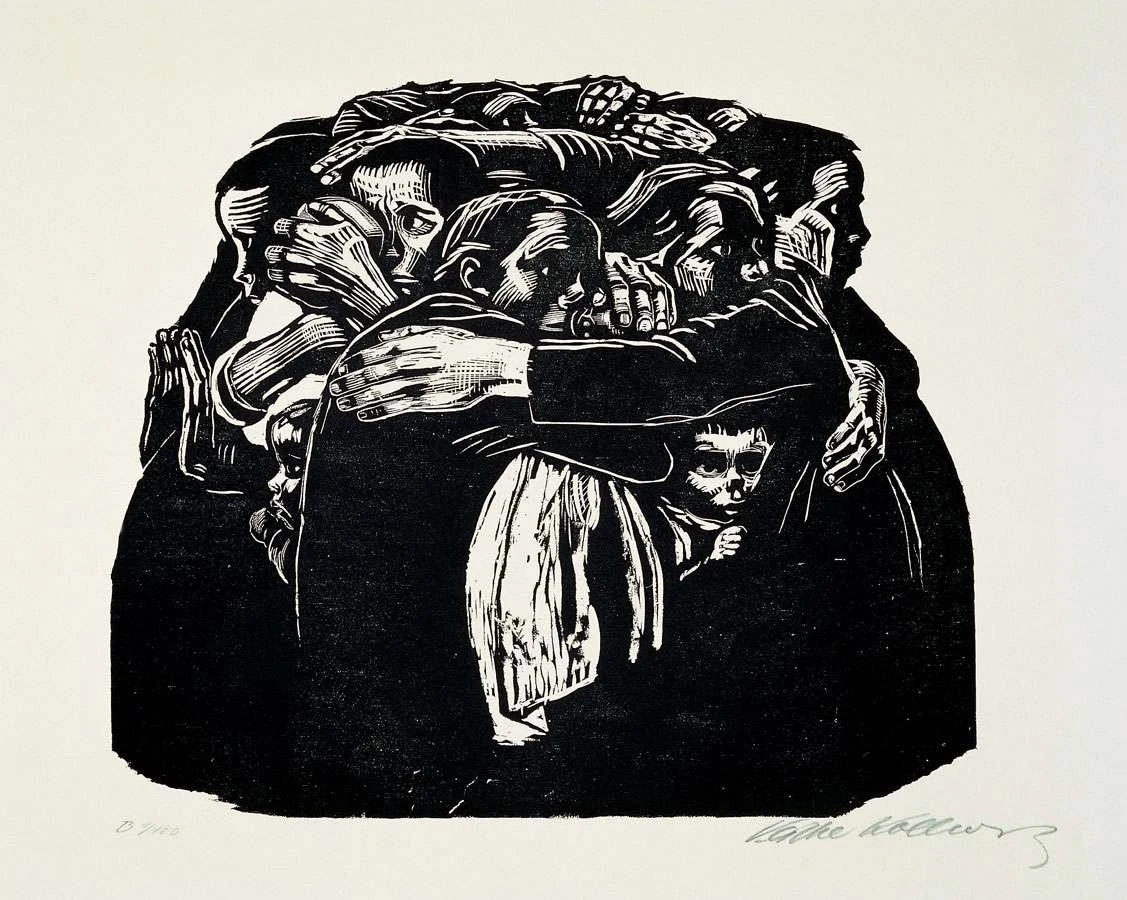
Käthe Kollwitz - The Mothers, 1932-33. Lithograph.
To whoever is reading this. I do not know who you are. I know roughly what you are facing because I am facing it too.
This is not a series written in confidence that victory is inevitable.
The introduction said as much. We do not know if this will succeed. The world is on fire. The tools we had were not working. The framework exists because the conditions demand it, not because anyone can guarantee the outcome.
Architecture can be built. That is what the last piece said. This one says something else.
People will be lost.
That is the material reality of confronting a system that kills to maintain itself. The series has been honest about this throughout. Chile is the wound that must not close. The more than three thousand killed or disappeared after September 19731 were not abstractions - nor the tens of thousands imprisoned and tortured.2 They were people who voted, organized, believed that the democratic road was the correct road for their conditions. They were right, but they were murdered for it.
Every socialist experiment that the case studies examined carries its own dead. Every future attempt will carry more. The framework does not pretend otherwise. Anyone who tells you that change comes without cost is either naive or lying.
The framework's position is simple. Those who are lost are honoured as loved comrades. Not as martyrs. Not as strategic assets whose deaths serve a narrative purpose. As people. Their lives. Their names. The things they cared about that had nothing to do with politics. The meal they cooked the night before. The person who is now eating alone.
The revolution remembers its dead with grief and love. Not with instrumentalized glory.
This matters because the alternative is self-destruction. A movement that valorizes sacrifice creates a culture that consumes its own. A movement that treats its dead as fuel for morale produces an organization that needs more dead to sustain itself. Under RCE, that dynamic is as predictable as any other boomerang. It has happened before. It will happen again to any movement that fails to guard against it.
So the framework guards against it. Every structural mechanism in this series - the federated model, the kill switch, the distributed communication infrastructure, the insistence on discipline and security - exists to minimize loss. Readiness is loss prevention. Discipline is care. Solidarity is the mechanism by which no one absorbs more than they have to.
That is what we owe each other. Not slogans. Not sentiment. The practical work of keeping each other alive.
You know who your comrades are because they showed up. They were at the picket line or the mutual aid kitchen or the blockade. They did not buy a hat. They did the work. The identity is the work. And the obligation that comes with it is not optional. It is the condition of membership. The privileged absorb risk so that the vulnerable absorb less. This is not charity. It is a debt the system created, and solidarity is how you pay it.
I do not know what the world looks like in ten years. Neither does the framework. It is not a map. It provides the structural requirements - sovereignty or you get destroyed, anti-ossification or you rot from within, nationalization at the threshold of systemic criticality, proportional response calibrated to conditions, individual rights defended because the system that produces bigotry is the system you are fighting. Whether the people who build with these tools succeed depends on conditions none of us can fully predict.
What I know is this: The conditions are severe enough that the argument makes itself. Housing is unaffordable. Healthcare is inaccessible. The climate is destabilizing. Wealth concentrates while wages stagnate. The state funds wars its citizens oppose. Surveillance expands. The professional-managerial buffer is eroding. The gig economy strips what remains. Everyone already knows the system is broken. The question was always what to do about it.
This series is one answer. Not the only answer, nor a perfect one. A contribution to a tradition that stretches back through Luxemburg,3 through Marx,4 through every person who looked at the machinery of extraction and said: this does not have to be how it works.
The framework gets things wrong. It knows this about itself. The retrodiction and falsification criteria exist so that the framework can be tested and corrected rather than defended as doctrine. The transition is the weakest structural link - every historical experiment failed there, and the framework's answer is better than what came before but not proven. The monetary architecture is deliberately underspecified because getting it wrong at the design stage is worse than leaving room for the people who build it to adapt. The armed populace is the prescription where containment is weakest - procedural safeguards rather than architectural ones, and the framework says so rather than pretending otherwise. Future theorists will find errors this one missed. That is the point. A framework that cannot be corrected is a scripture, and scriptures are what you build when you have stopped thinking.
If you have read this far, the series was written for you. If you have organized, it was written because of you. If you are the person at the kitchen table at 1 AM, tired and not performing, deciding what to do next - you are not alone. That is what solidarity means, when it means anything at all. The first principle in the present is: do no harm, break no just law, organize peacefully when you can, and protect the vulnerable. The architecture is for a future that must be built through the hardest, most patient work - not through shortcuts that would bring repression back on those we seek to protect.
One last honest acknowledgment. I am aware that writing this book has costs. The framework's own analysis names the historical pattern: capabilities expand into available space, including the capability of states and capital to identify and respond to material threats to their continuation. This book is the kind of material the framework's own analysis predicts will be responded to. I accept that. Luxemburg wrote her critique of The Russian Revolution knowing the cost.5 The cost is a deterrent, and is one of the conditions the framework was developed to be honest about.
Capitalism assassinates the people who threaten it. The framework names this not as a documented pattern. Allende was overthrown and killed in 1973.6 Berta Cáceres was murdered in 2016 for opposing a hydroelectric project on Lenca territory; seven men were convicted of her murder in 2018, and the financial intellectual authors were prosecuted in the years that followed.7 Anna Politkovskaya was assassinated in 2006 for reporting on Chechnya; the contract chain was traced over a decade, with successive convictions through 2014.8 Daphne Caruana Galizia was killed by a car bomb in 2017 for reporting on Maltese state-business corruption; the Daphne Project organised by OCCRP and Forbidden Stories continued her investigations after her death.9 Front Line Defenders documented 324 human rights defenders killed in 2024, with land, environmental, and indigenous rights defenders the largest category.10 The framework writes against the pattern knowing what the pattern does to people who do.
What if it comes back? The question every person who writes this kind of work asks themselves at some point. The framework's answer is structural rather than personal. The architecture this book describes is not for the author. It is for the conditions. If the conditions are correctly described, the architecture survives the author's specific fate, and what comes back against any one writer is contained by the federated, distributed, redundant practice the action chapter names. If the architecture is correct, no single voice is load-bearing. That is the framework working against the framework's own author, in exactly the direction the framework was designed to work.
We know we are headed to catastrophic failure. And this is what we are doing about it.
Organize. In person. With people you trust. Protect each other. Be disciplined. Be patient. Be ready.
For those who come after us: we tried. We built what we could with what we had. The framework adapts. Use it, break it, rebuild it. It is a tool, not a scripture. The moment it becomes sacred it stops being useful.
Loved comrades, not martyrs. Take care of each other.
National Commission for Truth and Reconciliation (Chile), "Rettig Report" (1991). ↩
National Commission on Political Imprisonment and Torture (Chile), "Valech Report" (2004). ↩
Rosa Luxemburg, Reform or Revolution (1900). ↩
Karl Marx, Capital, Volume I (1867). ↩
Rosa Luxemburg, The Russian Revolution (1918). ↩
US Senate Select Committee to Study Governmental Operations, "Covert Action in Chile 1963-1973" (1975). ↩
Nina Lakhani, "Berta Caceres case: seven men convicted of murdering Honduran environmentalist" (2018). ↩
Shaun Walker, "Ten years after Anna Politkovskaya's murder, Kremlin's grip on Russian media tightens" (2016). ↩
The Daphne Caruana Galizia Foundation, "About Daphne" (2024). https://www.daphne.foundation/en/about/daphne/ [accessed 2026-04-27]. ↩
Front Line Defenders, "Global Analysis 2024/25" (2025). https://www.frontlinedefenders.org/en/resource-publication/global-analysis-202425 [accessed 2026-04-27]. ↩