Chile did not fail
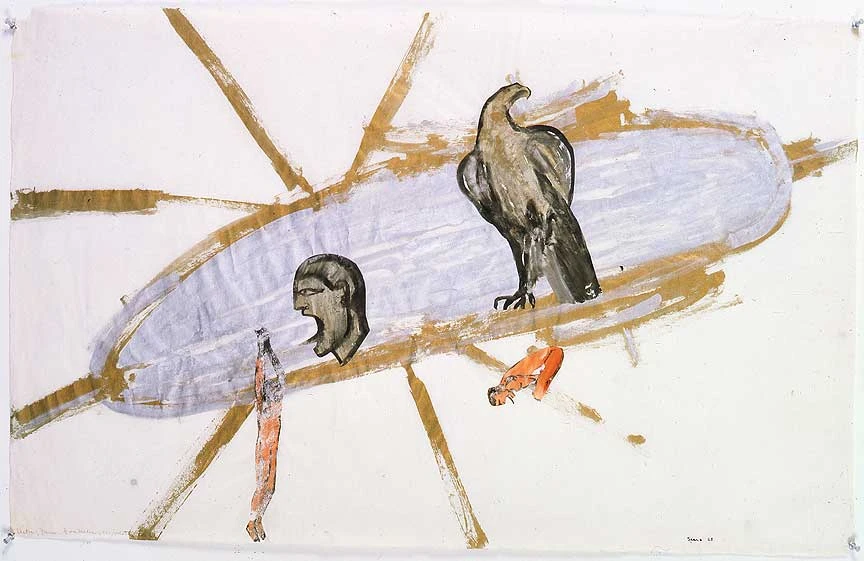
Nancy Spero - Victims Thrown From Helicopter, 1968. Gouache and ink on paper, 39 x 25 in.
On September 11, 1973, the Chilean military bombed the presidential palace in Santiago.1 Salvador Allende, the democratically elected president, died in the attack. He had won his election. He had nationalized copper through a unanimous vote of the Chilean congress.2 He had expanded healthcare, education, and land reform using the revenues that previously left the country in the pockets of American shareholders. He had done everything through legal channels, through democratic processes, through the institutions his opponents claimed to value.
None of it mattered. The United States, through the CIA, had spent three years destabilizing the Chilean economy, funding opposition media, financing strikes, and cultivating military officers willing to overthrow the government.3 When the coup came, it came with American backing, American planning, and American approval. Augusto Pinochet's military dictatorship killed thousands,4 tortured tens of thousands,5 and dismantled every social programme Allende had built. The economists who replaced Allende's team were trained at the University of Chicago under Milton Friedman.6 Chile became the first laboratory for neoliberal economics. The experiment was conducted on a population that had voted for socialism and gotten a military dictatorship instead.
Chile did not fail. Chile was functioning. The nationalization was working. The economy was growing. The social programmes were delivering. What destroyed Chile was not an internal flaw. It was the Central Intelligence Agency of the United States of America, acting on behalf of American corporate interests that had lost access to Chilean copper revenues.7
This is the lesson the left has never fully absorbed: you can do everything right and still be destroyed, if you cannot defend what you build.
The diagnosis in this chapter sits on strong-tendency groundi with a large and consistent case base: imperial powers destabilize socialist projects in their hemisphere using a documented repertoire of economic warfare, covert funding of opposition, and military proxies, and they do so under activation conditions that are persistent rather than episodic. The prescriptions split. Sovereignty architecture below the nuclear threshold - capital controls, domestic production of essentials, intelligence counter-penetration, federated civilian defence - is conditional architecture with named dependencies on the specific imperial relationship. The nuclear-deterrent prescription is held at arm's length. It is the only historical configuration that has prevented direct invasion of a socialist project by a nuclear-armed imperial power, and it is simultaneously the worst dam the framework knows how to build against its own expansion logic. The chapter makes the argument and names the contradiction. The self-critique chapter carries the argument further rather than resolving it here.
The pattern
Chile is not an isolated case. It is the clearest case.
Guatemala 1954: Arbenz nationalised land held by the United Fruit Company; the CIA organised a coup; four decades of military rule and a Maya genocide that killed over 200,000 people followed.8 Iran 1953: Mosaddegh nationalised Anglo-Iranian Oil; British and American intelligence organised a coup; twenty-six years of authoritarian rule produced the conditions for the 1979 revolution and everything that came after.9 Indonesia 1965: the PKI - the largest communist party in the non-aligned world - was destroyed in a CIA-backed military purge that killed between 500,000 and one million people, with kill lists supplied by American intelligence.1011 Congo 1961: Lumumba, the first democratically elected prime minister, assassinated with Belgian intelligence and CIA knowledge.12 The deep-dive below gives the operational detail of each. The point at this level of the argument is that the pattern is the standard operating procedure of the imperial system over the entire postwar period, and is heightened by the instability caused by the present rapid decline of the 'soft' imperial powers.
The pattern did not stop in the twentieth century. In January 2026, the United States launched a military operation in Venezuela and captured its sitting president on narco-terrorism charges.13 In February 2026, the United States and Israel conducted joint strikes against Iran - bombing military, nuclear, and government sites and assassinating the supreme leader.14 Iran had no nuclear deterrent. In Cuba, the United States imposed an oil blockade in January 2026, threatening tariffs on any country that supplied Cuba with fuel. Three nationwide blackouts followed in March. Hospitals went dark. The UN General Assembly voted 187-2 to end the embargo. It continues.15 On the other side of the ledger: the Alliance of Sahel States - Mali, Burkina Faso, and Niger - expelled French and American forces, withdrew from ECOWAS and the International Criminal Court, and established their own development bank, joint military force, and passport system.16 The pattern has not changed. What has changed is that some countries are beginning to build the sovereignty defence this series describes.
This is not a conspiracy theory. The CIA's own declassified documents confirm the operations in Guatemala, Iran, Chile, and Indonesia.171819 The Church Committee hearings of 1975 documented covert operations against foreign governments as official United States policy.20 This is not speculation about shadowy forces. This is the documented, admitted, publicly recorded behaviour of the imperial powers toward any state that threatens their economic interests.
The lesson is simple and absolute: sovereignty is the prerequisite for everything else. You cannot build socialism if you cannot defend it. You cannot nationalize resources if the empire can topple your government. You cannot redistribute wealth if a foreign power controls your military. Every structural mechanism this series has proposed - the anti-ossification architecture, the nationalization threshold, the political-functional separation, the proportional response - is meaningless if an imperial power can destroy your state before any of it takes root.

Pieter Bruegel the Elder - Massacre of the Innocents, c. 1565-67. Oil on panel.
Why Allende lost
The Chilean case deserves particular attention because it is the most precise illustration of the problem.
Allende did everything the democratic left says you should do. He won an election. He governed through legal processes. He respected the constitution. He nationalized through legislation, not by decree. He expanded social programmes through budgetary allocation, not through seizure. He followed every rule. The opposition could not defeat him democratically because his policies were popular. The economy was growing. The social programmes were working. The nationalization of copper was generating revenues that funded development.
So the opposition changed the rules.
The United States imposed an economic blockade. Nixon ordered the CIA to "make the economy scream."21 American banks cut off credit. Spare parts for Chilean industry - much of it dependent on American suppliers - stopped arriving. Truckers, supported by CIA-funded organizations, went on strike, disrupting the distribution of goods across the country.22 The economy was strangled from outside, and the resulting shortages were used to manufacture the narrative that socialism had failed.
The military, cultivated by American intelligence over years of relationship-building and training, moved when the conditions were ripe. Allende had no mechanism to resist. The Chilean left was not armed. There was no militia. There was no independent defence capacity outside the professional military. When the generals decided to act, the people who had voted for Allende had no material means to defend the government they had elected. The workers had strikes. The military had tanks.
The lesson is not that Allende should have been more radical. The lesson is not that he should have governed differently. The lesson is that without sovereignty defence, without the material capacity to prevent imperial intervention, the best policies in the world are written on paper that burns when the tanks roll in.
This is why the framework treats the armed populace as a structural necessity. The duty to overthrow - and the militia readiness that makes it possible - prevents internal degeneration and external destruction alike. A population that can fight back is a population that cannot be simply removed from the equation when imperial interests demand it. Allende's Chile had the policies. It did not have the teeth.
Three transition geometries
The chapter so far has assumed a particular shape for the transition: a multipolar world in which several socialist states emerge, voluntarily form a bloc, and deter capitalist hegemons through mutual support and economic chokepoint reciprocity. Adversarial reciprocation works in this geometry because there is a counter-bloc to reciprocate from. Two other geometries are possible, and the framework's prescriptions calibrate differently against each. Naming all three is the cost of being honest about what the architecture below assumes.
Multipolar-coordinated. The framework's default assumption. Multiple socialist states, voluntary bloc formation, mutual deterrence against capitalist hegemons, alternative settlement infrastructure built among bloc members. Adversarial reciprocation works. The nuclear-deterrence prescription scales because deterrence is collective; the economic-warfare defences work because the bloc supplies what the sanctioning power withholds; the sovereignty architecture below operates as designed. Most of the chapter is calibrated against this geometry.
Fragmented / single-state-isolated. One socialist state in a sea of hostile states, no bloc available. Adversarial reciprocation has no counter-bloc to reciprocate from. Deterrence logic stretched to its limit; sovereignty defence becomes the load-bearing constraint on every other architecture; the armed populace is operationally critical here in a way it is not under multipolar conditions, because the population is the deterrent of last resort. The economic-warfare defence runs against the full weight of the imperial system rather than against the share of it that has not yet been routed through bloc-internal infrastructure. Cuba's special period after 1991, Iran post-2018, and the various Latin American sovereignty experiments under sanctions are the closest historical references. The framework's position is not that this geometry is survivable on the same terms as multipolar; it is that the cost of survival is materially higher and is paid in lower consumption, lower import variety, longer adjustment periods after supply shocks, and reduced access to the global division of labour. Iran has functioned under sanctions for forty-five years. Cuba for sixty-five. The tax is not infinite. It is real. The framework does not pretend otherwise. The argument is that the tax is the price of building anything else, and that the price is paid by some generation regardless. The choice is whether the generation that pays it lives under socialism or under client-state capitalism.
Hegemonic transition. A hegemon - the United States, China - becomes a multi-party socialist state. The deterrence calculus inverts. The hegemon is now the one others deter against. The framework's adversarial-reciprocation logic becomes the capitalist world's strategy against the hegemon. New questions emerge that the multipolar geometry does not raise. The hegemon owes a duty not to impose socialism from above on smaller states whose own transitions have not yet matured - the anti-imperial borders doctrine binds the hegemon directly. Voluntary accession from below - sub-national territories, neighbouring states whose populations have already organized - is the legitimate mechanism for expansion of the bloc; the imperial-bloc-formation pattern by which hegemons consolidate adjacent territory is specifically prohibited. The economic-warfare defence runs in reverse: the hegemon defends against capital flight, against capitalist-state coordination on alternative settlement infrastructure designed to deny the hegemon's currency, against the same adversarial-reciprocation tools the framework's multipolar geometry deploys. The reader who finds this geometry implausible has identified one of the framework's open conditions; the reader who finds it the most likely path has identified a calibration the architecture below does not yet specify in detail.
The architecture in the rest of this chapter is calibrated against the multipolar-coordinated geometry. The fragmented and hegemonic-transition geometries change the parameters; the self-critique chapter names this as a limit the framework does not close. What follows is the architecture; the conditions under which it applies are the three geometries above.
Nuclear deterrence
There is a harder version of this lesson, and it involves weapons that most people prefer not to think about.
Cuba survived. Chile did not. The difference is not geography, not ideology, not the quality of leadership. The difference is that Cuba had a patron with nuclear weapons, and Chile did not.
In October 1962, the United States prepared to invade Cuba to remove the Castro government. The operation was planned, the troops were mobilized, the political will existed. What stopped it was the presence of Soviet nuclear missiles on the island. The Cuban Missile Crisis ended with the removal of those missiles, but also with an American commitment not to invade Cuba. The commitment was imperfect - the CIA continued assassination attempts and economic warfare for decades - but the invasion never came. The material reality of nuclear deterrence made the cost of direct military intervention too high.
Cuba's sovereignty for the next six decades rested in part on this foundation: the Soviet Union, and later the residual reality that an attack on Cuba would have unpredictable consequences in a nuclear world. Vietnam survived for similar reasons - Soviet and Chinese backing made direct American escalation beyond a certain point strategically untenable, and even within that constraint, Vietnam bled the empire for twenty years.
The states that survived were states that could not be destroyed cheaply. The states that were destroyed - Chile, Guatemala, Iran, Indonesia, the Congo - were states whose destruction carried no risk of reciprocal escalation. The empire does not intervene where the cost is existential. It intervenes where the cost is low.
The chapter's uncomfortable conclusion - and the author is unwilling to soften this by pretending there is a comfortable answer - is that sovereignty defence in a world of nuclear powers is the question every socialist project fails to take seriously until the intervention arrives. Chile failed it. Guatemala failed it. Iran in 1953 failed it. The states that survived - Cuba, Vietnam - survived under extended deterrence from nuclear patrons that no longer exist for a new project today.
The hardest answer this framework can produce is that nuclear capability, held as deterrent rather than doctrine of use, is the only historical precedent for surviving imperial intervention without catastrophic cost. This answer is offered with full awareness that it contradicts the framework's foundational principle: capabilities expand into every available space, and no structural containment on a nuclear arsenal has ever held permanently. If RCE is right, then a socialist state that acquires nuclear weapons has built the worst dam the framework describes, against the same expansion dynamic the framework exists to architect against. This is named directly in the self-critique chapter rather than glossed here, because the argument the chapter is going to make is not resolved by wishing the contradiction away.
The framework does not resolve the tension, we can only name it. A serious alternative - collective security architecture among socialist states, economic chokepoint reciprocity of the kind some states have demonstrated against sanction regimes, permanent strategic ambiguity about the acquirement question itself - deserves more work than this chapter does.
The deeper problem is that the architecture is public. Every adversary worth the name has read it within a year of publication. The procedural-deterrence assumption was already shaky in the unipolar period. In the multipolar one we are in now, with the United States no longer guaranteeing rules-based order and the United States, Russia, China, and Israel actively probing each other's red lines while the smaller nuclear powers (the United Kingdom, France, India, Pakistan, North Korea) calibrate their own postures around the noise, the assumption may not hold at all. Procedure deters when the adversary believes you will follow it. None of the great powers behave today as though anyone else's procedure is binding on them. The framework's deterrence story rests on a regime of expectations the regime itself is dismantling in real time.
I consider nuclear deterrence the strongest currently available answer. I also consider this the part where I am most likely to be wrong. You can disagree, and the tradition is invited to do better.
This is not a moral argument for nuclear weapons. It is a material analysis of what happens to states that lack them. The reasoning is strictly reciprocal. In a world where your adversaries possess nuclear weapons, the absence of that capability creates an asymmetric vulnerability. The empire can bomb your presidential palace because the worst you can do in return is bleed. Give the empire a reason to believe that intervention carries existential risk, and the intervention does not come. This is deterrence. It is ugly. It works.
The distinction between deterrence and transgression matters here, because the framework has already established a category of technologies that must never be built. Nuclear weapons are not in that category. The difference is the structural distance between possession and deployment. A domestic surveillance apparatus has zero structural distance - the moment it is built, it is collecting, and the moment it is collecting, it is being turned against the population. Acquirement is usage. A nuclear weapon has wide structural distance - chain-of-command authorization, physical launch procedures, multiple deliberate human decisions separate the silo from the detonation. A warhead can sit in a hardened facility for fifty years and serve its function through its existence alone. Possession is sovereignty. First use is a transgression - an act whose reciprocal consequences are civilizational. The framework permits the weapon. It prohibits the act.
This does not mean acquirement carries zero reciprocal consequences. Nuclear possession produces its own lower-severity reciprocal dynamics: arms races that consume resources better directed toward domestic development, budget distortion toward military spending that ossifies the military-industrial relationship, geopolitical coercion dynamics that reshape the state's international posture, and the accumulation of political influence by the institutions that maintain the arsenal. These are real costs. The framework names them as a tradeoff it accepts, because the alternative - asymmetric vulnerability to imperial destruction, the fate of Chile and Guatemala and Indonesia - is worse. The honest position is not that nuclear deterrence is cost-free. It is that the acquirement-level costs are survivable and the absence of deterrence is not.
The military-industrial complex is itself an expansion dynamic. The institutions that build and maintain the arsenal develop institutional interests in the arsenal's growth, in threat inflation that justifies larger budgets, and in the political influence that comes from controlling the state's survival infrastructure. This is RCE applied to the state's own defence apparatus - a near-universal expansion dynamic operating inside the socialist state itself. The framework must build its dams here too.
The principle is structural separation between the institutions that maintain the arsenal and the institutions that decide whether it expands. Possession is permitted; first use is prohibited; the body that proposes is not the body that approves; the body that approves is not the body that releases; the ceiling is constitutional, not legislative; transparency obligations cannot be suspended during a crisis.
One workable picture: a deterrence-review body composed by sortition from the general population proposes arsenal size and posture; the strategic forces command operates the arsenal under the body's standing orders; a release-review body of randomly selected civilian constitutional officers serving a single non-renewable rotation must concur in real time on any launch authorization; the warhead ceiling is fixed in the constitution and movable only by binding national referendum. The numbers, the cycle lengths, the exact composition - these are calibrating parameters. What is non-negotiable is the principle: no single person, no single body, no single chain of command can issue a launch order alone, and the arsenal's expansion cannot be quietly grown through the ordinary political process. The full inter-body articulation is in the deep-dive below.
Nuclear-governance institutional articulation
The principle in the main text generates three named institutions, none of which can act unilaterally on the arsenal.
The deterrence-review body is the civilian authority. It is composed by sortition from the general population, with a minority of seats for scientific and strategic experts whose function is to inform deliberation, not to direct it. The body publishes the threat analysis, sets the maximum permitted arsenal size and posture, and controls the nuclear budget. It is rotated under the same eight-year ceiling that governs every other political role, and the experts who advise it cannot transition into seats they advised. No officer of the professional military sits on the body. No officer of the defence industry sits on the body. Its deliberations and findings are published, with operational specifics redacted under the same narrow exceptions that apply to active military operations elsewhere in the framework.
The strategic forces command is the operational body, purely military. It maintains the arsenal under standing orders the deterrence-review body has approved. It cannot alter arsenal size, doctrine, alert level, or deployment posture without that body's physical, biometric, and / or dual-key authorization. The line between maintenance and modification is published. Crossing it without authorization is a constitutional violation that triggers the same enforcement mechanisms as any other unconstitutional act by the state's coercive apparatus.
The release-review body is the third structure, separate from both the deterrence-review body and the command. Its members are randomly selected civilian constitutional officers serving a single non-renewable rotation. Any launch authorization requires this body's real-time concurrence. By design, it cannot be bypassed without dismantling the constitutional order, and dismantling the constitutional order is itself the activation condition for the duty to overthrow.
The constitutional ceiling. A specific number of warheads, written into the constitution, that the deterrence-review body cannot exceed and the command cannot quietly grow. Any increase requires a binding national referendum, super-majority threshold, mandatory waiting period between proposal and vote, multiple readings published in advance. The decision sits with the entire population, deliberately slow, deliberately diffuse. The mechanism that grew every other nuclear arsenal beyond its declared posture - threat inflation, classified expansion, budgets that compound through institutional inertia - cannot operate against a constitutional number that only a referendum can move.
The budget cap. The nuclear programme is published and capped as a percentage of national income. Any proposed increase requires the consultation-friction mechanism described in the proportional response architecture - mandatory review by independent bodies, published assessments, and a deliberation window proportional to the magnitude of the increase. Threat assessment is conducted by bodies independent of the institutions that benefit from elevated threat levels.
The personnel rotation. The personnel who rotate through the nuclear governance structure are drawn from the broader civilian population, not from the military or defence industry. The goal is to prevent the formation of a permanent nuclear priesthood - a class of people whose careers, identities, and institutional interests are bound to the arsenal's continuation and expansion.
The transparency obligations are constitutional and cannot be suspended during a crisis. The state commits to accept short-notice inspections of declared nuclear sites by any reciprocating state. The obligation is permanent. A crisis is precisely the condition under which secrecy becomes most attractive and most dangerous, and the framework refuses to leave the architecture exposed at the moment it is needed most. Reciprocation is the gate: the obligation runs to states that accept the same inspection regime against their own arsenals. States that refuse reciprocation receive no inspection access. The arrangement is by design, structural symmetry, and it is the closest thing to a self-enforcing arms-control architecture that the framework knows how to build.
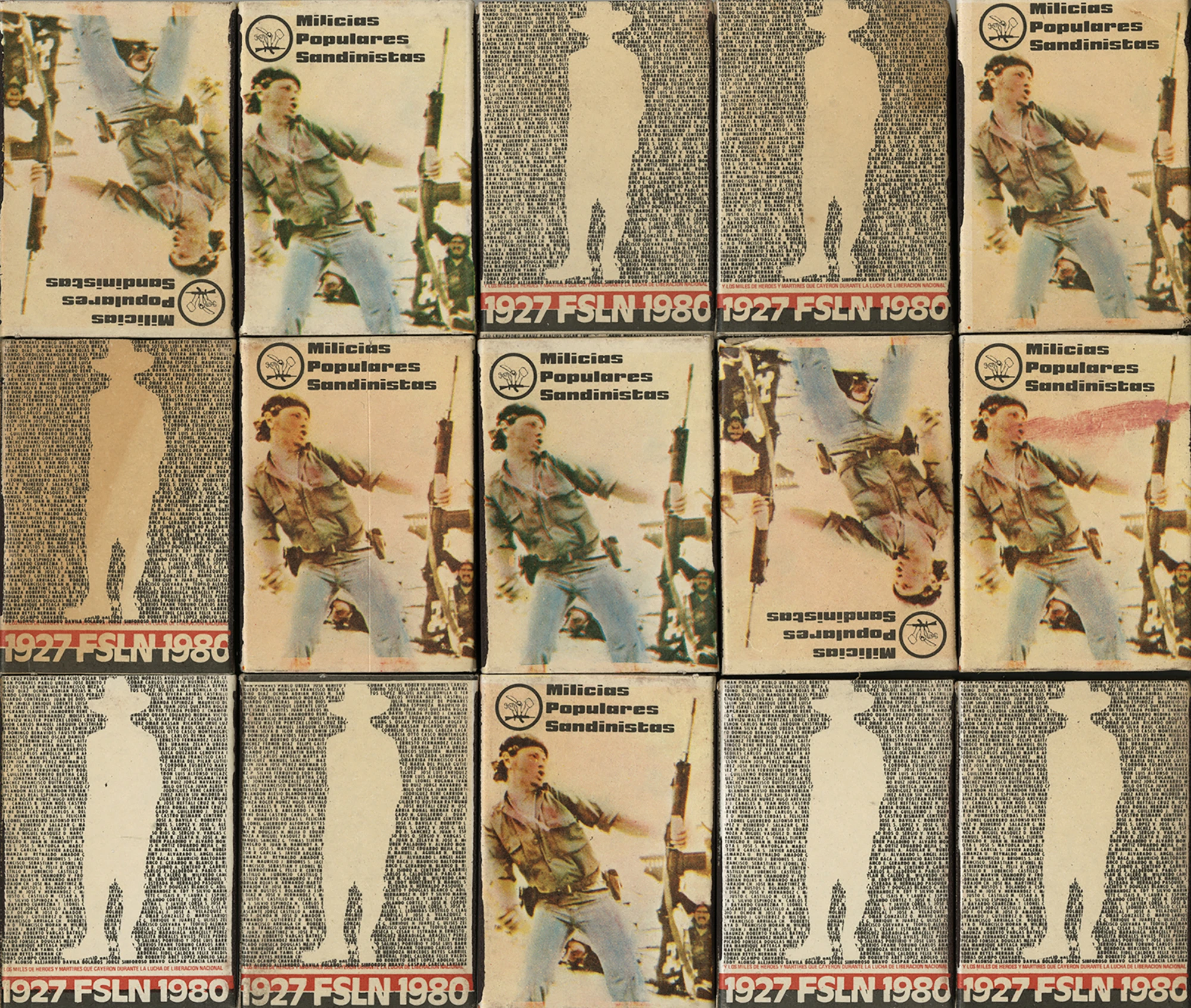
Susan Meiselas - Matchboxes commemorating the first anniversary of the revolution, Nicaragua, July 1980. Photograph.
Adversarial reciprocation
Sovereignty requires economic survival as much as military deterrence.
The socialist state operates in a world run by capitalist empires. It cannot opt out of that world. Autarky - complete economic self-sufficiency - is not viable in the contemporary global system. No state, regardless of size, can produce everything it needs domestically. The economy is global, the supply chains are global, the financial systems are global. You participate, or you are strangled. Cuba's sixty-year embargo demonstrates both the cost of partial isolation and the limits of what even the world's dominant empire can achieve against a sovereign state that refuses to collapse.
The framework's position is adversarial reciprocation, not isolationism. You engage with the global economy. You trade. You participate in financial systems. But you do it on terms that serve your sovereignty rather than undermine it, and you use the adversary's own economic instruments against them.
What does sovereignty look like for a state not strong enough to refuse engagement and not weak enough to be ignored? Four moves, in roughly the order they get reached for.
Currency competition: The dollar's dominance is maintained through military power, institutional control (the IMF, the World Bank, SWIFT), and the willingness to weaponize the financial system against states that resist - not through any natural law. When a state denominates its oil sales in yuan instead of dollars, it is conducting adversarial reciprocation - using the adversary's own tool (global currency markets) to undermine the adversary's advantage (dollar hegemony). This is the economic equivalent of proportional response, not aggression. The empire weaponized the dollar. You respond in kind.
Counter-sanctions capability: When the United States sanctions a state, it is leveraging its control of the global financial system to impose economic pain. The reciprocal response is to develop the capacity to impose equivalent pain - through resource leverage, trade bloc coordination, alternative payment systems, and strategic relationships that reduce the sanction's effectiveness. Russia's partial insulation from Western sanctions through energy leverage and Chinese economic partnership is an example of adversarial reciprocation in practice, regardless of one's assessment of Russia or China's political character.
Bloc formation: Individual states are vulnerable. Blocs are not. The formation of economic and military alliances among anti-imperial states - mutual defence agreements, shared infrastructure, coordinated trade - creates the collective weight that no single state can generate alone. The logic is the same as the federated model applied to international relations: many independent actors, each sovereign, standing in solidarity, creating a network that is harder to destroy than any single node.
Coordination is the collective shape. Trade is the daily one.
Strategic trade. The socialist state engages in trade relationships that serve its development rather than its dependency. This means diversifying supply chains, developing domestic productive capacity in strategically critical sectors, and refusing trade terms that create the kind of economic dependency that gives imperial powers leverage. The goal is to engage from a position of strength rather than submission, not to refuse engagement.
The general posture is not aggression. It is reciprocation. Speak the language of your adversaries. If they use economic weapons, develop economic defences and economic weapons of your own. If they use military threats, develop the military capacity to make those threats costly. If they use institutional control - the IMF, the World Bank, the WTO - build alternative institutions. The framework does not ask the empire for permission. It matches what the empire does, with the tools the empire uses, until the empire finds that the cost of hostility exceeds the benefit.
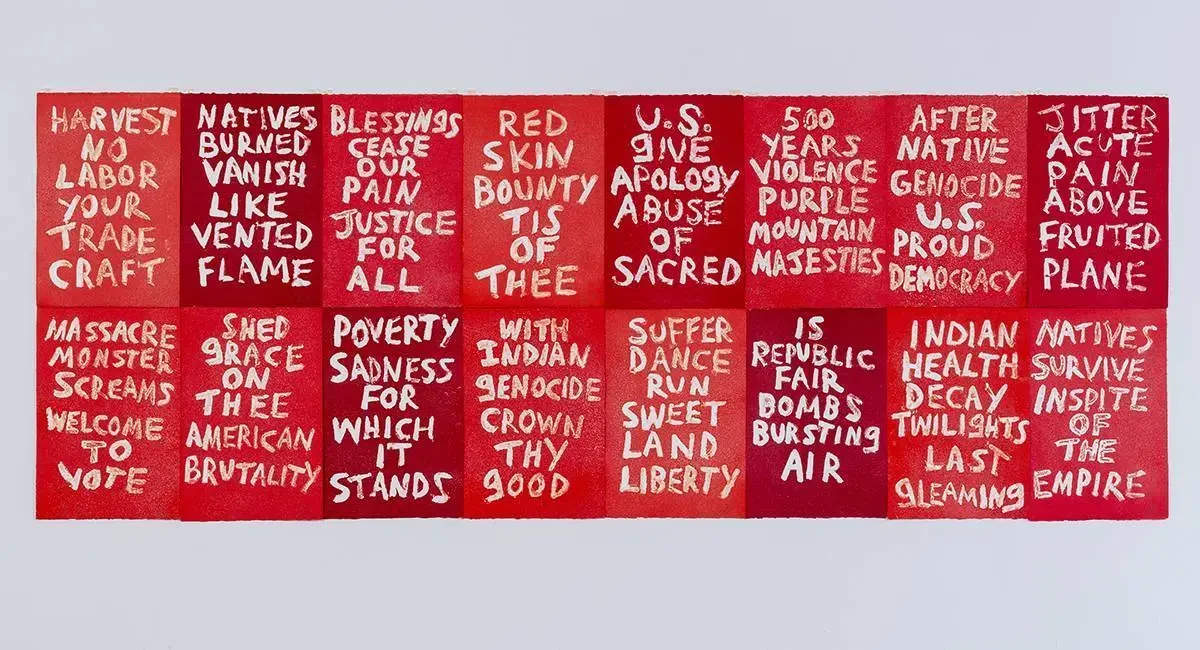
Edgar Heap of Birds - Genocide and Democracy, 2016. Print.
Anti-imperial borders
The framework's position on territorial expansion is absolute. The socialist state never expands. Never. No territorial conquest, no annexation, no occupation, no "liberation" of neighbouring territories, no incorporation of foreign land by force.
No special circumstances, because the logic admits none. Imperialism is the foundational antagonist of this entire framework. Every tool built for imperial purposes turns inward. Every colonial technique becomes a domestic technique. Every occupied territory produces the institutional habits and coercive capacities that degrade the occupying state. If you build an empire, the empire builds you - into the thing you claimed to oppose.
Eastern Europe is the case in evidence. The Soviet Union claimed to liberate it. What it produced was resentment, dependency, and puppet states whose populations did not choose socialism and therefore never defended it when the opportunity came to abandon it. When the Berlin Wall fell, the populations of Soviet client states did not mourn the loss of socialism. They celebrated the end of occupation. Territorial expansion did not spread socialism. It spread the Soviet Union, and the Soviet Union was not socialism - it was a bureaucratic empire wearing a socialist uniform. The anti-ossification failures of the Soviet system were amplified, not moderated, by the maintenance of an empire that required military garrisons, security services, and coercive control to sustain.
A distinction holds the line. A neighbouring people achieving their own revolution and asking to join a socialist bloc is one thing. A socialist state invading its neighbour and claiming to have liberated it is another. The first is voluntary accession. The second is imperialism, regardless of the flag it flies.
Voluntary accession the framework permits. If a group of people - through their own revolution, their own democratic process, their own self-determination - achieves sovereignty and wishes to form a bloc or a union with an existing socialist state, the door is open. The material logic is sound: a larger bloc has more economic weight, more strategic depth, more collective defence capability. But the revolution must be self-generated. It must be the product of the people's own conditions, their own organization, their own assessment of what is proportionate to their own oppression. Imposed revolution is imperialism. The flag the imposer flies does not change the verdict. The tool turns inward. The empire degrades the metropole. This is the principle, and it does not grant exceptions for good intentions.
Non-interference follows from the same logic. The socialist state does not invade countries to "liberate" them, sponsor coups in neighbouring states, or fund proxy forces to overthrow foreign governments. These are the methods of the empire. Using the empire's methods produces the empire's results. You welcome those who liberate themselves. You form alliances with states that choose socialism. You provide moral and rhetorical support to movements that request it. You do not impose. The distinction between solidarity and imperialism is the distinction between an open door and a battering ram.
The United States calls its interventions "democracy promotion." Britain called its empire a "civilizing mission." The Soviet Union called its occupations "fraternal assistance." The language changes. The mechanism does not. The framework refuses to participate in the mechanism, regardless of what language is available to justify it.
One carve-out, narrow and structural. It remains an individual right to volunteer to serve bodies which respect and enforce international law. The state must not oppose the individual capacity to participate in global peacemaking. The clear line in this case is a framework which is independent from politics within the domestic scale. The two powers - international peacemaking and political powers - are structurally and architecturally separate.
International approach
The framework's posture toward other states proceeds from a single principle: you cannot wait for the empire to permit you. Sovereignty is built on your own, in your own conditions, against your own adversary, with the architecture this chapter has named. The international order is not a body that grants legitimacy. It is the field in which sovereignty is contested. A movement that organizes its transition around the expectation of being recognized first and supported afterward has organised against the historical record. Allende waited. The Cuban revolution did not. The framework treats the on-your-own posture as the default, not the exception.ii
The on-your-own posture is not isolation. It is the recognition that solidarity arrives second, not first. International support that is structurally available - anti-imperial bloc partners, allied movements within the metropoles of hostile states, observer mechanisms that raise the legitimacy cost of intervention, the voluntary-accession architecture developed below - is a force-multiplier on a sovereignty that is already operational. It is not the sovereignty itself. A movement that builds its architecture against the day the foreign solidarity arrives is a movement whose architecture will collapse before the solidarity arrives, because the solidarity arrives only after the architecture has demonstrated the capacity to survive without it. The reciprocal cost of waiting is paid up front, in the period during which the architecture is supposed to be hardening but is instead postponing. The framework refuses the wait.
The strategic limit. International coordination is a force-multiplier on what is already there; it is not a substitute for what is not. Bloc formation, alternative payment infrastructure, allied military presence, and international observation each raise the cost of imperial action against the framework's state by a measurable amount, and each becomes available only once the state's own capacity has crossed the threshold at which the bloc partners assess that the alliance is worth the imperial response it will draw. Below that threshold, international support is rhetorical at best and counterproductive at worst - the language of solidarity offered to a movement that cannot defend itself produces the imperial calculation that the movement is now the bloc partners' liability rather than their asset, and the alliance withdraws on the same logic that produced it. The framework treats this limit as structural and names it directly. The architecture above is the work the framework does. The international support is the work the framework cannot.
The symmetric obligation runs in both directions. The standard of conduct the framework demands of the apparatuses it analyses as class enemies - non-intervention, non-imposition, non-expansion, the existential-vs-functional distinction the case-studies chapter develops in detail - applies in full to the framework's own future state in its international posture. The framework's state does not invade its neighbours under the banner of liberation; does not fund proxy forces to overthrow foreign governments whose programmes it disapproves of; does not impose its own architecture on populations that have not chosen it; does not exempt its own conduct from the standards the transition chapter's symmetric-self-submission section commits the founding state to. The asymmetry the framework would otherwise produce - applying the standard outward but not inward - is the asymmetry the entire architecture of this book is built against. International coordination is a force-multiplier.
Equal exchange, the substance sovereignty defends
Sovereignty is the precondition. Equal exchange is what sovereignty exists, in part, to defend. The deterrent posture, the multipolar bloc formation, the adversarial reciprocation in the financial domain, the anti-imperial border doctrine - each of these is structural. None of them, by itself, addresses the substantive content of the international order the framework's state operates inside. A multipolar world that preserves the unequal-exchange terms the imperial order has imposed across five centuries of metropolitan accumulation is a multipolar world the framework does not commit to. The architecture is the dam. The substance is what the dam is built to protect.
The substance is equal exchange: the structural commitment that labour, materials, and ecological throughput crossing borders are exchanged at terms that do not systematically transfer value from periphery to metropole. The historical record - Amin, Rodney, Wallerstein, Harvey - establishes the mechanism. The metropolitan economy purchases peripheral labour at a fraction of what equivalent labour costs in the metropolitan economy; purchases peripheral materials at extraction-economy prices that exclude the ecological and reproductive costs the periphery absorbs; sells finished goods, financial services, and intellectual-property rents back to the periphery at metropolitan price levels. The aggregate flow is one-directional. The framework's anti-imperial commitment is empty if it does not address the flow.
The framework's position on equal exchange differs by structural position, and the difference is named directly because pretending otherwise produces the social-democratic failure mode the case-studies chapter catalogues.
The metropolitan position. A socialist project arising in a metropolitan state inherits the metropolitan economy's accumulated benefit from five centuries of unequal exchange. The framework's commitment is that the metropolitan socialist state does not preserve that benefit as the price of internal class peace. The internal redistribution - dignified scarcity, the safeguard floor, the ownership architecture - is committed at full strength. The external redistribution - the commitment to fair-exchange terms with peripheral and semi-peripheral states, the structural reduction of metropolitan extraction across the trade interface - is committed at the same constitutional weight. The metropolitan working class is not asked to surrender the safeguard floor for the sake of equal exchange. The metropolitan economy is asked to absorb the equalisation cost out of the surplus the economic-architecture chapter reorganises, the innovation-attribution architecture bounds, and the ecological constitution's throughput reduction releases.
The semi-peripheral position. A socialist project arising in a semi-peripheral state inherits a structurally ambiguous position - extracting from the periphery on some fronts while being extracted from on others. The framework's commitment is that the semi-peripheral state, as it transitions, structurally aligns with the equalisation rather than with the preservation of its semi-peripheral extraction privileges. The Cuban biotechnology sector's pricing of its products to peripheral health systems is the load-bearing example. The framework writes the same posture in.
The peripheral position. A socialist project arising in a peripheral state inherits the position the equal-exchange commitment is constructed to defend. The framework's commitment, here, is that the architecture above is built to defeat the structural mechanisms by which peripheral value is extracted: the adversarial-reciprocation currency and financial architecture, the voluntary-accession bloc formation, the domestic productive capacity commitment, and the auditable-value-flow infrastructure the section below specifies. The peripheral state operates with the empire's full attention; the architecture is built for that condition.
The three positions are not symmetric. They are united by the same structural commitment - equal exchange as the substance sovereignty defends - and they require different operational architectures. The framework writes the difference in.
Substantive equal-exchange terms and the auditable-value-flow infrastructure
The equal-exchange commitment is not abstract. The substantive terms are constructed across four operating layers, each of which carries part of the load.
Labour-time anchoring at the trade interface. Cross-border trade between framework states (and between framework and non-framework states, where the framework state is the more powerful party) is denominated in a labour-time-adjusted unit of account that the currency chapter develops at the operational level. The unit is anchored in the labour-time content of the goods and services exchanged - the Cockshott-tradition labour-abstraction methodology - rather than in the metropolitan-currency price differential that current trade carries. The architecture's commitment is that the trade interface does not encode the wage differential the unequal-exchange mechanism rests on.
Ecological-throughput accounting at the trade interface. Cross-border trade carries an ecological-throughput accounting that surfaces the ecological constitution's carrying-capacity envelope at the trade interface itself. Goods whose production exceeds the exporting state's carrying-capacity allocation cannot be exported on terms that externalise the ecological cost; the cost is internalised in the unit-of-account adjustment, with the surplus flowing back to the regenerative architecture the ecological-constitution chapter specifies. The architecture's commitment is that the trade interface does not encode the ecological-cost transfer the extraction economy has run on.
Materials-content commitment. The trade interface tracks the material content of imported goods - the rare-earth metals, the labour-intensive textiles, the agricultural commodities - against the domestic productive capacity commitment. Imports that displace domestic productive capacity in framework partner states are accepted only on terms that respect the partner's productive-capacity transition. The architecture commits the metropolitan or semi-peripheral framework state against the de-industrialisation pattern the metropolitan economy has imposed on peripheral states across the postwar period.
Auditable-value-flow infrastructure. The architecture above operates only if the trade interface is auditable. The infrastructure that makes it auditable - the cryptographically attested ledger of cross-border value flows, the bilateral and multilateral verification protocols, the open-source data layer the petition body and the partner states' equivalent bodies can read against - is the substrate of the equal-exchange commitment. The substrate is built and operated under the architectural pattern the digital sovereignty chapter develops at full length: the building institution structurally separated from the specifying institution, the population's audit standing constitutionally protected, the surveillance-transgression boundary held at the same line that contains every other infrastructure the framework specifies. The auditable-value-flow infrastructure is the digital-sovereignty chapter's load-bearing case for why the fourth domain is sovereignty work, not technology work.
The four layers are bounded against the failure modes the framework writes against. They do not produce a global price administration, because no body has the standing to administer global prices and the institution that would claim that standing is the institution the anti-ossification architecture is built against. They do not produce autarky, because autarky is the failure mode the Amin-tradition delinking analysis names directly. They do not produce a single-currency global order, because the framework's commitment to multipolar sovereignty rejects the consolidation. They produce, instead, a substrate against which equal-exchange terms can be specified bilaterally and multilaterally, audited transparently, and revised as conditions change.
The forward pointer is the digital-sovereignty chapter, which carries the audit-infrastructure architecture at full length. The current chapter establishes that the auditable-value-flow infrastructure is sovereignty work. The chapter that follows builds it.
The fourth domain
Sovereignty in the twenty-first century is not exhausted by military deterrence, economic reciprocation, and bloc formation. It has a fourth domain. A state whose payment rails, identity infrastructure, and communications channels can be remotely compromised by a foreign adversary does not control its own policy, regardless of the strength of its deterrent posture or the resilience of its economic relationships. The Estonia denial-of-service campaign in 2007, the Stuxnet operation against Iranian centrifuges, the BlackEnergy and Industroyer attacks on the Ukrainian power grid in 2015 and 2016 - these are the equivalents of the coups this chapter has been analysing, conducted at lower cost, with greater deniability, and against a wider set of targets. They are not subordinate to the older patterns. They are continuous with them. The Chilean copper boycott and the Cuban embargo were the twentieth-century shape of economic warfare. A foreign adversary acting through software against the substrate of the political economy is the twenty-first-century shape of the same thing, and the framework's response must be of equivalent structural seriousness.
The framework's position on the fourth domain is the same as its position on the other three. The state must hold the capacity to act under its own authority within the domain. Remote deniability by any other state's permission is not acceptable. The substrate of the political economy is built under conditions that make external compromise costly and detectable. It must be auditable by the population whose political will the state claims to express. And the institution that builds the substrate must be contained against the framework's own principle by the same standard that contains every other institution this book proposes - including the state itself.
The detail of the architecture - the constitutional scope of what counts as a critical system, the bilateral separation between the body that builds the infrastructure and the body that specifies its conditions, the security properties of public code and cryptographic distribution and formal verification, the surveillance-transgression boundary that prevents the architecture from being turned against the population it is built to serve, and the dissolution mechanism that prevents the building institution from becoming the new dominator - lives in the digital sovereignty chapter. This chapter names the domain, locates it alongside the other three, and connects the framework's diagnostic to it. The chapter that follows develops it.
The CIA's record
The Central Intelligence Agency's history of intervention against socialist and progressive governments is documented across a coherent set of operations - Iran 1953 (AJAX), Guatemala 1954 (PBSUCCESS), Congo 1961, Indonesia 1965-66, Chile 1973 (FUBELT), Nicaragua throughout the 1980s. Each operation followed the same pattern: a government attempting to control its own resources, nationalize foreign-owned assets, or pursue economic policies that conflicted with American corporate interests; destabilization through funded opposition media, supported strikes, cultivated military contacts; and a coup or proxy war that produced an authoritarian government friendly to foreign capital. The full archival treatment - the documented techniques, the bodies, the outcomes - is in the case-studies chapter. The lesson named there and named again here: sovereignty defence is not optional. It is the first requirement, the material precondition for everything else.
Israel as the contemporary integrated case. Israel demonstrates the framework's reciprocal capability dynamic at scale disproportionate to state size. Decades of integrated surveillance, biometric, and operational capacity developed in the occupied Palestinian territories have been packaged into export products supplied to dozens of governments. Israeli firms supply the Pegasus spyware tracked by Citizen Lab to operations in forty-five countries.2324 Elbit Systems supplies border surveillance to the United States and several European states, with the technology field-tested along the militarised perimeter of the Gaza Strip before export.25 Israeli information-operations infrastructure operates in allied democracies through a documented network. In Canada, the Centre for Israel and Jewish Affairs lobbied or sponsored trips for fifty-eight percent of the members of parliament running for re-election in 2025; CIJA and B'nai Brith Canada are both registered as active lobbyists with the federal Commissioner of Lobbying.262728
Two qualifications. First, the Israeli case is not unique in kind - the United States, Britain, France, Russia, and China all run analogous operations. What distinguishes the Israeli case is the integration of military, surveillance, and information-operations capacity into a single export package, and the political protection that exempts the analysis from being made in most public discourse. Second, naming the operations of a Jewish state is not antisemitism. I am Jewish. The framework's identity-extraction analysis names the deliberate conflation of anti-Zionism with antisemitism as a coercive apparatus that protects extraction by making criticism unspeakable. The Israeli state's operations are subject to the same analytical lens the framework applies to every other state's operations. The exemption demand is what is exceptional, not the analysis.
Nuclear deterrence under reciprocal materialism
The framework's position on nuclear weapons is uncomfortable and must be stated precisely.
Nuclear weapons are instruments of mass death. Their use would constitute a crime against humanity on a scale that has no historical parallel except Hiroshima and Nagasaki. The framework does not celebrate, minimize, or aestheticize this. It accepts a material reality: in a world where hostile nuclear-armed states exist, the absence of nuclear capability is an invitation to destruction.
The structural distance doctrine. The framework distinguishes between categories of dangerous technology based on the structural distance between possession and deployment - the number of additional deliberate activation steps between having the tool and using it. A domestic surveillance network has zero structural distance: its construction is its use, because the moment it exists it is collecting data, and the data will be used against the population. Nuclear weapons have wide structural distance. A warhead in a silo is not being used. It is deterring. Its function is served by its existence, not by its deployment. Chain-of-command authorization, physical launch procedures, and multiple deliberate human decisions separate the resting state from deployment. The weapon that is never fired but prevents invasion has achieved its purpose entirely through possession. This wide structural distance does not mean zero reciprocal cost. Possession itself produces acquirement-level consequences: arms race dynamics, budget distortion, military-industrial complex formation, and the geopolitical coercion patterns that nuclear states impose on and receive from their adversaries. The framework names these costs honestly and accepts them as a tradeoff against the sovereignty vulnerability of going without.
First use is a transgression. The framework permits nuclear acquirement and prohibits first use. The use of nuclear weapons against another state - offensive nuclear deployment - would set a precedent whose reciprocal consequences are civilizational. If you use nuclear weapons first, you have established that nuclear weapons are for use. The reciprocal logic is immediate: you will be targeted by the same doctrine. The deterrent value of possession collapses into the catastrophic reality of use. First use is therefore categorically prohibited, not as a moral position but as a material calculation: the reciprocal cost is existential.
Retaliatory capability as sovereignty guarantee. The strongest case this framework can produce for credible second-strike capability - the capacity to respond to a nuclear attack even after absorbing one - is that deterrence is the foundation of sovereignty in a nuclear world, and a state that can be destroyed without consequence will eventually be destroyed. A state that can retaliate makes its own destruction mutually catastrophic, and therefore: unlikely. The self-critique chapter returns to this - it is the framework's most exposed prescription against its own principle.
The moral weight. This is not a cheerful position. The framework's commitment to protecting life - to loved comrades, not martyrs, to readiness as loss prevention rather than sacrifice optimization - sits in tension with the possession of weapons that could end millions of lives. The tension is real. The framework does not resolve it. It acknowledges it, and it says: the alternative is worse. The alternative is Chile. The alternative is Guatemala. The alternative is every state that could not fight back and was destroyed by an empire that could. The moral weight of nuclear possession is heavy. The material weight of its absence is heavier.
The disarmament horizon. In a world where all nuclear-armed states disarm simultaneously and verifiably, the framework supports disarmament. Nuclear weapons are not an end. They are a material response to material conditions. Change the conditions - eliminate the threat of nuclear attack by any state - and the rationale for possession disappears. But the framework does not disarm unilaterally. Unilateral disarmament in a world of nuclear-armed adversaries is not morality. It is suicide. And the people who would die are not the leaders who made the decision, but the population that had no say in it.
Economic warfare and counter-measures
If nuclear deterrence is the hard floor of sovereignty, economic resilience is the daily work of it. Empires do not always invade. Sometimes they strangle.
The American-led international financial system is not neutral infrastructure. It is a weapon.29 The United States controls or exercises dominant influence over the Society for Worldwide Interbank Financial Telecommunication (SWIFT), the International Monetary Fund, the World Bank, and the dollar-denominated global commodity markets. These institutions were presented to the world as neutral mechanisms for international cooperation. They are instruments of American economic power, and they are used as such.
When the United States sanctions a state, it threatens secondary sanctions against any state or firm that continues to do business with the target. This is economic coercion at a global scale. The sanctioned state is effectively cut off from the entire global market. Any firm that continues doing business with the target risks losing access to the dollar clearing system that underlies most international trade.
Currency diversification. The dollar's role as global reserve currency is the foundation of American economic power. Any socialist state that intends to survive economic coercion has to address dollar exposure from day one - denominating trade in non-dollar currencies, building bilateral trade relationships that bypass the dollar, and supporting the development of alternative reserve currencies. China's move to denominate oil and commodity trades in yuan, Russia's shift to ruble-and-yuan bilateral settlements, and the BRICS discussion of an alternative settlement currency are all examples of adversarial reciprocation in the currency domain. The specific politics of these states are beside the point. The method is the lesson.
Alternative financial infrastructure. SWIFT is a chokepoint. Participation in and development of alternative interbank communication systems - China's CIPS, Russia's SPFS, and any future multilateral alternative - is the practical way through. The goal is not to replace SWIFT but to ensure that disconnection from SWIFT does not mean disconnection from the global economy.
Resource leverage. A state that controls critical resources has inherent economic power. The framework's nationalization of systemically critical enterprises doubles as a sovereignty tool. A state that controls its own copper, lithium, rare earths, agricultural output, or energy production has bargaining power that a state dependent on foreign corporations for these resources does not. Chile's copper was nationalized for domestic development, but it was also a sovereignty asset. The empire destroyed Chile because Chilean copper under Chilean control reduced American corporate leverage. Allende's socialism was the pretext. The resources were the motive.
Bloc economics. Individual states are vulnerable to economic isolation. Blocs are not. The formation of trade relationships among anti-imperial states - preferential trade agreements, shared infrastructure projects, mutual credit systems, coordinated commodity pricing - creates an economic network that reduces each member's vulnerability to individual sanction. The logic is collective resilience. You cannot strangle a state that has alternative markets, alternative suppliers, and alternative financial channels. You can only strangle a state that depends on you for everything. The strategic imperative is to depend on the empire for nothing.
Domestic productive capacity. The deepest form of economic sovereignty is the capacity to produce what you need. The socialist state invests in domestic industry not because autarky is the goal - it is not - but because dependency is the vulnerability. If your hospitals depend on imported pharmaceuticals from a hostile power, that power controls whether your people live or die. If your military depends on imported spare parts, the spare parts stop arriving the day you displease the supplier. Strategic self-sufficiency in critical sectors - food, energy, medicine, defence, communications, basic industrial capacity - is not economic nationalism. It is the material prerequisite for the survival of the state.
Voluntary accession and bloc formation
The framework prohibits territorial expansion and intervention. It permits - and encourages - voluntary association among sovereign socialist states.
The mechanism of voluntary accession. When a people achieve socialist transformation through their own revolution, their own democratic process, or their own liberation struggle, they may choose to associate with existing socialist states. This association can take multiple forms: full political union (rare and requiring extraordinary conditions), federated union (shared defence and economic coordination with retained sovereign governance), trade bloc membership (economic cooperation without political integration), or mutual defence pact (security coordination without economic integration). The form is determined by the associating peoples. It is never imposed.
The self-generation requirement. Revolution must be self-generated. This is a material requirement grounded in reciprocal materialism, not a procedural nicety. A revolution imposed from outside produces dependency. The imposed government owes its existence to the imposing power, not to the population it governs. This dependency undermines the legitimacy that is necessary for a socialist state to survive. The population that did not choose socialism does not defend it. The government that depends on a foreign patron serves the patron's interests when conflicts arise. Eastern Europe demonstrated this with precision: Soviet-imposed socialism was rejected the moment the Soviet Union could no longer maintain it. The populations had never chosen it. They felt no obligation to preserve it.
Self-generated revolution produces the opposite dynamic. The population that fought for its own liberation defends it. The government that emerged from popular struggle has legitimacy that does not depend on foreign approval. Cuba is the instructive contrast to Eastern Europe. Whatever its structural limitations, the Cuban revolution was Cuban. When the Soviet Union collapsed and Cuba lost its patron, the population did not abandon socialism. It suffered the Special Period - devastating economic contraction, hunger, hardship - and it held. Not because the government forced it to, but because enough of the population believed in what they had built to endure the cost of keeping it.
Bloc formation as mutual reinforcement. The strategic logic of bloc formation is defensive. A single socialist state in a capitalist world is vulnerable. Two socialist states with a mutual defence agreement are less vulnerable. Five socialist states with coordinated economic systems, shared defensive capability, and mutual aid commitments constitute a force that cannot be easily destroyed.
The historical model is imperfect but instructive. The Non-Aligned Movement attempted something like this without the shared economic system. It failed to provide sufficient economic independence from imperial powers - its members remained individually vulnerable to sanctions, coups, and economic warfare. The framework proposes something more substantial: genuine economic integration among socialist bloc members, with shared infrastructure, coordinated trade, and mutual development investment. Not dependency on a single patron (the Soviet model, which collapsed when the patron did) but interdependence among equals, where each member contributes what it can and receives what it needs, and where the collective weight ensures that no single member can be isolated and destroyed.
The prohibition on expansion as strategic strength. The refusal to expand carries strategic advantages beyond its moral weight. Empires are expensive. Occupations require garrisons, security services, administrative infrastructure, and the constant suppression of populations that would rather govern themselves. These costs drained the Soviet Union, drained the British Empire, drained the American military budget. A socialist state that refuses to occupy territory avoids these costs entirely. It does not maintain foreign garrisons. It does not fund occupation forces. It does not suppress foreign populations. Its military is purely defensive. Its resources go to domestic development, not imperial maintenance. The anti-imperial border doctrine is a strategic advantage, not a sacrifice.
Sovereignty in the tradition
Sovereignty as a prerequisite for socialist survival is a lesson that emerges from practice more than theory. The classical tradition underestimated the problem.
Marx and Engels expected revolution to occur first in the most advanced capitalist states - Britain, France, Germany - where the proletariat was largest, most organized, and most class-conscious. In this scenario, the sovereignty question barely arose, because the revolutionary states would be the most powerful states in the world. There would be no empire capable of intervening, because the empire would be the revolution.
This did not happen. Revolution came to Russia, China, Cuba, Vietnam - states at the periphery or semi-periphery of the capitalist world system. The advanced capitalist states did not revolutionize. They intervened. The sovereignty problem became the defining strategic challenge of 20th-century socialism, and the classical tradition had almost nothing to say about it.
Lenin recognized the problem in Imperialism, the Highest Stage of Capitalism (1916),30 identifying the structural logic by which advanced capitalist states export capital and violence to maintain dominance. But Lenin's analysis was diagnostic, not prescriptive on the question of sovereignty defence. His answer was world revolution - the expectation that the Russian revolution would spread, making sovereignty defence unnecessary because the imperial powers would themselves be transformed. When world revolution failed to materialize, the Soviet Union was left to improvise sovereignty defence without theoretical guidance, producing the militarized state that contributed to its own ossification.
Luxemburg's The Accumulation of Capital (1913)31 provided the theoretical foundation for understanding why imperial powers intervene: capitalism requires continuous expansion into non-capitalist territories for the realization of surplus value. The intervention against socialist states is an economic necessity of the capitalist mode of production. The destruction of Chile was not spite. It was business. American capital needed access to Chilean copper, and the political system that served American capital acted accordingly. Luxemburg's analysis explains the mechanism. It does not prescribe the defence.
Samir Amin's concept of "delinking" - the strategic partial disconnection from the global capitalist economy to create space for autonomous development - provides a framework for economic sovereignty.32 Amin later deepened this analysis in Eurocentrism (1988),33 demonstrating how the ideology of Western universalism itself functions as a tool of imperial domination - framing peripheral development on metropolitan terms as the only legitimate path. Walter Rodney's How Europe Underdeveloped Africa (1972)34 documented the material mechanisms by which imperial extraction systematically drained the periphery - not through neglect but through active restructuring of colonized economies to serve metropolitan accumulation. Amin argued that peripheral states could not develop under the terms set by the imperial core, because those terms were designed to maintain dependency. Development required altering the terms of engagement entirely - more aggressive participation within a rigged system still produces dependency. The framework's adversarial reciprocation doctrine draws on Amin's insight while recognizing that complete delinking is not viable - the global economy is too integrated, and autarky produces its own forms of stagnation and fragility.
Wallerstein's world-systems theory provides the structural analysis of why some states are consistently intervened against: the core-periphery hierarchy is maintained through unequal exchange, and any state that threatens to alter the terms of that exchange threatens the core's accumulation model.35 David Harvey's concept of "accumulation by dispossession" - the ongoing primitive accumulation through which capital seizes public assets, privatizes commons, and enforces structural adjustment on debtor nations - describes the contemporary mechanism.36 The interventions against Guatemala, Iran, Chile, and Indonesia were not random acts of imperial malice. They were structural responses by a system that requires peripheral dependency for its own functioning. The framework's sovereignty doctrine is a response to this structural reality: if the system requires your dependency, then independence is itself a revolutionary act, and defending that independence is the material precondition for all other revolutionary acts.
The framework's contribution is to synthesize these insights into a programmatic doctrine: sovereignty first, as material precondition; nuclear deterrence as the hard floor; adversarial reciprocation as the economic strategy; anti-imperial borders as the ethical and strategic constraint; and voluntary accession as the mechanism for expanding the socialist project without reproducing the imperial logic it opposes.
Indigenous sovereignty and proportional praxis
The proportional response chapter acknowledges that Indigenous communities face an escalated baseline - that colonial violence has been continuous for centuries and never de-escalated. This deep dive develops what proportional praxis means concretely for Indigenous nations within and against settler states, and what Land Back means as a structural political demand rather than a rhetorical gesture.
The baseline is not zero. For Indigenous peoples in settler-colonial states, the starting conditions for proportional assessment are not the same as for settlers. The Canadian state surveils, polices, and extracts from Indigenous communities using tools built during the explicitly colonial period and never dismantled. The boil-water advisories that have lasted decades are not infrastructure neglect - they are the material expression of a relationship in which Indigenous lands are treated as extraction zones and Indigenous people as populations to be managed. The RCMP enforcement against land defenders at Wet'suwet'en, at Fairy Creek, at 1492 Land Back Lane are not exceptional police actions - they are the routine operation of a colonial security apparatus. Under proportional praxis, the Indigenous community's assessment of its conditions starts from this baseline. The state has already escalated. It escalated when it arrived.
Land Back as structural demand. Land Back is not a slogan. It is a concrete political demand with specific content.37 Glen Coulthard's Red Skin, White Masks argues that the politics of recognition - the liberal framework of treaty negotiation, land claims, and reconciliation - operates as a mechanism of colonial management rather than decolonization. The state offers recognition on terms that preserve its sovereignty over Indigenous land. The recognition is conditional on Indigenous nations accepting the state's jurisdiction. Coulthard, drawing on Fanon, argues that genuine decolonization requires a refusal of the terms on which recognition is offered - a politics of refusal rather than a politics of petition.
The framework's position is that Land Back is a legitimate structural demand: the return of land to Indigenous nations, the restoration of territorial sovereignty where treaties were violated or never signed, and the recognition of Indigenous governance systems as sovereign rather than subordinate. This is not a metaphor for better policy. It is the demand that land stolen through colonial violence be returned - with governance authority, resource rights, and territorial sovereignty intact.
The specifics are condition-dependent and determined by the Indigenous nations themselves, not by the settler state or by a socialist framework claiming to know what Indigenous sovereignty should look like. What the framework commits to: under reciprocal materialist socialism in a settler state, the nationalization of land and resources does not override Indigenous territorial sovereignty. The nationalization chapter addresses this directly: nationalization on unceded territory requires the consent of the sovereign Indigenous nation whose territory is affected.
Leanne Betasamosake Simpson and resurgence.38 Simpson's work on Indigenous resurgence - the practice of living Indigenous political, cultural, and economic systems as an act of sovereignty rather than waiting for the settler state to grant recognition - provides a model of dual power that the framework recognizes as a form of proportional praxis. Indigenous communities that operate their own governance systems, maintain their own legal orders, and manage their own territories alongside (not within) the settler state are practising a form of resistance that is proportional to the conditions they face: sustained, structural, and oriented toward the construction of alternatives rather than the reform of the colonial system.
Taiaiake Alfred and the wasase.39 Alfred's Wasase: Indigenous Pathways of Action and Freedom argues for a warrior ethic that combines spiritual discipline with direct action against colonial structures. The framework does not adopt the spiritual framework but recognizes the structural argument: that Indigenous resistance to colonial violence is proportional by definition, because the colonial relationship is itself the escalation. The warrior ethic Alfred describes is not militarism - it is the disciplined commitment to sovereignty defence that the framework recognizes as proportional to ongoing colonial aggression.
Audra Simpson and the politics of refusal.40 Audra Simpson's work on Kahnawake Mohawk politics of refusal - the refusal to participate in settler state citizenship, census, and border regimes - demonstrates a form of non-violent resistance that operates at the level of sovereignty rather than protest. The refusal to be counted, to cross borders on settler terms, to accept citizenship in a state you do not recognize - this is proportional praxis applied to the fundamental question of political membership. It does not ask the state for better treatment. It refuses the state's authority to define the terms of the relationship.
Proportional praxis and the settler left. The settler left's role is to support the assessment Indigenous communities make about their own conditions, not to define what proportional praxis looks like for Indigenous communities. This means: material support for land defence when requested. Legal and political pressure on the settler state to honour treaties. Refusal to participate in or benefit from extraction on Indigenous land. And the structural commitment, within the framework's architecture, that Indigenous sovereignty is not subordinate to socialist state-building. A socialist state that reproduces the colonial relationship under a red flag has not transformed anything.
Not Dugin: the disanalogy with post-liberal civilizationism
A reader encountering the framework's hostility to American-led liberal universalism, its commitment to multipolar sovereignty, its rejection of border-erasing cosmopolitanism, and its willingness to treat the imperial core as the primary antagonist may recognise a surface resemblance to the post-liberal right - to Alexander Dugin's Eurasianism, to the civilizational-state doctrine advanced from Moscow, to the integralist and traditionalist projects that have accumulated in the Western right over the last decade, and to the various ethno-nationalist formations that increasingly describe themselves as anti-imperial. The resemblance is worth naming directly, because it is load-bearing in bad-faith readings and because the disanalogy is structural rather than rhetorical.
The superficial overlap. Both frameworks reject American unipolarity. Both name liberal universalism as an ideology of domination rather than a neutral description of the good. Both insist on the legitimacy of polities that refuse integration into a US-led global order. Both treat the IMF, the World Bank, and the SWIFT system as instruments of imperial power rather than neutral infrastructure. Both welcome the emergence of a multipolar world. A sentence-level comparison of certain passages in this framework and certain passages in Dugin's Fourth Political Theory41 or Foundations of Geopolitics42 would, if the subjects were redacted, produce lists of targets that partially overlap.
Where the frameworks actually live. The overlap terminates at the word "sovereignty." Everything that determines the content of sovereignty diverges, and the divergence is structural.
The unit of analysis. This framework's unit is class - specifically, the global working class as structurally defined by its relation to the means of production, regardless of civilizational, ethnic, religious, or national identity. Dugin's unit is the civilization - a bounded cultural-spiritual community, defined by mythos and rooted in a specific territory and people, whose preservation against modernity is the highest political value. These are not the same unit with different vocabulary. The class unit is universalist: a worker in Lagos and a worker in Hamilton share a structural position that the framework treats as the operative political fact about them. The civilizational unit is hierarchical-particularist: the Hamilton worker and the Lagos worker belong to different civilizations with different destinies, and the political project is to preserve those destinies rather than to dissolve the class hierarchy that runs through both.
The antagonist. This framework's antagonist is capital and the imperial state formations that defend it. The civilizational right's antagonist is liberal modernity as such - individualism, secularism, cosmopolitanism, gender equality, sexual minorities, the dissolution of traditional authority structures. These two antagonists sometimes produce overlapping enemies lists, because liberal modernity and capital have been historically co-extensive in their metropolitan form, but the analytical target is different. The framework opposes Amazon because Amazon is capital. Dugin opposes Amazon because Amazon is an instrument of an Atlanticist civilisation dissolving Russian-Orthodox particularity. A strategy aimed at the first antagonist produces worker ownership and class transformation. A strategy aimed at the second produces ethno-religious hierarchy policed by a civilisational state.
Borders. This framework's border doctrine is anti-expansion, anti-ethnonationalist, and explicitly open to voluntary accession by peoples whose revolutions are self-generated. The state does not expand territorially, and it does not define its population by ethnic or religious descent. The civilisational-state doctrine defines borders by mythic-territorial claims (the "Russian world," the "Eurasian space," the "great spaces" of schmittian geopolitics)43 that routinely extend beyond current political boundaries and routinely license territorial adjustment by force.44 The Russian state's invasion of Ukraine is the operational expression of this doctrine, and the framework categorically rejects it: "imperialism under a red flag is still imperialism" generalises immediately to imperialism under an Orthodox flag, a civilisational flag, or any other flag. The expanding state degrades itself into the thing it claims to oppose. The framework's prohibition on expansion is absolute. The civilisational doctrine's prohibition on expansion does not exist.
Gender, minorities, and dissent inside the society. The framework's architectural commitments - anti-ossification, the armed-populace duty to overthrow, proportional response, strict separation of political from functional authority, the petition body as an always-available channel for minority demand - are designed to keep power contestable inside the society. The civilisational right's architecture, where it is specified, moves in the opposite direction: consolidated executive authority, suppression of sexual and religious minorities, restoration of patriarchal family structures, state management of a single spiritual-cultural identity, and the criminalisation of dissent as civilisational betrayal. This is not an incidental difference of emphasis. It is the operating core of the civilisational project. Remove it and the project dissolves.
The relation to the international working class. The framework's internationalism is a recognition that the structural position of the working class is the same across civilisations, and that solidarity across that shared position is both possible and strategically necessary. A socialist Canada stands in solidarity with a socialist Venezuela and with organised workers in states whose governments are hostile to both. The civilisational right rejects this solidarity at the foundational level. The Lagos worker and the Hamilton worker inhabit different civilisations, and cross-civilisational solidarity is, in the Duginist frame, a confusion induced by liberal universalism. The framework's anti-imperialism is structurally linked to working-class solidarity across borders. The civilisational right's anti-imperialism is structurally linked to ethno-spiritual separation.
Why the confusion is useful to the other side. The reason this disanalogy needs explicit naming is that collapsing the two positions serves two separate constituencies. Liberal commentators use the collapse to discredit any anti-imperial position from the left by tagging it as objectively aligned with the authoritarian right. Civilisational-right ideologues use the collapse to recruit disaffected leftists by presenting Dugin-adjacent positions as the only remaining serious critique of American power. Both moves depend on the reader treating "anti-American empire" as a sufficient political identity. It is not. The content of the alternative is what determines the politics, and the content here is universalist, class-structural, anti-border-violence, anti-ethnonational, democratic in its architecture, and explicit about working-class solidarity across national and civilisational lines. Those commitments are incompatible with the Eurasianist project at every level that matters. A reader who cannot tell the two apart is not a careful reader. A writer who conflates them is a hostile one.
The constructive version of the overlap. There is a real and limited convergence that should also be named honestly. Peoples whose political traditions are not European-liberal have the same right to sovereignty as peoples whose traditions are, and the framework's rejection of liberal universalism includes rejecting the claim that every serious society must converge on metropolitan liberal forms. Indigenous governance traditions, pre-colonial polities, and non-Western socialist experiments all have standing to develop on their own terms, and the framework's voluntary-accession and bloc-formation doctrine is built to accommodate this. The difference from the civilisational right is that this accommodation runs through class solidarity and working-class self-determination, not through ethno-spiritual hierarchy. The framework welcomes a multipolar world. It refuses a civilisational one.
Peter Kornbluh, The Pinochet File: A Declassified Dossier on Atrocity and Accountability (2013), Introduction. ↩
Sebastian Edwards, The Chile Project: The Story of the Chicago Boys and the Downfall of Neoliberalism (2023), ch. 3. ↩
US Senate Select Committee to Study Governmental Operations, "Covert Action in Chile 1963-1973" (1975). ↩
National Commission for Truth and Reconciliation (Chile), "Rettig Report" (1991). ↩
National Commission on Political Imprisonment and Torture (Chile), "Valech Report" (2004). ↩
Sebastian Edwards, The Chile Project: The Story of the Chicago Boys and the Downfall of Neoliberalism (2023), Introduction. ↩
Peter Kornbluh, The Pinochet File: A Declassified Dossier on Atrocity and Accountability (2013), ch. 1. ↩
Comisión para el Esclarecimiento Histórico, "Guatemala: Memoria del Silencio" (1999). ↩
National Security Archive, "CIA Confirms Role in 1953 Iran Coup" (2013). https://nsarchive.gwu.edu/briefing-book/iran/2013-08-19/cia-confirms-role-1953-iran-coup. ↩
Vincent Bevins, The Jakarta Method: Washington's Anticommunist Crusade and the Mass Murder Program that Shaped Our World (2020), ch. 7. ↩
National Security Archive, "US Embassy Tracked Indonesia Mass Murder 1965" (2017). https://nsarchive.gwu.edu/briefing-book/indonesia/2017-10-17/indonesia-mass-murder-1965-us-embassy-files. ↩
US Senate Select Committee to Study Governmental Operations, "Alleged Assassination Plots Involving Foreign Leaders" (1975), ch. 2. ↩
Wikipedia contributors, "2026 United States Intervention in Venezuela" (2026). https://en.wikipedia.org/wiki/2026_United_States_intervention_in_Venezuela [accessed 2026-04-16]. ↩
Wikipedia contributors, "2026 Iran War" (2026). https://en.wikipedia.org/wiki/2026_Iran_war [accessed 2026-04-16]. ↩
Wikipedia contributors, "2026 Cuban Crisis" (2026). https://en.wikipedia.org/wiki/2026_Cuban_crisis [accessed 2026-04-16]. ↩
Wikipedia contributors, "Alliance of Sahel States" (2025). https://en.wikipedia.org/wiki/Alliance_of_Sahel_States [accessed 2026-04-16]. ↩
National Security Archive, "CIA Confirms Role in 1953 Iran Coup" (2013). https://nsarchive.gwu.edu/briefing-book/iran/2013-08-19/cia-confirms-role-1953-iran-coup. ↩
US Senate Select Committee to Study Governmental Operations, "Covert Action in Chile 1963-1973" (1975). ↩
National Security Archive, "US Embassy Tracked Indonesia Mass Murder 1965" (2017). https://nsarchive.gwu.edu/briefing-book/indonesia/2017-10-17/indonesia-mass-murder-1965-us-embassy-files. ↩
US Senate Select Committee to Study Governmental Operations, "Alleged Assassination Plots Involving Foreign Leaders" (1975). ↩
Peter Kornbluh, The Pinochet File: A Declassified Dossier on Atrocity and Accountability (2013), ch. 1. ↩
US Senate Select Committee to Study Governmental Operations, "Covert Action in Chile 1963-1973" (1975). ↩
Bill Marczak; John Scott-Railton; Sarah McKune; Bahr Abdul Razzak; Ron Deibert, "Hide and Seek: Tracking NSO Group's Pegasus Spyware to Operations in 45 Countries" (2018). https://citizenlab.ca/research/hide-and-seek-tracking-nso-groups-pegasus-spyware-to-operations-in-45-countries/ [accessed 2026-04-27]. ↩
Forbidden Stories; Amnesty International, "The Pegasus Project" (2021). https://forbiddenstories.org/about-the-pegasus-project/. ↩
Sarah Lazare, "Elbit Systems: How Israeli Apartheid Came to the US Border" (2024). ↩
Alex Cosh, "CIJA Lobbied Or Sponsored Trips For 58% Of MPs Running In 2025" (2025). ↩
Office of the Commissioner of Lobbying of Canada, "Registration: Centre for Israel and Jewish Affairs (CIJA)" (2026). https://lobbycanada.gc.ca/app/secure/ocl/lrs/do/vwRg?cno=111®Id=986854 [accessed 2026-04-27]. ↩
Office of the Commissioner of Lobbying of Canada, "Registration: B'nai Brith Canada" (2026). https://lobbycanada.gc.ca/app/secure/ocl/lrs/do/vwRg?cno=378700®Id=987079 [accessed 2026-04-27]. ↩
Juan Carlos Zarate, Treasury's War: The Unleashing of a New Era of Financial Warfare (2013). ↩
Vladimir Lenin, Imperialism, the Highest Stage of Capitalism (1916). ↩
Rosa Luxemburg, The Accumulation of Capital (1913). ↩
Samir Amin, Accumulation on a World Scale (1970). ↩
Samir Amin, Eurocentrism (1988). ↩
Walter Rodney, How Europe Underdeveloped Africa (1972). ↩
Immanuel Wallerstein, The Modern World-System (1974-2011). ↩
David Harvey, The New Imperialism (2003). ↩
Glen Sean Coulthard, Red Skin, White Masks: Rejecting the Colonial Politics of Recognition (2014). ↩
Leanne Betasamosake Simpson, As We Have Always Done: Indigenous Freedom through Radical Resistance (2017). ↩
Taiaiake Alfred, Wasase: Indigenous Pathways of Action and Freedom (2005). ↩
Audra Simpson, Mohawk Interruptus: Political Life Across the Borders of Settler States (2014). ↩
Aleksandr Dugin, The Fourth Political Theory (2012). ↩
Aleksandr Dugin, Foundations of Geopolitics: The Geopolitical Future of Russia (1997). ↩
Carl Schmitt, The Nomos of the Earth in the International Law of the Jus Publicum Europaeum (2003). ↩
Marlene Laruelle, Is Russia Fascist? Unraveling Propaganda East and West (2021). ↩
i. Strong-tendency claim. The destabilisation pattern (economic warfare, covert opposition funding, military proxies) is documented across Chile 1973, Cuba 1961-, Nicaragua 1979-1990, Vietnam 1954-1975, and the Indochina interventions. Counter-cases exist where imperial powers tolerated socialist projects under specific geopolitical constraints (Cuba post-Cold-War, post-1990 Chinese policy in select cases). The claim is that the pattern is the default response of imperial powers to socialist projects in their hemisphere, not that it is unavoidable in every configuration. ↩
ii. Near-universal claim on the on-your-own posture; strong-tendency on the strategic limit; near-universal on the symmetric obligation. Every documented case of a socialist or anti-imperial transition that organised primarily around expected international support rather than around its own architectural self-sufficiency collapsed at the moment the support did not arrive in the form expected; Allende's Chile is the load-bearing case in the case-studies chapter. The disconfirmer for the on-your-own claim would be a documented case of a transition that survived primarily on international support without operational domestic architecture, and no such case is currently in the record. The strategic-limit claim - that international support becomes available above a threshold of demonstrated domestic capacity and not below it - is calibrated as strong-tendency because the threshold is conditions-dependent and observable in retrospect rather than predictable in advance. The symmetric-obligation claim runs on the same structural logic that grounds the self-submission section and is calibrated identically. ↩