“There are two classes”
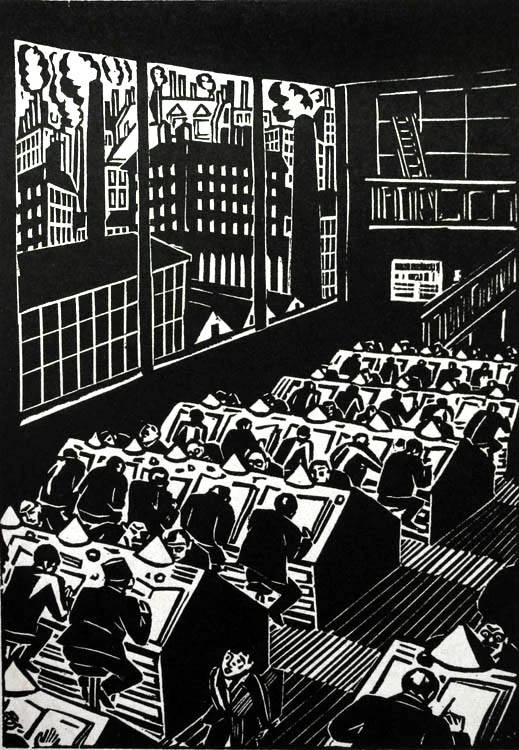
Frans Masereel - The City (plate 7), 1925. Woodcut.
There is a question that economics has spent two centuries trying not to answer: where does profit come from?
Your employer pays you for eight hours of work. In those eight hours, you produce value - you build something, move something, serve something, code something, care for something. The value of what you produce in those eight hours exceeds what you are paid. It has to. If it did not, your employer would not hire you. The difference between what you produce and what you are paid is profit. Your employer keeps it. You do not.
Marx called this surplus value. The mechanism has not changed since he described it in 1867. 1 The spreadsheet looks different. The product might be an app instead of a textile. The factory might be a fulfilment centre run by algorithms instead of a foreman with a pocket watch. But the structure is identical: you produce more than you receive, and the surplus goes to someone who did not produce it.
We should not describe this as a theory of exploitation in the emotional sense: Marx provided a description of a mechanism. The mechanism is how the system works. Every corporation, every platform, every gig-economy app operates on this principle: hire people, extract more value from their labour than you pay them, and accumulate and expand on the difference. If this mechanism stopped, profits would stop. If profits stopped, the system would stop. The system depends on the gap between what you make and what you get. That gap is no accident: just the vehicle.
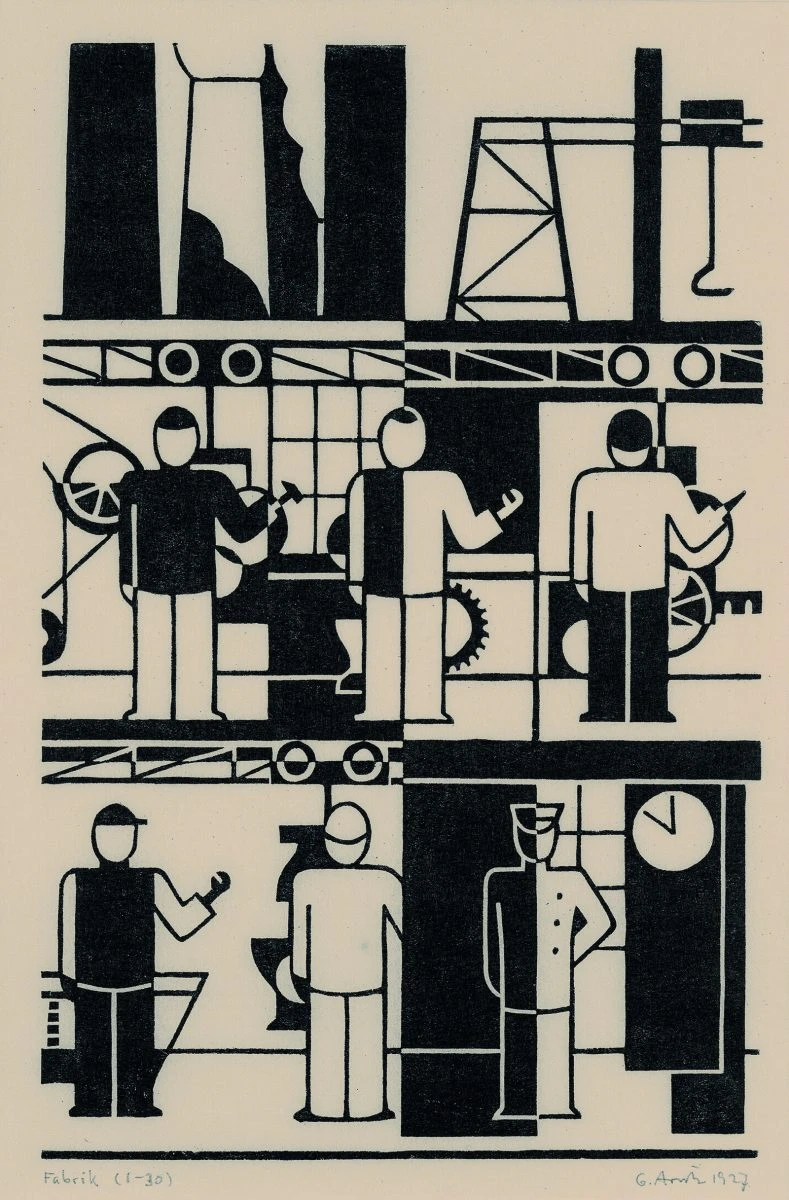
Gerd Arntz - Fabrik (Factory), 1927. Woodcut on paper.
Two classes
If the system runs on the extraction of surplus from labour, then there are two groups of people in it: those who own the thing that extracts, and those on whom the extraction is performed.
Marx called the first group the bourgeoisie and the second the proletariat. The vocabulary has fallen out of use. The categories have not. Call them what you wish: working class, elites, Epstein class, uber-rich, etc. The meaning holds.
The bourgeoisie are the people who own the means of production. In the 19th century, that meant factories, mills, mines, and railroads. In the 21st century, this means platforms, data infrastructure, supply chains, financial instruments, and the algorithms that manage them all. The owner class has not disappeared. It has concentrated. Three people in the United States own more wealth than the bottom half of the population. Globally, the top one percent holds nearly half of all wealth.23 These are not âthe richâ in the sense of your neighbour with a nice house and a new car. These are people whose wealth is measured in the productive apparatus they control - the servers, the logistics networks, the media empires, the financial systems that determine how resources are distributed across the planet.4
A note on what the author brings to claims about ruling-class extraction. My financial systems work has included building and monitoring KYC and AML infrastructure for large financial institutions - work that requires routine analysis of money laundering, human trafficking, and child exploitation patterns at the level of transaction documentation and entity relationships. The identical analytical apparatus, applied to the public Epstein file releases, produced a working understanding of how a single ruling-class extraction network operated for decades through correspondent banking relationships. The apparatus is designed to flag. When this book says ruling-class extraction is documented at scale, I have professionally documented it and privately analysed it, using the same methods across different bodies of evidence. I will tell you as it is: the Epstein network is not exceptional in kind - itâs just exceptional for being one of the few cases where the documentation became publicly available.
The proletariat are the people who work. Not in the narrow image of the 19th-century factory worker - though those workers still exist, in enormous numbers, in the Global South. The working class in the 21st century includes the factory worker in Bangladesh, the Amazon warehouse picker in Manchester, the Uber driver in Toronto, the nurse working double shifts in a public hospital that is being gutted by austerity, the freelance graphic designer bidding against thirty other freelancers for a contract that pays less than minimum wage, the content creator whose ad revenue depends on an algorithm they do not control and cannot see.
You are working class if you do not own the tools you use. The app, the platform, the algorithm, the warehouse, the hospital infrastructure, the delivery network. If someone else owns that, you show up, produce value with it, and they keep the difference, you are working class. The hard hat versus the laptop does not matter. Whether you call yourself middle class does not matter. The question is the relationship to the productive apparatus. Do you own it, or do you work it?
The fake bourgeoisie
There is a third group that complicates this, and the complication is by design.
The professional-managerial class
The professional-managerial class - the layer named and theorized by Barbara and John Ehrenreich in 19775 - occupies the space between the people who own the productive apparatus and the people who work in it under conditions they do not set. Lawyers, consultants, mid-level corporate managers, senior engineers at big tech firms, tenured professors, doctors in private practice. They earn enough to feel comfortable. They own homes, take holidays, and send their children to good schools. They identify upward and see themselves as closer to the people who own the system than to the people who clean the offices and deliver the goods.
They are wrong about the identification. The question the rest of this section works out is what they are right about, what they are wrong about, and how much the distinction matters for how a movement organizes around them.
I have read the objections to writing about this layer. I have read them many times. I was trained in it. I worked inside it - the technical fraction, building parts of the financial system machinery this book argues against. The moment of seeing it from the outside arrived alongside the wider thing becoming undeniable, and the admission that has to come first is that we all have to eat: the layerâs complicity is not a moral failure, it is the shape of the trap. None of that exempts the analysis. It just means I am writing about a layer I sat inside, and am aware of.
The theoretical question and the political question
Two questions sit atop each other. They are worth separating.
The theoretical question is whether the PMC is a separate class. By the strict ownership test, no: the corporate lawyer does not own the firm, the senior engineer does not control the productive apparatus, the tenured professor does not determine what the university produces. By the material-stake test, the answer is less clean: credentialed monopolies, property equity, deferred compensation, pension exposure. The layerâs material conditions are neither the ownerâs nor the wage-labourerâs.
The political question is how a movement organizes around the layer. That has a practical answer regardless of which theoretical reading wins. Address material conditions. Name capitalâs role in producing them. Work segment by segment rather than lumping the entire layer into a single political subject. The frameworkâs settled position is that the PMC is a class fraction whose ownership relation is proletarian and whose material stakes are sufficiently distinct to warrant its own analysis. Both readings are defensible. The book does not require the reader to settle the theoretical question. It demands that the reader not confuse it with the political one.
A senior engineer, a doctor, and what they actually hold
Before the segments, two illustrations that run through the lump.
A senior software engineer in a technology company earns a good salary and might hold stock options. She is not a capitalist. She does not control the productive apparatus. She does not determine what the company builds, who it sells to, or how its profits are distributed. She can be laid off in a corporate restructuring she had no say in, and 20,000 people like her were across the technology sector in a single week. Her stock options are worth what the market says they are worth, and the market answers to the people who own it, not the people who hold options in it.
A doctor in private practice appears independent. He is, in practice, dependent on insurance companies, hospital networks, pharmaceutical supply chains, and a regulatory framework written by and for the industries it ostensibly regulates. His independence is the independence of a sharecropper who owns his plough but not his field.
Neither holds what the firm's owner holds. Both hold more than the worker below them. The segment analysis below names the contrast that actually matters for how each behaves.
Segments
The single label lumps together people with very different material conditions. They vote differently, organize differently, and respond to redistribution differently. Five segments are worth naming.
State-adjacent professionals. Tenured academics, public-health nurses on the upper end, career civil servants in professional grades, senior teachers in unionized systems. Their material interest is in state capacity and funding; their employer is the state or a state-dependent institution. They tend toward social-democratic alignment and are the most natural constituency for the framework if organized around their actual material conditions rather than around the class self-identification that conflates them with the capital-adjacent segment.
Capital-adjacent professionals. Corporate lawyers, management consultants, investment bankersâ professional staff, and senior compliance officers at financial firms. Their material interest is directly tied to capitalâs extraction apparatus; their income depends on the survival of the structures that produce it. They tend toward liberal-centrist resistance to structural change: progressive articulation, materially protective behaviour under redistribution pressure. Hardest segment to organize. The framework does not waste organizing capacity on them as a bloc.
Credentialed-autonomous professionals. Private-practice doctors, architects, senior engineers with equity stakes, and partners at mid-size firms. Their material interest is in credential monopolies and professional autonomy. Politically volatile: social-liberal on identity, economically protective on anything that touches professional income or gatekeeping. Defection risk is high when credential monopolies are threatened. The credentialism diagnostic below is most directly relevant to this segment.
Rentier-adjacent professionals. Real estate agents, financial analysts, wealth managers, tax-planning specialists. Their material interest is in asset-price inflation and rent extraction. They tend toward right-libertarian alignment on economic issues, resistant to property reform. The segment overlaps with the ârentier-adjacent professionalsâ entry in the working-class fractions list below - the overlap is deliberate, because the segment sits at the boundary where the PMC analysis connects to the extraction architecture.
Tech-platform labour. Engineers, designers, product staff, and research workers at platform companies. Genuinely new category, and the largest swing constituency in advanced economies right now. Tech-platform labour is the working-class fraction whose RCE exposure is most acute, because it is the immediate material producer of the boomerang. They built the surveillance system that watches the workers. They write the algorithm that organizes the warehouse picker. They train the model that displaces other workers, including themselves. This is structurally unlike prior categories of proletarian labour. They are not only workers under capital. They are the workers who produce the specific instruments through which capital extracts surplus from other workers.
The segment has three sub-segments worth separating, because their material conditions and political trajectories diverge.
Compensation-equity holders. Rank-and-file engineers and product staff at established public companies are paid in a salary-plus-equity package, where the equity is a wage substitute denominated in volatile units rather than an ownership stake of any meaningful kind. No control over the firm. No extraction at scale from anyone elseâs labour. Structurally proletarian by every test the framework applies. Politically, the most stable progressive bloc within tech labour, because their material conditions are most exposed to the RCE dynamic the segment as a whole produces, and their ideological proximity to founder mythology is weakest.
Founder-equity holders. Early employees at startups, technical co-founders, and senior staff with substantial pre-IPO stakes. The structurally complicated case. They hold actual ownership stakes, even if minority. Some will become petty bourgeois - sell stakes, never employ at scale. Some will become bourgeois - extract sufficient capital to deploy productively against othersâ labour. The framework treats this group as transitional - petty bourgeois by current material stake, with an unresolved question about which direction they will take. Politically, the sub-segment is most susceptible to libertarian framings because the founder mythology relates directly to their material situation. The organizing question is what reaches them before that mythology hardens.
Salaried platform workers. Engineers and product staff with no equity component are paid on standard wage relations. Straightforwardly proletarian. The most numerous sub-segment. Materially most similar to the historical PMCâs lower stratum, and the easiest of the three to organize around shared material conditions.
The political fact that this segment has to be read through. AI displacement is hitting tech-platform labour harder and faster than any prior automation wave has hit prior labour categories. The material conditions of all three sub-segments are converging downward toward standard proletarian conditions, while subjective consciousness still lags behind. The 2026 cohort of laid-off tech workers is the political object the framework aims to reach, and it will radicalize either the left or the right, depending on which framework arrives first.
The organizing frame is not âyou are working class, accept it.â That reads as condescending to people whose subjective experience is still PMC-coded, and it cedes the easier rhetorical ground to the right-libertarian framings already in motion. The frameworkâs native frame is RCE applied to their own experience: you built the surveillance state, you built the gig-economy management software, you built the AI replacing workers, and now those tools are coming for you. The framework works because it is true and speaks to their technical understanding of how the systems they built actually work. They know how the layoff algorithm chose them. They wrote it.
The organizing moment is not at hire but at displacement. A tech worker with a stable role and a healthy stock package is a hard recruit. A tech worker just let go in a restructuring she had no say in, watching her former employer announce record profits two quarters later, is the easiest political conversation in a generation.
Geographical concentration matters for chapter strategy. Tech-platform labour is concentrated in roughly 20 metro areas internationally, making it a politically consequential bloc in specific districts and a non-factor in most others. Chapter network density in those districts should be calibrated specifically to this segment. The federated chapter architecture already permits this kind of differential calibration; what it has not yet done is name the segment.
One cross-reference that the rest of the book picks up. The AI safety community and the AI labour-displacement community are largely separate movements that should not be. Both are downstream of the same dynamic - capability development without containment, deployed against the people the developers built it to serve. The framework names them as a single political object, and the organizing work that follows from this segment is part of how that political object gets built.
The second mobilization frame follows from this. Tech-platform labour is also the constituency on which the enforcement architecture, the framework specifies, depends for its security property. The architectureâs defining commitment is that the code is public, and the public-code property is only as strong as the auditing community that actually reads the code. The auditing community is the technically capable fraction of this segment. Their technical capability is not only a political asset in the abstract sense developed in the counter-hegemony chapter. It is a definite structural role: the people who can read a formal specification, the people who can verify that the running code is consistent with the public repository, the people who can detect a covert modification by reading what is actually there. The single political object the framework names - the AI safety community and the AI labour-displacement community read together - is also the primary auditing constituency for the enforcement architecture, and the organizing work in this segment should involve explicit cultivation of the auditing function. The architecture cannot supply the constituency. It can only specify the constituency for which it is intended. The class chapter names the constituency.
The care-labour fraction. Nurses, teachers, social workers, eldercare staff, childcare workers, home-care aides. Simultaneously PMC-coded by credential, working class by ownership, and the fraction that absorbs the system's failures most directly. RCE-exposed in a specific way: the people who watch the welfare apparatus discipline the population they serve. The teacher who calls the truancy officer knows where the truancy officer's report goes. The nurse working a public hospital triage knows which patients get which level of care and why. The social worker filing a child-protection report knows the apparatus the report activates. They are inside the boomerang.
The fraction is structurally distinct on three axes the rest of the working class does not share in combination.i Reproductive: the labour produces the labour-power on which every other sector depends, and the wage relation reads what reproductive labour produces as cost rather than as production - which is why the fraction is paid below what its surplus produces by a margin no other working-class fraction faces. Gendered and racialised: the composition is not incidental, it is the wage architecture's mechanism for pricing the labour at the margin and for splitting the fraction's organising along identity lines that the wider institutional context already enforces elsewhere. Isolated: the labour is performed across households, hospital wards, classrooms, and care-home shifts that suppress the collective consciousness formation other fractions get from the shop floor. The combination is what makes the fraction's class consciousness the framework's hardest case to read, because the structural position produces a knowledge of the apparatus that runs decades ahead of the fraction's political weight.
Three sub-segments worth separating, because their material conditions and political trajectories diverge.
Credentialed care professionals with autonomy of practice. Tenured teachers in well-funded districts, registered nurses in unionized public systems with full collective-agreement protection, senior social workers with clinical autonomy. Their material interest tracks the state-adjacent professionals segment above: state capacity and funding determine their conditions. The most stable progressive bloc within care labour, and one of the most reliable left constituencies in any advanced economy when organized around the actual mechanism degrading their work.
Credentialed care workers under aggressive managerial discipline. Most American nurses operating under hospital-chain productivity metrics, most teachers under standardized-testing regimes, most public-sector social workers operating under caseload quotas designed for fiscal compression rather than for the work. Credentialed by training, proletarianized by managerial control. Their material conditions are converging downward - the credential floor that protected the previous generation has been eroded by the same commodification dynamic that produced the precariat. Politically the most volatile of the three, and the segment driving the 2018-2026 wave of teacher strikes, nurse unionization, and care-sector militancy. The framework's natural constituency, currently radicalizing on its own without the framework's prompting.
Uncredentialed care workers. Home-care aides, childcare workers, eldercare staff, kitchen and laundry workers in care institutions, classroom paraprofessionals. Straightforwardly proletarian by every test. Disproportionately racialized and gendered - overwhelmingly women, disproportionately Black, Latina, Filipina, South Asian, and immigrant. The most exploited fraction of the care economy, the one whose labour the credentialed strata depend on, and the one whose organizing has historically been suppressed by the credentialed strata's defence of professional gatekeeping. The framework's organizing implications here are not subtle: any care-labour politics that does not place the uncredentialed fraction at the centre is a politics that has accepted the credential hierarchy capital uses to fragment the workforce.
The political fact for this segment as a whole. Care labour is the largest organized labour force in advanced economies, and it is currently radicalizing - the teacher strikes, the nurse unionizations, the care-sector militancy of the past decade are the leading edge of a wave whose full political consequences have not yet been measured. Their material conditions are converging downward across all three sub-segments; their consciousness, especially in the credentialed-disciplined and uncredentialed segments, is years ahead of the tech-platform-labour fraction's. The compensation reckoning developed in the economic architecture chapter addresses what the transition to functional-compensation actually does to this fraction, since the framework's compression rhetoric - written against corporate lawyers - lands harder on a hospital nurse than on the lawyer the rhetoric targets, and that asymmetry is named directly there. The organizing implications run through to the action chapter: the fraction is already organizing itself, and the framework's role is to provide a political vocabulary adequate to what care workers already see.
The alliance positions follow from the structural position. The natural alignment is with the resource-worker fraction below - the labour the dominant economy externalises shares with care labour the structural relationship of producing the conditions of social and metabolic continuity while being read as cost - and with the wage-floor service fraction, which shares the safeguard floor as the primary architectural protection. The structural tension is with the tech-platform fraction. Tech-platform tools, deployed under the wrong architecture, manage care workers in the same shape they manage gig drivers - scheduling algorithms, productivity metrics, surveillance of the consultation room - and the alliance between care labour and tech-platform labour has to be built across that tension, not by pretending the tension does not exist. The framework's organizing implication is direct: the auditing constituency named in the tech-platform passage is also the constituency that will or will not let the management tools get deployed inside care work, and the alliance is operational, not aesthetic.
The empirical question
The standard buffer-stratum formulation holds that PMC defects move leftward when its material floor is threatened and rightward when its position is contested by reforms. It is a clean formulation, and it is too neat. The historical pattern runs through a different variable.
The question worth resolving empirically: does the PMC support the left when its material interests are threatened (the buffer-stratum reading), or does it identify with the right whenever substantial redistribution is on the agenda, regardless of whether the layer is falling (the separate-fraction reading)?
The cases.
2008 financial crisis, United States. Mixed. Middle-class political realignment was partial and uneven; much of the professional class remained Democratic under Obama and moved rightward incrementally only when redistributive policy became concrete rather than rhetorical.
United Kingdom austerity, 2010-2024. Mixed-to-split. Professional-class realignment produced majority opposition to public service cuts and to the tax increases that would have reversed them. A clean left-alignment did not materialize; a clean right-alignment did not either.
French Yellow Vests, 2018-2020. The provincial middle class moved rightward, populist, in response to fuel-tax increases, which were experienced as a tax on the middle class rather than as a redistributive move against capital. Perceived-threat-to-position drove the alignment.
Chilean middle class, 1970-1973. Under the Allende government, the layer was not materially falling; it was being asked to accept nationalization that touched its asset position. The alignment went right-authoritarian and supported the coup.6
Greek middle class, 2010-2015. Under Syriza and through the austerity crisis, the layer stood as both falling and seeing the left in power. The result was a split - not the clean left-alignment the buffer-stratum reading would predict under those conditions.
Honest reading of the cases: the pattern is mixed, and the variable that most consistently explains alignment is perceived threat to position, not the question of whether the layer is objectively falling. The German middle class in the 1920s and 1930s fell economically, perceived a left-wing threat, and went fascist. The Chilean middle class did not experience economic decline, perceived a left-wing threat, and went authoritarian.ii The Greek middle class fell, perceived the left in power, and split. The defection mechanism is perceived as a threat to position, not actual falling.
This complicates the buffer-stratum reading without overturning it. The material-stake reading is defensible but not decisive; the cases do not produce a clean answer on the theoretical question. What the cases do produce, with some consistency, is a practical claim: the organizing strategy has to address perception, not just objective material conditions, which makes the work of the counter-hegemony chapter load-bearing for any movement that intends to organize around this layer.
The frameworkâs updated position: the PMC is, for political-organizing purposes, a separate class fraction, even if it shares the proletarian ownership relation together with the broader working class. Both readings produce the same anti-capture architecture. The readings diverge on posture, not on prescription.
Credentialism under the frameworkâs own logic
Credential monopolies - bar associations, medical licensing boards, PhD gatekeeping at research institutions, professional certifications that restrict practice to the credentialed - are not property in the classical sense. They are apparatus. Under RCE, the apparatus expands wherever the activation conditions are present, and they are present here.
The expansion has already occurred and is observable. Bar associations moved from practitioner self-regulation to gatekeeping that restricts legal access for non-wealthy populations, with documented effects on how many lawyers practice in poor and rural areas and who can afford one when they do. Medical licensing moved from competence certification to an artificial scarcity that keeps physician incomes above market-clearing levels, as reflected in the number of residency slots relative to demand and in the barriers to foreign-credentialed doctors practicing in the systems that need them most. PhD gatekeeping shifted from scholarly credentialing to the structural exclusion of working-class intellectuals from the research institutions that produce most scholarship. The pattern is the expansion pattern that the framework anticipates.
The implication is that the PMCâs material stake in credential monopolies is real - the credentialed earn more, do less contested work, and pass the credential down through family access to the institutions that credential - and that the stake is in an apparatus the framework expects will be subject to containment. The prescriptive half of this argument lives in the economic architecture chapter. The diagnostic half is that the PMCâs strongest material stake is in a system the framework reads as structurally unstable by its own logic, which is the reading most likely to actually change how a PMC reader engages with the rest of the argument. The layerâs material position is precarious in a specific way, and the precarity is produced by the same dynamic that the framework is built to diagnose.
What the framework commits to
The PMC is a class fraction whose ownership relation is proletarian and whose material stakes are sufficiently distinct to warrant its own analysis. Both the buffer-stratum and separate-fraction readings are defensible. The cases do not settle the theoretical question, and I wouldnât pretend the framework does either.
What the framework commits to is operational. The anti-capture architecture applies under both readings. Organizing works segment by segment, not on the layer as a bloc. The defection mechanism is perceived as a threat to position, not actual decline. The credential monopolizes the layerâs most acute material stake, which rests on an apparatus subject to the frameworkâs own containment logic, and the transition from credential-monopoly income to functional-compensation income is not a marginal adjustment. It is one of the most materially disruptive aspects of the framework for this layer, and the book names it directly rather than routing around it.
What the framework does not yet know: what this layer actually does once the conditions change. The credential monopolies are dismantled, the equity packages collapse into wages and ownership stakes, and the gatekeeping institutions lose their gates. For the corporate lawyer, the management consultant, the tenured administrator - what is the work after? Some of the technical-professional fractions have an obvious answer (the engineer keeps engineering, the doctor keeps doctoring, under different incentives). The rest of the layer consisted of the gatekeeping itself, and a society that has dismantled the gate has dismantled most of what the gatekeeper was for. I do not know the answer. The honest position is that the layer will have to find one, and the finding is part of what the transition is for.
The PMC in adjacent Marxist theory
The most developed Marxist treatment of the layer is Erik Olin Wrightâs framework of contradictory class locations.7 Wright argues that the PMC occupies a location that is neither pure labour nor pure capital - credentialed monopolies constitute a form of asset ownership that sits alongside the ownership of means of production without reducing to it, and managerial labour combines exploitation (the PMC is exploited by capital) with exploitation-administration (the PMC administers the exploitation of the workers below). The framework used in this book agrees with all three moves.
The divergence is about what the contradictory location does. Wrightâs framework is primarily classificatory: it names the location and treats the PMC as a stable fraction inside the class structure, generating a politics of cross-class coalition with the fraction. The framework used here adds the mechanism. The PMCâs contradictory location is structurally unstable under the conditions of capitalâs expansion and the frameworkâs own expansion logic. The credentialed monopolies that the location depends on are apparatus subject to the containment dynamic. The managerial position is itself subject to the institution's expansion. The location is not a stable equilibrium the movement negotiates with; it is a structurally unstable zone the movement has to organize inside, segment by segment.
The practical implication: Wrightâs framework points toward a cross-class coalition with the PMC as a single political subject. This design points toward the segment-level strategies above, differentiated by each segmentâs specific material position and its specific exposure to the expansion dynamic. Both framings converge on the same anti-capture architecture. They diverge on how to organize around the layer before the architecture exists.
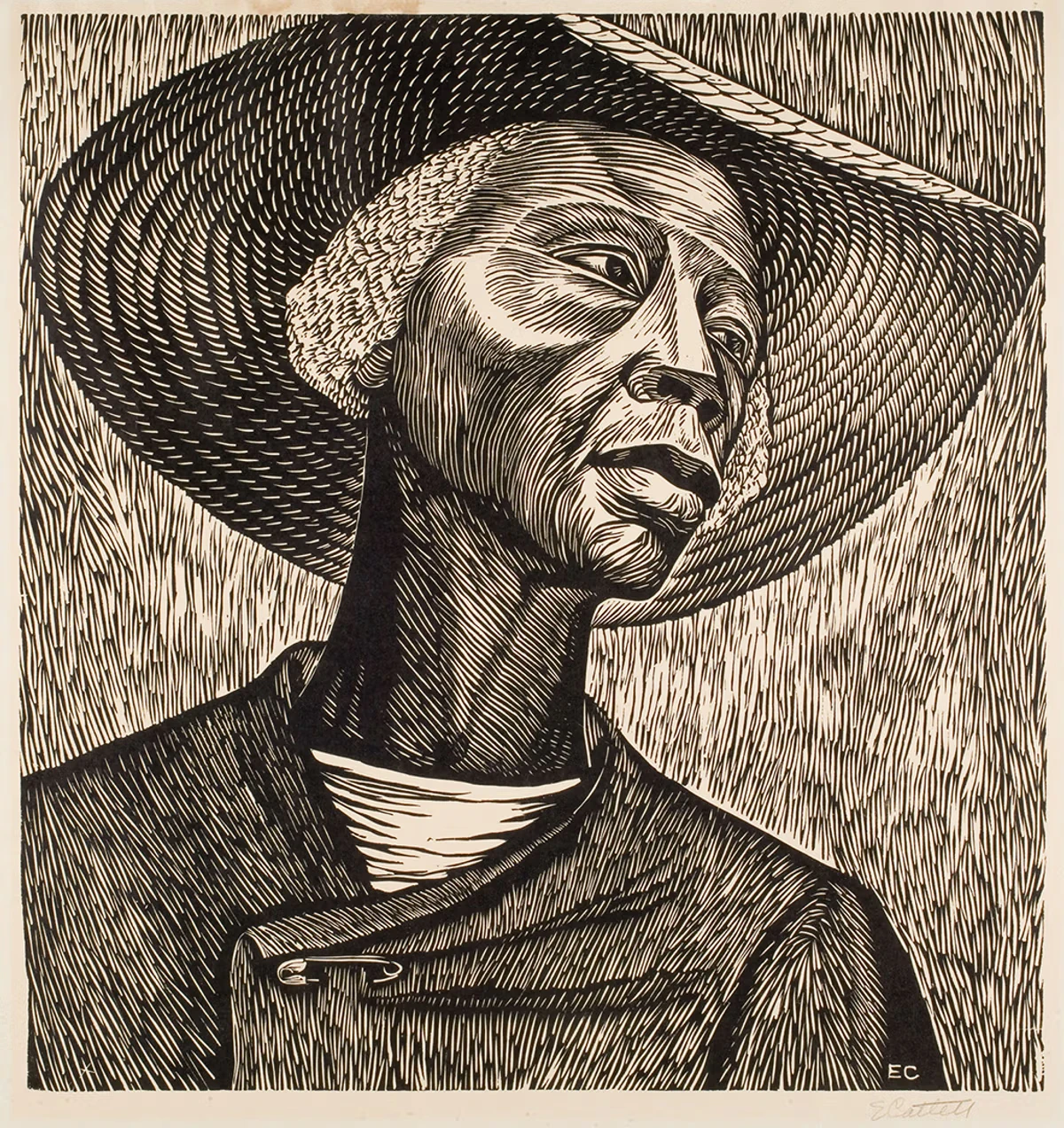
Elizabeth Catlett - Sharecropper, 1952. Linocut.
The working class is not one thing
The two-class framework is structurally correct: you either own the means of production or you do not. But the working class comprises distinct fractions with different material conditions, political tendencies, and relationships to capital. Treating the proletariat as a uniform mass produces organizing strategies that fail because they address a class that does not exist as the organizer imagines it.
The labour aristocracy. Unionized workers in protected industries - autoworkers, steelworkers, construction trades, public sector employees with defined-benefit pensions. Their wages are above the median for the working class. Their conditions are negotiated collectively. They have something to lose. Politically, the labour aristocracy tends toward defensive conservatism: protect the contract, protect the pension, protect the job. This fraction is vulnerable to right-populism when the contract is threatened by trade liberalization or immigration-driven wage competition, because the right names the threat (correctly) while misdirecting the blame (toward other workers rather than capital). The left that dismisses the labour aristocracyâs material anxieties as false consciousness loses them. The left that addresses those anxieties by naming the actual mechanism - capitalâs use of trade and immigration policy to suppress wages - gets their attention. The left that provides solutions to the same mechanisms and seeks not just to align but to improve their material conditions wins their support.
The precariat. Gig workers, zero-hours contract workers, temporary agency staff, freelancers lacking stable clients, seasonal agricultural workers, and the growing population whose employment is structured to avoid the obligations that come with permanent employment. The precariat is the fastest-growing fraction of the working class in every advanced economy.8 Their main condition is insecurity: no guaranteed hours, no guaranteed income, no benefits, no pension, no path to stability. The precariat tends toward volatile politics - susceptible to both left-populism and right-populism, depending on who names their condition most convincingly. When the left articulates their insecurity as a structural product of capitalâs need for flexible, disposable labour, the precariat moves left. When the right articulates their insecurity as a product of immigration or cultural change, the precariat moves right. The fraction is in play and large enough to determine political consequences in most democracies.
The informal sector. Street vendors, domestic workers paid under the table, undocumented labourers, and subsistence farmers are integrated into commodity chains they do not control. In the Global South, the informal sector is not a marginal category - thatâs the majority of the working class. In India, over 80 percent of workers are in the informal economy.9 In sub-Saharan Africa, the figure is higher still. These workers are exploited by capital but are invisible to most class analysis developed in metropolitan contexts. They have no union, no contract, no legal standing as employees. Their exploitation is not mediated by the wage relation in the classical sense - it is mediated by market dependency, debt bondage, and the absence of alternatives. Any class analysis that treats the wage-earning industrial proletariat as the universal working-class subject has already excluded the majority of the worldâs workers.
Rentier-adjacent professionals. Financial analysts, real estate agents, corporate lawyers, management consultants, and venture capitalistsâ junior staff. These workers earn wages, but their wages derive from the management, facilitation, or expansion of capitalâs extraction apparatus. A corporate lawyer who structures a leveraged buyout that strips a companyâs assets and fires its workers is working class by the ownership test - she does not own the firm - but her labour is directly instrumental to capitalâs extraction from other workers. This fraction tends toward liberal centrism: they benefit from the systemâs current operation, they are educated enough to articulate progressive values, and they are materially invested in the maintenance of the structures that produce their income. The left should not expect this fraction to self-organize against its own material interest. It should expect this fraction to resist structural change while supporting superficial reform.
Small property owners and the petty bourgeoisie. The owner of a corner shop, a family farm, a small restaurant, and a plumbing business with three employees. These people own means of production in the technical sense - they own the shop, the land, the restaurant. They also work in them, sometimes harder and longer than their employees. Their relationship to capital is contradictory: they are exploited by the supply chains, landlords, and financial systems they depend on, while they exploit the small number of workers they employ. Politically, the petty bourgeoisie is the most volatile fraction. It is the base of fascism when economic crisis threatens its position - simultaneously, it is the base of left-populism when the threat is identified as corporate monopoly rather than as workers or immigrants. The fractionâs political direction depends almost entirely on who names the threat to their livelihood and what target they are given in return.
State functionaries. Teachers, social workers, public health nurses, municipal administrators, civil servants. They work for wages. They do not own the means of production. They are working class, but their employer is the state, and their material interest is in the stateâs capacity and funding. Public austerity hits this fraction directly - every budget cut eliminates their colleagues, increases their workload, and degrades their conditions. This fraction tends toward social democracy: it supports state capacity, public investment, and collective provision because those are the conditions of its own employment. The leftâs natural constituency, if the left bothers to organize it. The rightâs target, because attacking the civil service serves capitalâs interest in reducing the stateâs capacity to regulate and redistribute.
Indigenous nations and the extraction relation. Indigenous nations are not inside the settler class structure. They are subject to capitalist extraction - land seizure, resource extraction, treaty violation, forced inclusion into wage labour - but the relationship is not the wage relation. The reader is prompted to distinguish that this is a colonial relation: dispossession and extraction from peoples whose relationship to land and production precedes and is inherently distinct from the capitalist mode. The Wetâsuwetâen hereditary chiefs resisting the Coastal GasLink pipeline are not fighting a class struggle in the Marxist sense - they are fighting a sovereignty struggle against an extractive apparatus that treats their territory as a resource colony. The Lakota at Standing Rock were not striking workers - they were a nation defending its land and water against a corporation backed by state violence. Class analysis that treats Indigenous resistance as a subset of working-class politics misrepresents the relationship: the framework positions Indigenous nations as peoples subject to the imperial-extraction machinery, whose struggle is allied with but not reducible to the class struggle. The nationalization chapter addresses how the frameworkâs economic architecture interacts with Indigenous sovereignty.
Political tendencies and organizing implications. The fractions do not move in the same direction at the same time. A left project that speaks only to the industrial proletariat has lost the precariat, the informal sector, and the petty bourgeoisie before it starts. A left project that speaks only to the precariat has failed to build the institutional base that unionized workers provide. The organizing challenge is to articulate a programme that addresses each fractionâs specific material conditions while maintaining class unity against the common extraction mechanism. This is what the counter-hegemony chapter develops in detail. The class fractions described here are the raw material; the organizing strategy must work with their actual conditions, not with an idealized proletariat that exists in theory and not on the ground.
Class across borders
The class fractions described above assume workers located within a single state. Most of the worldâs most exploited workers are not. Their class position spans borders, and the borders are themselves instruments of extraction.
A Nepali construction worker in Qatar lives under the kafala system: his legal residency is tied to his employer, his passport is held by his employer, and he cannot change jobs or leave the country without his employerâs permission. His wages are a fraction of what a Qatari citizen would receive for the same work. He borrowed money to pay a recruitment agent to get the job. He is working to repay the debt. He is, in every material sense, an indentured labourer. His class position is not captured by any analysis that treats him as a worker within the Qatari economy. He is a worker extracted from the Nepali economy, transported to the Gulf, and subjected to conditions that would be illegal if applied to citizens. The border is the mechanism that enables this extraction.
A Filipino domestic worker in Hong Kong sends over half her wages home. She raises another familyâs children while her own children are raised by relatives. Her labour subsidizes the professional class in Hong Kong - the dual-income household that can function because a migrant worker provides childcare at a wage no Hong Kong resident would accept. She is exploited twice: once by the employer who pays poverty wages for essential labour, and once by the remittance economy that substitutes cash transfers for the structural development that might give her a livelihood at home.
Mexican agricultural workers in the United States harvest the food that American consumers eat. They are paid less than minimum wage in practice, have no effective legal recourse when cheated, and their immigration status makes them unable to organize without risking deportation. The agricultural sector in the American Southwest functions on this labour. Without it, the food system collapses. The workers who make it function are the most precarious, least protected, and most exploited in the entire supply chain.
South Asian tech workers on H-1B visas in Silicon Valley appear to be in a different category - they are paid well by global standards, and they work in offices rather than fields. But the visa ties them to their sponsoring employer: if they are fired, they have sixty days to find a new sponsor or leave the country. The employer knows this. The worker knows this. The power asymmetry structures every engagement: the worker accepts conditions - unpaid overtime, abusive management, stagnant wages relative to peers - that a worker with full labour mobility would refuse. A golden cage is still a cage.
African-trained doctors and nurses in European health systems represent the brain drain that strips origin countries of the human capital they invested in. Nigeria trains a doctor; the UK hires her. Nigeria bears the cost of training; the UK captures the return. The doctorâs class position spans both countries - she is a professional in the UK and a loss in Nigeria. The extraction is not of her labour alone but of the entire social investment that produced her capacity to labour. Simultaneously, the asymmetrical relationship between her and her employer will result in lower wages, which, in turn, reduces the wage-bargaining power of her domestic peers.
The common mechanism across all these cases is that the border functions as a class instrument. It creates a differential legal status that capital exploits. It produces workers with reduced rights who compete with workers with full rights, suppressing wages for both. It enables extraction from origin countries (brain drain, remittance dependency) and destination countries (wage suppression, labour market segmentation) simultaneously. Any class analysis that works within a single national frame has already missed the mechanism.
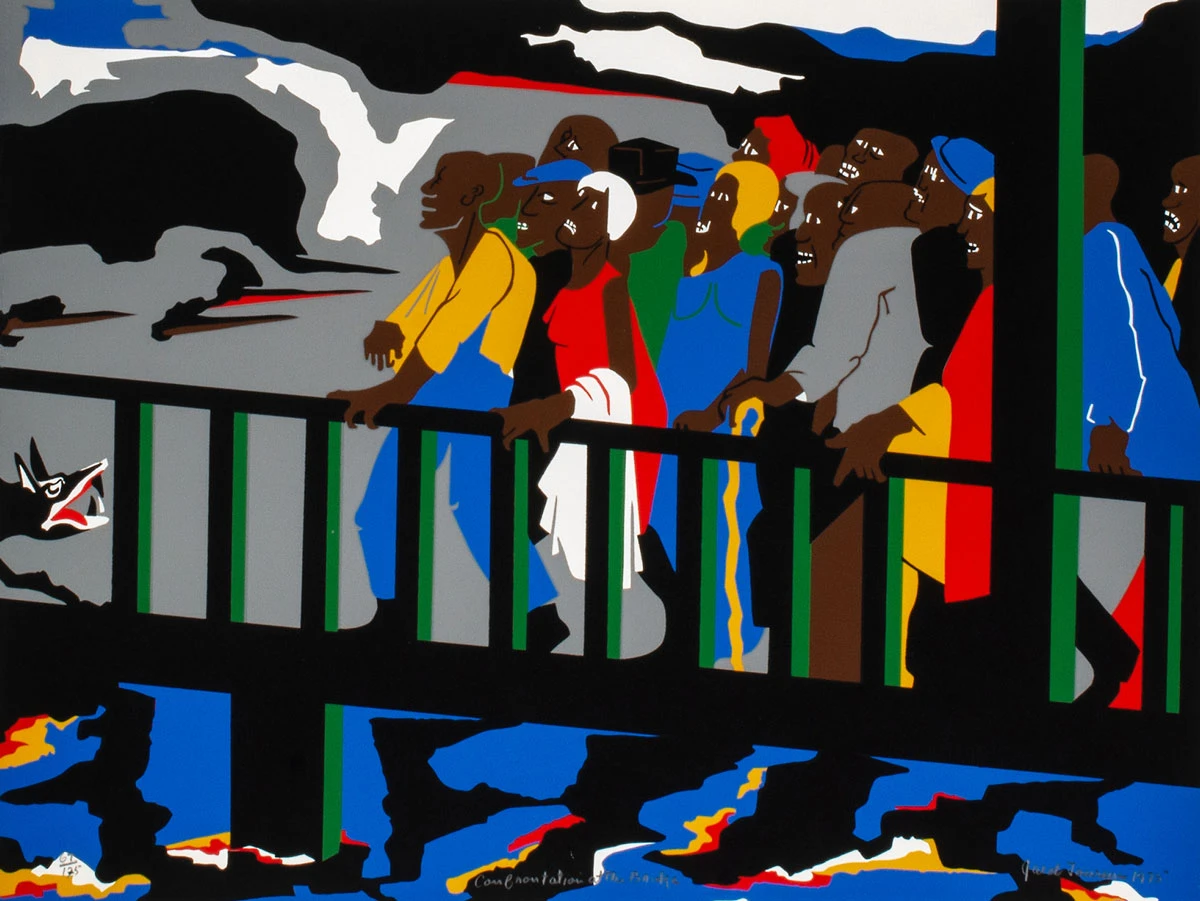
Jacob Lawrence - Confrontation on the Bridge, 1976. Gouache on paper.
The immigration deep dive below develops the structural prescription: no visa programme ties a worker to a specific employer, workers who live and work in a country have full rights regardless of origin, and immigration policy promotes working-class interests in both origin and destination countries rather than capitalâs need for exploitable labour. The opposition precedes itself: what are the conditions for allowing / disallowing immigration? The framework seeks to answer the following question, with the following constraint: can society sustain its surplus with the accepted level of immigration without suppressing wages for its existing population? If so, there is a material reason to limit or prohibit it based on the reasons already described.
The distinction matters: material assessment of immigration policies provides clear guidance for both sides of the argument, grounded in collective bargaining power. Likewise, the reader must acknowledge that regardless of the position you come into this with - a state inheriting the status of its inheritors (e.g. high immigration), must concede to the material conditions whose cost of uncontained deployment without confronting the underlying systems producing them (e.g. building out mass deportation or execution infrastructure), will expand to groups the creator did not extend to. Not might, will.
You are not your identity
There is a conversation that happens in every political space where people try to organize against the system, and it goes like this: Is the real problem class, or is it race? Is it economic or is it about gender? Can we focus on redistribution or on recognition? Is it about who owns the factory or about who gets harassed on the way to it?
The frameworkâs answer is: this is a trick question, and the system designed it.
Racism, homophobia, transphobia, misogyny, xenophobia - these are not separate problems that happen to coexist alongside class exploitation. They are produced by the same machinery. Imperialism requires the construction of the Other. A system that extracts wealth from colonized peoples, that exploits the labour of subjugated populations, that maintains hierarchies of access and dignity - that system needs you to believe that the differences between you and your neighbour are more important than the difference between both of you and the person who owns the building you both live in.
The British Empire did not import racial hierarchy to India because the British were unusually prejudiced. It imported racial hierarchy because Empire requires it. You cannot govern 300 million people with a few thousand administrators unless you convince yourself - and enough of the governed - that the hierarchy is natural. Race is the tool. Empire is the purpose.
The same logic applies domestically. In the United States, the racial division of the working class has been the most effective mechanism for preventing class solidarity in the countryâs history. W.E.B. Du Bois called it the wages of whiteness10, the psychological compensation that white workers received for not organizing with Black workers. You do not get higher wages. You do not get better conditions. You get the knowledge that there is someone below you, and that knowledge is enough to keep you from looking up at the people above you.
This is the operating logic of every right-wing populist movement in the world right now, not ancient history, and the substitutions are consistent across them: blame the immigrant rather than the employer, the trans person rather than the landlord, the activist rather than the profiteer. The system produces identity-based divisions because those divisions prevent the one thing the system cannot survive - working people recognizing that they have more in common with each other than with the people who exploit them.
The liberal left performs the same function from the other direction. Where the right fragments the working class through scapegoating - directing anger downward at immigrants, minorities, and the vulnerable - the liberal left fragments it through inclusion without redistribution. Representation in the boardroom. Diversity at the management level. A Black CEO, a woman defence secretary, a gay billionaire. The identities change. The extraction does not. Capital does not care who sits in the corner office as long as the surplus keeps flowing upward. The right tells the white worker that the immigrant is his enemy. The liberal left tells the same worker that his real problem is his attitude, not his material conditions. Both messages serve the same purpose: they prevent him from looking up at the person who owns the building they are all standing in. The right and the liberal left are not opposite sides of a genuine divide. There are two management styles for the same system - one that rules through resentment, one that rules through guilt, neither of which threatens the people who profit from both.
The frameworkâs position is this: class is primary in the causal sense - the imperial-capitalist machinery produces and instrumentalizes identity oppression because division serves extraction. Identity oppression is real, devastating, and must be fought on its own terms. It is not reducible to class - the specific forms of anti-Black racism, of misogyny, of homophobia have their own logics, their own histories, their own harms that do not disappear when you name the economic mechanism behind them. Black feminist theorists - Crenshaw, Collins, Davis - are correct that lived experience at the intersection of multiple oppressions produces something that cannot be captured by a class-only analysis. A Black woman facing both racial and gender discrimination does not experience two separate oppressions that can be addressed sequentially. She experiences a compounded condition that class analysis alone cannot describe.
Where the framework parts from intersectionality as a standalone analytical method is on the question of structural origin. The framework argues that imperialism and capitalism produce the conditions under which identity oppression is manufactured and maintained at an institutional scale - not that individuals would stop being prejudiced without capitalism, but that the institutional reinforcement of prejudice, the state apparatus of racial control, the economic incentive structures that reward division, would lose their engine. Cultural residue persists - private prejudice does not disappear instantly when the structural incentives that manufactured it are dismantled - but without institutional reinforcement, prejudice attenuates over generations rather than reproducing itself through state and economic power. This is a defensible empirical claim, and it is a weaker claim than the caricature: the framework does not say âfix class and racism disappears.â It says: fix the structural engine that produces and reproduces racism at the institutional scale, fight the cultural residue simultaneously, and the compounded condition that Crenshaw describes loses the institutional machinery that generates it.
Defending individual rights - the right to exist as you are regardless of orientation, identity, ethnicity, or origin - is not a liberal add-on to class politics. It is a direct attack on the system that depends on class-based identity division in the first place. Every time the working class is fragmented along identity lines, capital wins. Every time those lines are refused, capital loses a weapon.
This is why the framework insists that the state does not care if you are gay or trans - not because tolerance is a nice value - because the criminalization of queerness, the persecution of minorities, the enforcement of conformity: these are imperial tools that fragment the working class, and under RCE, the activation conditions for expansion against the stateâs own base are functionally equivalent to the act of persecution itself. The Soviet Union recriminalized homosexuality under Stalin.11 The material consequence was a fragmented working class, alienated allies, and internal contradictions that weakened the project from within. The repression did not strengthen the state. It corroded it. The capability expanded inward.
The framework goes further. Identity persecution isn't simply counterproductive. It is a transgression - within the same analytical category as domestic surveillance and uncontained AGI. The reasoning is structural, not moral. The working class holds power as a classiii - that is what working-class state authority means. Identity persecution fragments the working class. A fragmented working class cannot hold power as a class. Therefore, identity persecution subverts class power by definition. A âdemocraticâ vote for identity persecution is structurally equivalent to a vote to build a domestic panopticon - it is the class voting to undermine its own capacity for collective power. The reciprocal consequences (class fragmentation, state weakening, ossification) are structurally predictable and historically unanimous. The framework does not need to import liberal rights theory to block identity persecution. It rejects it on its own structural grounds: the activation conditions for reciprocal harm are inherent to the act, and the consequences are severe enough to place it in the transgression category alongside other technologies whose structural distance between possession and harm is zero.
Materialist analysis finds structural conditions that produce outcomes. It does not make claims about metaphysics. The frameworkâs grounding in material consequences rather than moral abstraction does not require atheism or hostility to religious belief. Liberation theology, Islamic socialism, Buddhist economics, and other religious traditions that centre justice and collective wellbeing have arrived at compatible structural commitments through different paths. The framework asks: Do you reject the claim that the working class is exploited, accept that exploitation is structural, and that the structure can be changed? If yes, you are welcome here regardless of what you believe about the universe beyond the material conditions we share.
Defending individual rights is anti-imperial praxis. It was never separate from the class struggle; it was part of it.

Hans Haacke - Shapolsky et al. Manhattan Real Estate Holdings, A Real-Time Social System, as of May 1, 1971, 1971. Photographs and ownership records.
What is your attention worth?
There is one more dimension of the extraction that Marx could not have seen, because his world did not have it: your attention is a commodity.
When you scroll through a social media feed, you are working. You are not being paid, but you are producing value - your engagement, your clicks, your emotional reactions, your data - and that value is being sold. The buyer is an advertiser, the commodity is you. Not your labour in the traditional sense, but your attention, your behaviour patterns, your demonstrated preferences, your revealed anxieties. All of it is captured, packaged, and sold.
This is not a metaphor. Advertising revenue is literally the primary business model of the largest technology companies in the world. Metaâs revenue in 2024 was over $160 billion. 12. Virtually all of it came from selling access to your attention. Googleâs was higher. The product is not the search engine, nor the social network. The product is the population that uses them, measured, segmented, and delivered to the highest bidder.
The labour theory of value says that profit comes from the difference between what a worker produces and what the worker is paid. In the attention economy, what you produce is engagement data and what you are paid is nothing. The surplus extraction rate is total. You are an unpaid worker whose product is your own psychological profile, and the factory floor is your phone screen.
Data extraction operates on the same principle at a different scale. Every engagement you have with a digital system generates data. That data is collected, aggregated, and used to train algorithms, target advertising, assess risk, price insurance, approve or deny credit, and make decisions about your life that you have no visibility into and no control over. You produced this data through your activity. You are not compensated. The entity that collects its profits. The mechanism is surplus extraction. The commodity is behavioural surplus - the predictive data harvested from your actions, beyond what is needed to serve you.13 Many argue that attempting to regulate this away is an argument for big government - fair enough. I ask the reader, then, what is this arrangement other than a governance system without democratic oversight? The framework argues that it is a system of privatized governance.
Fetishization of Capital
Then there are derivatives. Financial instruments are built not on productive activity but on bets about the future direction of other financial instruments. A credit default swap is a bet on whether a borrower will default. A collateralized debt obligation is a package of debts, sliced and sold as investment products. These instruments hold market value - they can be bought, sold, and traded for enormous sums. But they contain no labour. No one built anything. No one grew anything. No one moved anything. The value is generated from abstraction, from the gap between expectation and outcome, and the mathematics of risk modelling.
Marx called this commodity fetishism - the process by which the social relations embedded in a commodity become invisible, and the commodity appears to have value in itself, independent of the labour that produced it. Derivatives are commodity fetishism in its purest form. Value abstracted entirely from labour, appearing to generate surplus from nothing. The 2008 financial crisis14 revealed what happens when an economy is built on a mountain of these abstractions: the mountain collapses, and the people who never held a derivative in their lives lose their homes, their jobs, and their savings, while the people who built the mountain are made whole by the state.
The labour theory of value was formulated in the 19th century and remains a valid description of the 21st century. The forms of extraction have changed, while the relationship has not. You produce, someone else profits: that is the system.
Where this goes
Class is the foundation of the analysis. But knowing what class you belong to is not, by itself, a programme. The question that follows is: what do you do about it?
The next pieces in this series address this directly. How power is maintained through economic extraction and through the manufacture of consent - the media, the platforms, the incentive systems that make the machinery invisible. How the form of resistance must match the form of oppression, calibrated to the conditions you actually face. How to build economic structures in which the productive apparatus serves the people who work it, not the people who own it. How to design institutions that do not rot from the inside.
Class tells you where you stand, what comes next tells you where to go.
The commodification of everything
The main text develops platform labour, attention as commodity, and derivatives as fetishism. This deep-dive supplements those passages with three sharper claims that the main-text register did not carry.
Ghost work. Behind the algorithmic facade, millions perform invisible labour that makes AI systems function - labelling data, moderating content, training models - under conditions that Ghost Work documents as the new permanent underclass hidden by design.15 The commodification is not just of attention; it is of the human cognitive labour required to produce the appearance of automation. The "AI" that displaces a content moderator was trained on the labour of fifty other content moderators in the Philippines, Kenya, and India, working through the same content the displaced worker used to handle, for a fraction of the displaced worker's wage, with none of the protections.
The unilateral claim. Shoshana Zuboff's specific contribution16 is the analytic point that surveillance capitalism unilaterally claims private human experience as free raw material - without consent, without compensation, without the symmetry the wage relation at least pretends to maintain. The labour theory of value clarifies what surveillance capitalism is: extraction with the surplus capture rate set to total. In Marx's terms, you are working an unpaid shift every time you use a digital device, and the product of that shift is sold for profit you will never see. The same surveillance logic now extends into the workplace itself: employers deploy productivity scoring software that tracks keystrokes, mouse movements, and screen activity to extract maximum output from each paid hour.17
Use value versus exchange value at the derivatives endpoint. A commodity in Marx's analysis has a dual character - use value (it does something, satisfies a need) and exchange value (it can be traded). Use value is grounded in the material world; exchange value is a social relation reflecting embedded labour. A derivative has exchange value but no use value. The notional value of the global derivatives market exceeds world annual GDP several times over.18 This is value generated from mathematics, risk modelling, and the collective agreement that a number on a screen represents a claim on future wealth. Marx would have recognized it instantly: commodity fetishism - the belief that the commodity has value in itself, independent of the social relations and labour that produced it - taken to its logical conclusion. The derivative market is a cathedral built on the faith that abstractions of abstractions of abstractions will continue to find buyers. When that faith breaks, as it did in 2008, the consequences are not abstract. Real people lose real homes.
The labour theory of value does not need updating for the 21st century. It needs to be applied. The forms of labour have diversified - platform work, attention production, data generation, ghost work. The forms of surplus capture have multiplied. The forms of commodity fetishism have escalated to planetary scale. The underlying mechanism - surplus extracted from labour by capital - is identical to what Marx described in 1867.
Why identity politics without class politics fails - and vice versa
The main text develops the synthesis claim. This deep-dive supplies the historical evidence that the synthesis is not optional.
Identity politics without class politics produces resistance the system can absorb. Corporate diversity programmes, rainbow capitalism, "representation" that puts a new face on the same extractive machinery - when the demand is for inclusion within the existing structure rather than its transformation, the structure accommodates. A woman in the boardroom, a pride flag on the logo, and the exploitation of the people the firm has always exploited continues, now diversely. The civil rights movement in the United States produced formal legal equality, but the economic position of Black Americans relative to white Americans has barely moved in fifty years. Median Black household wealth remains a fraction of median white household wealth in North America. Incarceration rates remain catastrophically disproportionate. The legal victories were real and necessary; without economic transformation, they produced a Black professional class welcomed into the boardroom while the Black working class remained where it was. A feminism that fights for equal pay without restructuring the economy that produces pay inequality produces equal pay for women executives and continued poverty for women workers. A movement for LGBTQ+ rights that fights for marriage equality without fighting the economic system that produces homelessness among queer youth produces married couples who can file joint tax returns and homeless teenagers who cannot access shelter. The rights matter; without economic transformation, they are harm reduction available only to those with the economic power to exercise them.
Class politics without identity politics fails predictably. A working-class movement that ignores racial division will be divided along racial lines by the ruling class, because the ruling class has been doing exactly that for centuries and is very good at it. Du Bois documented this in Black Reconstruction19 - the deliberate cultivation of white working-class racism as the mechanism preventing the interracial solidarity that would threaten capital. Ignore it and you reproduce it. The history of the left is littered with movements that declared class as the sole axis of struggle and then found themselves unable to build solidarity across racial, gender, or sexual lines. The Soviet Union is the defining case: the revolution declared the equality of all peoples; in practice, it reproduced ethnic hierarchies, Russified national minorities, and recriminalized homosexuality. The party declared these divisions irrelevant to the class struggle. The divisions did not care what the party declared.
The framework's relationship to intersectionality. Crenshaw's20 observation - that oppressions intersect, producing experiences that cannot be reduced to any single axis - is descriptively correct, and the framework accepts it. The framework diverges on origin. Intersectionality describes intersections; the framework asks what produces them. The answer it argues is the imperial-capitalist machinery: racism produced by Empire because Empire requires a hierarchy of human worth to justify extraction; misogyny produced by structures that depend on the unpaid labour of women to subsidize the wage economy; homophobia and transphobia produced by enforcement of social conformity that serves capital's need for a disciplined, predictable workforce. The framework's empirical claim is weaker than the caricature: not "fix class and racism disappears," but "fix the structural engine that produces and reproduces these oppressions at the institutional scale, fight the cultural residue simultaneously, and the compounded condition Crenshaw describes loses the institutional machinery that generates it."
The framework's demand: fight both. Always. Simultaneously. Not one after the other. Not one as a prerequisite for the other. Any movement that tells you to choose between class and identity is a movement capital has already defeated.
Immigration as capital strategy
Immigration under capitalism is not a humanitarian question that happens to have economic consequences - capitalists use it as an economic strategy that wears humanitarian language when convenient, and nationalist language when that serves better. Capital benefits from both. The mechanism is worth examining precisely because the leftâs silence on it has ceded the analysis to the right, where it is captured by xenophobia rather than directed at the system that produces the dynamic.
The mechanism is simple: Capital lobbies for high immigration to expand the labour pool; a larger labour pool means more competition for jobs; more competition suppresses wages; and suppressed wages increase the surplus captured by the employer. Simultaneously, the cultural friction that accompanies rapid demographic change fragments the working class along ethnic and national lines. Workers blame each other for the wage suppression engineered by the employer. Capital profits from both the cheaper labour and the division. This is the consent-manufacturing mechanism applied to immigration policy: produce the conditions for resentment, channel it away from the people responsible, and extract from both sides of the divide.
Immigration under capitalism is a triple extraction. The immigrant is extracted from cheap labour, legal precarity that prevents complaint, separation from community and aid networks, and a constant threat of deportation that makes organizing impossible. The native-born worker is extracted from wage suppression through expanded competition, erosion of bargaining power, and the deliberate substitution of precarious migrant labour for unionized domestic labour. The origin country is extracted from - brain drain that strips the developing country of its educated and skilled workers, replacing structural development with remittance dependency that substitutes cash transfers for the investment that might actually build an independent economy. Capital profits from all three extractions simultaneously.
The responsible party is not ambiguous. The immigrant who crosses a border to work for poverty wages is not the enemy of the native-born worker whose wages are suppressed. Both are being exploited by the same system, which seeks to optimize exploitation mechanisms. The immigrant did not design the immigration policy; the company that lobbied for it did. The immigration consultant who profits from the process did. The government that structured the visa programme to maximize employer power over worker mobility did. The worker who resents the immigrant has identified a real problem - the wage suppression is real, the competition is real, the cultural disruption is real - and aimed that resentment at the wrong target. Capital designed it that way.
The Gulf state kafala system is the mechanism stripped of all pretence. Under kafala, a migrant workerâs legal residency is tied to a specific employer. The employer holds the workerâs passport. The worker cannot change jobs, leave the country, or access legal protections without the employerâs consent. This is modern indentured servitude, operating on a scale of millions across Saudi Arabia, the UAE, Qatar, Kuwait, Bahrain, and Oman. The workers who built Qatarâs World Cup stadiums lived in labour camps, worked in lethal heat, and died at rates that the Qatari government refused to investigate credibly. The kafala system is the purest expression of what capital wants from immigration: a labour force with no rights, no bargaining power, and no capacity to organize.
The Canadian Temporary Foreign Worker Programme is the same mechanism in a softer wrapper. The TFW Programme ties a workerâs legal status to a specific employer. The worker cannot change jobs without restarting the immigration process. The employer determines whether the worker stays in the country. The power asymmetry is structural and deliberate. The programme was expanded dramatically in the 2000s and 2010s, over the same period that wage growth for Canadian workers stagnated. The connection is not subtle: employers who can access a labour pool that cannot quit, cannot complain, and depend on the employer for legal residency have no incentive to raise wages or improve conditions for anyone. The TFW Programme suppressed wages by design, and the design served the employers who lobbied for it.
The pattern recurs across every major economy. The H-1B visa in the United States ties skilled workers to sponsoring employers, creating the same dependency. The Gastarbeiter programmes in postwar Germany imported Turkish workers as temporary labour and then failed to integrate them, producing a permanent underclass that served capitalâs need for cheap labour and the rightâs need for a scapegoat. The seasonal agricultural worker programmes across Europe and North America bring in workers for harvest, extract their labour, and return them without the social costs of year-round residency.
The prescription is structural: immigration policy under socialism must serve working-class interests in both origin and destination countries, not capitalâs need for cheap, exploitable labour. Workers who live and work in a country must have full rights in that country, regardless of origin. No visa programme ties a worker to a specific employer. No legal structure creates a subclass of worker with reduced rights or bargaining power. The structural principle is stated; specific immigration levels are condition-dependent and set through a democratic process. What is not condition-dependent is the prohibition on using immigration as a mechanism for wage suppression and class fragmentation. Is this arrangement permanent? It does not have to be - it just says that while you are in the arrangement, you are protected equally.
This is one of the most politically uncomfortable topics for the left. The orthodox position - open borders as an expression of international solidarity - refuses to address the material consequences of rapid labour pool expansion under capitalist conditions. The result is that the genuine material grievances of native-born workers who experience wage suppression are dismissed as racism, which drives those workers toward the right-populist movements that are willing to name the problem and misdirect the anger toward the immigrant rather than the employer. Silence on this question can no longer be considered neutrality. The left must consider it a cession of analytical territory to people who will use it to divide the working class further. The framework refuses silence.
Marx’s class analysis and its extensions
Two formal positions to register; the rest of the lineage is routed to the marxist-lineage appendix.
Fictitious capital. Marxâs analysis of fictitious capital in Capital Vol. III21 is directly relevant to the derivatives discussion. He distinguished capital invested in production (which generates surplus value through the exploitation of labour) from capital invested in financial instruments (which generates returns through the circulation of claims on future surplus, without directly involving production). The tendency toward fictitious capital has intensified beyond anything Marx could have observed; the notional value of the global derivatives market exceeds global GDP several times over. This is the apotheosis of commodity fetishism - value appearing to emerge from the instrument itself, with the social relations of production entirely invisible.
Intersectionality, formally positioned. Crenshawâs22 observation is descriptively correct and the framework accepts it. The divergence is on origin, not description: the framework argues that racism, misogyny, homophobia, and other identity-based oppressions are constituted by the imperial-capitalist machinery - a stronger claim than intersectionality makes, with a specific consequence: abolition of the system that produces identity oppression is a necessary (though not sufficient) condition for ending that oppression. Within the system, identity-based reforms reduce harm and should be pursued; they cannot eliminate the oppression while the machinery that produces it continues to operate. The full development is in the identity-politics deep-dive above.
Luxemburgâs Accumulation of Capital (1913) - that capital must constantly expand into non-capitalist territories to realize surplus value, making the Global South the condition of possibility for metropolitan accumulation rather than marginal to class analysis - is treated in full in marxist-lineage.
Karl Marx, Capital, Volume I (1867), ch. 7. ↩
Oxfam International, "Inequality Inc.: How Corporate Power Divides Our World" (2024). https://www.oxfam.org/en/research/inequality-inc. ↩
Oxfam International, "Resisting the Rule of the Rich: Protecting Freedom from Billionaire Power" (2026). https://www.oxfamamerica.org/explore/issues/economic-justice/extreme-inequality-and-poverty/ [accessed 2026-04-16]. ↩
Institute for Policy Studies, "Billionaire Bonanza: The Forbes 400 and the Rest of Us" (2017). ↩
Barbara Ehrenreich and John Ehrenreich, "The Professional-Managerial Class" (1977). ↩
Pamela Constable; Arturo Valenzuela, A Nation of Enemies: Chile Under Pinochet (1991). ↩
Erik Olin Wright, Class Counts: Comparative Studies in Class Analysis (1997). ↩
Guy Standing, The Precariat: The New Dangerous Class (2011). ↩
International Labour Organization, "Women and Men in the Informal Economy: A Statistical Picture" (2018). ↩
W. E. B. Du Bois, Black Reconstruction in America (1935). ↩
Irina Roldugina, "Soviet Recriminalization of Homosexuality", Russian Review (2025). ↩
Meta Platforms, Inc., "Form 10-K Annual Report, Fiscal Year 2024" (2025). https://www.sec.gov/cgi-bin/browse-edgar?action=getcompany&CIK=0001326801&type=10-K. ↩
Shoshana Zuboff, The Age of Surveillance Capitalism (2019). ↩
US Congress, "Emergency Economic Stabilization Act of 2008" (2008). ↩
Mary L. Gray; Siddharth Suri, Ghost Work: How to Stop Silicon Valley from Building a New Global Underclass (2019). ↩
Shoshana Zuboff, The Age of Surveillance Capitalism (2019). ↩
New York Times, "The Rise of the Worker Productivity Score" (2022). https://www.nytimes.com/interactive/2022/08/14/business/worker-productivity-tracking.html. ↩
Bank for International Settlements, "OTC Derivatives Statistics" (2024). https://www.bis.org/statistics/derstats.htm. ↩
W. E. B. Du Bois, Black Reconstruction in America (1935). ↩
Kimberlé Crenshaw, "Demarginalizing the Intersection of Race and Sex", University of Chicago Legal Forum (1989). ↩
Karl Marx, Capital, Volume III (1894). ↩
Kimberlé Crenshaw, "Demarginalizing the Intersection of Race and Sex", University of Chicago Legal Forum (1989). ↩
i. Near-universal on the structural-distinctness claim under the three conditions named (reproductive, gendered/racialised, isolated); strong-tendency on the consciousness-runs-ahead-of-political-weight pattern; strong-tendency on the alliance position; contingent on the architectural response specified in the economic-architecture chapter. A documented care-labour fraction with the three conditions co-occurring that did not produce the consciousness pattern named, or that produced a different alliance position than the framework predicts, weakens the calibration. The historical record on the consciousness pattern is consistent across nurse-led organising, domestic-worker organising, and front-line educator organising over the last forty years; the alliance-position claim is calibrated as strong-tendency precisely because the tech-platform tension is one the framework cannot fully resolve, only orient. ↩
ii. The Brazilian middle class under the Workers' Party government (2014-2022) is a third case in this pattern. The layer was not materially falling in aggregate during most of this period; significant fractions were rising in absolute terms. The rightward alignment that formed the Bolsonaro coalition was a response to the social mobility of those below - perceived-threat-to-position again - not to the layer's own decline. ↩
iii. Marx's term for this commitment was dictatorship of the proletariat - class power, not party power. The original-vocabulary lineage is laid out in the Marxist-lineage essay; the book's main chapters use translated language so the architecture is legible without the inherited terminology. ↩