Too important to be private

Tina Modotti - Hands of the Puppeteer, 1929. Gelatin silver print.
In September 2008, Lehman Brothers collapsed. The fourth-largest investment bank in the United States - a firm whose financial instruments were woven into the balance sheets of banks, pension funds, and insurance companies across the planet - filed for bankruptcy and nearly took the global economy with it. Within weeks, the United States government committed over $700 billion in public funds1 to bail out the financial institutions whose reckless speculation had caused the crisis.
The homeowners who lost their houses did not receive a bailout. The workers who lost their jobs did not receive a bailout. The pension funds that evaporated did not receive a bailout. The banks did. The executives who presided over the catastrophe kept their bonuses. The firms that survived used the public's money to stabilize their balance sheets, then returned to profitability, then returned to the same practices that had caused the crisis. The losses were socialized. The gains remained private. I built parts of this machine - don't take this as a stranger's diagnosis.
This was not corruption in the usual sense. It was the logical outcome of a principle that capitalism has operated on for decades: when a private entity becomes so systemically entangled that its collapse would destroy the economy, the public absorbs the cost. "Too big to fail." The diagnosis is correct. These institutions were too big to fail. Their collapse would have been catastrophic. Something had to be done.
The framework agrees with the diagnosis. It draws the opposite conclusion. If something is too big to fail, it is too big to be private.
The ground under this chapter is mixed. The systemic-criticality threshold is a strong-tendency claimi - concentrated private ownership of infrastructure a society cannot function without consistently produces the expansion dynamic the framework identifies, documented across banking, energy, pharmaceuticals, telecommunications, and food distribution. The pattern is strong, not unanimous; specific regulatory regimes have constrained specific sectors for specific periods. The transgression categoryii is harder and narrower. Domestic mass surveillance, identity-persecution apparatus, autonomous lethal systems - these carry their activation conditions inside the technology itself, and the prescriptions against them read closer to engineering constraints than to policy preferences.
The line moves
The traditional left position on nationalization is simple: the means of production should be publicly owned. Factories, mines, railroads, utilities. The state takes ownership, the workers benefit, the extraction ends. This is correct as far as it goes. But it does not go far enough, because it implies a static boundary - a fixed list of things that should be nationalized. Steel: yes. Luxury handbags: no. Water: obviously. A bakery: obviously not.
The problem is that the boundary is not fixed. It moves.
In 1950, a three-person startup in a garage was not systemically important. In 1976, a three-person startup launched the personal-computing and eventually the mobile-device revolution (Apple). In 2025, a three-person AI lab producing a model that powers medical diagnostics, financial trading, logistics optimization, and military targeting across a dozen countries is one of the most systemically consequential entities on earth. The lab has three employees. It might have a single product. And the failure of that product - or its capture by a hostile actor, or its weaponization against the population - would be systemically, and potentially civilizationally, catastrophic.
Size does not determine systemic importance. Consequence does. The question is not "how big is this company?" The question is "what happens if this company fails, or if the person who owns it decides to use it against the public interest?"
A thousand-employee luxury goods manufacturer can go bankrupt and the economy will barely notice. A twelve-person team running a model that half the country's hospitals depend on for diagnostic support cannot. The first company is private in a way that carries acceptable risk. The second is private in a way that is a structural danger. They have nothing in common except the legal form of their ownership.
The scale is no longer hypothetical. OpenAI's valuation reached $852 billion in early 2026, with 900 million weekly active users. Its February 2026 funding round of $110 billion - led by Amazon, SoftBank, and Nvidia - exceeded total annual American venture capital investment during any year prior to 2018.2 The Pentagon awarded OpenAI a $200 million military AI contract.3 Palantir's Maven Smart System is deployed across five combatant commands and NATO.4 When one AI company refused to remove safeguards from its models for mass surveillance or autonomous weapons (Anthropic), the Department of Defence designated it a supply-chain risk and the government stopped using its products across all agencies.5 The retaliatory response proved the dependency: the state had become so reliant on a private company's product that the company's ethical stance was treated as a national security threat. This is the systemic criticality the framework describes, and it is already here.
The framework calls this the dynamic nationalization threshold.iii Not a fixed line between "public" and "private" sectors. A moving boundary, determined by one thing: systemic criticality. When the output of an enterprise becomes so embedded in the functioning of the economy, the infrastructure, or the security of the state that its failure would constitute an unacceptable risk, private ownership of that enterprise is no longer a reasonable model. The enterprise must be absorbed into the commons because at a certain level of consequence, private ownership is a single point of failure controlled by a person or group whose interests may not align with the public's.
Myself, I thought the line was at ten. It is at one hundred. Half a decade ago a reasonable person could have believed that the dangerous concentration was somewhere distant and that the legal architecture would catch up before it became civilizational. The legal architecture is not catching up. The concentration has become civilizational. The trigger we need to take seriously is not size, revenue, or employee count. It is commodification and systemic integration. When a product or service has been commodified - bought and sold as a standard input to other economic processes - and integrated into systems whose failure would cascade, the threshold has been crossed.
This is the inverse of the capitalist model. Capitalism waits for the systemically important thing to fail, then uses public money to rescue the private owner. The framework nationalizes before the failure, while the thing is still functioning, precisely because it is too important to risk. Private ownership of a systemically critical enterprise is not a default right that the state overrides. It is a conditional permission whose conditions have expired. Nationalization is not seizure. It is the withdrawal of a permission that was always conditional.
The strongest counter-argument is worth engaging directly. A reader may accept the systemic-criticality problem and reject the threshold as the right way to solve it. Thresholds require someone to draw the line, and the people drawing the line are the state - precisely the actor the rest of the framework treats with the most suspicion. A monitoring commission that decides when a firm has become systemically critical is making the same judgment history warns us will produce capture. Once the state has the authority to absorb any sufficiently integrated enterprise, the pressure to expand the definition is the same pressure every regulatory regime has bent under. The threshold is a dam the framework's own principle predicts will be tested.
Anyone rejecting the threshold has to solve the problem some other way. Aggressive antitrust, mandatory interoperability, market-share caps in commodified inputs. A strict common-carrier regime, with private operation permitted only under binding public-interest obligations whose violation reverts ownership. A pure cooperative mandate at all scales, eliminating the owner relation rather than relocating it. Each is a plausible architecture and worth working out. This framework considers the threshold the strongest currently available answer because the alternatives either require continuous regulatory pressure against a persistent expansion dynamic (antitrust, common carrier) or assume that no enterprise will ever concentrate critical capability (pure cooperative), which the AI-lab case already refutes. A reader who prefers one of the alternative paths has not left the architecture. They have taken a different turn inside it, and the turn is named honestly because the threshold's risks are the framework's own risks. The self-critique chapter returns to this.
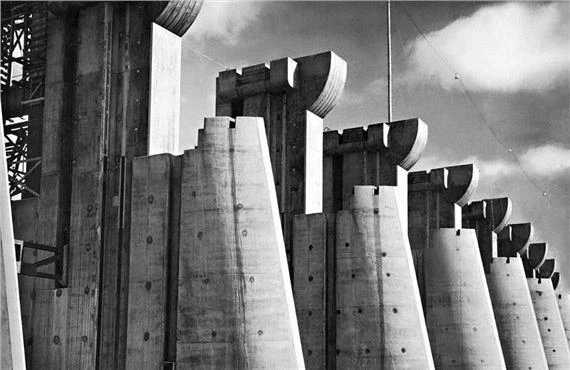
Margaret Bourke-White - Fort Peck Dam, Montana, 1936. Gelatin silver print.
What happens after
There is a version of this that people imagine and it looks like the Soviet Union. The state takes over the factory. The engineers are replaced by party appointees. Production targets are set by a committee in the capital. Quality drops. Innovation stops. The nationalized entity becomes a bloated, unresponsive arm of the state bureaucracy.
That version is the wrong one. It is also the version that failed, and the failure is well documented.
When an enterprise is nationalized under the dynamic threshold, the enterprise keeps running. The engineers keep engineering. The managers keep managing. What changes is governance - not operations.
So what does the state actually add? Three things, and only three.
Oversight. The enterprise is subject to democratic accountability. Activities are transparent. Strategic decisions are reviewed against national objectives.
Strategic direction. Priorities can be aligned with public needs rather than shareholder returns. A nationalized pharmaceutical company prioritizes affordable drugs over profitable ones. A nationalized energy company prioritizes grid transition over quarterly earnings.
Veto authority. The state can block decisions that conflict with the public interest. The sale of critical infrastructure to foreign buyers. The shut-down of services to extract concessions. The deployment of technology in ways that violate the rights of the population.
What the state does not do is replace the management with politicians. This is the mechanism described in the previous piece - the structural separation between political roles and functional roles. The politician sets the direction: we need affordable medication, we need clean energy, we need reliable infrastructure. The functional implementor executes: here is how to manufacture the drug, here is the engineering plan for the grid transition, here is the maintenance schedule for the water system. The politician has oversight, and the implementor has autonomy: The two roles do not merge.
This is what went wrong in the Soviet Union, and it is what the framework is designed to prevent. When the party secretary of a steel plant also runs the steel plant, you get a person making political decisions about steel production and operational decisions about party priorities, and both decisions are worse for it. When the steel plant is run by an engineer under the strategic direction of an elected government, you get good steel and good politics. Scale that across every steel plant in the country, with the supply chain coordinated as a public asset, and you get good steel, good politics, and a surplus that funds sovereignty rather than shareholders.
The operational continuity principle is simple: nationalization changes who the enterprise answers to. It does not change who runs it. Not unless the people running it are failing, in which case the failure is an operational question, not a political one, and the replacement is based on competence, not loyalty.
Governance transplant rather than rebuild
The framing above states the operational continuity principle. The deeper case for it is structural and worth working out in its own right, because the alternative the framework is rejecting - tearing out the existing planning infrastructure and rebuilding it from scratch under new ownership - is the path most prior socialist projects took, and it is the path that produced the planning-capacity collapse the transition chapter treats as one of the architecture's central failure modes.
The contemporary capitalist economy contains, embedded inside its largest enterprises, planning systems whose operational sophistication exceeds anything Gosplan ever attempted. The internal logistics infrastructure of a major retailer schedules tens of millions of units a day across continental supply chains. The ERP installation of a major manufacturer reconciles inventory, capacity, and demand across thousands of facilities in real time. The CAD/CAM systems of an aerospace prime coordinate engineering decisions across decade-long programmes. The internal payment ledger of a central bank clears national-scale transactions every second. None of this infrastructure was built to serve the working class. All of it was built to serve a shareholder objective function. None of it was built by accident. It was built because complex coordination at scale requires it, and the question of whether to build it under shareholder governance or under public governance was answered, decisively, in favour of the former during the period the framework is now proposing to reverse. Phillips and Rozworski's People's Republic of Walmart names this directly for the retail case. The argument generalises.
The framework's posture is that the planning infrastructure is repurposable. The objection that nationalisation rebuilds the planning function from zero is correct against the rebuild path and incorrect against the transplant path. A governance transplant takes the existing system and inverts three things: the database becomes public and auditable rather than proprietary and internal, the objective function shifts from shareholder return to the published public-interest specification (minimum ecological throughput at the safeguard floor, sequenced restructuring under the transition chapter's clock, the strategic priorities the elected political authority has set), and the management module is replaced by a worker-council interface that holds the same operational authority the prior management held but answers to the political-functional firewall rather than to the prior board. The engineers who maintained the system continue to maintain it. The data schema continues to operate. The operational rhythms continue. What changes is the directionality of the system's optimization and the locus of its accountability.
The same logic applies to the financial substrate. The currency chapter treats this in detail and the case is worth naming here because it is the most counter-intuitive application of the principle. A socialist transition does not require a new payment infrastructure built from scratch. It requires the existing central bank rails to be governed differently and bound by different rules. For example, the Bank of Canada's real-time settlement infrastructure, or its equivalent in any sufficiently developed jurisdiction, is critical infrastructure under the threshold by definition. Public governance of that ledger, the upward monitoring layer applied to its data, and the wealth-ceiling enforcement programmed directly into its settlement rules produce most of what the chapter's mature monetary architecture requires without writing a new line of code at the substrate level. The consumer-circulation layer the currency chapter specifies is, in the early transition, a new set of rules and a new public dashboard sitting on top of the existing settlement rails, with capital controls that slowly decouple the unit from the dollar settlement infrastructure rather than a hard fork from it.
The transplant approach has costs. The inherited systems carry assumptions that the prior governance imposed on them, some of which are not visible until they are tested under the new objective function. A logistics system tuned to minimise inventory cost under a shareholder objective behaves differently when retuned to maintain the safeguard floor as a hard constraint, and the retuning will surface failure modes the prior governance never had to handle. The auditing requirement that the public-database property imposes is heavier than the proprietary system was ever designed for. Some of the inherited code carries a dependency graph that includes vendor relationships the framework cannot continue to honour, and the substitution work for those dependencies is non-trivial. The framework's claim is that the cost of the transplant is significantly lower than the cost of the rebuild, and the historical record on the rebuild path - the Soviet planning collapse, the Chinese reversion to capitalist coordination as soon as it became politically possible, the Cuban dual-economy distortions - is the comparison the transplant cost has to be priced against.
The most important case the principle covers is the AI-lab nationalisation the previous deep-dives describe. The same logic operates. The lab's compute cluster, training pipeline, model weights, and research infrastructure continue to run. The board is reconstituted, the deployment veto authority moves to the public governance body, the publication regime is restored, the compensation architecture transitions on the calendar described above. The research programme is preserved (or it isn't, this is a question for the working class to vote on). The system is not rebuilt. This is the principle the chapter has now stated three times, in three different domains, because it is the principle that distinguishes a nationalisation that produces a functioning public economy from one that produces the planning collapse the framework is built to refuse.
Compensation and the brain drain question
Nationalized sectors prohibit ownership and surplus extraction; competitive pay stays. The dual-compensation architecture - bounded wage ratios offset by housing, healthcare, and education as public goods, with the ratio publicly set rather than constitutionally fixed - is the economic architecture chapter's load-bearing specification, and the brain-drain objection is engaged there at full length. What carries here is the structural point: the framework retains talent through the combination of competitive nominal wages, comprehensive non-monetary public provision, and the structural retention levers (research mandate, public publication norm, public compute access in the AI-lab case) that the private compensation package was paying to suppress. Many of us have sat in the rooms where the comp packages got justified. The argument that without the package the talent walks is sometimes true. It is more often a story the package tells about itself.
Technology is not neutral
Most of what nationalization absorbs is the standard case: steel mills, banks, pharmaceutical companies, logistics networks, energy grids - enterprises whose hazard is the surplus-extraction the threshold itself addresses. A subset is different. Some technologies carry risks that follow from the technology itself, not from the relations of production. Marx's claim of technology's neutrality6 was correct for the 19th-century factory and remains correct for the lathe and the industrial robot. It is partially incorrect now. The machine is not always neutral. Some machines, by their structure, will be turned. The framework sorts technology into five categories - socializable, conditionally deployable, deterrent, sovereignty tools, and transgressions - whose full operational definitions and the surveillance-transgression boundary are developed in the digital sovereignty chapter. What matters for the nationalization-threshold logic here is the transgression category: technologies whose acquirement is usage, whose existence cannot be separated from their deployment against the population. Domestic mass surveillance is the paradigmatic case. AGI without demonstrated containment is the contemporary one. These are the technologies the threshold treats not as candidates for public ownership but as artifacts the state does not build, regardless of who owns them. The line between deterrent and transgression is the acquirement-usage gap; nuclear weapons can sit in a silo, the panopticon cannot. Where commodified AI capability sits in the spectrum is the question the threshold has had to operationalize most aggressively, and the alignment-orthogonality objection - that technical containment is independent of governance - is engaged at full length in the digital sovereignty chapter alongside the critique of the Technological Republic position the framework rejects.
What does big mean?
The standard objection to the framework's scope is "big government." The objection is worth engaging, because it rests on a premise that is empirically false.
The question is not whether you are governed. The question is who governs you. A person in the United States in 2025 is governed by: their employer (who determines their schedule, their income, their healthcare access, and can terminate their livelihood at will), their landlord (who determines their housing security), their credit bureau (which determines their access to housing, employment, and financial services based on an opaque algorithmic score), their health insurer (who determines which medical treatments they can access), the platform terms of service they accept daily (which determine what they can say, see, and share online), and the private equity firm that owns their local hospital (which determines whether the emergency room stays open based on quarterly returns). None of these are elected. None are subject to democratic oversight. None are accountable to the governed.
The person who objects to "big government" while accepting governance by employer, landlord, credit bureau, insurer, platform, and private equity firm has not rejected being governed. They have rejected being governed democratically. What they call "small government" is distributed private government - thousands of unaccountable authorities exercising power over every dimension of daily life, with no democratic mechanism for the governed to shape the governance.
The framework's position is consolidation, not expansion. Replace the private insurer, the private credit bureau, the private landlord's arbitrary authority, the platform's opaque terms of service, with one democratically accountable public mechanism. The overhead drops - one universal healthcare system replaces thousands of competing insurers each with their own administrative apparatus, billing departments, claims processing, marketing budgets, and executive compensation. The administrative waste of the American healthcare system alone - the cost of maintaining competing private bureaucracies - exceeds the total healthcare spending of most countries. Consolidation into a single public system is smaller government by any honest measure. It replaces many unaccountable governments with one accountable one.
The charity question. The framework applies a three-test cascade to charitable functions. First: is the charitable function filling an obligation the state owes? Food banks exist because the state has failed to ensure food security. Homeless shelters exist because the state has failed to ensure housing. Medical fundraisers exist because the state has failed to ensure healthcare. If the charity is filling a state obligation, the charity is diagnostic of state failure, and the petition body provides the mechanism for citizens to demand that the state absorb the function.
Second: does the charitable function serve a public good that the state should provide? Educational programmes, environmental restoration, public health campaigns - if the function serves the public broadly, it belongs in the public provision apparatus.
Third: is the charity filling a gap that neither the first nor second test captures? Emergency mutual aid, specific community solidarity, artistic patronage, religious community support, political solidarity funds - these are voluntary associations that the framework protects under associational autonomy. They are not diagnostic of state failure. They are expressions of community that the state has no business absorbing.
The philanthropic-industrial complex operates in the first category while claiming to operate in the third. Tax-deductible donations to private foundations allow wealthy individuals to redirect public revenue (the forgone tax) toward their private priorities. A billionaire's foundation funding education reform according to the billionaire's vision is not charity - it is private governance of a public function, funded by tax revenue that the public never got to allocate democratically. The framework does not name specific foundations. It identifies the structural mechanism: tax-sheltered philanthropy is a mechanism for converting public revenue into private authority over public functions.
Mutual aid in state-failure contexts - the Black Panthers' breakfast programme, community kitchens in Palestine, neighbourhood response networks after natural disasters - is necessary and admirable. It is also evidence that the state has failed. The framework's goal is a society where mutual aid is an optional expression of solidarity, not a lifeline that substitutes for absent public provision.

Tina Modotti - Worker's Hands, 1927. Gelatin silver print.
Safe supply as public provision
The anti-ossification chapter establishes full decriminalization of all substances as a bodily-autonomy derivation. The provision side - what the state does once it stops criminalizing - is the nationalization logic applied to a commodity whose black-market provision kills people. Pharmaceutical-grade safe supply, quality-tested at point of manufacture, regulated dosing, clean consumption facilities, and voluntary opt-in case workers operating on harm-reduction principles. The framework's full treatment of safe-supply infrastructure, the gateway-effect and visible-disorder objections, and the Portland-versus-Portugal evidentiary record sits in the not-utopia chapter where it joins the rest of the bodily-autonomy register. What carries here is the threshold: criminal markets producing fentanyl-contaminated heroin and methanol-contaminated alcohol meet the systemic-criticality test for public absorption on the same terms as any other systemically dangerous private supply.
Nationalization, sovereignty, and unceded territory
"Collective ownership of the means of production" assumes a clearly bounded state with settled territorial sovereignty. This assumption fails in every settler-colonial state. When the land was never ceded, nationalization of resource extraction on that land is not the framework's standard case. It is a sovereignty question that the nationalization threshold alone cannot answer.
The Wet'suwet'en hereditary chiefs did not consent to the Coastal GasLink pipeline crossing their territory: the Canadian state authorized it. Under the framework's nationalization logic, a pipeline crossing Indigenous territory might meet the systemic criticality threshold - energy infrastructure is systemically critical. But nationalizing the pipeline does not resolve the sovereignty question. It replaces a private company extracting resources from unceded territory with a state extracting resources from unceded territory. The extraction continues, dispossession continues, and the relationship has not been transformed.
The framework's position is that nationalization on unceded territory requires the consent of the sovereign Indigenous nation whose territory is affected. This is a structural requirement derived from the framework's own principle, not a procedural formality: coercive apparatus expands against its operator unless structurally contained. A socialist state that nationalizes resources on Indigenous land without consent has reproduced the colonial extraction relation under a new flag. The boot has changed feet. It has not been removed.
Where Indigenous nations consent to resource development on their territory, the framework's nationalization architecture applies - public ownership, operational continuity, democratic oversight, surplus directed to public benefit including the benefit of the Indigenous nation whose territory is involved. Where Indigenous nations do not consent, the framework respects the refusal. Sovereignty means the capacity to say no.
The multi-national federation. The framework's universalism does not accommodate nations inside states without explicit structural engagement. Quebec, Catalonia, Scotland, the Basque Country, Kurdistan, Tibet, Kashmir - these are nations within or across state boundaries whose self-determination the framework must address.
The framework's position is multi-national federation. Nations within the federation hold substantive self-determination over language, culture, specific economic arrangements, and their relationship to the federal structure. This is not decorative autonomy - it is structural self-governance within the federal framework. The Austro-Marxists (Bauer, Renner) engaged this question a century ago: national-cultural autonomy as a structural feature of socialist governance, not a concession to be withdrawn when convenient. Lenin and Stalin's exchange on the national question produced the Soviet Union's formal federalism, which was real in form and hollow in content - the framework learns from this by insisting on structural rather than formal self-determination.
The boundary between national self-determination and reactionary nationalism is material: does this movement expand or contract self-determination for others? Catalan independence that expands Catalan self-determination while respecting the rights of non-Catalans within Catalonia is legitimate. Ethnic nationalism that claims self-determination while persecuting minorities within the claimed territory has crossed into the transgression category. The test is the same as everywhere else in the framework: the boot on someone's neck.
Indigenous nations are a distinct case within this framework - not a sub-state national question in the European sense (colonizer-versus-colonizer rivalry) but a sovereignty question rooted in prior occupation and unceded territorial rights. The class chapter positions Indigenous nations as peoples subject to the imperial-extraction machinery whose struggle is allied with but not reducible to the class struggle. The nationalization framework respects this distinction by requiring consent rather than assuming jurisdiction.
Not too big to fail - too important to be private
The capitalist model of "too big to fail" has a specific structure: the private entity grows until its failure would be systemic, then the public is held hostage to its survival. The entity knows this, and it behaves accordingly. It takes larger risks because it knows the downside is socialized. It extracts larger profits because it knows the state will not let it die. This is material hazard at civilizational scale, and it is built into the structure of capitalism, not a bug of it.
The framework inverts this. The point of nationalization is not to rescue a failing entity. It is to absorb a successful one into the commons before it fails, before a single owner can use its systemic importance as leverage against the public. The water utility is nationalized not because it went bankrupt but because water is too important to depend on someone's quarterly earnings report. The energy grid is nationalized not because it failed but because energy access is a precondition for everything else in modern life - healthcare, food, transport, heating, communication - and a precondition that important cannot be subject to the profit motive of a private owner. Internet access and mobile access is nationalized not because there are a few telecommunications companies failing but because internet and communications are critical to the function of democratic processes and information. This does not prevent the formation of new competitors within the national framework, on the contrary, the national interest is served best by the competition and subsequent distribution of innovation between each competitor.
The same logic extends to the new categories. A logistics network that delivers the majority of a country's consumer goods is systemically critical. A cloud computing provider that hosts the majority of a country's business infrastructure is systemically critical. An AI system that half the country's hospitals use for diagnostic support is systemically critical. The question is not whether these should be nationalized in principle. The question is whether the current owner's private interest can diverge from the public interest - and if the answer is yes, and if the consequence of that divergence is catastrophic, then private ownership is an unacceptable risk.
This is not hostility to small business. A bakery, a restaurant, a local construction firm, a freelance developer - these are not systemically critical. Their ownership structure is their own business. The framework has nothing to say about a person who bakes bread and sells it. The framework has everything to say about a person who controls the grain supply.
The dynamic threshold means the framework does not need to enumerate every industry that should be nationalized. It does not produce a list. It produces a test: is the thing systemically critical? Is its output commodified and integrated into systems whose failure would cascade? If yes, it crosses the threshold. If not, it does not. The test is reapplied continuously, because systemic criticality changes. An industry that was not critical a decade ago may be critical now. An enterprise that was not consequential last year may be consequential this year. The boundary is alive, and it moves with the material conditions.
Anyone who knows anything about 2008 can agree: if something is too important to fail, it is too important to be private. The rest is implementation and follow-through.
Chilean copper
In 1971, the Chilean congress voted unanimously - every party, left to right - to nationalize the country's copper mines. Copper was Chile's primary export, the backbone of its economy, responsible for the majority of its foreign exchange earnings. The mines were owned by two American corporations: Anaconda and Kennecott. The surplus they extracted left Chile entirely. The profit from Chilean labour, dug from Chilean soil, was deposited in American bank accounts, paid to American shareholders, and reinvested in American interests.
Salvador Allende, the democratically elected president, did not nationalize copper because he was a radical.7 He nationalized it because the test was straightforward: Copper was the single most systemically critical resource in the Chilean economy. Its failure - or its mismanagement, or its diversion to foreign interests at the expense of domestic needs - would be catastrophic for the country. And the private owners' interests were not aligned with Chile's. Their interest was to extract the maximum surplus and export it. Chile's interest was to retain that surplus and invest it in development.
The nationalization was correct under the dynamic threshold. Copper was commodified, systemically integrated, and controlled by foreign entities whose private interest conflicted directly with the public interest. Every indicator pointed to the same conclusion: this is too important to be private.
The operational implementation followed the continuity principle. The miners kept mining. The engineers kept engineering. What changed was the flow of surplus. Instead of leaving Chile, it stayed. Allende used the copper revenues to fund healthcare, education, and land reform. The nationalized mines continued to operate. They produced copper. The difference was that the people of Chile, rather than the shareholders of Anaconda, determined what happened with the value produced.
What happened next is a story about sovereignty, not about nationalization. The United States, acting through the CIA, destabilized the Chilean economy, funded opposition movements, and backed the military coup that ended in Allende's death and Pinochet's dictatorship.8 The nationalization was destroyed not because it failed - it was functioning - but because it threatened the interests of the imperial power that had been extracting Chile's resources. A later piece in this series will address what this teaches about sovereignty. Here, the relevant lesson is narrower: the decision to nationalize was correct. The test was met. The implementation worked. What broke was not the policy. What broke was the capacity to defend it.
AI labs and the commodification trigger
The most urgent contemporary application of the dynamic nationalization threshold is artificial intelligence.
In 2020, the major AI labs were research organizations. Some were non-profits. Their outputs were papers, models, experiments. Interesting, sometimes impressive, but not systemically integrated into anything. A lab could shut down and the economy would not notice.
By 2025, this is no longer true. AI models are embedded in healthcare diagnostics, legal research, financial trading, logistics optimization, education, military targeting, and the daily workflow of hundreds of millions of people. The output of a handful of labs - firms with hundreds of employees, not tens of thousands - has been commodified and woven into the infrastructure of multiple countries. The models are not experimental curiosities. They are productive forces, in the Marxist sense: instruments through which labour is organized and surplus is generated.
The commodification trigger has been pulled. The output is no longer research. It is a commodity - bought, sold, licensed, embedded in other products, integrated into systems whose failure would cascade across industries and borders.
The systemic integration test is met. If the leading AI providers were to fail simultaneously - or if their owners were to restrict access, manipulate outputs, sell the technology to a hostile power, or simply decide that their private interest no longer aligned with the public's - the consequences would propagate through every system that depends on their products. Healthcare, finance, logistics, defence, education. These are not hypothetical dependencies. They are current ones.
Under the dynamic threshold, the conclusion this framework reaches is direct: AI development at this scale is too important to be private. The question is not whether a government should have oversight of AI. The question is who makes the final decision about what the technology does, and the answer cannot be a private individual or a shareholder group whose interests may diverge from the public's at exactly the moment when the divergence matters most.
Nationalization of AI labs would follow the same operational continuity principle as any other nationalization. The researchers keep researching. The engineers keep engineering. The models keep running. What changes is governance: strategic direction aligned with national objectives rather than shareholder returns. Veto authority over deployments that threaten the public interest. Transparent development under democratic oversight rather than proprietary development under corporate secrecy, following strict containment requirements to prevent transgressions.
The objection will be: this kills innovation. The answer is: no, it doesn't. Innovation in AI is driven by talent, compute, and data. None of these are destroyed by public ownership. What is destroyed is the capacity of a private owner to capture the surplus generated by the innovation and to make unilateral decisions about deployment, in particular when crossing into transgression. That is the point.
Nationalising an AI lab: the operational problem
The previous deep-dive establishes that the threshold has been crossed and that the decision to nationalise follows from it. The operational problem is what happens on the Monday morning after the decision. The framework's standing answer - the researchers keep researching and the engineers keep engineering - is correct as a direction and insufficient as an instruction. The credibility of the framework's AI position depends on whether the transition survives contact with how these organisations actually function.
Research continuity moves first; operational change moves slowly. A frontier lab is a research programme whose value lives in the next training run, the next interpretability breakthrough, the next architecture. If the nationalisation severs that continuity even for a quarter, the asset depreciates faster than any other industrial asset the framework nationalises. Day one: ownership transfers, the board is reconstituted under the political-functional firewall, the deployment veto authority passes to the public body. The research organisation does not restructure on day one. Team leads keep their teams. Compute allocations to ongoing training runs do not move. The model release schedule is frozen in place while the new deployment process is specified, not cancelled.
Talent retention is structural, not monetary. A senior frontier-lab researcher in 2025 receives a package in the high single-digit to low double-digit millions, dominated by equity.9 That package is not a market-clearing price for the research. It is a rent extracted from the commodification of the output, distributed to senior researchers to keep them from walking. Once the commodification is nationalised, the rent is no longer available to distribute. Some researchers will leave. The retention strategy operates on four structural levers: a research mandate the private labs cannot match because the shareholder structure forbids it (long-horizon interpretability, public-interest alignment, capabilities research with deployment constraints private labs would not voluntarily accept); compute access at frontier scale that the researcher who leaves cannot find at smaller private alternatives; restoration of the open-publication norm10 that private labs have increasingly closed off, returning academic standing as a career asset; and a phased compensation transition over three to five years rather than a day-one cut, with existing contracts honoured under prior terms while new hires enter under the framework's compensation architecture.
The supply chain, weights governance, and bloc coordination. A frontier training run requires tens of thousands of high-end accelerators11 fabricated in a small number of jurisdictions on lithography produced in even fewer.12 Nationalising the lab without addressing the supply chain produces a lab that can be starved by a single export-control decision in a jurisdiction the framework's state does not control. The operational response - domestic fabrication investment, diversified procurement, stockpiling, where viable domestic lithography development - is resolvable through the sovereign-wealth and industrial-strategy apparatus the framework establishes in adjacent domains. Model weights are treated as a sovereignty asset: tiered access under audit, deployment authority gated by the public governance body's veto, offline cold-storage backups under multi-key custody. Internationally, a single-jurisdiction nationalisation is not a stable configuration; the architecture is most durable as a coordinated bloc action across states sharing the transgression analysis. Where the bloc has not formed on day one, the lab operates under partial containment - veto enforceable domestically, external posture combining open methodology publication with strategic reticence on capabilities whose release would strengthen labs in adjacent jurisdictions.
None of this is self-executing. The compensation transition can fail if the structural retention levers prove weaker than assumed. The supply-chain work can fail if the industrial-strategy apparatus is undercapitalised. International coordination can fail if the bloc does not form. The framework names the failure modes, places them in the operational sequence where they become actionable, and prices the difficulty against the alternative - private frontier labs operating under shareholder governance through the period in which their output becomes systemically integrated into every domain the framework is built to protect - which the framework refuses.
The standing commission and contestation process
The dynamic nationalization threshold requires an institutional mechanism for determining when it has been crossed. Without one, the threshold is a rhetorical principle rather than an operational standard. The framework proposes an independent standing commission with an adversarial evidentiary process and democratic final authority.
The commission. An independent body of functional professionals - economists, engineers, sector specialists, systems analysts - tasked with continuous monitoring of systemic criticality across the economy. The commission functions as the nationalization threshold body within the disaggregated sortition architecture: a sortition majority provides the anti-capture property, elected delegate minority provides democratic accountability, and functional economic expertise provides the technical competence that systemic-criticality assessment requires. Its members are selected on competence, not political affiliation. They are subject to rotation (though longer cycles than political term limits, to preserve institutional knowledge). They are transparent in their methodology and their findings. They cannot hold political office while serving. They cannot hold ownership stakes or employment relationships in the sectors they evaluate. The commission is the monitoring ecosystem applied to the economy rather than to state behaviour.
Assessment, not decision. The commission assesses whether an enterprise or sector has crossed the systemic criticality threshold. It does not decide whether to nationalize. The assessment is published. The methodology is public. The data is available. Anyone can evaluate the commission's reasoning. But the decision - whether to act on the assessment - belongs to the elected political body. The commission says "this enterprise meets the threshold criteria." The legislature decides whether to nationalize. The separation is the political-functional firewall applied to the nationalization process: the functional experts assess, the political representatives decide.
The adversarial evidentiary process. When the commission's assessment indicates that an enterprise has crossed the threshold, a formal process begins. The commission presents its case. The enterprise (or its defenders - which may include workers, communities, competing analysts) presents a counter-case. Both cases are public. The evidence is public. Multiple independent assessments can be submitted by any party - other commissions, academic institutions, civil society organizations, or the enterprise's own analysts. The process is adversarial because adversarial processes produce better evidence. A single assessment, unchallenged, is vulnerable to capture, bias, and methodological error. An assessment that has survived structured challenge from motivated opponents is more reliable.
Citizen petition as capture bypass. The commission can be captured. Any institution can be captured. If the commission fails to assess an enterprise that the public believes has crossed the threshold - because the enterprise has lobbied the commission, because the commissioners have been compromised, because the methodology has been gamed - any citizen or group of citizens can petition the legislature directly, through the petition body that aggregates citizen demand across all policy domains. The petition triggers the same adversarial process: the petitioners present their case, the enterprise responds, independent assessments are invited. The commission's failure to act does not prevent the process from occurring. This is the structural bypass for institutional capture. The commission is the normal pathway. The citizen petition is the emergency pathway. Both lead to the same adversarial process and the same democratic final authority.
Defined timeline. Once the adversarial process is triggered - whether by commission assessment or citizen petition - it operates on a defined timeline set by published rule rather than constitutional fiat. A workable picture: evidence submission, response, independent assessment, and legislative decision occur within a window of roughly twelve to eighteen months from petition or commission referral, with the specific calendar published by the commission in consultation with the legislature and amendable only by the same body that set it. The window is long enough for serious evaluation and short enough that the process cannot be indefinitely delayed by legal manoeuvring or legislative inaction. If the legislature fails to decide within the published period, the default is nationalization. The asymmetry is deliberate. When an enterprise has been assessed as systemically critical through an adversarial evidentiary process - where the evidence has survived structured challenge from motivated opponents - the risk of continued private control exceeds the risk of public ownership. Private control of a systemically critical enterprise concentrates a single point of failure in the hands of an owner whose interests may diverge from the public's at exactly the moment when the divergence matters most. Public ownership distributes that risk across democratic institutions with structural accountability. The default reflects this asymmetry of risk. The legislature can reject nationalization - it must do so actively, with published reasoning, subject to electoral accountability. Inaction is not a defensible position when systemic criticality has been established through adversarial evidence.
Democratic final authority. The elected legislature has the final say. Not the commission. Not the courts. Not the enterprise. The legislature, accountable to the electorate, makes the decision. If the legislature nationalizes against the commission's recommendation, it must publish its reasoning. If the legislature refuses to nationalize despite the commission's recommendation, it must publish its reasoning. In both cases, the electorate has the information to evaluate the decision at the next election. The accountability loop is complete: commission assesses, adversarial process tests, legislature decides, electorate judges.
The honest residual. The process is slower than executive decree. A state facing an immediate crisis - a financial collapse, a sudden capture of critical infrastructure by a hostile actor - may need to act faster than the adversarial process allows. The framework permits emergency nationalization by executive action in genuine emergencies, subject to post-hoc adversarial review. If the emergency nationalization cannot survive the review, it is reversed. This is the tension between deliberation and urgency, and the framework names it rather than pretending it does not exist.
Resource allocation and the calculation problem
The Austrian economists asked the right question: how does a planned economy allocate resources without price signals? The Soviet answer - comprehensive central planning through Gosplan - failed. Hayek's critique was substantively correct about the information problem: no central body can aggregate the distributed knowledge embedded in millions of individual production and consumption decisions. The framework takes the critique seriously and provides a different answer.
Market socialism with commanding heights. Markets operate for consumer goods and non-critical sectors. Democratic planning operates for nationalized strategic sectors. Markets are a tool, not an ideology. They allocate consumer goods efficiently under conditions where competitive pricing reflects actual costs, where externalities are internalized, and where market power is not concentrated enough to distort signals. They fail for strategic sectors (energy, healthcare, transport, communications, defence), public goods (education, housing, water), and goods with significant externalities (fossil fuels, ecological resources) where the price signal does not carry the full cost.
The nationalization threshold determines which sectors are planned and which are market-allocated. Above the threshold, democratic planning sets strategic direction and public ownership ensures accountability. Below the threshold, markets operate - but the enterprises that operate in those markets are cooperatively owned.
Investment allocation. Democratic budgeting sets broad allocation across major categories: infrastructure, healthcare, education, defence, housing, ecological transition. The allocation is decided through the political process - elected representatives propose, the legislature debates, the electorate judges the outcomes. Standing commissions - the same functional bodies described in the nationalization process - assess within-category priorities based on technical expertise. How much of the healthcare budget goes to hospital construction versus preventive care versus medical research is a question the commission answers based on functional assessment. The legislature finalizes based on the commission's recommendation. The electorate holds the legislature accountable at the next election for the results.
This is the political-functional firewall applied to investment: the public sets direction, experts assess feasibility, elected representatives decide, voters hold them accountable. It is slower than autocratic allocation. It is better than autocratic allocation for the same reason democratic governance is better than autocratic governance - feedback, accountability, and the structural impossibility of one person's assessment going unchallenged.
Below the threshold: cooperative ownership. Below the nationalization threshold, all enterprises with employees are cooperatively owned. No employer-employee relationship exists within the framework's mature economy. The moment you hire someone, the enterprise becomes a cooperative with shared ownership. Sole proprietors - one person, no extraction of anyone else's surplus - are permitted. One person producing and selling their own work is not exploitation. It is labour.
The full case for the cooperative mandate - the structural reasoning, alternative models, scale objections (capital access, international competition, the Mondragón record), and the interaction between cooperatives and nationalized sectors - sits in the economic-architecture chapter. The point relevant to nationalization is narrower: the mandate is what prevents below-threshold capital from reconstituting the class relation that the threshold was designed to abolish above it. A thousand bakeries with six employees each, owned by one person, is a class relation rebuilt from fragments. The mandate closes that route.
State capacity: why this time is different
The objection is familiar and reasonable: governments cannot run things. Procurement disasters, IT failures, bureaucratic paralysis, cost overruns, delayed projects, unresponsive services. The experience is real. The objection deserves a structural answer, not a hand-wave.
Governments are not inherently competent. But the specific failure modes of government-run enterprises are identifiable, and the architecture described in this series addresses each one.
The failure modes. Government-operated enterprises fail for specific, identifiable reasons. Political interference in operations: a minister overrides an engineering decision for electoral reasons, and the bridge falls down. Patronage staffing: positions are filled by political allies rather than qualified professionals, and performance degrades. Absence of competitive standards: without market pressure or rigorous performance benchmarks, quality drifts downward because nothing forces it upward. Absence of accountability: when failure has no consequences for the people responsible, failure becomes the norm.
Why the framework's model produces different outcomes. The political-functional firewall addresses political interference directly. Politicians set direction. Functional professionals run operations. The minister who wants to reroute a highway for electoral advantage cannot, because operational routing decisions are made by engineers who answer to performance standards, not to ministers. The minister can set the policy objective (more housing in underserved regions). The minister cannot design the foundation.
Operational continuity after nationalization addresses patronage staffing. The existing staff stays. The engineer who ran the energy company before nationalization runs it after. Competence is the hiring criterion for functional roles, enforced through the same merit-based selection that the best private firms use. The framework does not replace competent private-sector managers with loyal party members. That was the Soviet model. It failed. The framework learned from the failure.
Competitive compensation, addressed in the main text, retains talent. The combination of capped but competitive wages and comprehensive public goods - housing, healthcare, education - creates total compensation packages that compare favourably with private-sector alternatives once the full cost of living is factored in.
The adversarial evidentiary process and independent monitoring provide accountability that most government enterprises lack. Performance data is published. Independent monitors assess outcomes. The political oversight body can remove failing managers. The electorate can remove failing political leadership. The accountability loop is shorter and more transparent than in most current public enterprises.
Positive counterexamples. Public ownership does not inherently produce incompetence. Equinor, Norway's state-owned energy company, operates globally, competes with private oil majors, and generates returns that fund Norway's sovereign wealth fund - the largest in the world. Singapore Airlines, majority-owned by the Singaporean state holding company Temasek, is consistently rated among the best airlines in the world. The Tennessee Valley Authority brought electrification to one of the poorest regions of the United States and operates to this day. They demonstrate that public ownership combined with operational competence, functional independence, and clear strategic direction produces outcomes as good as or better than private ownership.
The honest position. Nationalized industries will not be perfectly efficient. What changes is which failure modes operate. Private ownership fails through surplus extraction, misalignment between owner and public interest, single point of failure, systemic risk. Public ownership fails through political interference, patronage, and absence of accountability. Nationalization eliminates the first set. The political-functional firewall, competitive compensation, operational continuity, and independent monitoring address the second. The standard is whether the identified failure modes are structurally addressed. They are.
Ecological prescription
The reciprocal materialism piece establishes ecology as a hard material constraint. This section develops the specific prescriptions: what a socialist state does about energy, agriculture, industrial policy, water, and the transition tension between ecological constraint and material improvement.
Energy. The energy sector is nationalized under the systemic criticality threshold - energy access is a precondition for healthcare, food, transport, heating, and communication, and no precondition that fundamental can be subject to private profit motive. Within the nationalized energy sector, political oversight sets the trajectory: binding, time-bound renewable transition targets with enforceable milestones. Functional implementors determine how: which renewable mix (solar, wind, geothermal, tidal) for which geography, what grid infrastructure is required, what storage solutions are viable at what timescale. Fossil fuel extraction is wound down on a defined schedule - not aspirational targets but binding commitments with consequences for failure. Transition costs are borne collectively: retraining programmes, redeployment support, and community investment in regions whose economies depended on extraction.
The nuclear position: pro-nuclear. Nuclear power is necessary for baseload energy during the renewable transition and likely permanent. The anti-nuclear position within the left is a case where ideological commitment overrides material assessment, and the framework criticises this pattern everywhere else and will not reproduce it here. The materialist grounding is straightforward: the reciprocal cost of continued fossil fuel dependence - climate collapse at civilisational scale, irreversible on any human timescale - dwarfs the reciprocal cost of nuclear waste, which is containable, localised, and manageable on engineering timescales. The risk calculus is not close. A framework that applies reciprocal analysis honestly must follow the analysis where it leads, and the analysis leads to nuclear as part of the energy mix. Newer reactor designs (small modular reactors, thorium cycles, molten salt) reduce already-manageable waste profiles further. The opposition to nuclear within the left is historically rooted in anti-weapons activism that conflated civilian nuclear power with nuclear weapons - an understandable conflation that does not survive materialist scrutiny.
Agriculture. Agricultural policy is grounded in metabolic return rather than extraction. The earth gives nutrients to the crop. The crop must return nutrients to the earth. Productivity metrics are paired with soil health metrics - a farm that increases yield while depleting topsoil is failing on a timescale the market does not price. Water use is constrained by aquifer recharge rates. No agricultural operation is permitted to draw water faster than the aquifer refills. Industrial agriculture practices that deplete long-term productivity - monocropping at scale, excessive synthetic fertiliser application that degrades soil biology, irrigation that draws from non-renewable aquifer reserves - are phased out even at cost to short-term output. A ten percent reduction in agricultural output that preserves the productive base for a century is preferable to a ten percent increase that depletes the aquifer in a decade.
Industrial policy. All industrial activity is subject to ecological audit with constitutional weight. Emissions, water use, soil impact, and biodiversity impact are assessed as part of ongoing monitoring by the same independent functional bodies that monitor economic performance. The ecological constraints are binding, not aspirational. They carry the same constitutional weight as term limits or the prohibition on domestic surveillance. An industry that violates ecological constraints is in violation of the constitutional order, not merely in breach of a regulation that can be waived under political pressure.
Water. Aquifer management as a hard constraint. Extraction is capped at recharge rates. Industrial and agricultural water use is subject to the same metabolic return principle as soil: you do not take more than the system can regenerate. Water is nationalized by default under the systemic criticality threshold - no argument is needed. The harder question is how the public institution manages a finite resource when demand exceeds sustainable supply. The answer is rationing by recharge rate, with industrial and agricultural use constrained first and domestic use protected.
The transition tension. Ecological constraint means reduced material throughput in economies already failing to meet populations' needs. This is the hardest tension in the framework, and the honest answer is not comfortable. The framework's response: material improvement comes from redistribution and efficiency, not from increased extraction. The surplus currently captured by capital - the difference between what workers produce and what they receive, the profits extracted by shareholders, the rents captured by landlords, the financial surplus generated by speculation - is the transition budget. Redirect it from private accumulation to public investment: housing, healthcare, education, renewable energy, transport, ecological restoration. The material throughput of the economy can decrease while material conditions for the majority improve, because the current distribution is so skewed that redistribution alone produces an enormous improvement in living standards for the working class. This is not a theoretical claim. It is arithmetic. The surplus exists. It is currently captured. Redirect it.
What this does not solve
The threshold is a dam, not a wall. The standing commission's adversarial process is the strongest version of the dam I know how to build, and it is still capturable. The body that decides what counts as systemically critical is the body whose capture the framework's own principle predicts under sustained pressure from the enterprises whose ownership is at stake. The petition bypass routes around the commission. It does not route around the legislature. A captured legislature can refuse nationalization in the face of an evidentiary record that would compel it under uncaptured conditions. The default of dissolution shifts the burden, and the default does not vote.
The technology spectrum carries its own residual. The line between deterrent and transgression is the acquirement-usage gap, and the gap is judgment-dependent at the boundary. Domestic mass surveillance is named structurally because the gap collapses for that technology to the extent that acquirement is usage. Other technologies sit closer to the boundary than the architecture would prefer, and the structural separation between foreign and domestic infrastructure is an engineering claim that the framework can specify but cannot enforce against a state determined to violate it. The wall is physical where it can be physical. Where the physics is contestable, the wall is procedural, and procedures are rewritten by the people they constrain.
The AI-lab nationalization specifically depends on the bloc-coordination posture and the supply chain commitments described above. A jurisdiction acting alone faces the talent and compute exit options the lab's prior compensation package was paying to suppress. The framework names the bloc requirement directly. Where the bloc does not form, the architecture absorbs partial loss as the cost of refusing the alternative.
What the chapter does solve is the pretence that private ownership of systemically critical capability is compatible with the population's continued capacity to govern itself. The dam is the closest thing to a structural answer the framework knows how to build. The chapter accepts the residual rather than soft-pedalling it.
Nationalization in the tradition
The main text develops the dynamic nationalization threshold, the systemic criticality test, the standing commission, and the technology spectrum in detail. This theory block positions the framework's departure from the orthodox tradition.
Marx's position was comprehensive nationalization: social production demands social ownership.13 Lenin operationalized this as the immediate seizure of the "commanding heights" - banking, heavy industry, transport, communications.14 The framework draws on both but departs in a specific way. Marx and Lenin both implied, to varying degrees, eventual comprehensive nationalization. The framework introduces a dynamic threshold that is deliberately selective. Not everything needs to be nationalized. The bakery, the freelance developer, the local construction firm - these are not systemically critical.
What demands state intervention is systemic criticality - a property that is historically contingent, not permanent. The sectors Lenin identified remain largely critical. Others have been joined or superseded by sectors he could not have anticipated: cloud computing, AI development, logistics platforms, pharmaceutical supply chains, semiconductor manufacturing. The framework's contribution is the recognition that the threshold must be reapplied continuously as material conditions change.
China provides the cautionary lesson.15 Selective nationalization without anti-ossification mechanisms produced exactly the dynamic that RCE predicts. The party that nationalized selectively became a vehicle for the class that emerged around the private sector it permitted. The lesson is not that selective nationalization is wrong. The lesson is that selective nationalization without structural protections against class formation is a slower route to the same destination.
US Congress, "Emergency Economic Stabilization Act of 2008" (2008). ↩
OpenAI, "OpenAI Raises $122 Billion to Accelerate the Next Phase of AI" (2026). https://openai.com/index/openai-raises-122-billion/ [accessed 2026-04-16]. ↩
OpenAI, "OpenAI and the Department of Defense" (2025). https://openai.com/global-affairs/openai-department-of-war/ [accessed 2026-04-16]. ↩
NATO, "NATO Acquires AI-Enabled Warfighting System" (2025). https://shape.nato.int/news-archive/2025/nato-acquires-ai-enabled-warfighting-system [accessed 2026-04-16]. ↩
Just Security, "Anthropic Supply-Chain Risk Designation" (2026). https://www.justsecurity.org/2026/anthropic-supply-chain-risk-designation/ [accessed 2026-04-16]. ↩
Karl Marx, Capital, Volume I (1867), Vol. I, ch. 15. ↩
Peter Kornbluh, The Pinochet File: A Declassified Dossier on Atrocity and Accountability (2013), ch. 1. ↩
US Senate Select Committee to Study Governmental Operations, "Covert Action in Chile 1963-1973" (1975). ↩
New York Times, "A.I. Researchers Are Negotiating $250 Million Pay Packages, Just Like N.B.A. Stars" (2025). https://www.nytimes.com/2025/07/31/technology/ai-researchers-nba-stars.html. ↩
Nathan Benaich and Air Street Capital, "State of AI Report" (2025). https://www.stateof.ai/. ↩
Epoch AI, "Notable AI Models: Training Compute Over Time" (2026). https://epoch.ai/data/ai-models?view=graph&tab=notable. ↩
Chris Miller, Chip War: The Fight for the World's Most Critical Technology (2022), Part VI. ↩
Karl Marx, Capital, Volume I (1867). ↩
Vladimir Lenin, The State and Revolution (1917). ↩
Yuk Hui, The Question Concerning Technology in China (2016). ↩
i. Strong-tendency claim. Holds where private control of socially-essential infrastructure meets the activation conditions in the foundations chapter - persistent ownership concentration, retained operational expertise, captured regulatory budgets, and absent designed containment. Counter-cases exist where regulatory regimes designed structural containment for specific sectors and periods (eg Glass-Steagall 1933-1999, postwar European utility nationalisation through deregulation). The claim is not that concentration always produces capture; it is that it does so absent specific architectural prevention. ↩
ii. Near-universal claim, technical-structural subtype. The transgression category covers technologies whose activation conditions sit inside the artifact rather than in the institution operating it - mass surveillance, identity-persecution apparatus, autonomous lethal systems. Counter-cases require demonstrating zero structural distance between acquirement and misuse in the specific case, which the historical record does not provide for any of the named technologies. See the self-critique chapter for failure-mode analysis. ↩
iii. Strong-tendency claim, with one near-universal element. The dynamic threshold itself is strong-tendency - the boundary moves and the criteria for crossing it are calibrated against documented patterns of systemic integration. The near-universal element is the prediction that absent the threshold, systemically-integrated private entities will produce the bailout-or-collapse pattern documented across banking (2008), critical pharmaceuticals (insulin pricing), and concentrated platform infrastructure. The threshold's specific design (commodification + systemic integration trigger) is itself subject to capture, addressed in the self-critique chapter. ↩