Not utopia
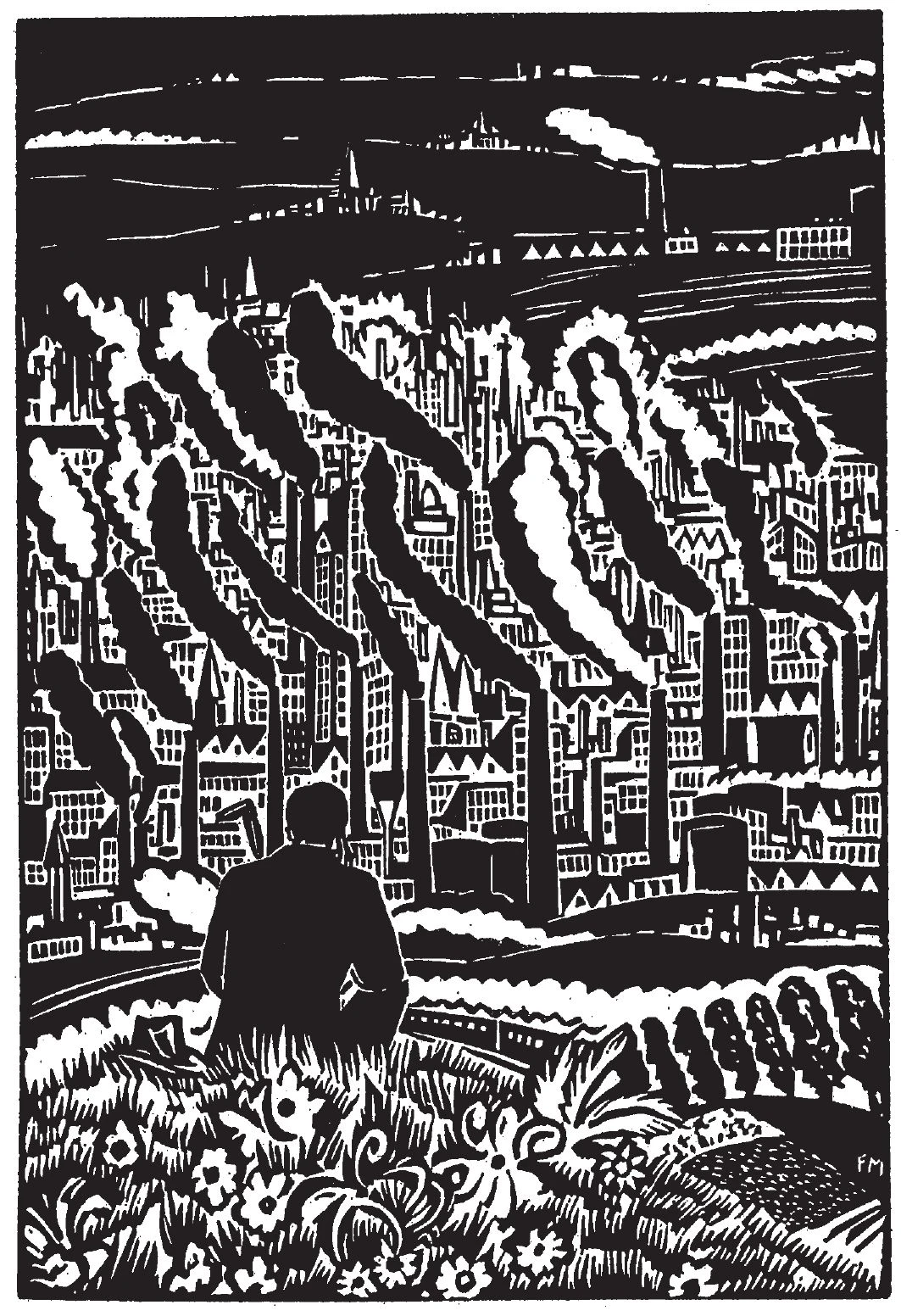
Frans Masereel - La Cité, 1925. Woodcut.
The poster version of socialism is a world without conflict, without scarcity, without the ugly compromises that make real governance difficult. That is not what this framework describes. What follows is what success looks like when you account for the planet's hard limits, the constraints of actual human societies, and the lessons of every experiment that came before. Some of it is uncomfortable. It is honest.
What I hope this looks like, when it works: a society where the worst hour of someone's life is not also the most expensive. That is the floor I am writing toward. Anything above it is bonus. Anything below it is failure. I am prepared to give up the post-scarcity story to get there. I do not know that post-scarcity is coming, and I do not need it to come for the architecture to be worth building. I am also prepared to be wrong about the transition. I have spent more time on the transition than on any other piece of this and I trust it less than any other piece. If something in this framework breaks, I expect it to break there.
One framing first: success in this framework is contested. There is not one picture of what a functioning socialist state looks like and a reader who rejects the picture is outside the book. There are several pictures, and the one the reader ends up preferring depends on which tradeoffs the reader takes most seriously - scarcity versus post-scarcity, proportional allocation versus need-based allocation, market mechanisms below the nationalization threshold versus their abolition, the weight to place on material outcomes versus procedural legitimacy, the priority of ecological constraint versus developmental pace. The chapter below lays out the version this book commits to, and it names the places where a different commitment would still keep the reader inside the framework. The picture is contested inside the book because it is contested inside the tradition, and a chapter that pretended otherwise would be writing propaganda rather than a working design document.
Scarcity is real
Marx distinguished between two phases of communist society - the scarcity phase and the abundance phase.i1 In the scarcity phase, scarcity persists. People contribute according to their ability and receive according to their contribution. You work, you get paid proportionally. Not equally - proportionally. The person who contributes more receives more. This is not capitalism. There are no owners extracting surplus. There are no billionaires. There is no class that profits from your labour without contributing its own. But there is equitable allocation based on contribution, because there is not enough for everyone to have everything.
In the abundance phase, scarcity is overcome. Technology and collective organization have produced enough that everyone's needs are met regardless of their individual contribution. From each according to ability, to each according to need. This is the vision on the poster.
The honest position is this: we do not know whether the abundance phase is achievable. Post-scarcity depends on levels of technological development and resource availability that cannot be guaranteed. The planet has hard limits. Energy is finite in practical terms. Materials degrade. Ecosystems have carrying capacities. The first confirmed tipping point has already been crossed: warm-water coral reefs, on which nearly a billion people and a quarter of all marine life depend, have passed their thermal threshold.2 The remaining carbon budget for 1.5°C of warming is approximately 170 gigatonnes of CO2 - roughly four years at current emission rates.3 Governments plan to produce 120 percent more fossil fuels by 2030 than that budget permits.4 The assumption that growth and technology will inevitably solve scarcity is the same assumption the neoliberals make - that the line will keep going up and the problems will sort themselves out. It has not sorted itself out under capitalism. Therefore, there is no reason to assume it will sort itself out under socialism through sheer optimism.
The framework holds post-scarcity as a possibility, not a promise. If technology and collective organization advance sufficiently - if socialized productive technology eliminates enough drudgery and generates enough surplus - then the framework adapts. Distribution shifts from proportional contribution toward need. Working hours shrink. The scope of what is freely available expands. This is the hopeful case. It may happen. It is worth working toward.
But the framework does not depend on it. If scarcity persists - and it may persist permanently, given ecological constraints - then proportional allocation within a classless society is the stable state. That is not a failure. That is realism. A classless society where everyone works and everyone receives proportionally is not paradise. It is dramatically better than what exists now, where a vanishing minority extracts the surplus of everyone else's labour and calls the arrangement natural.
The difference between this position and capitalism is not the presence of allocation mechanisms. It is the absence of a class that profits from everyone else's labour. It is the absence of billionaires. It is the absence of a system that produces homelessness alongside empty houses owned by corporations, hunger alongside food waste, and poverty alongside wealth that no human could spend in a thousand lifetimes.
What it looks like
Strip away the abstraction. What does a functioning society under this framework actually look like?
You work. You are paid fairly. There is no employer extracting three hours of unpaid labour from your eight-hour day. The surplus your labour produces goes to the collective - to infrastructure, healthcare, education, defence, the commons. You receive a proportional share of what you contribute. If the productive technology is advanced enough to reduce working hours, working hours are reduced. If automation eliminates your job, you are retrained and redeployed - not discarded.
Housing, healthcare, and education are public goods. You do not go homeless because you cannot afford rent. You do not die because you cannot afford treatment. Your children do not receive worse education because your postal code is wrong. Higher education is a public good. These are not market commodities. They are the floor beneath which no one falls. Kerala demonstrates that this is achievable under conditions of severe resource constraint. A sovereign socialist state with more resources achieves more.
The state does not care who you are. You are gay, straight, trans, non-binary, religious, secular, of any ethnicity. The state does not care. It does not criminalize your identity. It does not monitor your personal life. It does not produce the fantasy of a normative citizen against which you are measured and found deviant. Identity oppression is an imperial product, and identity persecution is classified as a transgression - prohibited at the architectural level because its reciprocal consequences (class fragmentation, state weakening) are structurally predictable and severe. This prohibition is enforced through five layers: transgression classification that places identity persecution alongside domestic surveillance; an independent monitoring body that detects systematic exclusion patterns in state operations; non-discrimination as an operational competence requirement for functional roles; structural diversity requirements for militia chapters; and bounded multi-party competition that prohibits parties from campaigning on identity persecution. Private prejudice persists - the framework does not claim to abolish what people think - but the machinery that manufactures and instrumentalizes prejudice is dismantled, and without structural reinforcement, prejudice attenuates over generations rather than reproducing itself through state power.
The state can be corrected. Multiple parties compete within socialist bounds. No one holds political office for more than eight years. The people who make policy and the people who implement it are structurally separated. The population is armed. If the state rots - if the party becomes a class, if the officials become oligarchs - the people have the material means and the structural duty to fix it. This is not a threat to a healthy state. It is the guarantee that the state stays healthy.
Sovereignty is defended. The state maintains deterrent capability. It engages with hostile powers through adversarial reciprocation - currency competition, counter-sanctions, bloc formation. It never expands its borders. It welcomes other sovereign peoples who choose to join through their own processes. It is not a client state. It is not a dependency. It survives because it has built the material capacity to survive.
The ecology is a constraint, not a preference. The framework treats ecological sustainability as a hard material boundary - a limit that cannot be negotiated. The metabolic rift between production and nature is closed, or the system collapses regardless of its political label. The Soviet Union's industrial programme devastated Central Asia's ecology. China's growth has produced environmental crises that threaten the stability of the state itself. Socialism that reproduces capitalism's extractive relationship with the earth will face the same reciprocal consequences. The framework does not exempt itself.
This is not paradise. It is a society where the floor is high enough that no one lives in misery, the ceiling is low enough that no one accumulates the power to exploit others, the state is strong enough to defend itself and accountable enough to be corrected, and the relationship between production and the natural world is sustainable rather than suicidal.
What success looks like also depends on what was possible given the starting conditions. A socialist state emerging from colonial extraction, with shattered infrastructure and a brain drain engineered by sanctions, does not have the same starting line as one emerging from an industrialized economy with intact institutions. Kerala achieved near-universal literacy and healthcare outcomes comparable to rich countries on a fraction of their per-capita income - but it did so within the shell of a capitalist state that provided federal transfers and a legal framework. Cuba built a healthcare system that exports doctors to the world - but it did so under an embargo that constrained every other dimension of economic development. Evaluating success requires accounting for initial conditions, imperial interference, and the material constraints the state inherited. A state that achieves full employment, universal education, and ecological sustainability under sanctions has succeeded more, not less, than a state that achieves the same under favourable conditions. The metric is not a comparison to an abstract ideal. It is the distance travelled from the conditions that existed.
The transition architecture matters here because most historical socialist experiments failed not in their stable state but in the transition to it. The Soviet Union's permanent emergency became permanent bureaucratic rule. Cuba's revolutionary generation could not build the institutional mechanisms to transfer power without transferring the revolution's content. The framework's answer - time-bounded centralization with hard sunset clauses, constitutional bars on administrators holding political office, and the entire anti-ossification architecture activating before the transition ends - is an attempt to solve the problem that killed the experiments this book studies. Success is not only the stable state described in this chapter. It is also the transition handled well enough that the stable state is reachable.
The material specifics
The abstract is easier than the concrete, so here is the concrete. What happens to your house? What happens to your debt? What happens to your pension? What happens to the person with three rental properties and the person with a small business?
Housing. The model draws from Singapore's HDB programme, adapted for the framework's structure. The state builds housing at scale - quality housing, not brutalist warehouses - and offers it through zero-interest lease-to-own arrangements. You live in it, you pay a lease based on your income, and after a defined period the unit is yours. Not the land underneath it - the land is public - but the dwelling. You can live in it, pass it to your children, or sell it back to the state at assessed value. The property cap is two: a primary residence and one additional property (a family cottage, a unit for an aging parent). Beyond two, the property reverts to the public housing stock. No landlord class. No rental extraction at scale. No homelessness alongside empty investment properties. The transition: existing homeowners keep their primary residence. Second properties are assessed and either retained (within the cap) or purchased by the state at fair value over a transition period. No one is thrown out of their home. The framework builds new housing before it restructures existing ownership, because the point is to house people, not to perform a revolution.
Debt. Student debt is cancelled. The reasoning is straightforward: education is a public good, and charging individuals for access to it produces a debt class whose labour is captured not by an employer but by a creditor. The debt does not represent value received - it represents a barrier imposed on access to knowledge that the society needs its members to have. Medical debt is cancelled for the same reason. Consumer debt is restructured through public banking at fair terms. The predatory lending apparatus - payday loans, subprime credit, debt securitization that profits from the borrower's inability to pay - is dismantled. Mortgage debt on primary residences is converted to the lease-to-own structure over a transition period.
Pensions. Public guarantee, full stop. No pension fund invested in the stock market that evaporates when the market crashes. No defined-contribution scheme where the risk falls on the worker and the management fees accrue to the financial sector. The pension is a public commitment: you worked, you contributed, you are guaranteed a dignified retirement. Funded through the surplus that currently goes to shareholders and the financial sector. The arithmetic works when you eliminate the extraction layer.
Wealth redistribution. A hard ceiling on personal wealth, set through democratic process and indexed to the median. The framework states the principle, not the number: no individual accumulates wealth sufficient to translate economic power into political power. Inheritance is capped - you can leave your children a home and a reasonable sum, not an empire. The transition uses graduated taxation with an amnesty period: existing wealth above the ceiling is taxed at escalating rates over a defined period, giving people time to adjust, spend, donate, or invest in cooperative enterprises. Extreme concentration of wealth is structurally incompatible with democracy. The framework treats it as such.
Small business. The bakery stays open. The freelance developer keeps freelancing. The sole proprietor is not the target. Below the nationalization threshold, economic activity continues - the difference is that enterprises with employees operate as cooperatives. The person who started the business retains seniority-weighted shares and founder premiums. What they do not retain is the capacity to extract surplus from employees' labour in perpetuity. If you build something and hire people to help build it, those people share in what they help create. The employer-employee relationship is the structural seed from which class re-forms, and the cooperative structure pulls it out at the root.
Armed populace, lived
The constitutional duty to overthrow a degenerated state is the framework's most uncomfortable load-bearing element, and the self-critique names the cost honestly. This section attempts what the self-critique cannot: a description of what the duty looks like under steady-state conditions, when the state has not degenerated, when the duty has never been exercised in living memory, and when the population nonetheless holds the material capacity that makes the duty practicable.
A Tuesday afternoon. Civic-defence rotation runs as a bounded obligation, not a vocation - one weekend every several months for most adults, more for those who choose specialist roles, none for those whose age, health, or family circumstance excuses them under the standing exemption schedule. The training cycle is run by the federated chapters, not by the state, and the chapters' single-purpose mandate restricts the training scope to the constitutional duty itself - readiness, coordination, the discipline that makes a federated militia a coherent force rather than a collection of armed individuals. The cycles are public. Who attends, what is trained, how the chapter assesses readiness - all of it is on the chapter ledger that the cross-audit reads each year. The visibility is the point: a publicly auditable competence rather than a privately held one.
The texture of the rotation is closer to a fire department's quarterly drill than to a standing army's basic training. The skills are practical: coordination under stress, communications discipline, basic first aid, the constitutional thresholds at which the duty's conditions are reviewed. Live-fire training exists for the specialist roles. Most rotations are not live-fire. The point is to produce a population whose material capacity to act, if the conditions are met, is real rather than rhetorical, with the proficiency cost paid in public visibility rather than in standing militarisation.
The civic culture this produces is the part the self-critique names as the framework's least-architectable variable. Some of what changes is healthy - political assessment is a publicly distributed competence rather than a technocratic one, and the population is harder to deceive about whether the state has crossed the constitutional thresholds. Some of what changes is the slow weight of carrying the duty without exercising it. The framework's structural answer is the schism right within the federation, the sovereign defence trust's constitutional insulation of the rotation infrastructure from the executive, and the publication of every threshold the duty turns on - so that the conditions for activation are not a private judgment held by armed individuals but a public test the entire federation reads against the same evidence. The structural answer raises the cost of drift toward weaponized civic culture. It does not eliminate it.
The lived experience for most people, most of the time, is unremarkable. The rotation arrives. You go. You train with the same chapter you train with every quarter, with people whose names you know and whose civilian work you know. You return home. The duty exists, the capacity exists, the readiness exists, and the state - because the duty exists, the capacity exists, the readiness exists - has not given the population the conditions that would require activation. The steady state the framework is aiming for is bounded readiness rather than perpetual mobilisation: publicly visible, materially competent, and structured so that the constitutional thresholds are enforceable in fact rather than only on paper.
The capacity-building pathway - how an unarmed organizing context builds toward this steady state - is in the action chapter. What is described here is the destination, not the route. The framework does not claim either is comfortable. It claims both are structurally necessary, and that the lived cost is paid against a worse cost the historical record names directly.
What it is not
It is not a world without conflict. People will disagree. Parties will compete. Policy debates will be sharp. The political process will produce bad decisions that need correction and good decisions that produce unintended consequences. The anti-ossification architecture is designed to handle this - not by preventing conflict but by ensuring that conflict is resolved through legitimate, accountable processes rather than through the accumulation of unchecked power.
It is not a world without work. Unless productive technology eliminates the need for human labour in specific domains, people work. The difference is that they work without exploitation: the surplus of their labour goes to the collective, not to an owner. If automation allows a four-day work week, the gain is distributed. If it allows a three-day work week, the gain is distributed further. The socialization of productive technology means that the benefits of automation accrue to the people who previously did the work, not to the owner of the robot that replaced them.
It is not a world without hierarchy. Functional roles exist. The person who runs a hospital knows more about running hospitals than the person who sets healthcare policy. The engineer who maintains the power grid has operational authority that the politician does not. The political-functional separation preserves this: competent people do their jobs without political interference, while political authority provides strategic direction and accountability. Hierarchy of function is not hierarchy of class. Your surgeon being better at surgery than you is not exploitation.
It is not a world without markets. Below the nationalization threshold, cooperative and individual economic activity continues. The person who bakes bread and sells it is not the target of the framework. Small-scale economic exchange, cooperative enterprise, artisanal production - these continue. What does not continue is private ownership of systemically critical infrastructure, extraction of surplus value at industrial scale, and the existence of a class whose wealth depends on the labour of others.
It is not a world without risk. The socialist state operates in a world of hostile powers. Imperial intervention remains a possibility for as long as imperial powers exist. Ecological crises will test the system's capacity to adapt. Internal contradictions will emerge that the framework's diagnostic tools may not anticipate. The framework is a compass, not a map. It provides orientation and principles. It does not guarantee safe arrival.
Safe supply
The anti-ossification chapter establishes full decriminalization as a bodily-autonomy derivation, and the nationalization chapter establishes that criminal markets producing fentanyl-contaminated heroin and methanol-contaminated alcohol meet the systemic-criticality test for public absorption. The provision side belongs here because safe-supply infrastructure operates as a bodily-autonomy commitment rather than an industrial-policy decision.
The state provides pharmaceutical-grade safe supply of all substances for adults, regulated as pharmaceutical manufacturing is regulated. Voluntary case workers are available at every point of access - opt-in, revocable, harm-reduction oriented, no record kept of refusal. The relationship is between a person seeking help and a person offering it, not between subject and monitor.
The predictable objections have structural answers. Safe supply for adults does not extend to minors, and gateway theory has been empirically discredited. Fentanyl deaths are caused by dose uncertainty in unregulated markets, which safe supply eliminates. Portland's failure was decriminalization without concurrent social provision; Portugal's success was decriminalization with investment in housing, healthcare, and social infrastructure. Decriminalization alone, without the dams of social provision, produces the disorder that critics use to discredit the entire approach. Bodily autonomy and healthcare for those who seek it are complementary, not contradictory.
The concession that is not a concession
The acknowledgment that commodification and proportional allocation may persist under socialism sounds, to some on the left, like a betrayal. If the goal is to abolish commodity production, then accepting its continuation under any circumstances concedes the argument to capitalism.
It does not. The distinction matters and it is precise.
Under capitalism, commodification serves the extraction of surplus value by an owning class. Bread is commodified so that the bakery's owner can profit from the baker's labour. Housing is commodified so that landlords can extract rent. Healthcare is commodified so that insurance companies can extract premiums. The commodity form under capitalism is the mechanism of exploitation.
Under the framework, commodification under scarcity serves proportional allocation within a classless society. There is no owner extracting surplus. There is no landlord. There is no insurance executive. The commodity form, where it persists, serves a distributive function: ensuring that scarce goods are allocated proportionally to contribution, preventing the inefficiencies that destroyed Soviet distribution (where the planning apparatus produced goods nobody wanted and failed to produce goods people needed), and providing price signals that allow the productive apparatus to respond to actual demand.
The Soviet economy's distribution failures were not ideological failures. They were material failures. Central planning without price signals produced mountains of unwanted goods and shortages of needed ones. The political-functional merger meant that reporting a shortage was a political act that threatened the person responsible. So shortages went unreported and unmet. People stood in lines for hours for basic necessities while warehouses held products no one had asked for.
The framework learns from this. Proportional allocation mechanisms - including, where necessary, market mechanisms operating within a classless structure - are a materialist acknowledgment that allocation systems must match reality. When scarcity exists, allocation by need alone produces rationing, corruption, and bureaucratic control over distribution. Allocation by contribution, within a classless society where no one extracts surplus, produces a system that is both fair and functional.
If or when scarcity is overcome - if collective ownership of socialized productive technology produces genuine abundance - the framework adapts. The scope of free allocation expands. Proportional mechanisms recede. The abundance phase approaches. But the framework does not promise this. It prepares for it while functioning under the assumption that it may not arrive.
Why this is not social democracy
The position described above invites the criticism that the framework is social democracy with extra steps. The criticism is wrong, and the reasons are structural.
Social democracy accepts the capitalist mode of production. It taxes the profits of the owning class and returns some of the extracted surplus to the working class as public services. The owning class retains its structural position. The extraction continues. The redistribution is always at the mercy of the extractors.
The framework abolishes the owning class. Private ownership of systemically critical production is ended through the dynamic nationalization threshold. Capitalist parties are suppressed under working-class state authorityii - class power, not party power, as the anti-ossification chapter sets out. The surplus of labour goes to the collective. There is no owner, no extractor, no billionaire.
Social democracy in Scandinavia produced the best outcomes capitalism has achieved by extracting from the Global South, benefiting from American military protection, and operating during a period of unprecedented growth fuelled by cheap fossil fuels.5 When those conditions eroded, austerity and privatization followed. Social democracy cannot defend itself because it does not control the means of production: capital can leave, lobby, fund opposition, or back a coup. The framework controls the means of production. The state is not captured by capital because capital, at the systemic level, does not exist as a private force.
The distinction is the distinction between a system where the working class negotiates for a better share of what is extracted from them, and a system where the extraction does not occur.
Technology and liberation
The conditional case for post-scarcity rests on technology - not on the assumption that it will save us, but on the conditional claim that if productive technology is developed and deployed under socialist relations, the result could be liberation from labour that no one should have to do.
Marx anticipated this dynamic in the Grundrisse (1858),6 describing the "general intellect" - accumulated social knowledge embedded in machinery becoming the primary productive force. Under capitalist relations, the worker who is automated loses a job and gains nothing while profit accrues upward. Under the framework, the same automation produces a different outcome: if a machine does the work of ten people, the gain goes to the commons, and the ten people do something else, work fewer hours, or some combination. One workable picture: the four-day work week is not a policy choice under socialist ownership of productive technology - it is a material possibility created by the socialization of productivity gains. Whether the gain reaches three days, or two, depends on conditions the framework cannot promise in advance.
The framework does not promise post-scarcity. It creates the structural conditions under which it becomes possible: collective ownership of productive technology, the nationalization of systemically critical AI, the political-functional separation that prevents the state from mismanaging what it owns, and the proportional distribution of productivity gains across the working class rather than their concentration in an ownership class that no longer exists. If the technology matures and the conditions hold, working hours shrink and the scope of what is freely available expands. If they do not, proportional allocation within a classless society remains a stable state. It is not paradise. It is better than what we have.
What socialized technology could actually do
The specifics matter, because the claim is conditional and the conditions are concrete.
Healthcare. Diagnostic AI can identify cancers, infections, and chronic conditions at earlier stages and lower cost than current screening methods. Under capitalist relations, this technology is owned by companies that sell access. Under socialist relations, it is deployed universally. Every clinic has access. Every patient benefits. The technology does not replace doctors - it gives doctors better tools. Rural communities that currently lack specialist access gain it through telemedicine backed by diagnostic AI. Wait times drop because triage improves. Outcomes improve because early detection improves. This is not just speculation: Diagnostic AI already outperforms human specialists in specific imaging tasks. The question is deployment, not capability. Under capitalist relations, deployment follows profit. Under socialist relations, deployment follows need.
Agriculture and food distribution. Precision agriculture - sensor-based monitoring of soil conditions, water levels, crop health - can increase yields while reducing resource use. Under capitalist relations, this technology is deployed on industrial farms owned by agribusiness, while smallholders are priced out. Under socialist relations, the technology is deployed wherever food is grown. Cooperative farms gain access to the same tools as state agricultural operations. Food waste - which in capitalist economies accounts for roughly a third of all food produced7 - is reduced through distribution optimization. The algorithm that currently routes delivery trucks for Amazon routes food to where it is needed under socialist relations. The technology is identical. The purpose changes.
Energy. Smart grid technology can optimize energy distribution, integrate renewable sources, reduce waste, and improve reliability. Under capitalist relations, smart grid deployment follows profit - affluent areas receive upgrades while poorer areas do not. Under socialist relations, energy infrastructure is nationalized and the grid serves the population, not shareholders. The transition from fossil fuels to renewables is not constrained by the profit motive of fossil fuel companies that have every incentive to delay it. The ecological constraint that the framework treats as a hard material boundary is addressed through state-directed energy transition rather than market incentives that profit from delay.
Manufacturing and automation. Factory automation already exists at scale. Under capitalist relations, the gains accrue to the owner. Workers are laid off. Communities that depended on the factory are devastated. Under socialist relations, the gains accrue to the collective. Workers are retrained and redeployed. If the factory now runs with half the human labour, the other half work fewer hours or are deployed to work that remains - care work, education, infrastructure maintenance, the tasks that automation does not reach. The four-day work week is not a policy choice under these conditions. It is a material possibility created by the socialization of productivity gains.
The honest limit. None of this eliminates scarcity in the fundamental sense. Energy is constrained. Materials are physically finite. Ecological carrying capacity imposes a ceiling regardless of economic system. Automation reduces human labour in specific domains but does not eliminate the need for human judgement, care, creativity, and the forms of work that resist mechanization. The framework does not pretend otherwise. What technology does, under socialist relations, is raise the floor and lower the ceiling - more for everyone, less extracted by anyone. Whether that amounts to post-scarcity depends on the specific conditions of the planet, the population, and the technology at a given moment in history. The framework adapts to whatever that moment produces.
The honest answer
We do not know exactly what the end state looks like. This is not a weakness. It is the only honest position available.
There are pieces of this I do not know how to build. I am naming them so the person who does know - if that is you - can find the place I left off.
Every framework that has promised a specific endpoint - a world without contradiction, a society beyond conflict, a final historical stage - has been wrong. The world does not arrive at endpoints. It arrives at conditions, and conditions change. The framework is built for conditions, not for endpoints.
What we know is what the structural requirements are. Sovereignty or you get destroyed. Anti-ossification or you rot from within. Nationalized commanding heights or private capital captures the economy. Proportional response calibrated to conditions or you fight the wrong fight. Containment materialism as a constraint or your tools turn against you.
If all of these hold - if the case studies teach us anything, it is that no historical experiment held all of them simultaneously - the result is a society without an owning class, without imperial extraction, without a state that cannot be corrected, with public goods that cannot be privatized, with individual rights that cannot be revoked, and with the capacity to adapt as conditions change.
Whether that society achieves post-scarcity or operates under proportional allocation. Whether working hours drop to twenty per week or stabilize at thirty. Whether market mechanisms persist at the sub-systemic level or gradually become unnecessary. Whether the international order is one socialist bloc or many sovereign states in voluntary association. These are questions the framework cannot answer in advance. They depend on conditions we cannot fully predict.
The framework is a compass, not a map. It adapts. That is the point.
What it does promise is this: a society where no one is exploited, where no one is homeless while houses stand empty, where no one dies because they cannot afford treatment, where the state serves the people and the people have the means to ensure it continues to, where the ecology is respected as a material constraint rather than ignored as an inconvenience, and where the system can be corrected without revolution because the mechanisms of correction are built into its structure.
That is not utopia. It is architecture. And architecture can be built.
Ecological architecture, the constitutional ground
The political constitution operates inside the ecological constitution. The carrying-capacity envelope, the negative list at transition start, the steady-state allocation mechanism, ecocide as electoral disqualification, and the metabolic-loop architecture (annual ecology budget, restoration-first allocation of surplus, regional ecological assemblies with binding veto) are committed at constitutional weight in the ecological constitution chapter. What material life under the architecture is for - the work of this chapter - is built on that ground rather than alongside it. The reduction in nominal throughput is a reduction of waste, friction, and rent rather than of utility, and the throughput-honesty section of the ecological-constitution chapter carries the substantive treatment. This chapter operates against the constraint as a given.
The spatial plan, the refusal
The architecture is precise about what the built environment must achieve. It is also precise about what the architecture cannot specify on behalf of the people who will live inside it.
What the spatial architecture must achieve. Urban density sufficient that public transit, public services, and the safeguard floor's decommodified essentials are reachable on foot or by transit within a bounded time. Regional food sufficiency at a calibration that the ecological constitution's carrying-capacity envelope sustains. Public space as constitutional commitment - parks, plazas, libraries, civic infrastructure - rather than as residual after private development. Housing stock distributed so that a worker, a caregiver, a student, a retiree can live within the same neighbourhood as the work, the care, the school, the community their lives are made from. The fifteen-minute-neighbourhood frame is the legible name for the calibration the architecture is committed to, with the regional and rural variants the architecture refuses to compress to a single template.
What the architecture refuses to specify. The form the city takes. The material vocabulary - low-rise, mid-rise, high-rise, courtyard block, terrace, hutong, longhouse, tenement, mat-housing, rural pattern. The street width, the block size, the public-private rhythm. The integration of the existing built stock with the new build the redirection programme produces. The negotiation between rural communities and the bioregional assemblies over land-use boundaries. The reckoning with settler-colonial geography the transition chapter names but does not adjudicate.
This is the refused-overreach principle in operation. The architecture's commitments are structural - the spatial outcomes the federation must deliver - and the substantive design is the work of urbanists, architects, ecological-design practitioners, rural community members, Indigenous custodians of the bioregion, and the people who will live in the configurations they produce. The architecture writes the conditions under which their work is legible, durable, and protected from the developer-class capture that the existing built environment has been produced under. The work itself is theirs.
The gap is named directly: the framework does not contain the spatial plan, and a chapter that pretended to write it would write a plan no one would build. The architecture summons the disciplines whose work is the design. The petition body, the regional ecological assemblies, the cooperative federations, and the Indigenous nations whose territories include the bioregions are the institutional sites at which the work is held.
Marx's phases and the framework's divergence
The main text develops the framework's refusal to promise post-scarcity and its insistence on designing for the scarcity phase. This theory block positions that refusal within the tradition, using Marx's original "lower phase / higher phase" vocabulary.
Marx distinguished between lower and higher phases of communist society in the Critique of the Gotha Programme (1875).8 Orthodox Marxism has generally treated the lower phase as transitional and the higher phase as the telos - the assumption being that historical development will produce the material conditions for the higher phase. The framework diverges: it holds the lower phase as potentially permanent rather than necessarily transitional. Not because it rejects the higher phase. Because it refuses to assume the material conditions that would make it possible.
This positions the framework differently from both orthodox Marxism (which treats the transition as the arc of history) and from accelerationism (which treats technological development as the mechanism for post-scarcity). The framework is adaptive. The end state is not prescribed. It emerges from conditions.
The case studies demonstrate that every historical socialist experiment was built under the assumption that history would carry it forward. None of these assumptions held unconditionally. The framework draws the conclusion: stop assuming. Build for the conditions that actually exist, with mechanisms that adapt as conditions change.
Karl Marx, Critique of the Gotha Programme (1875). ↩
Global Tipping Points consortium (University of Exeter et al.), "Global Tipping Points Report 2025" (2025). https://www.stockholmresilience.org/research/research-news/2025-10-01-world-reaches-first-climate-tipping-point--widespread-mortality-of-coral-reefs.html. ↩
Robin D. Lamboll et al., "Assessing the Size and Uncertainty of Remaining Carbon Budgets", Nature Climate Change (2023). ↩
SEI, Climate Analytics, E3G, IISD, UNEP, "Production Gap Report 2023" (2023). https://productiongap.org. ↩
Andreas Malm, Fossil Capital (2016). ↩
Karl Marx, Grundrisse (1857-58). ↩
Jenny Gustavsson et al., "Global Food Losses and Food Waste" (2011). ↩
Karl Marx, Critique of the Gotha Programme (1875). ↩
i. Marx's vocabulary in the Critique of the Gotha Programme (1875) is "lower phase" and "higher phase" of communist society - the framework translates these to scarcity phase and abundance phase in main text because the descriptive terms are legible without the inherited terminology. The original-vocabulary lineage is laid out in the Marxist-lineage essay; the theory block below uses Marx's language for exegesis. ↩
ii. Marx's term was dictatorship of the proletariat - class power, not party power. See the Marxist-lineage essay for the original vocabulary. ↩