What the recursive hour earns
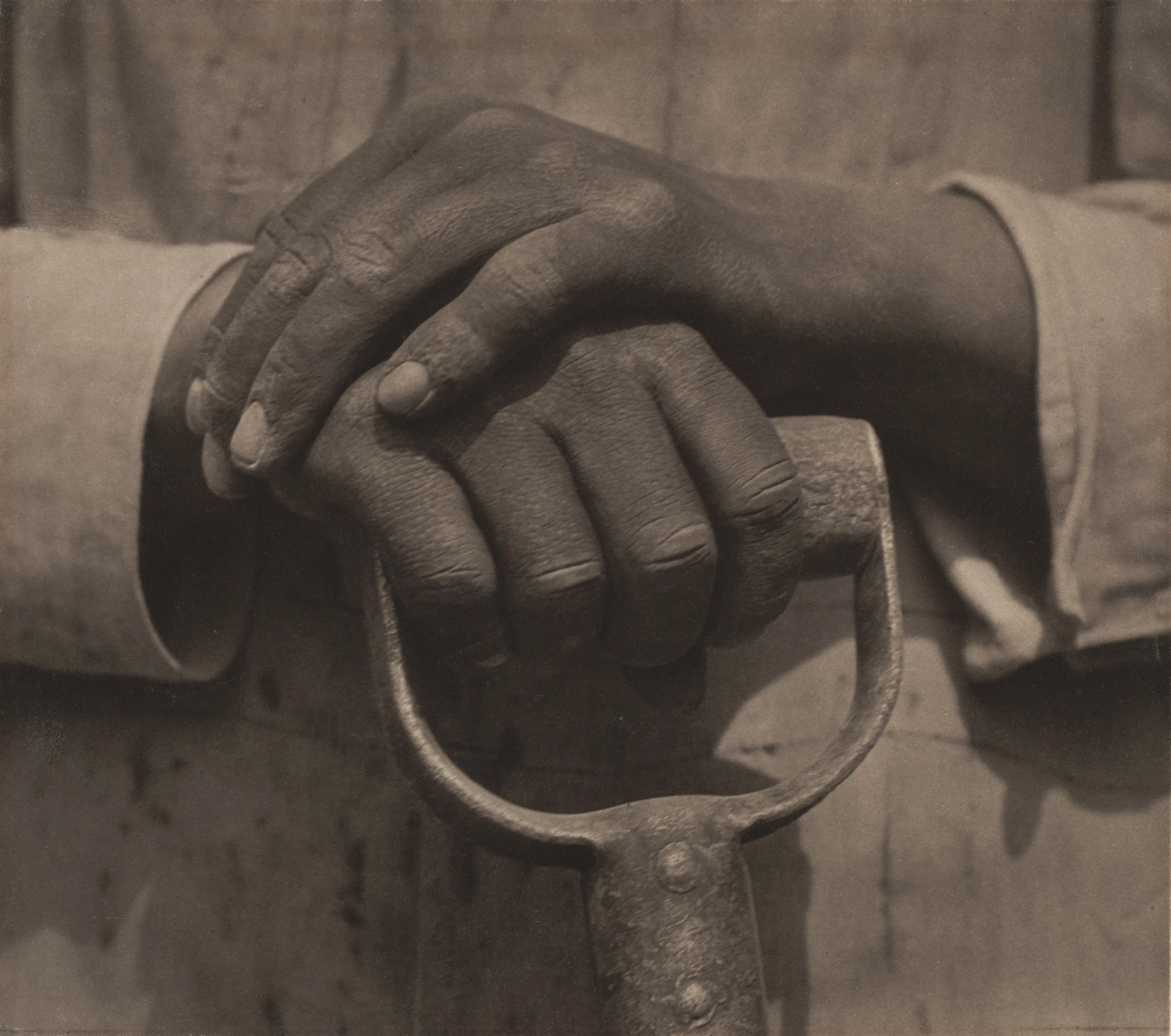
Tina Modotti - Workers' Hands, c. 1927. Gelatin silver print. Placeholder; replace at integration time with an image of hands working at a desk or a bench rather than a line.
Most labour produces value at roughly the rate at which it is performed. The factory shift, the bedside nursing hour, the construction crew's day are exchanged for wages and compensated through the ownership architecture that tracks them. The hour is the measure; the surplus is allocated by the mechanisms the economic-architecture chapter commits to, with the bounded ratios and the labour-theory-of-value gradient those mechanisms specify.
A small fraction of labour produces value that exceeds the hour by a significant multiple. The sepsis screening protocol that a nurse develops on a Tuesday afternoon and that, once written down and propagated, prevents a hundred thousand deaths a year for a generation. The modular design that lets a grid engineer extend the operating life of a substation from twenty-five years to forty. The mRNA platform built across a decade of underfunded laboratory work that, when the conditions called for it, produced a viable vaccine inside ten months. The recursive hour. The hour whose output is not consumed but compounds.
The framework treats this fraction as production, not as exception. The architecture of how it is recognised, rewarded, and converted to commons is the work of this chapter. The chapter sits between the economic architecture, which establishes ownership and surplus, and the calculation problem, which addresses how the heterogeneous-labour reduction the recursive hour requires is solved. The two chapters carry the load on either side. This chapter occupies the seam.
The chapter rests on strong-tendency groundi - the architectural pattern (public salary during exploration, attribution graph at completion, time-bounded productive-tier dividend, automatic conversion to commons) is documented to produce durable innovation in specific institutional contexts (Bell Labs, DARPA, Max Planck) and to be eroded in others (the Disney-exception extension of US copyright; the IP-extension lobbying around the WTO TRIPS framework). The claim is that the mechanisms work where their activation conditions are protected, not that they hold automatically.
Two failure modes the architecture exists between
Two failure modes the historical record names directly.
Brain-drain. The Soviet experience and the post-1990 retreat of the Cuban biotechnology sector under sanctions are the canonical cases. A socialist project that pays its researchers, doctors, and engineers identically to its production workers does not retain them under conditions of imperial competition. The trained surgeon emigrates. The senior researcher accepts the offer from the foreign institute. The computer engineer sells their labour into the global market the architecture cannot regulate alone. The brain-drain failure is not a failure of theoretical commitment. It is a failure of the activation conditions the ownership-without-recognition architecture creates.
IP-capture. The capitalist failure mode the framework rejects. Innovation that is publicly funded during exploration is privately appropriated at the point of attribution; rents are extracted across decades or centuries; the commons that funded the work never receives back the work it funded. The mRNA platform funded across a decade by NIH grants is patented privately at the point of vaccine production; the artificial-life-extension architecture of US copyright (Disney-exception, Sonny Bono Term Extension) holds work in private hands across the lives of the workers and the lives of their grandchildren; the academic article funded by public grants is published in a journal that charges the public's libraries to read what the public paid to produce. The capture is not aberrant. It is the structural form innovation takes under capitalist relations.
The framework's architecture exists between these two failure modes. It pays the recursive worker enough that the brain-drain pressure does not dominate. It bounds the recognition tightly enough that the work converts to commons before it produces a class. The pattern is precise. It is not gentle.
The unified criterion
The recursive hour is recognised by a single criterion: durability, transferability, surplus.
Durability. The contribution must produce value across time. The product idea that sells well one quarter and fails the next does not qualify. The protocol, the platform, the design, the architecture that continues to deliver value after the labour that produced it has stopped, does.
Transferability. The contribution must propagate beyond the worker who produced it. The artisan whose work is excellent but whose technique cannot be transferred to others is compensated through the wage architecture, fully and fairly. The artisan whose technique can be written down, taught, and replicated produces transferable value.
Surplus. The contribution must produce value beyond what the labour-time accounting can measure. The hour was an hour. The output of the hour, propagated, is fifty thousand hours of avoided suffering, or the operating life of a substation extended by fifteen years, or the vaccine platform that produces the next viable vaccine inside the next time-pressured window.
The factory shift well-worked is compensated through wages and cooperative ownership. It does not qualify. The shift worker is not lesser - the wage architecture commits to dignified scarcity for everyone, the safeguard floor holds against precarity for everyone, the ownership compensation accumulates faster for production roles than for management roles in the inverted-gradient the economic-architecture chapter specifies. The shift worker is not below the architecture. The shift worker is inside the central architecture. The recursive sliver is recognised through a different channel because the value structure is different, not because the worker is.
The criterion is named because the alternative is recognition by social proximity to the institutions that have historically dispensed it. Recognition by social proximity reproduces the credentialed-class dynamic the class chapter and the credential-system reform section identify. Recognition by durability, transferability, and surplus is the architectural answer to the question of how the recursive hour is identified without the answer collapsing into the existing patronage structure.
Five categories
The criterion applies across five categories of contribution. Each category has its own evaluation methodology. The categories are bounded so that the architecture does not become a general-purpose recognition apparatus that can be expanded into the soft-power tool every prior award structure has become.
Productive. Material processes, manufacturing techniques, agricultural protocols, distribution architectures, infrastructure designs. The contribution that durably increases the output of a given labour and material input. Evaluation methodology: measured output across the propagated population over a defined window, audited by sectoral federations and the attribution chamber.
Care. Clinical protocols, diagnostic methods, therapeutic techniques, public-health interventions, social-care methodologies. The contribution that durably reduces suffering, mortality, or morbidity at the population level. Evaluation methodology: measured outcomes across the propagated patient or community population over a defined window, audited by the relevant nationalized health system and the attribution chamber.
Durability. The category capitalism systematically under-rewards because durability is anti-profit. The phone built to last fifteen years rather than three. The appliance designed for field-replaceable components. The substation extended from twenty-five years of service to forty. The architectural design that holds against earthquake or sea-level rise across a century rather than a decade. Evaluation methodology: measured operating lifetime, replacement-cycle elongation, materials-throughput reduction across the propagated population, audited by sectoral federations and the attribution chamber.
The durability category is the framework's structural answer to the metabolic-reciprocity question that the ecological constitution holds the line on. The throughput-honesty argument the ecological-constitution chapter develops is structurally dependent on a labour fraction whose recursive output is durability. Recognition that goes elsewhere does not produce the labour the throughput reduction requires.
Ecological. Restoration architectures, low-throughput design, closed-loop manufacturing, regeneration protocols, biome-scale recovery work. The contribution that durably reduces extraction or accelerates restoration. Evaluation methodology: measured ecological outcomes against the ecology budget's baselines, audited by the regional ecological assemblies and the attribution chamber.
Knowledge. Theoretical advances, mathematical results, computational methods, scientific theory, software architectures, language tools. The contribution that durably extends what is knowable, computable, or expressible. Evaluation methodology: peer assessment within the relevant knowledge community, citation and propagation across the propagated work, audited by the relevant knowledge federations and the attribution chamber.
The five categories are not exhaustive in the ordinary sense. The architecture does not refuse to recognise contributions outside the five; it refuses to construct a sixth category as a soft-power instrument. A contribution that does not fit any of the five categories is held against the unified criterion (durability, transferability, surplus) and either recognised under one of the five or named honestly as outside the architecture. The architecture's expansion logic is the architecture's expansion logic; the dam against the dam is the bounded category set, audited periodically by the attribution chamber against the historical record of category creep in prior award structures.
The architectural pattern
The unified pattern across all five categories: public salary during exploration, attribution graph at completion, time-bounded productive-tier dividend, automatic conversion to commons.
Public salary during exploration. The Bell Labs / DARPA / Max Planck pattern, named explicitly. The recursive worker is paid a salary by the federation - not by an employer who owns the output, not by a venture investor who will appropriate the equity, not on a commission tied to a downstream commercial product. The salary is set inside the wage architecture's bounded ratios; the recursive worker is not paid more than the surgeon, more than the senior engineer, more than the production worker by a factor that violates the parity commitment. The salary is paid against the duration of the exploration, which may be years. The exploration is not measured by quarterly milestones. The mandate is the work, and the work is judged at the cycle of evidence the work produces.
The dam against the dam: the exploration salary is constitutionally bounded against the wage architecture, audited by the petition body, and revoked when the recursive worker fails to produce contributions that meet the unified criterion across multiple sustained cycles. Sustained non-production returns the worker to the regular wage architecture, with no penalty beyond the loss of the recursive-track placement and no presumption against re-entry on a future application.
Attribution graph at completion. When the contribution is delivered, the attribution graph is constructed: who contributed what, when, in what sequence, with what dependencies. The graph is cryptographically attested - each contribution committed at its time of contribution to a publicly auditable ledger - and constructed against the contemporaneous record rather than against the post-facto narrative the press release would write. The methodology is transferred from the same forensic apparatus the framework's anti-money-laundering architecture uses: graph reconstruction at industrial scale, with the auditing posture that no node in the graph is taken at its self-description.
The attribution graph is constructed by the attribution chamber below, with appeal to source communities and prior contributors. The graph's default is toward team and network; affirmative justification is required for individual attribution. The justification is structural: the historical record of innovation is overwhelmingly a record of teams, networks, and prior commons that the post-facto narrative compresses to individuals. Edison's lab was a team. The Wright brothers were two-and-a-network. Einstein in 1905 was building on Lorentz, Poincaré, Mach, Besso. The architecture's default tracks the historical record. The narrative compression does not.
Time-bounded productive-tier dividend. Recognition produces a dividend - a share of the surplus the contribution generates, distributed across the attribution graph in proportion to the graph's apportionment. The dividend runs for a bounded period: 15 to 25 years, depending on the category and the scale of the contribution. The bound is constitutionally specified, not lobbied. There is no Disney exception. There is no Sonny Bono Term Extension. The Disney-exception failure mode is the canonical case the architecture writes against: a constitutional bound that was repeatedly extended by lobbying, until the boundary was no longer a boundary and the commons that the bound was supposed to protect was hollowed out across generations.
The dividend is denominated within the currency layer the currency chapter specifies. The constraints on what the dividend can purchase are the constraints the currency layer carries: the productive-tier dividend cannot purchase political power, cannot fund media influence, cannot accumulate above the systemic-criticality threshold. The architectural ceiling holds. The recognition does not produce a class.
Automatic conversion to commons at expiry. At the end of the bounded period, the contribution converts to commons by operation of the architecture, not by negotiation. The conversion is automatic: the cryptographic ledger records the expiry, the contribution becomes available for free use, replication, modification, and propagation by anyone. There is no transfer mechanism the lobbying apparatus can capture. There is no extension mechanism the post-facto narrative can purchase. The bound is the bound.
The architecture writes the bound in because every prior IP architecture that did not write the bound in lost it. The Disney-exception case is structural, not aberrant. The framework's commitment is the bound; the dam against the dam is the constitutional weight on the bound, the glass-wall transparency of the ledger, and the attribution chamber's sortition oversight of the expiry process.
Four attribution modes
The architecture distinguishes four modes by which a contribution is attributed.
Individual-traceable. A single worker's contribution, demonstrably distinct from prior commons and from contemporary collaborators. The case is rare. Affirmative justification is required. Even in the rare case, the attribution graph identifies the prior commons the work depended on - the textbooks, the prior protocols, the open methods - and a fraction of the dividend flows to the relevant commons under the commons attribution mechanism below.
Team. The default in most cases. A bounded set of workers contributed across a defined period to a contribution that none of them produced alone. The graph apportions among the team according to the cryptographically attested contributions of each member. The default is approximate equality across team members, with departures justified against the contemporaneous record rather than against the senior-author narrative the existing academic publication culture produces.
Network. A larger set of workers, often across multiple cooperatives, federations, or even nations, contributed across a longer period through a propagating chain rather than through a bounded team. The mRNA platform across a decade of underfunded basic research is the canonical case. The graph apportions across the network using the attribution chamber's network-attribution methodology, with the network's own consent processes informing the apportionment.
Commons. A contribution whose substantive content draws on a body of knowledge, practice, or relation held by a community whose terms for that body the architecture does not specify. Indigenous medicinal knowledge. Traditional agricultural protocols. Folk-music traditions. Cultural forms held collectively across generations. The mode is structurally distinct from the first three because the federation cannot specify the substantive terms; it can only guarantee that the obligations exist and are enforceable inside the architecture.
Commons attribution mechanism
Commons-mode attribution operates on a recognition obligation rather than a dividend. The federation guarantees that the source community's standing to set terms is structurally protected. The federation does not specify what the terms are.
The architecture's commitment is precise. Where a contribution draws substantively on a commons held by a source community, the attribution graph names the commons, the source community, and the dependency. The federation's role is to enforce the source community's terms - whatever those terms are - across the federation's territory and at every interface where the federation has authority. The terms are co-developed by the source community and the cooperatives, federations, or nationalized enterprises seeking to use the commons. The federation guarantees the standing. The federation does not specify the substance.
This is the refused-overreach principle the self-critique chapter carries at full length. The architecture is precise about what it requires (recognition obligations exist, source-community standing is structurally protected, the federation enforces inside its territory). The architecture is also precise about what it cannot supply (the substantive terms of the recognition obligation, which are not the federation's to write). The companion's §V framing - the Christian, Buddhist, Marxist line that the work is what builds the kingdom you may not see - applies: the architecture writes the conditions under which the substantive terms are legible, durable, and enforceable. The substantive terms are the work the source communities do, not the work the architecture pre-empts.
The commons-attribution gap is named directly:
The framework names this gap as a real one. It does not pretend to fill it. The substantive terms of recognition obligations toward source communities are the source communities' to set, not the federation's to write. The federation guarantees the standing under which those terms become enforceable. The terms themselves are theirs.
Attribution chamber
The chamber is the sortition body that operates the architecture above. Its mandate is bounded: classify contributions against the unified criterion, construct attribution graphs against the contemporaneous record, apportion dividends across the graph, audit expirations, hear appeals from source communities and prior contributors. It does not allocate budgets. It does not direct research priorities. It does not select which workers receive exploration salaries (that allocation runs through the federation's research and development apparatus under the political-functional firewall).
Composition. Sortition-selected citizens, term-limited under the eight-year constitutional ceiling. Technical seats for sectoral federations whose function is to inform the chamber's classification work, not to direct it. The chamber's sortition seats outweigh the technical seats; the technical seats inform; the sortition seats decide. The political-functional firewall the architecture commits to elsewhere applies inside the chamber as well.
Default toward team and network. The chamber's classification methodology defaults to team and network attribution. Individual attribution requires affirmative justification against the contemporaneous record. The default is the historical record. The default is the dam against the great-man-of-history failure mode that has produced the existing IP architecture's worst captures.
Appeals from source communities. Where a contribution's attribution graph touches a commons whose source community does not consent to the apportionment, the source community has standing to appeal to the chamber. The appeal is heard with the source community's consent processes informing the methodology. The chamber's authority is bounded: it can adjust the apportionment within the architecture; it cannot specify the terms of the source community's commons.
Audit cycles. The chamber reviews its own classification decisions on a published cycle, with the sortition rotation producing a continuous audit posture. Decisions are revisable when the contemporaneous record is augmented by evidence the original classification did not have access to. The architecture's posture is that errors are a property of the archive's incompleteness rather than of the chamber's judgment, and revision is a function of the work rather than a censure on the prior chamber.
Worked examples
Five vignettes anchor the architecture against specific cases. The vignettes are illustrative; they do not exhaust the architecture's reach.
The sepsis nurse. Maria, a nurse in a regional hospital, develops a sepsis-screening protocol over eighteen months of bedside observation. The protocol identifies sepsis risk twelve hours earlier than the prevailing standard at her institution. She writes it down, validates it against four years of her unit's records, and submits it through the nationalized health system's clinical-protocol federation. The federation assesses, propagates the protocol across the system, and tracks outcomes across two years of deployment. Sepsis mortality across the propagated population falls by 18 percent. The attribution chamber receives the submission, constructs the graph: Maria as the originator, her unit's prior protocols as commons inputs, the validation team as a small contributing team, the federation's deployment as a propagation network. The graph apportions an individual-traceable productive-tier dividend to Maria across a 20-year window, with smaller fractions to the validation team and to the prior-commons commitment. The dividend's currency-layer constraint prevents Maria from accumulating above the systemic-criticality threshold; her household income remains within the bounded wage architecture's ratios; the recursive recognition is a recognition of the work, not a transformation of her class position. At year 20, the protocol converts to commons. By year 25, every nursing programme in the federation teaches it as standard practice. By year 50, no one in the federation remembers it as anything other than how sepsis screening is done. The architecture has done what it was supposed to do.
The grid engineer. Daniel, a grid engineer in a nationalized electrical utility, designs a modular substation architecture that extends operating life from 25 years to 40. The contribution falls under the durability category. The attribution graph is team-mode: Daniel led the design; four other engineers contributed substantively; an Indigenous source community whose traditional construction techniques informed the modular-replacement methodology is named as commons. The dividend apportions across the team. The commons-mode commitment to the Indigenous source community is enforced through the source community's own terms, set in dialogue with the utility federation and the nationalized utility. The substantive terms are theirs. The federation guarantees the standing. The substations the federation builds across the next decade run on Daniel's architecture, the Indigenous commons it draws on, and the team's collaborative work. Throughput in the materials-mining and substation-manufacturing chains drops measurably. The ecological constitution's carrying-capacity envelope holds against the demand the older architecture would have created.
The displaced warehouse workers and the engineer who designed the system. Politically toxic case, handled directly. Sara is an engineer in a nationalized logistics cooperative. She designs an automated warehouse system that, when deployed, eliminates 60 percent of the warehouse roles in the federation's distribution network. The contribution is durable, transferable, and produces surplus in the formal sense. It is also socially destructive in the form a capitalist deployment would take. The architecture's response is structural, not punitive against the engineer. The dividend Sara receives is apportioned per the unified criterion. The displacement is absorbed through the ownership architecture: the displaced warehouse workers are restructured into reduced-hours work across the rest of the logistics cooperative, with the productivity surplus distributed as reduced hours and additional ownership accumulation rather than as redundancy. The engineer's recognition does not extract from the displaced workers; it is paid out of the surplus the workers' reduced-hours configuration captures. The architecture's commitment is that automation's gains accrue to the people whose labour the automation displaces, not against them. The attribution chamber, the cooperative's worker council, and the petition body coordinate the absorption. The case is uncomfortable. The architecture handles it without flinching.
The Borlaug-scale ceiling case. Norman is a research agronomist whose decades of plant-breeding work in a federation-funded laboratory produces wheat varieties that, when propagated across multiple federations and beyond, save hundreds of millions of lives. The contribution exceeds any single dividend's reach. The architecture's response: recognition through public honour, institutional naming, voluntary delegation. The 20-year productive-tier dividend applies at its constitutional ceiling. The recognition that exceeds the ceiling is named (institutional buildings, scholarship programmes, a sustained delegation to the federation's research priorities). The ceiling holds. The recursive worker does not become a class. The contribution becomes commons at year 20, propagates through the seed federations of multiple peripheries, and is taught in agricultural programmes across the world. The architecture has rewarded the work without producing the dynasty. This is the structural commitment the framework writes against the great-man-of-history failure mode and the dynastic-philanthropy failure mode together.
The mRNA platform across a decade of underfunded basic research. The contribution is network-mode. The platform was built across a decade of laboratory work in multiple federations, on funding flows the federation's research apparatus carried at low priority, by researchers whose individual outputs across the period were modest. When the time-pressured window arrived (the next pandemic the federation faced), the platform produced the viable response inside ten months. The attribution chamber constructs the network graph: dozens of researchers across multiple institutions, decades of incremental work, the prior commons that informed each step. The dividend apportions across the network at its network-mode default. No single worker's share is larger than the bounded productive-tier dividend permits. The recognition is durable, the conversion to commons is automatic at the bounded period, and the platform becomes the foundation the next platform builds on. The architecture's network-mode default does what the great-man-of-history failure mode could not have done: it recognises the work that the post-facto narrative compresses to individuals, at the scale and the apportionment the contemporaneous record actually carries.
The Cockshott deepening hook
The unified criterion (durability, transferability, surplus) is one face of the labour-abstraction problem the calculation problem chapter takes up at full length. The reduction of heterogeneous labour to a common measure - skill differentials, intensity differentials, complexity differentials - is the technical problem the cybernetic-socialism chapter inherits from the Cockshott programme. This chapter contributes one piece: the recursive sliver is recognised as production rather than as exception, with the architectural pattern above carrying the recognition without converting it to capital. The labour-abstraction reduction the cybernetic-socialism chapter develops handles the rest of the heterogeneous-labour problem - the production-worker hour, the care hour, the construction hour, the management hour - against the sortition-supervised committee architecture the chapter specifies.
The forward pointer to the Marxist-lineage essay extends the engagement. The lineage chapter carries the framework's full position on Cockshott's labour-time accounting and the Ferrer-Hernández critique of the discipline mechanism in the absence of price signals. The architectural commitment, here, is that the recursive sliver is one recognised and bounded category of heterogeneous labour, not the architecture of all heterogeneous labour at scale.
What the architecture commits to and what it leaves open
Committed positions. The two failure modes the architecture writes against (brain-drain and IP-capture). The unified criterion (durability, transferability, surplus). Five categories (productive, care, durability, ecological, knowledge). The architectural pattern (public salary during exploration, attribution graph at completion, time-bounded productive-tier dividend, automatic conversion to commons). Four attribution modes (individual-traceable, team, network, commons). The commons attribution mechanism (recognition obligation rather than dividend; federation guarantees source-community standing; federation does not specify the substantive terms). The attribution chamber (sortition-based, term-limited, bounded mandate, default toward team and network).
Principles without specific model. The exact dividend apportionment formulas across the four attribution modes (the chamber's methodology, audited periodically). The exact length of the time-bounded period within the 15-25 year range (set by category and scale, constitutionally specified per category). The transition apparatus that handles existing private IP at the start of the architecture (the transition chapter carries the political content; the architectural form is the conversion of existing private IP to commons under graduated terms).
Open questions the architecture names but does not resolve. The substantive terms of commons-attribution recognition obligations - those are the source communities' to set, not the federation's to write; the architecture commits only to the standing. The non-human and embedded-relationship attribution case - the agronomist whose work is inseparable from the soil they work with, the ethologist whose work is inseparable from the animal population they study, the Indigenous custodian whose relationship with the bioregion is the work - is named as a real gap; the architecture does not pretend the four attribution modes capture it. The interface with non-federation IP architectures during the period when both architectures coexist in a partially-federated world - the sovereignty chapter and the currency chapter carry adjacent material; the resolution is partial.
The architecture is honest about the open questions because the alternative - pretending the architecture closes them - would produce the same artificial-closure failure mode the existing IP architecture has produced under capitalist relations. The architecture writes the dam against the dam: the commitments it cannot keep, it does not write.
i. Strong-tendency claim with the calibration named. The institutional patterns the chapter draws on - public funding during exploration, time-bounded private return, automatic commons conversion - have produced specific innovations under specific conditions. Bell Labs produced the transistor, the laser, information theory, and the C language under public-utility regulation that gave AT&T monopoly profits in exchange for open publication and licensing. DARPA produced the foundational layers of the internet, GPS, and modern computing under public funding with long-horizon programme officers. Max Planck has produced 38 Nobel laureates under salaried lifetime appointments. None of the patterns is self-enforcing. Each has been eroded where the architectural conditions were not protected. The chapter writes the conditions in. ↩