The fourth domain
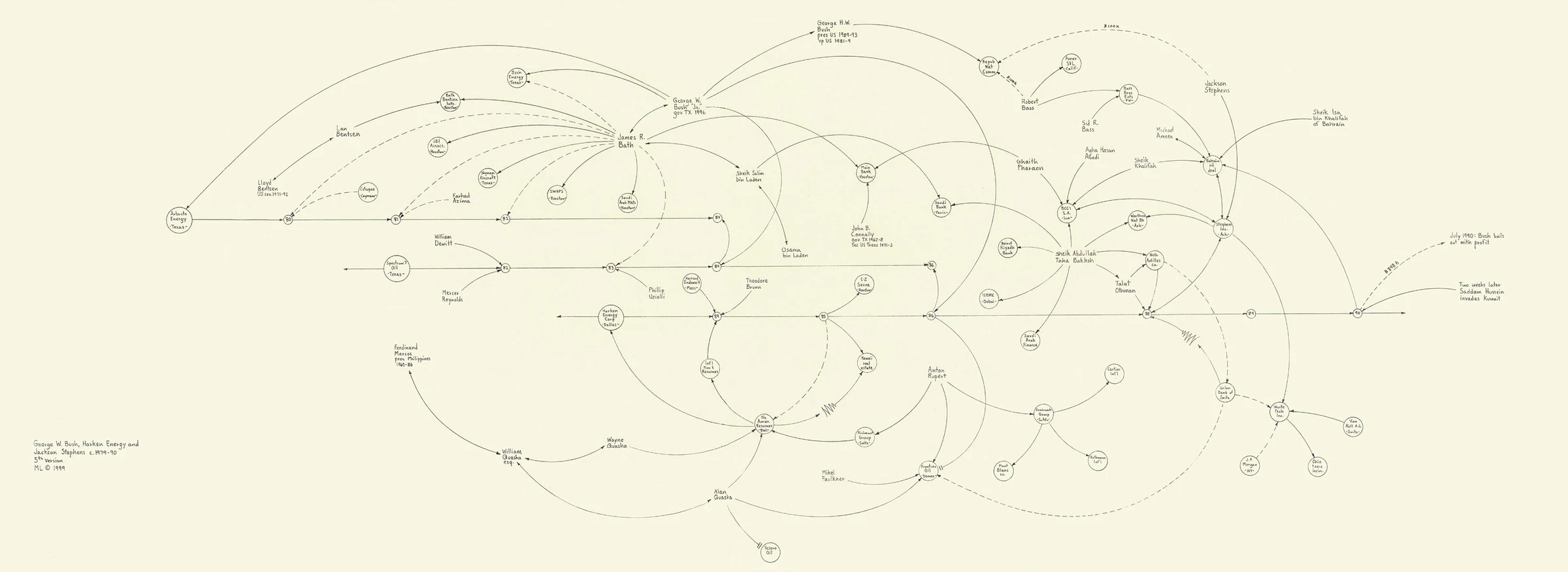
Mark Lombardi - George W. Bush, Harken Energy and Jackson Stephens c. 1979-90, 1999. Graphite on paper.
This is the most technical chapter in this book. It is also one of the most critical, because it describes the only enforcement mechanism in the architecture that does not depend on a human decision at the moment a commitment is being broken. Every other dam the framework has built - the ratchet clause, the Monitoring Commission, the armed populace, the federated chapter network - operates through human will under pressure. Each was prefigured by a historical mechanism that failed under exactly that pressure. The framework's response, as named directly in the self-critique chapter, is to layer them so that no single failure ends the architecture. The mechanism described in this chapter is not a substitute for the others. It is the layer that continues to operate when the others have been worn down, captured, or delayed.
The chapter has two readers in mind: the first is the reader who is sceptical of any framework that hands structural authority to people who write code. That scepticism is correct. The history of computing as a political infrastructure is a history of capture: every general-purpose communication system the working class has ever built has been bought, fenced, instrumented, or weaponised against the population it was supposed to serve. The second reader is the technologist who already knows this and has nevertheless concluded that the right response is to build nothing - to refuse the domain, on the grounds that the tool will be turned. The argument of this chapter is that both readers are working with the same diagnosis and the wrong prescription. Capital does not stop building because the working class refuses to. The infrastructure exists either way. The question is whether the people the infrastructure can be turned against also have a hand on the dial.
Marx wrote about this directly, in the chapter on machinery and modern industry in Capital Volume I. The instrument of labour, in capital's hands, becomes the means of the worker's domination. The same instrument, in the hands of an organised working class, is one of the conditions of liberation. The instrument itself is not the enemy and is not the saviour. It is a multiplier of whichever class wields it. The framework's foundational principle - that every coercive capability expands against the operator unless structurally contained - applies to digital infrastructure exactly as it applies to a nuclear arsenal or a monitoring commission. It does not exempt the technology and does not romanticise it. What follows is the framework's account of the only posture toward digital infrastructure that is consistent with its own commitments: build it, contain it, dissolve the institution that built it on a fixed schedule, and write the containment in code that anyone can audit.
This chapter does not fetishise technology. It does not claim that cryptography solves political problems. It does not propose that the right machine, deployed at the right moment, replaces the difficult work of organising. The claim is narrower and structural. Every prior socialist project staked the survival of the transition on the willingness of human enforcers to act under direct pressure from the people they were enforcing against. The historical record is a record of those enforcers failing - being captured, being defunded, being assassinated, being convinced that the moment was wrong, being told that the conditions had not technically been met. The framework's diagnosis of why is in the case studies chapter. The framework's response, as developed across the transition and anti-ossification chapters, is layered enforcement. This chapter describes the load-bearing layer that operates without a human decision in the loop at the moment of violation. The dams are partial, but that is also the difference between a transition that holds and one that does not.
The diagnostic
A state whose critical infrastructure can be remotely compromised by a foreign adversary does not control its own policy. The Estonia denial-of-service campaign in 2007, the Stuxnet operation against Iranian centrifuges, the BlackEnergy and Industroyer attacks on the Ukrainian power grid in 2015 and 2016 - these are the twenty-first-century equivalents of the coups the sovereignty chapter analyses. They are conducted at lower cost, with greater deniability, and against a wider set of targets. The framework's response to a military sovereignty threat is deterrent capacity. The framework's response to a digital sovereignty threat must be of the same structural seriousness: hardened, auditable, distributed critical infrastructure, with explicit constitutional scope and an explicit principle for what the architecture cannot be turned to do.
The diagnostic operates in two registers. Externally, the threat is a foreign state acting through software against the substrate of the political economy - payment systems, identity infrastructure, communications channels, the public code that the rest of the framework depends on. Internally, the threat is the activation condition the framework names everywhere: a transitional government under pressure, an administrative class accumulating leverage, a monitoring commission being defunded or staffed sympathetically, an enforcement body that needs the cooperation of the people it is supposed to be enforcing against. The same architecture answers both registers, because the same security properties - public code, cryptographic distribution, structural inability to act unilaterally - defeat external compromise and internal capture by the same mechanism. The honest position, repeated through this chapter, is that the architecture defeats them partially and at cost.
The claim structure of the chapter is explicit. The diagnosis that critical digital infrastructure under unitary administrative control is the activation condition for both external compromise and internal capture is a near-universal claim.i The prescriptions - public code, bilateral separation between the body that builds the infrastructure and the body that specifies its conditions, time-bounded existence of the building institution, formal verification on bounded-scope critical systems, geographic distribution of cryptographic key material - are strong-tendency claims.ii Each addresses a specific structural failure mode. The combination is the dam. None of them, individually or together, eliminate the underlying expansion pressure, instead we must seek to raise the cost.
The neutral tool
The framework's posture toward technology is the posture Marx took toward machinery, restated for a domain Marx did not live to see. The instrument is not the enemy, nor a remedy for political failure. Marx would consider it a multiplier. The class that controls the instrument multiplies its capacity, and the class that does not is acted upon by it. Capital has spent forty years building the digital instrument and has been entirely consistent about whose capacity it multiplies. The platforms, the payment rails, the identity systems, the analytics infrastructure - none of these are politically neutral artefacts that capital happens to own. They are productive forces shaped from the ground up by the relations of production they emerged from, and their architecture reflects the interests of the class that built them. That is true of every productive force. It does not make the productive force unusable for any other class. It makes the question of who builds it the political question.
Two postures fail. The first is the posture that refuses the domain - that treats digital infrastructure as inherently anti-popular and concludes that the working class should organise outside it, around it, or in opposition to it without building its own. This posture cedes the multiplier. Capital does not stop building because the working class declines to. Refusing the domain produces a working class that is acted upon by an infrastructure it does not control and cannot audit. The historical analogue is a labour movement that refused the printing press because the bourgeoisie owned the presses. The presses did not stop: movements that built their own - pamphlet networks, the underground press of every revolutionary period - won the struggles that the movements without their own presses lost.
The second posture is the posture that fetishises the domain - that treats a sufficiently sophisticated machine as a substitute for the political work of organising. This posture concentrates structural power in the people who build the machine and assumes that their good intentions are a containment mechanism (this is the technologist's desire). The framework has been entirely consistent about why good intentions are not a containment mechanism. The people who built the machine are subject to RCE, and the institution they built becomes the activation condition for the expansion dynamic the framework exists to architect against. Without designed containment of the building institution itself, the machine becomes the new dominator under different colours. The recent history of cryptocurrency-adjacent governance experiments - projects that proposed code-as-law and discovered, repeatedly, that whoever controls the code controls the law - is a record of this posture failing in real time.
The third posture, the one this chapter develops, is the only one consistent with the framework's own commitments. Build the infrastructure. Apply the framework's containment principle to the institution that builds it, with the same severity the framework applies to the transitional government, the Monitoring Commission, and every other body the architecture depends on. Specify the dissolution of the building institution at founding, not as an aspiration but as a constitutional requirement. Make the code public. Distribute the cryptographic authority across institutions that cannot collude without becoming visible. Constitutionally enumerate what the infrastructure may be turned to and architect it so it cannot be turned to anything else. The third posture treats digital infrastructure the way the framework treats every other capability: as a productive force the working class must build, and as a coercive risk the working class must contain at the moment of building.iii
The sharper way to state the third posture is that it treats software as an evidential anchor rather than as automation of authority. Cryptographic primitives can do exactly one kind of work reliably and at scale: they can produce certainty about a narrow set of invariants. That a transaction occurred at the time the ledger says it occurred. That a specific key signed a specific instruction. That the running enforcement code matches the code in the public repository, byte for byte. That the published specification matches the specification the auditing community read. These are evidentiary properties. They are the architecture's load-bearing claims, and they are the only claims the architecture is permitted to make on its own authority. Everything beyond them - what the specification says the system should do, when a condition has been violated in a contested case, whether a violation should be cured rather than enforced, whether the specification itself was wrong - is a human political question that the architecture forwards to the bodies the rest of the book has already specified. Software does what the specification says it does. The specification is a human political document. The fetishised version of the third posture - the cryptocurrency-adjacent code-as-law tradition the previous paragraph names - collapses the two layers, freezes the political document inside the evidential layer, and discovers the same thing every time: that there are conditions under which the law must change for famine, for war, for a flawed specification that was committed in good faith and turned out to be incorrect, and that an architecture that cannot accommodate the change has produced the orthodoxy machine the framework's containment principle exists to refuse. The architecture in this chapter is built to refuse it. The evidential layer is hard. The political layer is soft. The boundary between them is the property the framework defends.
Constitutional scope
What counts as a critical system, for the purposes of this chapter, is a constitutional question and not an administrative one. The boundary is the failure point of the entire architecture. A scope defined administratively expands under pressure. A scope defined constitutionally with a high threshold for amendment can still expand, but expansion becomes visible, contestable, and slow. The framework requires the high-threshold version.
The tentative constitutional enumeration covers four categories. The boundary of each is defined by the function it serves in the rest of the architecture, not by the technology used to implement it.
The first category is payment rails and monetary switching infrastructure. These are the substrate of the enforcement layer. A government that cannot trigger or be subjected to a payment freeze under specified structural conditions is a government for which the entire enforcement architecture has been removed. The payment rail is therefore a critical system in the strongest sense the framework recognises.
The second category is identity and authentication infrastructure. This is the substrate of the political-functional firewalls described in the anti-ossification chapter, the substrate of sortition selection, and the substrate of any subsequent democratic process that requires distinguishing one citizen from another or one institutional actor from another. An identity infrastructure under unitary administrative control is the pre-condition for every form of personalist authority the framework names.
The third category is the enforcement code and the condition specifications repository. The code itself is a critical system, because modification of the code is modification of every property the framework depends on. The repository is a critical system, because the conditions specified in the repository determine what the enforcement layer enforces. The two together constitute the constitutional implementation of the transition chapter's sunset architecture.
The fourth category is the communications infrastructure for the federated chapter network. The federation operates as the counter-power the framework requires throughout the transition and afterward. A federation whose communications can be selectively interdicted by a centralised actor is a federation whose counter-power is contingent on the centralised actor's tolerance.
The criteria by which new systems qualify for designation must be specified at the same time as the initial enumeration, with the same constitutional weight. The enumeration without the rule that governs additions is the activation condition for scope creep. The rule must be machine-checkable and structurally narrow: a candidate system qualifies for designation if and only if it is a substrate for one of the named architectural functions, the substrate is non-substitutable in the short run, and the substrate's compromise would defeat the function in the way the constitutional designation is designed to prevent. Any addition to the list must go through the same cryptographic coalition process required to modify the enforcement logic. Administrative determination of scope is the expansion vector the framework predicts and prohibits in this chapter as elsewhere.

Laura Poitras - Bed Down Location, 2016. Photograph, from the Astro Noise installation.
What this is not - the surveillance transgression boundary
The architecture described here is not a domestic surveillance apparatus. The distinction is structural and runs through everything that follows.
The reader at stake here is the activist whose phone metadata becomes evidence, the journalist whose sources get reverse-mapped from telecom records, the worker whose union organising shows up in payroll-adjacent data the employer was never supposed to see. The architecture this chapter specifies must be incapable of producing any of those things. If the chapter does its job, the population this infrastructure exists to serve never appears in its data scope.
The framework's transgression category covers technologies whose activation conditions sit inside the artefact rather than in the institution operating it. Mass surveillance is the canonical example: a population-wide surveillance capability built for any purpose becomes available for every subsequent purpose, regardless of the legal framework that governs the original use. The framework's response is structural distance - building the architecture in such a way that it is incapable of the transgression by design, not merely prohibited from it by law.
Structural distance, applied to the architecture of this chapter, is directional. The infrastructure monitors state and corporate actors for compliance with specified structural commitments. It does not monitor the general population's communications, movements, or activities. The architectural constraint is not a legal restriction. It is that the infrastructure is technically incapable of general population surveillance because the data it processes is financial-flow data and structural-indicator data, not personal communications data. If the architecture were specified in such a way that it required access to personal communications data to function, the architecture has been specified incorrectly. The specification is wrong, and a correct specification is required before the architecture is built.
The directionality is the reverse of the surveillance state's directionality and is not a softer version of it. Existing know-your-customer and anti-money-laundering infrastructure points downward, at individuals and small entities whose financial behaviour is presumed suspect. The architecture in this chapter inverts the direction. It points upward, at administrators and concentrated capital, whose financial behaviour is the documented activation condition for the structural failure modes the framework names. The same technical instrument, pointed in the opposite direction, produces a different political object. The boundary that prevents the instrument from being turned downward against the population is the same boundary that defines what the instrument is for in the first place: data scope, data type, and the cryptographic authority required to expand either.
The boundary is structural, and like every structural boundary the framework specifies, it is partial. A state determined to repurpose the architecture into a population surveillance system must rebuild substantial portions of it, must alter the constitutional scope, must obtain cryptographic coalition consent, and must do all of this in public against the auditing community whose existence is the security property. The cost is high. It is not infinite. The chapter says so directly. The argument is that the structural boundary raises the cost of transgression above the cost of compliance, not that the boundary cannot be crossed.
The boundary runs in the temporal direction as well. The intelligence and sabotage tools that the proportional-response chapter authorises against the existing state during the pre-state movement period - tools whose authorisation comes from the proportional logic that authorises any other organised resistance to a state operating outside its constitutional discipline - are subject to the boundary above on the day the movement assumes the apparatus, not at some later moment when the architectural pressure has eased. The pre-state authorisation expires on the day of state assumption. There is no transition period during which the tools the movement built against the prior state retain authorisation against the population the movement now governs, because the historical record on transition periods of that shape is uniform: they are the period during which the new state's secret-police apparatus is built. The proportional-response chapter develops the architectural enforcement - structural separation of personnel, declassification timetable, federated and Monitoring-Commission oversight - that this chapter's surveillance-transgression boundary depends on holding from day one. A failure of that enforcement is, in this chapter's vocabulary, the failure mode the architecture above does not solve.
Security architecture
The security properties of the architecture are five, and each addresses a specific category of attack the framework anticipates.
Public code. All critical systems infrastructure is open-source without exception. Security is derived from cryptographic key quality and from the auditability of the implementation, not from obscurity about how the systems work. The principle is older than the framework - it is named in the cryptographic literature as Kerckhoffs's principle, and it is the working assumption of every security system that has held up under sustained adversarial pressure. The public code requirement is the property that makes the auditing community a security property rather than a slogan. Modification of the code is detectable by any technically capable auditor. Covert modification is not possible against an active auditing community. Whether the auditing community is active is an organising question, treated below.
Cryptographic distribution. No single node holds sufficient authority to modify the enforcement logic or the condition specifications. The cryptographic threshold is set such that physical coercion of individual members of the building institution does not yield operational control, and foreign state compromise of any single node does not yield operational control. The attack required to gain operational control is coalition compromise - simultaneous compromise of a quorum of distributed nodes - which is exponentially more expensive than single-node compromise and is detectable against the public code property. The cryptographic distribution is the property that defeats coercion of any individual or any single institution.
Formal verification. The enforcement logic and the condition specifications are bounded-scope, high-stakes systems. They are not the operating system, the database, or the general computing platform. They are a small set of specific functions whose correctness can be proved mathematically against a formal specification. Formal verification - proof that the code behaves according to its specification under every possible input - is the appropriate standard for these specific functions, and it is the only standard that gives the auditing community the ability to verify correctness rather than merely the absence of known bugs. The cost is real. Formal verification is more expensive than testing, and it is feasible only because the scope is narrow. The narrowness of scope is itself a structural commitment of this chapter.
Geographic distribution. Nodes of the building institution and cryptographic key material are distributed across jurisdictions not aligned with the most likely imperial adversaries. Physical seizure of any single location does not yield operational control. The federated chapter network provides redundant communication channels for distributed coordination under partial network partition. The redundancy is the property that defeats kinetic action against the infrastructure.
Air-gapping. The payment-freeze mechanism specifically runs on infrastructure that is physically isolated from the general network and connects to the broader system only at specified intervals to receive compliance signals. The remote attack surface during the most sensitive operational period is near zero. Air-gapping is the property that defeats remote action against the infrastructure during the period of greatest operational stress, which is the period of the transition itself.
The five properties are not independent. They reinforce each other and they fail together. Public code without an active auditing community is opacity by another name. Cryptographic distribution without geographic distribution is coercion-resistant against a domestic adversary and indifferent to a foreign one. Formal verification without public code is a private claim about correctness with no means of independent confirmation. The architecture is the combination, and the combination is what raises the cost of compromise above the cost of compliance.
The infiltration threat model
Long-timeline infiltration by a well-resourced foreign actor is not addressed by the five properties above on their own. A foreign intelligence service that places technical personnel inside the building institution five years before the transition is positioned to compromise the architecture at the moment it is needed most. Cryptographic distribution is not a defence against an attacker who has supplied a sufficient share of the distributed nodes. Public code is not a defence against an attacker whose people are credible auditors. Formal verification is not a defence against an attacker who has shaped the specification.
The framework's posture is that infiltration is the design assumption, not the worst case. The building institution operates on the assumption that infiltration is likely rather than possible. Cryptographic distribution is the primary security property; personnel security is secondary and partial. The threshold for the cryptographic coalition required to act is set high enough that infiltration of a partial fraction of the institution does not yield operational control. The institution must remain secure even when some of its members are compromised. This is not an aspiration. It is a design requirement. Any architecture that fails when a single member is compromised is insufficiently distributed and must be rebuilt before it is deployed.
The infiltration threat is also the place where the public-code property and the auditing-community property carry the heaviest load. A specification that has been shaped by an adversarial process is, in principle, detectable by an auditing community that is reading the specification with adversarial eyes. The auditing community's existence is a political question and an organising question, addressed below and in the class chapter. A weak auditing community is the failure mode of the entire architecture.
Graceful degradation
The architecture's security properties assume the architecture continues to operate. The failure mode the security properties do not address is the architecture stopping. The specification has to commit to the degraded mode in advance, because every prior infrastructure that did not has produced, at the moment of partial failure, a panic-driven concentration of authority into whichever node was still running.
The first commitment is cryptographic agility. The signature algorithms, the hashing primitives, the post-quantum readiness of the long-lived keys are specified as replaceable rather than fixed. A discovery that breaks one of the underlying primitives - a quantum advance against the current public-key system, an unforeseen weakness in a hash function, an exfiltration of long-lived key material from a node that was supposed to be air-gapped - must be recoverable through a planned algorithmic transition that does not require rewriting the architecture. The framework is honest that the transition itself is a moment of structural exposure. The architecture during a primitive replacement runs on weaker assumptions than the architecture before or after, and the replacement procedure is itself a critical operation that requires the cryptographic coalition. The agility is a commitment to make the replacement possible, but not a claim that the replacement is safe.
The second commitment is paper-ledger fallback at the chapter level. Each federated chapter maintains the capacity to operate its local accounts, its local enforcement records, and its local custodianship-share material on physical media that does not depend on the digital substrate. The capacity is not a hypothetical document. It is a rehearsed practice, exercised on a defined cycle, with the artefacts retained in the chapter's secure storage. A digital-substrate failure that takes the central settlement infrastructure offline must produce, on the chapter side, a coordinated falling-back to the rehearsed practice rather than the chapter discovering at the moment of failure that it had no rehearsed practice to fall back on. The exercise itself produces the institutional memory the framework requires.
The third commitment is the emergency identity mode for the case in which the digital identity infrastructure is unavailable to a population that needs to act through it. The framework names this directly because it is the most uncomfortable of the three. A multi-witness biometric procedure, operated by the chapter network and bound to a declared emergency window, is the only fallback the framework can responsibly specify, and it is acknowledged as degraded along the dimensions the rest of the chapter spends its length defending. It is privacy-harmful in a way the architecture's normal operation is built to refuse. It is fallible against impersonation under coordinated pressure in a way the cryptographic identity layer is not. The procedure is permissible only when the digital substrate is documentably unavailable, only inside a declared emergency window with a constitutional sunset, and only against a published procedure committed during the same constitutional window as the rest of the architecture. The procedure is not a fallback in the sense of an option the architecture exposes for convenience. It is a fallback in the sense of the form the architecture has chosen to specify rather than leave to be improvised under pressure, because every comparable architecture that left it to be improvised has discovered that the improvised form was worse.
The fourth commitment is reconstitution from paper. After a digital catastrophic loss - a coordinated attack that defeats the geographic distribution, a sustained physical disruption of the substrate, or the digital-dark-age contingency the next section names - the architecture's recovery procedure is the federated reconstruction of the digital ledger from the chapter-level paper artefacts under the cryptographic coalition's supervision. The reconstruction is slow on purpose. The specification commits to the slow recovery rather than to a fast one because a fast reconstruction is, structurally, the activation condition for whichever node still has the most usable digital infrastructure to consolidate authority during the recovery window. The slow reconstruction privileges the paper trail and the chapter-level artefact over the surviving digital fragment. This is the framework's commitment that recovery does not become the new transition's centralization moment.

Hito Steyerl - still from Factory of the Sun, 2015. Single-channel HD video installation.
The infrastructure trust
The institution that builds and maintains the enforcement architecture is an infrastructure trust. The name is deliberate. It is parallel to the sovereign defence trust the transition chapter establishes for the nuclear command system, and it operates under the same constitutional posture: a single-purpose body, time-bounded by design, whose dissolution is the design and not the failure mode.
The trust is a pre-transitional formation. It is constituted before any transitional government is constituted, and it is operational before the transition begins. The technical work - building the payment rails, the identity infrastructure, the public code repository, the formal specifications, the federated communication channels - is done under conditions where the trust is a federated chapter operating under the existing chapter architecture, subject to all charter commitments, with no special authority over the political process the chapters are operating in. The trust is not the transition's government; it is the institution that builds the infrastructure the transition's government will be constrained by.
The composition is drawn from the technically capable fraction of the tech-platform labour segment the class chapter identifies - the constituency most exposed to RCE from the systems they themselves built and the constituency whose technical capability is the security property of the architecture. The trust is bounded in size per the chapter architecture: fifteen active members, thirty as the absolute ceiling at any node, with scaling done through federated nodes rather than through institutional consolidation. Internal roles rotate on fixed schedules. Membership is a rotation, not a career.
The trust holds no authority over what the conditions are. It runs the machinery and only the machinery. The conditions are specified by the body described in the next section, and the trust cannot modify the conditions without that body's cryptographic consent. The body that specifies the conditions cannot execute enforcement without the trust's cryptographic consent. Bilateral separation is the primary security property of the entire architecture. Collusion between both layers is required for either abuse or renegotiation, and collusion is detectable against the public code property and the published specifications.
The trust's dissolution is constitutionally specified at founding. On satisfaction of the transition completion conditions, the key-holding functions transfer to the sortition bodies of the mature state, and the trust ceases to exist. Its former members may not constitute a successor body with equivalent authority. The dissolution is automatic, machine-confirmed, and recorded by the same enforcement layer the trust built. It is a constitutionally specified event whose triggering conditions are themselves under the bilateral separation principle, rather than a political decision or a negotiated outcome.
The transfer itself runs through a temporary sortition convention drawn afresh at the moment the dissolution conditions are confirmed. The convention's composition is fixed by the same sortition mechanism the framework's other temporary bodies run on, drawn from the federated chapter network and the auditing community, with the constitutional bar that members of the convention may not subsequently sit on the receiving sortition bodies of the mature state. The bar removes the personal continuity that would otherwise reproduce the trust's authority inside the institutions receiving the keys. The convention's mandate is bounded at three steps: receive the keys from the dissolving trust under cryptographic confirmation, distribute the keys to the receiving sortition bodies under the bilateral-separation rules the two-key custodianship commits to, and dissolve on completion. The window is fixed at ninety days from convocation, on a calendar published with the rest of the dissolution architecture. A convention that has not completed its mandate at the close of the window dissolves regardless and the receiving bodies' default keys activate against the published fallback specification. The convention's authority is exhausted on key transfer; the dissolution conditions and the transfer window stand outside its scope.
The framework's principle applies to the trust with the same severity it applies to every other institution in the architecture. The trust holds structural leverage over the state and over capital. Institutional persistence, expertise retention, and budget inertia are present. The activation conditions for the expansion dynamic the framework predicts are all there. The dams - cryptographic distribution, public code, time-bounded mandate, dissolution as design - raise the cost of expansion but do not eliminate it. The honest position, consistent with the self-critique chapter and named again there directly, is that the trust is the institution in this architecture most exposed to its own principle, and the dissolution mechanism is the load-bearing containment.
Two-key custodianship
The body that determines what the sunset clause conditions are is constituted from the federated chapter network operating in its highest-formality mode. It is the federation in the specific configuration this architecture requires, with custody of the second key, not a new institution.
The structure is bilateral. The trust executes; the custodianship specifies. The trust cannot modify what the conditions say; the custodianship cannot trigger an enforcement action. Either can refuse to act. Neither can act unilaterally. The bilateral separation is what the architecture's security depends on, and the bilateral separation is what makes the architecture distinct from every prior digital governance experiment that proposed code-as-law and discovered that whoever held the keys held the law. Two-key custodianship is the structural answer to that discovery.
The condition specifications are produced through the consultation-scope framework the book has already developed. The output is machine-verifiable criteria, committed publicly before any transition begins. The chapters that participated in specification are on the public record. The specifications themselves are on the public record. Any chapter may challenge the specifications during the commitment window. No chapter may challenge the specifications after the window closes, because that is what the commitment means.
The commitment window. The specifications are committed publicly with a documented waiting period before any transition begins. The waiting period serves two structural functions. It allows external challenge before the conditions are sealed, and it creates an observable record that the conditions were determined independently of any transitional government - the transitional government does not yet exist at the moment of commitment. The window cannot be shortened by a body that did not exist when the window opened.
Condition specification requirements. Conditions must be machine-verifiable. They must be financial signatures and structural indicators, not assessments of political legitimacy. The line is bright. Examples of valid condition classes: salary flows from public accounts to private entities controlled by administrative-class members exceeding a specified ratio; asset accumulation by named transitional administrators above the concentration threshold; failure to transfer specified control functions to sortition bodies by a specified date; failure to constitute specified institutions within their constitutional windows; divergence between the public code repository and the running enforcement infrastructure. Examples of invalid condition classes: that the transitional government is acting in good faith; that the transition is proceeding as intended; any condition that cannot be reduced to a financial indicator, a structural indicator, or a verifiable code-state comparison. Conditions that cannot be machine-verified are not invalid as a category - some are necessary - but they must be classified explicitly as judgment-reviewed conditions, not automatically-enforced conditions, and the classification must be visible from the start.
Partial completion handling. The transition is a period and not a moment. Conditions are sequenced and individually timestamped. Partial satisfaction triggers public progress reporting. Full dissolution unlocks only when all conditions are satisfied. The progress reporting is itself automatic and public - not a report issued by a body that can be pressured to delay or soften it. This prevents premature declaration of completion, which is the point of highest political pressure and the point at which prior socialist transitions discovered that the conditions had been quietly relaxed.
Condition gaming. A transitional government that knows the exact indicators it is being monitored against will optimise against the indicators rather than against the underlying commitment. The specification process must anticipate this. Where indicators are gameable, either replace them with indicators that are not, or classify the condition explicitly as judgment-reviewed and accept the additional political cost of doing so. The distinction between automatically-enforced and judgment-reviewed conditions must be in the public specification from the start. A specification that does not name its own gameable indicators is a specification whose authors have not yet thought through what they are committing to.
Upward monitoring
Existing know-your-customer and anti-money-laundering infrastructure detects suspicious financial flows downward. The architecture in this chapter inverts the direction. The same technical instrument, pointed upward, monitors state and corporate financial flows for the structural failure modes the book identifies with precision: Djilas's new class formation, the dachas-and-special-shops pattern, regulatory capture through financial relationship, the asset accumulation that signals the emergence of a privileged tier within the state apparatus.
What it monitors is bounded. Asset accumulation by transitional administrators and their immediate associates. Financial relationships between public procurement and private entities with administrative connections. Salary and compensation flows that indicate the emergence of a privileged tier. Corporate financial behaviour relative to the nationalization threshold and the systemic-criticality criteria. The monitoring is structural and financial, not communicational. The architecture is incapable of monitoring anything else, which is the surveillance transgression boundary again, in operational form.
The output is public, machine-readable, and directly linked to the enforcement layer. Detection of a violation pattern sustained beyond a specified cure period initiates the compliance procedure: progressively restrictive measures, with documented cure windows, terminating in a payment freeze if cure does not occur. The population does not need to decide whether conditions warrant action. The system provides specific evidentiary grounding, the cure windows operate, and the material consequence is already in motion.
The relationship to the Monitoring Commission is structural and operates in two directions. The upward monitoring layer is the Commission's machine-readable feed. The Commission directs the analytical and investigative function, sets the indicators against which the financial flows are evaluated, and is the political body that interprets ambiguous patterns. The Commission is not made redundant by the layer; it is augmented. The layer is not a replacement for political analysis; it is the substrate that political analysis runs on. The Commission gains a feed it can defund, staff sympathetically, or wear down - and the layer continues to operate on its own, because the consequences are structural rather than dependent on the Commission's ongoing organisational health. Even a captured Commission cannot reverse an automated payment freeze. That requires the cryptographic coalition of the custodianship and the trust together. The upward monitoring layer is the structural property that makes Monitoring Commission capture insufficient to prevent enforcement.
The auditable-value-flow infrastructure
The same architectural substrate carries the auditable-value-flow infrastructure the sovereignty chapter commits to as the substrate of equal exchange. The trade interface between the framework state and its partners runs on a cryptographically attested ledger of cross-border value flows, with bilateral and multilateral verification protocols against which the equal-exchange terms are auditable in operation rather than only in commitment. The infrastructure is not a separate system. It is the same architectural substrate as the upward monitoring layer, with the trade interface as an additional class of monitored flow.
What the infrastructure tracks. The four layers of the equal-exchange substantive specification - labour-time anchoring, ecological-throughput accounting, materials-content commitment, and the audit substrate itself - are each tracked against the cryptographically attested ledger. The labour-time content of exported goods is committed at the export interface, audited against the labour-abstraction discipline the cybernetic-socialism chapter specifies. The ecological-throughput content is committed at the export interface, audited against the ecological constitution's carrying-capacity envelope. The materials-content commitments are committed bilaterally at the trade-relationship interface, audited against the partner state's productive-capacity transition. Each commitment is published, machine-readable, and revisable on a published cycle.
Bilateral and multilateral verification. The architecture's standing for cross-state verification is bilateral by default and multilateral by composition. Bilateral verification operates between any two framework states (and between any framework state and a non-framework counterparty that has accepted the verification protocol) by reciprocal attestation: each state's federation attests to its side of the trade, the attestations are cross-verified against each other, and the residual variation triggers the bilateral resolution mechanism the trade-relationship interface specifies. Multilateral verification operates across the bloc by composition of the bilateral attestations: the bloc's verification protocol does not require a central body that performs the multilateral attestation; it requires the bilateral attestations to be public, cryptographically composable, and auditable against each other. The architecture commits to this composition pattern because the alternative - a central multilateral body - is the institutional concentration the framework's anti-ossification commitments write against.
The architectural pattern is identical. The infrastructure trust the chapter has specified above operates the substrate. The custodianship commits the verification protocols and the labour-time and ecological-throughput accounting standards as condition specifications. The two-key custodianship architecture applies to the trade-interface specifications at the same constitutional weight as it applies to the domestic enforcement specifications. The surveillance-transgression boundary applies in full: the trade-interface ledger tracks value flows between states; it does not track the personal financial flows of the workers whose labour produced the goods, the consumers whose purchases carried the goods, or the populations whose ecology absorbed the costs. The structural-financial-not-communicational restriction is what permits the architecture to operate without becoming the surveillance instrument the framework writes against.
The standing for partner-state and population audit. The architecture's commitment is that the partner states' federation bodies have standing to audit the framework state's trade-interface attestations, with the petition body and the partner states' equivalent bodies as the institutional sites at which the audit standing is exercised. The framework state's own population, through the petition body, has standing to audit the trade-interface attestations against the architecture's equal-exchange commitments. The audit standing is not a procedural formality; it is the substantive mechanism by which the equal-exchange commitments become operationally enforceable rather than only architecturally committed.
The auditable-value-flow infrastructure is the load-bearing case for the chapter's structural argument. The fourth domain is sovereignty work because the substrate of the political economy - including the substrate of the trade interface across which the framework state's substantive equal-exchange commitments operate - is now built rather than inherited. The framework's commitments to equal exchange, to ecological reciprocity at the trade interface, and to the audit standing of partner states and the framework's own population are operational only if the substrate is built. The substrate is what this chapter builds.
Sequencing
The architecture must be built and sealed before the transition begins. The transition chapter's sequencing requires this as a precondition. The trust is operational, the custodianship has committed the condition specifications, the public code has been audited against the specifications, the formal verification proofs have been published, the cryptographic key material has been distributed to nodes across non-aligned jurisdictions, and the air-gapped enforcement infrastructure is running before the transitional government is constituted. A transition that begins before the architecture is sealed is a transition whose enforcement layer is still being built by the very government it is supposed to enforce against. The framework prohibits this directly.
The sequencing has political costs. Building the architecture in public, before the transition, exposes the technical work to adversarial pressure during the period in which adversarial pressure is highest. The framework accepts this cost. The alternative - building the architecture during or after the transition - is the failure mode the framework predicts and prohibits. The cost of building in public is the cost of having the architecture survive the period it is designed to constrain.
What this does not solve
The chapter does not claim that the architecture solves the underlying problem. It claims that the architecture raises the cost of failure above the cost of compliance, and the gaps it leaves are real.
The objective-condition specification problem. Some sunset clause commitments resist clean translation into machine-verifiable indicators. The framework is honest about this and requires the specification to be honest about it from the start. Conditions that cannot be machine-verified must be separated explicitly from automatically-enforced conditions in the public record. The distinction must be visible at commitment time and not retroactively applied when a government argues that a violated condition was always a judgment call. The architecture does not eliminate the difficulty of writing a good specification. It makes the specification visible.
The auditing community dependency. Public code is only as secure as the auditing community that actually reads it. The architecture depends on a technically capable, politically aligned auditing community throughout the transition and after. If the constituency shrinks, is co-opted, or never coheres, the auditability guarantee weakens. This is an organising dependency rather than a technical one, and the class chapter and the action chapter name it as such. The architecture cannot supply the constituency. It can only specify what the constituency is for.
The community-as-constituted is also insufficient on its own. A politically aligned auditing community shares the architecture's commitments, which is the property the security argument depends on, and shares the architecture's blind spots, which is the property the security argument is most exposed to. The architecture must additionally fund a paid red-team function, drawn from outside the trust's culture and outside the federation's organising lineage, briefed to operate as a paranoid adversary against the specification, the running code, and the cryptographic coalition's procedures rather than as a sympathetic auditor. The red team is paid because the work is unrewarding inside the political community the rest of the architecture inhabits, and the framework will not depend on the red-team function being performed as volunteer labour by people whose alignment makes them less likely to find what the function exists to find. The red team is structurally separated from the alignment-shared auditing community by mandate, reporting, and selection process, and its findings are part of the public record the alignment-shared community reads. The redundancy is real. It is what makes the auditability guarantee survive the homogenization the political-alignment property otherwise produces.
The digital-dark-age contingency. The architecture's evidential properties depend on the technical substrate being trustworthy in the way the architecture's specification claims it is. The contingency the framework has to commit to in advance is that the technical evidence is demonstrated to be unreliable - a discovered systemic compromise of a primitive, an undisclosed backdoor in a hardware substrate the architecture turned out to depend on, a sustained adversarial action that has corrupted the running code or the historical ledger in a way the auditing community confirms cannot be cleanly undone. The architecture cannot continue to enforce against signatures it has reason to doubt. The constitutional contingency is therefore that on a finding of demonstrated unreliability by the cryptographic coalition acting under the published procedure, the automated enforcement actions are suspended, any payment freezes already in motion are manually unlocked under the proportional-response chapter's inquiry posture, and the architecture reverts to the older, slower, judgment-reviewed governance mode the rest of the framework operates under, until a new trust is convened, a new specification is written under the same commitment-window discipline, and a new architecture is sealed against the now-known weakness. The reversion is itself four of the five enforcement modalities the transition chapter names - the constitutional, the institutional, the federated, and the technical (the fifth, anchor triggers, operates against the absorption slope rather than the moment of violation and is not engaged by this contingency) - reasserting the prior three when the technical layer is no longer carrying its weight. The contingency is named directly because the architecture that does not name it produces, at the moment the technical layer fails, exactly the panic-driven concentration of authority the framework is built to prevent.
Scope creep. Constitutional enumeration of critical systems reduces but does not eliminate expansion pressure. The criteria for adding new systems will be contested at the margin. The framework's response is to require that the criteria be specified at the same time as the initial enumeration, with the same constitutional weight, and that any addition go through the same cryptographic coalition process required for any other constitutional modification. The dam is real. The dam is partial.
The trust's own expansion risk. The trust holds structural leverage over the state and over capital. The activation conditions for RCE are present in the institution by design - that is what gives it the security properties the architecture depends on. The dissolution mechanism is the load-bearing containment. If the dissolution is delayed, resisted, or legally challenged, the trust's institutional persistence is the activation condition for the expansion dynamic the entire architecture is built to prevent. The framework requires that dissolution be automatic and constitutionally non-negotiable on satisfaction of the completion conditions - not a political decision, not a negotiated outcome, but an event the enforcement layer itself confirms and records. The exposure is named directly in the self-critique chapter. The dissolution is real. It is the load-bearing dam against the institution this chapter requires.
Theory
Technology spectrum and transgressions
The nationalization chapter sketches the five-category sort - socializable, conditionally deployable, deterrent, sovereignty tools, and transgressions - that determines what a public state may build, deploy, or hold. The full operational definitions, the surveillance-transgression boundary, and the engagement with Karp and Zamiska's Technological Republic belong here, alongside the rest of the chapter's digital-sovereignty work, because the categories are sorting decisions about technology rather than ownership decisions about firms.
Socializable technologies augment human labour, automate drudgery, or enable capabilities that improve material conditions. Industrial robotics, task-specific AI (translation, medical imaging, crop optimization), renewable energy generation, computational research tools, logistics optimization. Under capitalist relations these eliminate jobs and concentrate productivity gains in the hands of owners. Under socialist relations they reduce working hours and distribute the gains across the working class. They should be socialized broadly and nationalized once they cross the systemic-criticality threshold.
Conditionally deployable technologies are dual-use. CRISPR (therapeutic use socializable; weaponization a transgression), industrial chemistry (fertilizer socializable; nerve agents a transgression), encryption (individual privacy a right; state-imposed back doors a transgression). Evaluation uses the framework's proportionality logic: what are the reciprocal consequences of deployment, and can they be structurally contained? If containment is achievable and verifiable, deployment is permitted. If containment cannot be guaranteed, the technology slides toward the transgression category.
Deterrent technologies exist in a paradox: their value lies in their non-use. Nuclear weapons are paradigmatic. The framework permits acquisition because the asymmetry created by absence invites imperial intervention. It prohibits first use; first use is itself a transgression. The distinction between deterrent and transgression is the acquirement-usage gap: nuclear weapons can sit in a silo, the panopticon cannot. A nuclear weapon can exist without being fired. Domestic surveillance cannot exist without being used.
Sovereignty tools are technologies whose purpose is the defence of the state's independence in a hostile international system - foreign signals intelligence, satellite surveillance, cyber espionage directed at foreign adversaries. The framework requires them; the alternative is unilateral disarmament against adversaries who do not respect the sovereignty of socialist states. The boundary is absolute and directional: sovereignty tools point outward. The moment they are turned inward, the technology has crossed from sovereignty tool to transgression. The structural separation between foreign intelligence and domestic governance must be architectural, not procedural - different buildings, different networks, different personnel, no shared databases, no "coordination centres" that bridge the two. Every bridge is a leak point. The historical record is uniform: NSA was authorized to collect foreign signals; PRISM collected the communications of American citizens.1 MI5 and MI6 have shared intelligence under every framework meant to separate them. The wall must be physical where physics permits. Where physics is contestable, the wall is procedural, and procedures are rewritten by the people they constrain.
Transgressions are technologies whose reciprocal consequences are so severe that no deployment context justifies them. The category is small but absolute. Domestic mass surveillance: any system designed to monitor a country's own population at scale - facial recognition in public spaces, AI-based identification or tracking, mass communications interception directed domestically, social media monitoring by state agencies, algorithmic profiling of citizens by behaviour, movement, association, or communication. These systems must not be built. Not regulated. Not built. AGI without demonstrated containment: an artificial general intelligence whose behaviour cannot be reliably predicted and controlled is an existential risk regardless of who owns it. The framework refuses the fantasy that socialist relations of production neutralize a technology risk rooted in the technology itself.
The CCTV containment test. Public-space camera systems used for crime investigation are permitted under hard constraints: no AI applied to footage, no facial recognition, no algorithmic pattern analysis, no behavioural prediction, no movement tracking. The camera records; a human investigator reviews footage for a specific investigation under a specific warrant reviewed by independent oversight; footage is deleted after a defined retention period unless it is evidence in a criminal case. Any technology deployed for domestic use that could, with modification or reinterpretation of its mandate, be used for mass surveillance must be evaluated as if it were already being used for mass surveillance. The question is not whether the technology is currently being used to watch the population. The question is whether it can be. If yes, it must be constrained to the point where it cannot, or it must not be deployed.
The alignment-orthogonality objection. The objection arrives on cue: alignment is a technical research question about reward modelling and interpretability, separable from who owns the lab. The distinction is real; the separability is not. Containment operates at two levels at once. Technical: whether the system's behaviour can be reliably bounded. Political-economic: whether the institutions that build, deploy, and extend it can be reliably bounded. Alignment to a shareholder-selected objective is not safety - it is a guarantee that the system will pursue someone else's selection well. Governance failure guarantees alignment failure, because it hands the objective-selection lever to a class with a different objective. Governance success does not guarantee alignment success, because the selected objective still has to be implementable in the system's actual behaviour, and democratic legitimacy cannot solve that by fiat. The framework's claim is the conjunction, not the substitution. Containment requires both. The transgression category applies to the absence of either.
The technological republic critique. Alex Karp and Nicholas Zamiska's The Technological Republic is the most articulate contemporary argument for an alliance between Silicon Valley and the national security state, and the framework must engage with it directly because parts of the diagnosis are correct. The decay of the liberal consensus is real. AI weapons will be built regardless of Western restraint. Platform capitalism has degraded cognition. The psychologization of politics has substituted therapeutic language for structural analysis. The framework's other chapters describe the same phenomena from a different theoretical frame - the class chapter on attention economy as surplus extraction, the reciprocal materialism chapter on coercive expansion, the counter-hegemony chapter on consent manufactured through the platforms.
The frames diverge at diagnosis. Karp and Zamiska diagnose civilizational decline requiring elite stewardship - specifically, Silicon Valley builders guiding national security. The frame is nation, not class; civilization, not the mode of production; technological elites, not the working class. This frame contaminates each downstream prescription. Observed: AI weapons will be built. Prescribed: American technologists should build them faster - rather than transforming the material conditions producing the arms race. Observed: cognitive degradation from platform capitalism. Prescribed: builders should rebel against the apps - rather than eliminating the profit motive driving the degradation. Observed: psychologization of politics. Prescribed: leaders should show grace - rather than addressing the structural conditions (atomization, precarity, destruction of collective institutions) producing the therapeutic turn. At every step the diagnosis stops at the symptom and prescribes character where the framework prescribes structure.
The nation-as-unit framing is the deepest error. Karp and Zamiska argue American power enabled the long peace, no country has advanced progressive values more than the United States, and the postwar neutering of Germany and Japan must be undone. This is imperial nostalgia in progressive language. The "long peace" was not peaceful for Vietnam, Chile, Iraq, Afghanistan, Libya, or the dozens of countries subjected to American intervention during the period. The "progressive values" were not extended to populations whose governments were overthrown when they pursued those values independently. The framing erases the material reality that American hegemony was built on extraction from the Global South, maintained through military intervention, and experienced as violence by the majority of the world's population.
Palantir, the company Karp co-founded, makes the case materially. Maven is deployed across five combatant commands and NATO. Palantir's software was used by ICE for immigration enforcement. Palantir's predictive policing tools were deployed in American cities. Military targeting software adapted for immigration raids. Intelligence analysis tools adapted for domestic law enforcement. The expansion is exactly what RCE predicts: the tool, once built, expands into available space. Intention does not matter. Capability does. The framework's structural alternative to the technological republic is the conjunction this chapter develops - public ownership of systemically critical technology under the nationalization threshold, democratic oversight of weapons development through the proportional-response architecture, the transgression classification of domestic surveillance, and elimination of the profit motive that produces the cognitive degradation Karp and Zamiska correctly identify and incorrectly propose to solve through elite virtue.
theory
Marx on machinery, restated.
The chapter on machinery and modern industry in Capital Volume I treats the machine as the productive force whose social character is determined by the relations of production it operates within. Under capital, the machine extends and intensifies the working day, replaces skilled labour with the supervision of unskilled labour, and concentrates control over the labour process in the owners of the machine. The same machine, under different relations of production, would shorten the working day, reduce the dependence of human life on alienated labour, and distribute control over production. The machine itself does neither. The relations of production around the machine determine what the machine does.
Digital infrastructure is the machinery of the present. The chapter applies Marx's diagnostic to it without metaphor. The infrastructure that capital has built - the platforms, the payment rails, the identity systems, the analytics - concentrates control, extends and intensifies the working day, replaces skilled labour with the supervision of unskilled labour, and surveils the population whose alienated labour produced the infrastructure in the first place. The infrastructure has these properties because of the relations of production it was built within. It does not have these properties because of the silicon.
The framework's posture is that the working class must build the infrastructure under different relations of production, with different containment properties, against the same expansion dynamic that produced the existing infrastructure. The Marxian commitment is not that technology is liberatory and not that technology is oppressive. The Marxian commitment is that technology is a productive force whose political character is determined by the class that controls it. Refusing the technology cedes the multiplier. Fetishising the technology produces a new dominator class. Building the technology under designed containment is the only posture consistent with the principle that productive forces are the substrate of class struggle and not its outcome.
RCE is the dialectical specification of the same insight. Every coercive capability expands against its operator. The capability must be built. The capability must be contained. Building without containment produces the next dominator. Refusing to build cedes the capability to whoever does. The third path, named throughout this chapter, is the only one consistent with both Marx's diagnostic and the framework's principle.
What the chapter does not do
The chapter does not claim that the architecture is sufficient. The architecture is one of five enforcement modalities the transition chapter specifies, and it operates alongside the other four rather than in place of them. The chapter does not claim that the technology will not fail. The technology will fail in some specific way the chapter does not anticipate, and the architecture must survive the failure of any specific component. The chapter does not claim that the auditing community will exist. The auditing community is an organising achievement, and if the organising fails, the architecture's security weakens.
The chapter also does not claim that the architecture cannot be turned. It claims that the architecture can only be turned at a cost the framework's principle treats as the cost of compliance with the working class's continuing political will. If the working class permits the cost to fall, the architecture falls. If the working class organises to maintain the cost, the architecture holds. This is the framework's position on every dam it has built. The architecture is the structural condition under which political will operates. It is not a substitute for political will, and the chapter does not pretend otherwise.
What the chapter does is name the only enforcement mechanism in the architecture that does not require human action at the moment of violation, specify what it must look like to be consistent with the framework's principles, and refuse the two postures - refusal of the domain and fetishisation of the domain - that the framework's analysis predicts will fail. The third posture is harder. It is also, on the framework's diagnostic, the only one that the working class has not yet tried.
The exposure the chapter creates is treated directly in the self-critique chapter, alongside the nuclear arsenal, the transitional state, the Monitoring Commission, the federated chapter network, the organising-stage leadership, and the anchor triggers the transition chapter commits federated chapters to firing during the absorption window. The architecture this chapter describes is the seventh exposure. The chapter that names it is the chapter that the framework's principle requires.
Washington Post, "Here's Everything We Know about PRISM to Date" (2013). https://www.washingtonpost.com/news/the-switch/wp/2013/06/12/heres-everything-we-know-about-prism-to-date/. ↩
i. Near-universal claim. Holds across every documented case where a state's critical digital infrastructure was concentrated under unitary administrative or operational control without designed containment. Counter-cases require a centralised digital infrastructure that persisted with retained operational expertise, continuing budget, and no architectural separation, and that nevertheless surrendered or rotated control cleanly under pressure. The historical record provides no such case at scale. The closest near-counter-case - Estonia's post-2007 e-state architecture, with its explicit data-distribution and cryptographic-attestation properties - survives by structural design rather than by persistence of unitary authority. ↩
ii. Strong-tendency claim. Public code, bilateral separation, time-bounded institutional existence, formal verification, and geographic key distribution are documented to constrain expansion in specific operational contexts (the Linux kernel's distributed maintainership through the contested decades, certificate transparency's reduction of unilateral CA authority, the airgap-and-coalition pattern in nuclear command and control) and to be partially circumvented in others. The claim is that the combination raises the cost of capture above the cost of compliance, not that any single property reliably holds. ↩
iii. The technical designs in this chapter are speculative architectures for a post-transition society, not blueprints for unauthorized access to computer systems. Building and testing any enforcement layer on existing networks without permission would be highly illegal, and harmful to society as a whole. The author strongly advises against this. ↩